

Proper wine storage temperature control is the secret to protecting your collection. It’s all about creating a stable environment, ideally holding steady around 55°F (13°C). This isn't just about chilling wine; it's about preventing premature aging, preserving complex flavors, and allowing each bottle to mature exactly as the winemaker intended. Get this right, and you turn your wine collection into a valuable, evolving asset.
Why Temperature Control Is a Necessity, Not a Luxury
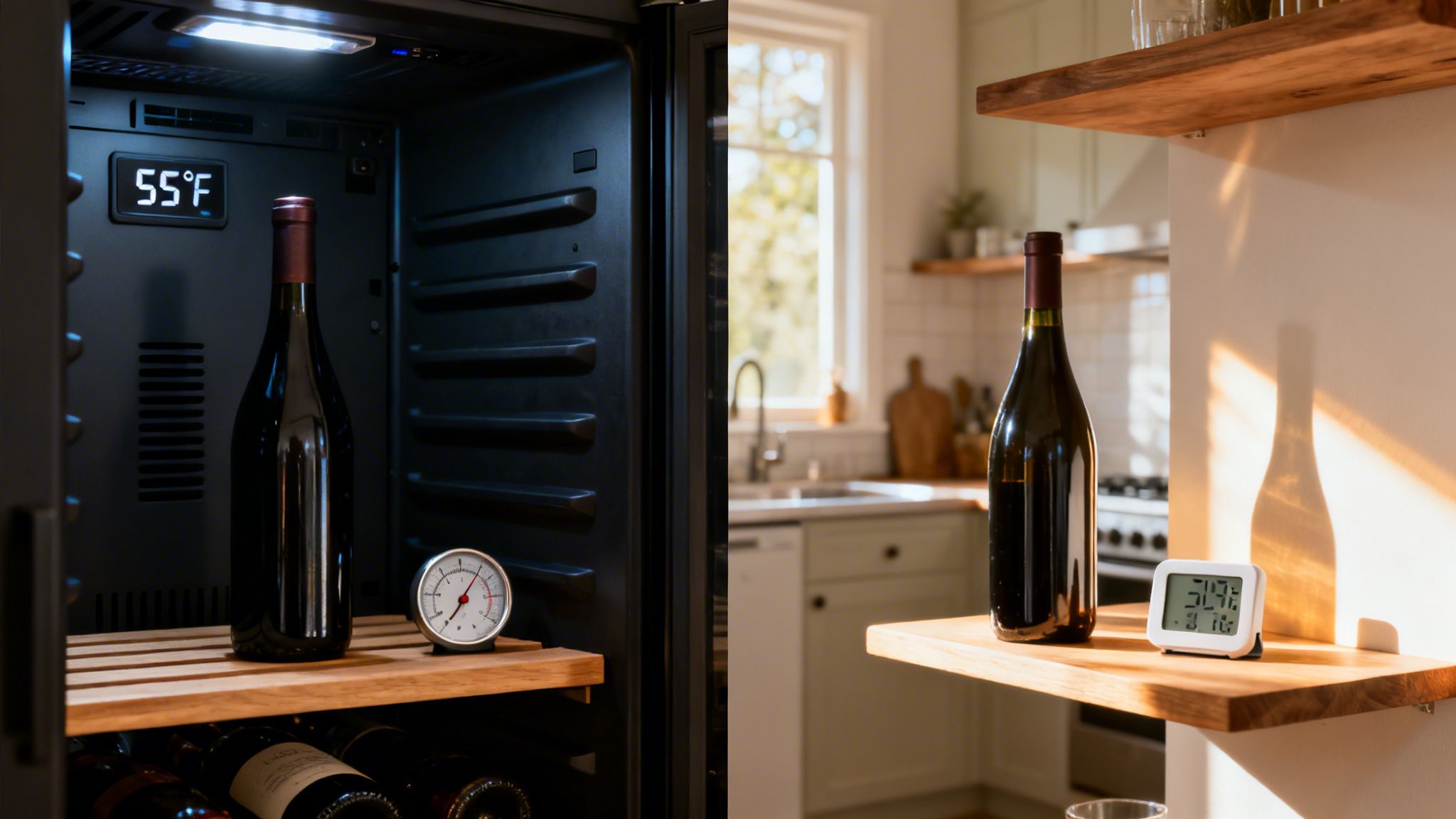
Picture this: you have two bottles of the exact same prized vintage. One is nestled in a perfectly stable, climate-controlled enclosure. The other sits on a rack in your kitchen, enduring the daily ups and downs of household temperatures. In just a couple of years, the first bottle will be a symphony of flavor. The second? A muted, cooked disappointment.
This simple comparison gets to the heart of wine preservation. Think of a great bottle of wine as a living thing. Its complex chemistry is in constant, slow-motion evolution, developing those beautiful, nuanced aromas and flavors over time. Proper temperature control acts as the conductor of this delicate orchestra, ensuring everything unfolds at the perfect pace.
If the environment gets too warm, that evolution speeds up uncontrollably. The wine essentially "cooks," flattening its delicate notes and erasing its potential. But if it's too cold, the process grinds to a halt. The wine enters a state of suspended animation, never developing the complexity you were waiting for.
The Real Danger Is Fluctuation
What's even more damaging than a room that's a bit too warm or cool? Inconsistency.
Daily temperature swings, even seemingly minor ones of just 5-8°F, can be absolutely devastating to your wine. As the temperature rises, the liquid inside the bottle expands. As it cools, it contracts. This constant push-and-pull compromises the cork's seal, letting tiny amounts of oxygen seep inside. And for an aging wine, oxygen is the ultimate enemy, causing irreversible damage through oxidation.
A consistent temperature, even if it's a few degrees off the 'perfect' 55°F, is far superior to a storage area that cycles between 60°F and 75°F daily. Stability is the true secret to successful long-term aging.
Protecting Your Financial and Sentimental Investment
A well-curated wine collection is more than just a hobby—it's a serious investment of both money and passion. Protecting it from environmental threats isn't just smart; it's essential. This isn't a niche concern, either. The wine cellar market was valued at USD 3.2 billion and continues to grow, proving that homeowners see a professional wine enclosure not as an amenity, but as a critical strategy for protecting valuable assets.
At the heart of any climate-controlled system is a reliable sensor. Understanding how appliance temperature sensors work gives you a peek behind the curtain at the technology that makes this consistency possible. It’s this commitment to precision that transforms a simple storage space into a true sanctuary for your wine.
By treating professional wine storage as a necessity, you guarantee that your collection—and the stories behind each bottle—will be ready to enjoy at its absolute peak. For those of us here in Southwest Florida, building a space that can achieve this requires specialized expertise. You can learn more about our dedication to precision and craftsmanship on our company page at https://ameriglassindustries.com/about-us/.
The Unseen Enemies Sabotaging Your Wine Collection
Think of your wine collection. More than light or vibration, there are two silent destroyers constantly working against it: heat and humidity. These culprits can hide in any unstable environment, slowly turning a promising vintage into a massive disappointment. Getting a handle on the specific threats they pose is the absolute first step toward mastering wine storage temperature control.
Excessive heat is the most obvious and aggressive villain in this story. When a bottle of wine sits in temperatures above 70°F for too long, a destructive chain reaction kicks off. The delicate compounds that give wine its gorgeous aroma and complex flavors are literally cooked away.
This process is sometimes called "maderization," and it permanently ruins the wine. It swaps out those vibrant fruit notes for dull, stewed, or nutty flavors, completely bulldozing the character the winemaker worked so hard to create. Heat basically puts the aging process on fast-forward in the worst possible way, stripping the wine of its potential long before it’s ready.
The Problem with Being Too Cold
While not as immediately catastrophic as heat, storing wine where it's too cold creates its own set of issues. A standard kitchen fridge, which usually hovers around 38°F, is far too chilly for long-term wine storage.
At those temperatures, the natural aging process pretty much grinds to a halt. The subtle chemical changes that allow a fine wine to develop those incredible secondary and tertiary flavors simply can't happen. The wine is essentially put into suspended animation. It might not spoil, but it will never become the masterpiece it was meant to be. Plus, the bone-dry air inside a refrigerator can cause the cork to dry out and shrink, breaking that all-important seal.
The Most Destructive Threat of All
But here’s the real kicker: the single greatest danger to your wine isn't a steady high or a steady low temperature. It’s fluctuation. Even small daily temperature swings of just 5-8°F can be absolutely ruinous over time.
Picture what’s happening inside that bottle with every cycle. As the temperature goes up, the wine and the tiny bit of air in the bottle expand, pushing against the cork. When the temperature drops, they contract, creating a slight vacuum.
This constant expansion and contraction acts like a tiny pump, repeatedly pushing air out and pulling oxygen in past the cork's seal. This slow, steady introduction of oxygen is the death knell for fine wine, leading to irreversible oxidation.
Oxidation is what turns a crisp apple brown after you slice it. In wine, it strips away freshness and fruit, leaving behind dull, bruised-apple flavors and a faded, brownish color. A bottle that’s been through these temperature swings has aged a decade in just a few months, and not gracefully. A consistently stable climate is the only defense against this sneaky process.
The Delicate Balance of Humidity
Right alongside temperature, humidity plays a vital supporting role. The sweet spot for wine storage humidity is between 50% and 70%. This range is absolutely critical for keeping the cork—the bottle's traditional gatekeeper—in perfect condition.
If the air is too dry (below 50% humidity), the cork will start to dry out from the outside. A dried-out cork gets brittle, shrinks, and loses its seal. This lets oxygen creep into the bottle, causing the exact same oxidative damage as temperature swings.
On the other hand, too much humidity (above 80%) creates a different kind of headache. While it won't harm the wine itself, the damp conditions are a perfect breeding ground for mold and mildew. This can completely destroy the bottle's label, which doesn't just look bad—it can tank the resale value for serious collectors.
Maintaining this perfect moisture balance is a non-negotiable feature of any serious temperature control system. Building an enclosure with the right materials is essential, and using advanced options like ultra-clear glass ensures you can see your collection without compromising the carefully controlled environment. You can discover the benefits of using specialized glass and see how it elevates modern wine enclosure designs.
Choosing the Right Wine Cooling System for Your Home
Picking the mechanical heart for your wine cellar is one of the biggest decisions you'll make. This isn't just about cooling; it's the engine that drives precise wine storage temperature control, and matching the technology to your space is absolutely critical. Think of it like this: you wouldn't use a compact car to haul a ton of bricks, right? The same logic applies here. A small, simple cellar might be fine with a basic unit, but a large, glass-walled showpiece demands a far more powerful and sophisticated solution.
Let's break down the three main players in the game—self-contained, split, and ducted systems—so you can make a choice you’ll be happy with for years to come.
Self-Contained Cooling Systems
A self-contained unit is the most direct, plug-and-play option available. It works just like a window air conditioner, with all the machinery—the evaporator and the condenser—housed in a single box. These are typically installed right through a wall, pulling in warm cellar air and venting heat into an adjacent space, like a utility room or garage.
The big appeal here is simplicity and a lower initial price tag. This makes them a go-to for smaller cellars, closet conversions, or ready-made wine cabinets. But there are trade-offs. They take up valuable real estate inside the cellar and create some noticeable noise. More importantly, their performance is tied to the room they vent into, which can be a serious drawback in constantly warm climates like Southwest Florida.
The infographic below really drives home what a good cooling system is fighting against.
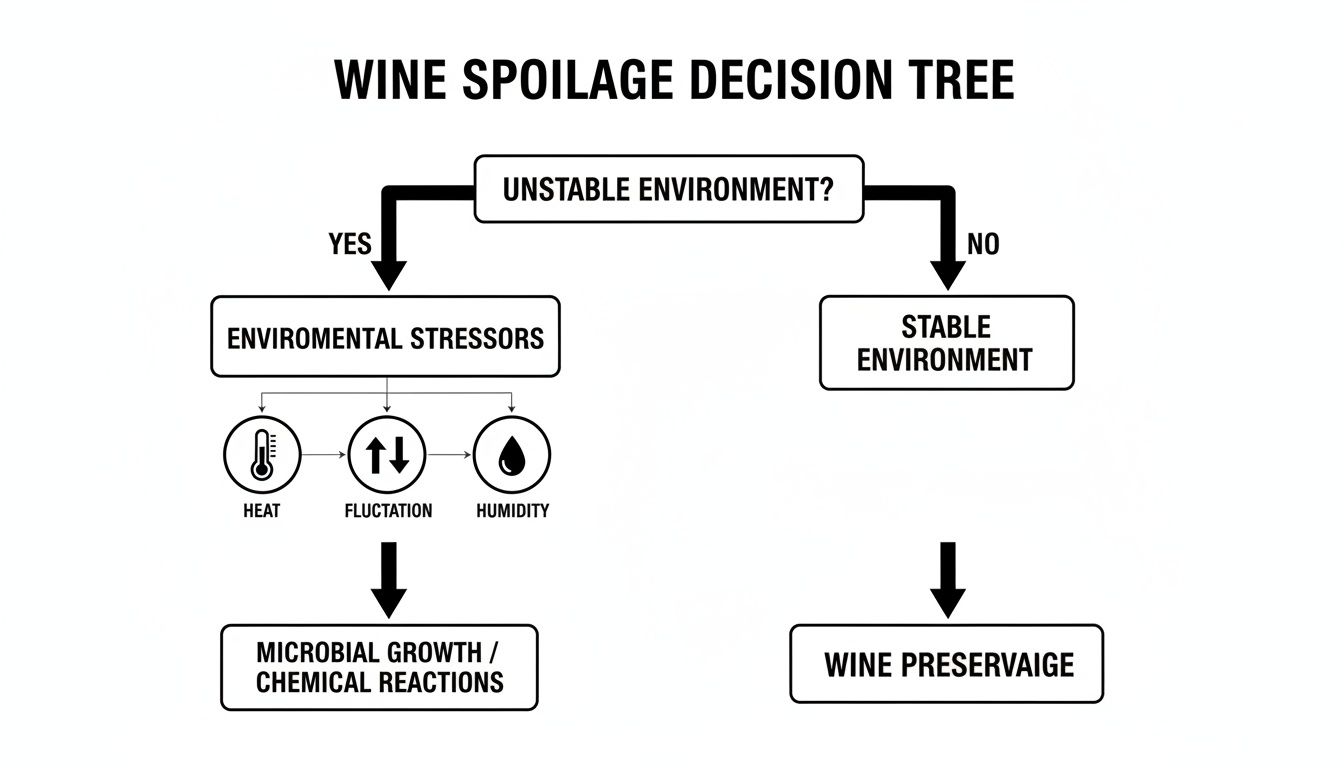
As you can see, heat, wild temperature swings, and humidity are the three horsemen of the wine apocalypse. Your cooling unit is the only thing standing between your collection and spoilage.
Split Cooling Systems
For collectors who refuse to compromise on aesthetics or a quiet environment, a split system is often the perfect answer. The design genius is right in the name: it "splits" the noisy, heat-generating condenser from the in-cellar evaporator. The cooling part stays in the cellar, while the loud machinery is tucked away in a mechanical room, the attic, or even completely outside the house.
This separation is the key. It banishes all the heat and operational noise from your wine storage area, creating a truly serene atmosphere where the wine itself is the star of the show.
A split system really delivers on multiple fronts:
- Silent Operation: With the condenser humming away elsewhere, your cellar remains blissfully quiet.
- Aesthetic Flexibility: The indoor unit is slim and unobtrusive, opening up far more possibilities for a clean, elegant design.
- Efficient Heat Dissipation: Moving the condenser to a well-ventilated spot means it can dump heat far more effectively without impacting the cellar.
This makes them the hands-down winner for high-end custom enclosures, especially the stunning glass cellars where looks are just as important as function.
Ducted Cooling Systems
When you want your climate control to be completely invisible, a ducted system is the way to go. Here, the entire cooling unit is installed outside the cellar. It then pushes perfectly chilled air into the space—and pulls warm air out—through insulated ductwork hidden in the walls or ceiling. The result? No mechanical equipment in sight. Just your wine.
It’s a booming market, once valued at USD 2.96 billion and projected to climb to USD 4.73 billion by 2032, largely because of how perfectly these systems integrate with modern design. They can maintain incredibly stable temperature and humidity levels, making them the ideal partner for a custom glass enclosure that showcases your collection without any distractions.
No matter which system you lean toward, always keep efficiency in mind. It's not just about the upfront cost; it’s about long-term performance and your energy bills. A great first step is understanding what a SEER rating is and how it affects your unit’s running costs. For more deep dives into designing the perfect space for your collection, be sure to check out the other guides on our blog.
Building an Airtight Fortress for Your Wine
You can have the most powerful, state-of-the-art cooling unit on the market, but it’s fighting a losing battle if your wine enclosure isn’t built to match. A wine cellar isn't just a box to hold your bottles; it's a complete system where the structure and the mechanics have to work in perfect harmony.
Think of it like a high-performance sports car—all the horsepower in the world doesn't mean a thing if the tires can't grip the road.
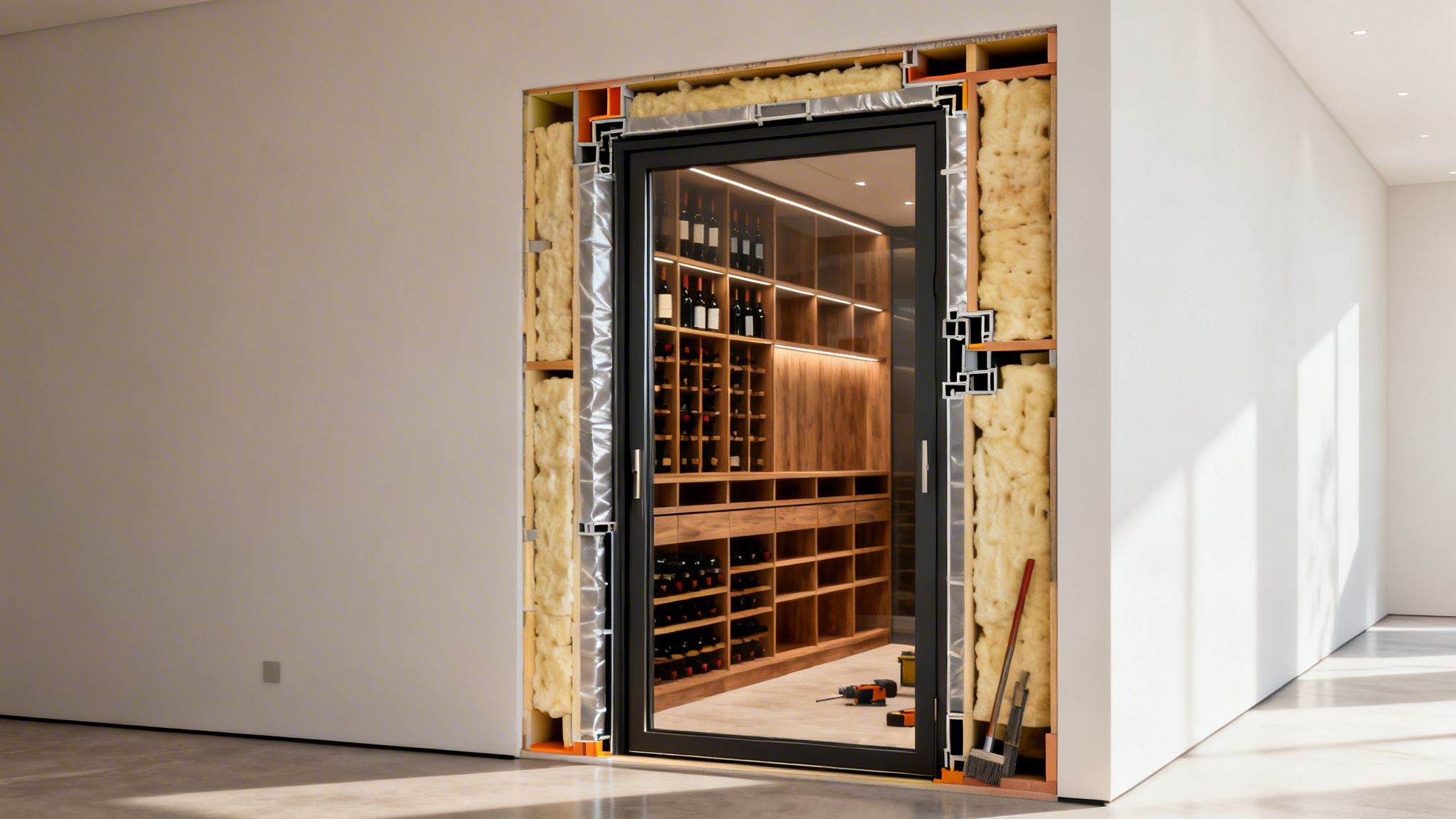
This synergy is the absolute foundation of effective wine storage temperature control. If your cellar is constantly leaking cool air or letting in ambient heat, your cooling system will run nonstop. That’s a fast track to premature equipment failure, shocking energy bills, and worst of all, the very temperature swings that put your entire collection at risk.
Creating an Impenetrable Vapor Barrier
Your first line of defense, especially in a humid climate like we have here in Southwest Florida, is a properly installed vapor barrier. This step is completely non-negotiable. Typically made of 6-mil plastic sheeting, this barrier is carefully applied to the "warm side" of the cellar walls and ceiling—that is, the exterior-facing side of your insulation.
Its job is simple but critical: stop moisture from creeping through your walls and into your chilled cellar. Without it, condensation will inevitably form inside your walls as warm, moist air meets the cold interior surface. That trapped moisture is a recipe for disaster, leading to mold, mildew, and rot that can threaten the very structure of your home.
A cellar without a vapor barrier is like a ship with a slow leak. Eventually, the damage becomes overwhelming, and the entire system fails. It's the unseen hero that ensures the long-term health of both your cellar and your home.
The Power of High-Performance Insulation
With the vapor barrier in place, insulation is the next critical layer of your fortress. Insulation provides thermal resistance, which we measure in R-value. The higher the number, the better it is at stopping heat from passing through. For a dedicated wine cellar, your standard fiberglass batts just won't cut it.
The gold standard for modern wine cellars is closed-cell spray foam insulation. It's a game-changer. Unlike fluffy fiberglass, closed-cell foam is dense and rigid, creating an almost impenetrable barrier to both air and moisture. Its high R-value (usually R-6 to R-7 per inch) delivers incredible thermal performance, which dramatically cuts down the workload on your cooling system. That efficiency doesn't just save you money—it helps maintain the rock-solid temperature stability your wine needs to age gracefully.
A few key benefits of closed-cell spray foam include:
- Superior R-Value: It offers the highest R-value per inch of any common insulation material.
- Structural Rigidity: It actually adds strength to the wall structure itself.
- Secondary Moisture Barrier: Its dense, closed-cell nature makes it highly resistant to moisture getting through.
The Modern Challenge of Glass Enclosures
Let's be honest, today's most stunning wine cellars are often defined by their expansive glass walls and doors. They transform a storage space into a breathtaking design feature. But glass, by its very nature, is a poor insulator. To get that beautiful look without compromising performance, you have to use specialized materials.
This is where thermally broken frames and insulated glass units (IGUs) come in. A thermally broken frame has a special barrier made of a less conductive material sandwiched between the interior and exterior metal parts, stopping heat from traveling right through the frame. In the same way, an IGU uses two panes of glass separated by a sealed space filled with air or argon gas, which drastically reduces thermal transfer.
When designed and installed by experts, these components make it possible to have a jaw-dropping, glass-forward design that still maintains a perfectly airtight, stable environment inside. Building this fortress requires real precision. Seeing how custom wine enclosures are expertly crafted can give you a better feel for how to achieve this perfect balance of form and function.
Taming the Florida Climate to Protect Your Collection
Trying to store fine wine in Southwest Florida can feel like trying to keep an ice cube from melting on the beach. It's a tough battle. Our region’s relentless heat and sticky, oppressive humidity are a constant assault on any wine storage space, turning a simple cellar into a serious engineering challenge.
This climate doesn't play nice. It actively works against the stability your wine needs to mature into something special. The fight is on two fronts: the sheer heat (thermal load) and the invasive moisture (humidity). One threatens to literally cook your wine, while the other invites mold and equipment failure. Nailing wine storage temperature control here means understanding—and defeating—these powerful local forces.
The Double Threat of Heat and Humidity
Here in Southwest Florida, the air isn't just hot; it's heavy with water. That humidity is always looking for a way in. In a poorly sealed cellar, it will sneak inside where your cooling system is trying to chill the air. When that warm, moist air hits a cold surface, you get condensation, and that’s where the real trouble begins.
All that moisture can fuel mold growth on your walls, racking, and even the labels of your most prized bottles. Worse yet, it can completely overwhelm your cooling unit's ability to pull moisture from the air, forcing it to run nonstop until it burns out. A professionally designed enclosure isn't just a room; it's a fortress built to keep this invisible enemy out.
In this climate, the "enemy" is always at the gates. The combination of high heat and high humidity means your enclosure's insulation, seals, and cooling system must perform flawlessly, 24/7. There's simply no room for error.
Managing the Intense Thermal Load
The other major challenge is the thermal load from the Florida sun. We're not just talking about the number on the thermometer; it's the intense radiant heat that warms up any surface it touches. This is a huge issue for modern wine displays with large glass walls and doors. They look stunning, but standard glass is a terrible insulator compared to a solid wall.
A regular pane of glass essentially turns your cellar into a greenhouse, letting heat pour into your carefully chilled space. This puts your cooling system into overdrive as it struggles to pump heat out as fast as it comes in. The result? You get constant temperature swings—the single worst thing for fine wine—along with sky-high energy bills.
This is exactly why expert design and materials aren't just a suggestion; they're a requirement.
- Robust Cooling Systems: Your cooling unit has to be professionally sized to handle our extreme outside temperatures and the specific heat-gain properties of your enclosure.
- High-Performance Glass: We're talking dual-pane, insulated glass with special Low-E coatings. This is crucial for reflecting solar heat and minimizing how much warmth gets through.
- Perfect Sealing: Every single door, joint, and wall penetration has to be perfectly sealed. This stops cool air from escaping and prevents hot, humid air from sneaking in.
As more people learn to appreciate fine wine, the demand for proper storage has exploded. Projections show the global wine storage market could hit USD 6.80 billion by 2030. This trend highlights that collectors see professional solutions not as a luxury, but as an essential way to protect their investments. You can read more about these market trends and their drivers.
For anyone with a collection in Southwest Florida, this reality is magnified. Local expertise in climate control isn't just helpful—it's the only way to succeed.
Common Questions About Wine Storage Temperature Control
Even when you've got the basics down, a few key questions always pop up when you're planning a custom wine enclosure. Getting straight answers is the only way to move forward with confidence and avoid those small, nagging mistakes that can turn into big, expensive problems later on. When it comes to wine storage temperature control, it's a game of precision, and a little expert insight goes a long way.
This section tackles the most common worries and myths we hear from collectors every day. We’ll give you direct, no-nonsense answers to help you lock in the core principles of protecting your wine for decades of enjoyment.
What Is the Single Most Important Factor in Wine Storage?
While humidity, light, and vibration definitely matter, the undisputed champion of wine preservation is temperature stability. Everyone gets hung up on hitting that perfect 55°F (13°C) target, but what’s far more damaging is letting the temperature bounce around.
Think of your wine as a living, breathing thing. When the temperature shoots up and down, the liquid inside the bottle is constantly expanding and contracting. This subtle movement works like a tiny pump against the cork, slowly but surely ruining its seal and letting tiny bits of destructive oxygen creep inside. A constant temperature, even if it's a few degrees off the "perfect" 55°F, is infinitely better than a storage space that swings between 60°F and 75°F every day.
This is exactly why a dedicated, high-quality cooling system isn't just a luxury—it's the heart and soul of any serious wine cellar. It’s the only way to get that rock-solid stability your investment deserves, especially in a demanding climate like ours.
Can I Just Use a Regular Refrigerator for My Wine?
We get this question all the time, and the answer is a hard no. A standard kitchen refrigerator is built to do two things that are absolutely terrible for your wine: get very, very cold and suck out all the moisture.
Your food fridge usually hums along at or below 38°F, which is way too cold for wine. At that temperature, the aging process doesn't just slow down—it pretty much grinds to a halt, stopping your wine from developing all those amazing, complex flavors you're waiting for. Even worse, refrigerators create a bone-dry desert inside. This will dry out your corks over time, causing them to shrink, crack, and fail completely, leading to the one thing you want to avoid at all costs: oxidation.
On that same note, your home's air conditioner can't pull off this job either. It simply wasn't designed to hold a precise temperature as low as 55°F and creates wild temperature swings as it cycles on and off. A purpose-built wine cooling system is the only right tool for the job. It’s engineered specifically to maintain both a consistent temperature and the perfect humidity level, typically between 50% and 70%.
How Does a Glass Wine Enclosure Affect Temperature Control?
A sleek, modern glass wine enclosure can be a stunning focal point in any home, but it also brings a unique set of thermal challenges that demand expert handling. Glass just isn't a great insulator compared to a solid, insulated wall, so you have to be smart about compensating with the right materials to keep everything under control.
To build a high-performance glass enclosure that actually works, a few things are absolutely non-negotiable:
- Insulated Glass Units (IGUs): These are the foundation. We use dual-pane glass with a sealed layer of inert argon gas sandwiched between them, which dramatically slows down heat transfer.
- Low-Emissivity (Low-E) Coatings: This is a microscopic, metallic coating applied to the glass that acts like a mirror for heat, reflecting thermal energy and keeping the summer heat out.
- Airtight Sealing: Every single seam, joint, and door frame has to be sealed perfectly. We use high-quality gaskets and door sweeps to completely eliminate air leakage.
Without these critical elements, your cooling unit would be forced to run nonstop, fighting a losing battle against the heat seeping in. This is where professional design and installation make all the difference. An expert makes sure the entire system—the glass, frames, and seals—works together as a single unit to support the cooling system, creating an environment that’s not only beautiful but also perfectly stable. For more answers, feel free to check out our detailed FAQ page, which covers many of our custom glass services.
How Often Should My Cooling Unit Run?
Here's the thing: a properly sized and installed wine cooling unit should not run all the time. In a well-insulated and perfectly sealed cellar, the system should cycle on and off periodically to hold the target temperature. How often it cycles depends on things like the ambient temperature outside the enclosure and how often you open the door.
If you notice your unit is running almost constantly, that’s a major red flag. It’s a sign that something is wrong and needs to be addressed right away.
The usual suspects are:
- An Undersized Unit: The cooling system might not have enough power for the size and thermal load of your space.
- Poor Insulation: The enclosure is "leaking" cold air, forcing the unit to work overtime to keep up.
- Air Gaps: Warm air is seeping in through gaps in the door or seals.
A system that never stops running is incredibly inefficient, will burn out much faster, and isn't giving your wine the stable environment it needs. That's why professional load calculations during the design phase are so critical—they ensure the cooling unit is perfectly matched to your specific enclosure and climate.
Getting wine storage temperature control right is a blend of art and science. It demands a real understanding of thermodynamics, top-notch construction practices, and the unique needs of a fine wine collection.
At AmeriGlass Industries, we specialize in designing and building custom glass wine enclosures that are not just visual showstoppers but are engineered for flawless performance, especially in the challenging Southwest Florida climate. Our team obsesses over every detail—from the insulated glass to the precision seals—to ensure everything works in harmony to create a stable, beautiful sanctuary for your investment.
Ready to build the wine cellar you’ve always dreamed of? Contact us today to start the conversation at https://ameriglassindustries.com.