

When you think about protecting your wine collection, temperature probably comes to mind first. But there’s another, quieter factor that’s just as critical: humidity. For any serious collector, maintaining a stable relative humidity between 50% and 70% is arguably the most important thing you can do to preserve the quality, flavor, and value of your wine.
Why Humidity Is Your Wine Collection's Unseen Guardian
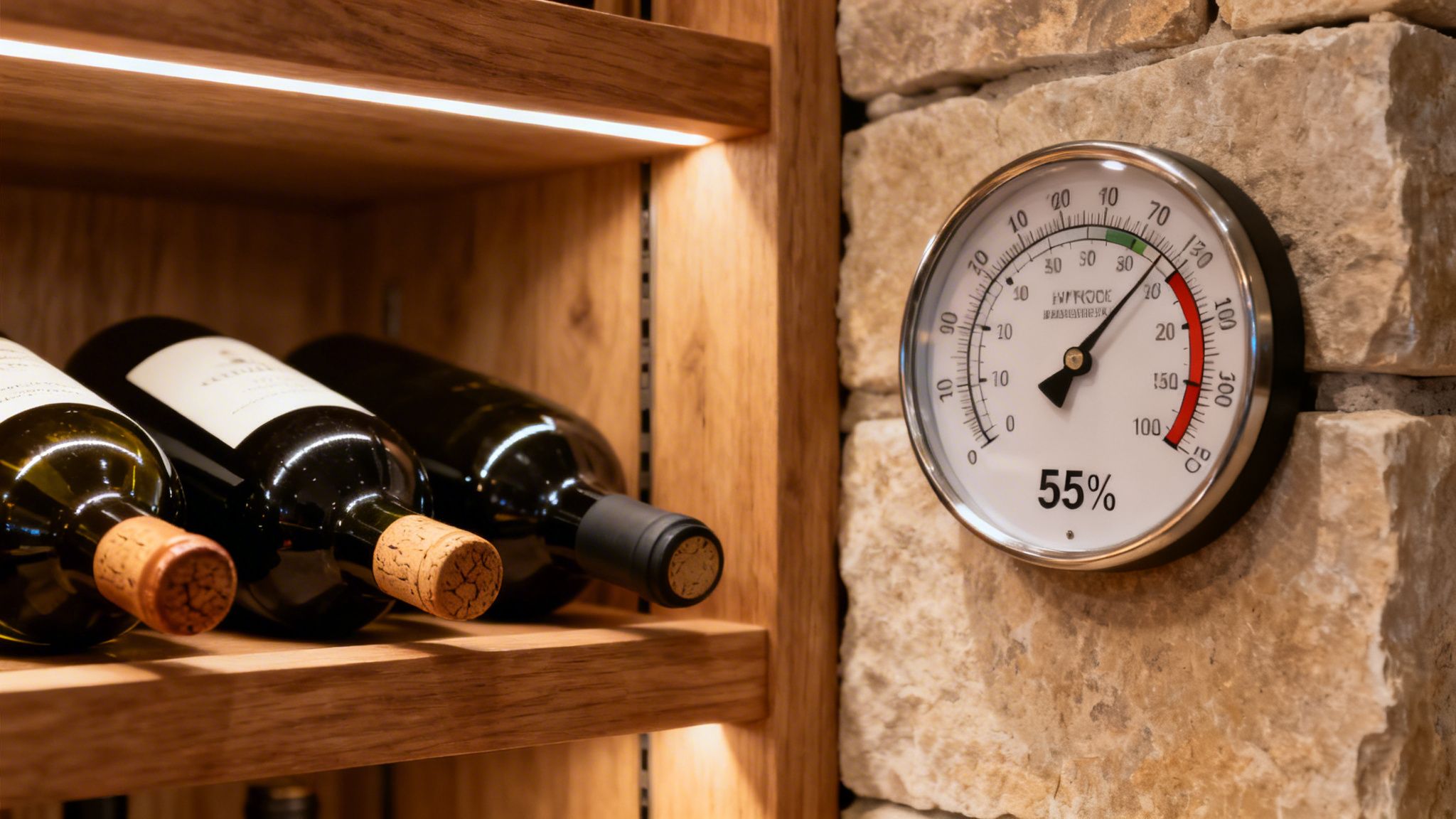
While temperature gets the spotlight, humidity is the silent partner in aging wine gracefully. It’s an invisible force that can either safeguard your investment for decades or quietly ruin it. For those of us in Southwest Florida, from Naples to Fort Myers, controlling this element is a constant tug-of-war with our naturally humid, salty air.
Just think of a wine cork as the gatekeeper. Its entire job is to create a perfect seal, keeping the precious wine in and destructive oxygen out. The right humidity is what keeps that cork plump, pliable, and up to the task.
The Dangers of Imbalance
What happens when that balance is lost?
If the air in your cellar gets too dry (below 50% humidity), the corks start to dry out. They shrink, turn brittle, and lose their seal. This allows tiny amounts of oxygen to creep in, triggering premature oxidation. That’s a fast track to turning a vibrant, complex wine into something flat and lifeless.
On the other hand, letting humidity climb too high (above 70%)—a very real risk here in Florida—creates a different set of problems. While the excess moisture won't harm the wine inside the bottle directly, it creates a perfect breeding ground for mold and mildew on the outside.
Mold can completely destroy priceless wine labels, tanking a bottle's resale value and ruining its appearance. In the worst cases, those musty smells can even work their way through the cork over time, tainting the wine itself.
This is why effective wine cellar humidity control isn't just a "nice-to-have"; it's a fundamental requirement. The global wine cellar market, valued at a projected USD 1.34 billion, is built on this very principle. In fact, studies show that just a 10% drop below the ideal humidity range can speed up cork degradation by as much as 30%, putting your collection at significant financial risk.
The Foundation of Preservation
At the end of the day, your wine cellar is a complete ecosystem. It doesn’t matter if it’s a grand, custom glass enclosure or a cleverly retrofitted closet; its success hinges on its ability to hold that 50-70% sweet spot.
This stability is what prevents the endless cycle of corks expanding and contracting, which is what truly protects both the financial and sentimental value you've invested in every bottle. You can find more preservation insights on our blog.
How to Accurately Measure Your Cellar's Climate
There’s a simple truth in the world of wine collecting: you can't control what you don't measure. This isn't just a saying; it's the fundamental principle of protecting your investment. To truly master your cellar’s environment, you need the right tools and the know-how to use them correctly.
It all starts with a quality hygrometer, the device that measures relative humidity (RH). While old-school analog hygrometers have a certain charm, modern digital models are worlds apart in reliability and ease of use. For any serious collector, they’re the only real choice.
Choosing and Placing Your Hygrometer
When you’re shopping for a digital hygrometer, look for a model that also reads temperature and has a big, clear display. Accuracy is everything. My advice? Don't skimp here. A cheap, inaccurate hygrometer is genuinely worse than having none at all, giving you a false sense of security.
Now, where you put it matters just as much as the device itself. To get a real sense of your cellar's climate, you have to avoid a few common mistakes I've seen people make. Never place your sensor:
- Near the door: The constant opening and closing will give you wild, useless readings.
- Next to the cooling unit: The air right around the unit is always artificially dry or cool.
- Directly on the floor: Since cool air sinks, a reading from the floor can be deceptively low compared to the rest of the cellar.
The sweet spot is a central location, about midway up a wall and away from any direct airflow from your climate systems. For the most complete picture, I often recommend using two sensors—one in a warmer, higher spot and another in a cooler, lower area. This quickly reveals if you have any significant temperature or humidity layering in your cellar. If you're designing a cellar from the ground up, explore the custom options available with our wine enclosure products to integrate monitoring from the start.
Embracing Smart Sensor Technology
For true peace of mind, especially for those of us who are seasonal residents in Southwest Florida, Wi-Fi-enabled smart sensors are a total game-changer. These devices stream real-time data right to your smartphone, letting you keep an eye on your cellar’s health from anywhere in the world.
The smart wine cellar market exploded to US$13.84 billion in 2023, and for good reason. These integrated systems are designed to hold that perfect 55-75% RH, with sensors that can detect a shift as small as 2% and send an instant alert to your phone.
I can't overstate how vital this technology has become. Experts warn that when humidity drops below 50% RH, corks can lose 20% of their elasticity in just a few months, drastically accelerating evaporation. A smart sensor alerts you the moment that drop happens—whether from a system failure or a power outage—giving you the chance to act before the damage is done. You can learn more about how these protections are becoming the new standard by checking out the latest smart wine cellar market analysis.
Adjusting Humidity to Protect Your Collection
Getting an accurate read on your cellar's climate is one thing; actually controlling it is where the real work begins. Think of it less as a "set it and forget it" task and more like actively managing a delicate ecosystem. Whether your cellar is too damp or bone-dry, the right equipment is your most crucial ally in protecting your collection.
For those of us in Southwest Florida, the primary enemy is almost always high humidity. That thick, soupy air outside, often sitting at 70-90% humidity, is relentless. It’s constantly looking for a way into your cellar. I’ve seen too many people try to solve this with a standard household dehumidifier, and it’s a recipe for disaster. They simply aren't built to run in the cool 55°F environment of a wine cellar and will burn out in no time.
Mastering High Humidity in Florida
This is where a cellar-grade dehumidifier becomes non-negotiable. These are specialized machines, engineered from the ground up to perform in low temperatures without freezing over. They are the true workhorses of a Florida wine cellar.
When you're shopping for one, there are a few features I always tell my clients to insist on:
- Low-Temperature Operation: The unit absolutely must be rated to work efficiently at temperatures down to 50°F or even lower.
- Automatic Drainage: A model with a built-in pump or a gravity drain hose is a must. The last thing you want is to be hauling a full water bucket out of your cellar every day.
- Integrated Humidistat: This is what gives you precision. You can dial in your target humidity—I always aim for around 60%—and the machine will automatically turn on and off to maintain that perfect level.
A correctly installed cellar-grade dehumidifier is the absolute cornerstone of wine cellar humidity control in a humid climate. It’s what stops mold from destroying your labels, prevents that musty cellar smell, and protects the integrity of your expensive racking and enclosure.
As modern wine storage becomes more sophisticated, so does the technology. The electric wine cellar market, which is on track to become a $3.4 billion industry, is built on the promise of perfectly mimicking those old-world cave conditions. While you're tackling your cellar, it doesn't hurt to explore some simple steps to reduce humidity in your home, as the underlying principles can help. Professional-grade cellar systems with precise dehumidifiers not only hit their targets but can also cut energy costs by up to 25% by using more efficient compressors.
Choosing the Right Humidity Control Device
To make the right call, it helps to see the options side-by-side. This table breaks down what you need to know when choosing between a humidifier and a dehumidifier for your cellar.
| Device Type | Best For | Key Feature to Look For | AmeriGlass Pro-Tip |
|---|---|---|---|
| Cellar-Grade Dehumidifier | Humid climates like Florida; cellars consistently above 65% RH. | Low-temperature rating (operable down to 50°F) and an automatic drain feature. | Don't skimp here. A residential unit will fail. A purpose-built machine is an investment that protects your entire collection. |
| Evaporative Humidifier | Dry climates or winter months; cellars consistently below 50% RH. | An integrated humidistat for automated control and a design that avoids direct misting. | Avoid ultrasonic "cool mist" models. The mist can settle on bottles and cause mold—the very problem you're trying to prevent. |
Ultimately, selecting the right device is about diagnosing your cellar's specific needs and investing in a solution built for the unique, cool environment of wine storage.
Handling Low Humidity Conditions
While it’s less common here in Florida, dry air can still be a problem, especially in well-sealed cellars during drier winter months. If your hygrometer is consistently dipping below 50%, you have a different problem: your corks are at risk of drying out, shrinking, and letting damaging oxygen seep into your bottles.
To fix this, you’ll need to add moisture back into the air with a cellar humidifier. But a word of caution—not just any humidifier will do. Stay away from the common ultrasonic models that produce a fine, cool mist. They might be great for a bedroom, but in a cellar, that mist can settle directly on bottles and racks, creating damp spots that invite mold.
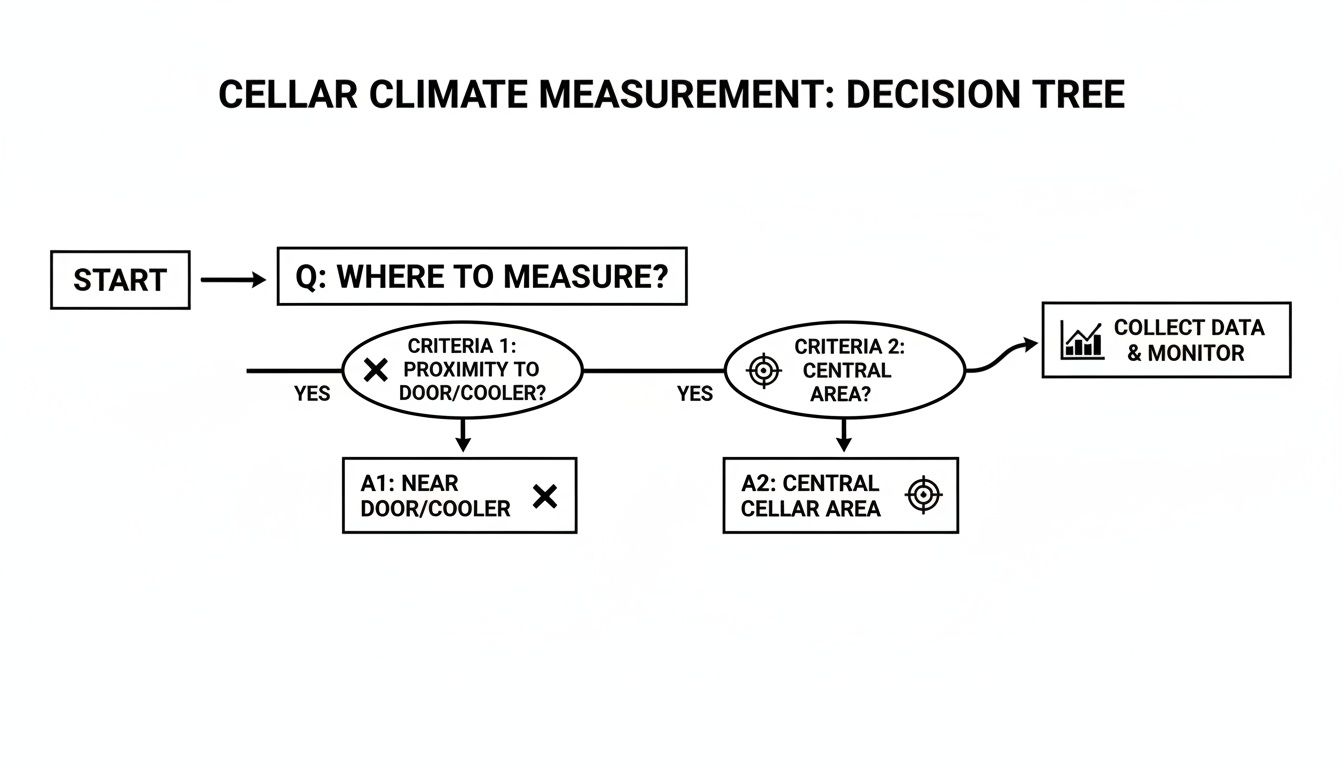
Before you add or remove any humidity, make sure you're getting a true reading. This graphic shows why placing your hygrometer in the center of the cellar, away from doors and cooling units, gives you the most accurate data to work with.
The right tool for the job is an evaporative humidifier. These units use a fan to push air across a wet wick or filter, which releases water vapor much more gently and evenly. It’s a process that raises the ambient humidity without creating direct condensation on your collection. Just like with their dehumidifying counterparts, look for a model with a built-in humidistat for true automated control.
If you're looking for climate control solutions designed specifically for wine cellars, you can explore the options in our shop.
Why Your Cellar Enclosure Is Your First Line of Defense
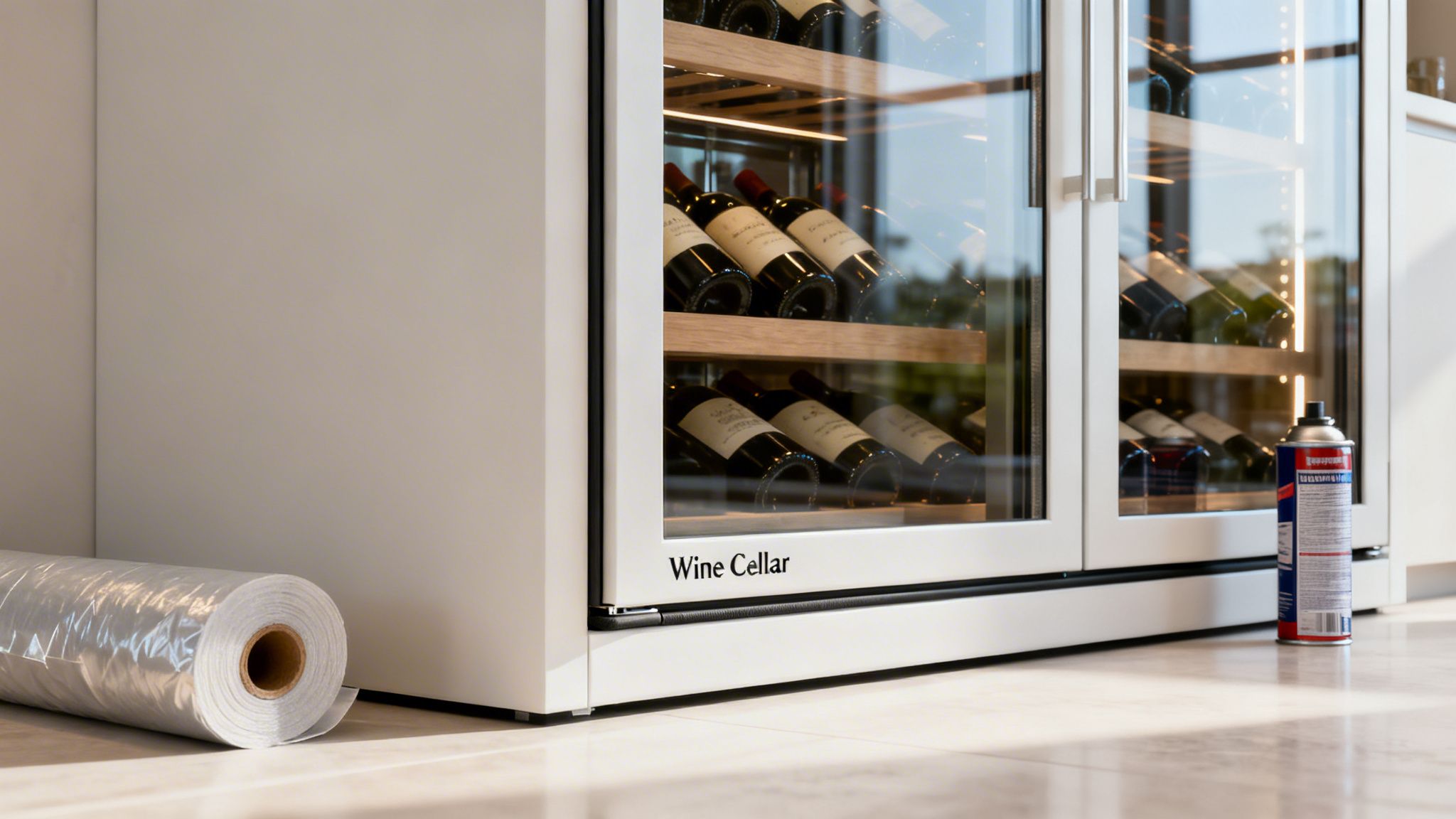
We can talk all day about humidifiers and dehumidifiers, but those are just tools. The real secret to mastering wine cellar humidity control has less to do with the machines you put inside the room and everything to do with the room itself. A properly built enclosure is your single most effective weapon against the outside climate.
Think of it this way: a poorly sealed cellar is like a boat with a gaping hole. Your climate control system is bailing water as fast as it can, running constantly, and fighting a losing battle. A well-constructed enclosure, however, acts like a perfectly sealed hull. It creates a stable environment, allowing your equipment to simply nudge the conditions into place rather than fighting a constant war.
The Unskippable Step: Your Vapor Barrier
Especially here in Southwest Florida, a vapor barrier isn't just a nice-to-have feature; it's the absolute heart of a functional cellar. This is a simple layer, usually a 6-mil plastic sheet, installed on the "warm side" of your cellar walls—that is, on the outside of your insulation.
Its entire job is to block moisture from the humid air from seeping through porous materials like drywall and wood into your cool cellar. Without one, your dehumidifier is stuck working overtime to remove moisture that should never have gotten inside in the first place.
I’ve seen it countless times: the number one culprit behind out-of-control humidity and mold in wine cellars is a missing or badly installed vapor barrier. It makes stable climate control virtually impossible, no matter how powerful your equipment is.
If you’re serious about protecting your collection, this is a step you simply can't afford to skip. It's completely non-negotiable.
Insulation and Doors: Sealing the Deal
With the vapor barrier in place, the right insulation is your next layer of defense. For wine cellars, the gold standard is closed-cell spray foam. It’s a fantastic material because, unlike traditional fiberglass batts, it’s impermeable to moisture and expands to create a perfect air seal, leaving zero gaps for humid air to sneak through.
Finally, let’s talk about the cellar door, which is often the most overlooked weak spot. A standard interior door, or even many off-the-shelf "wine cellar doors," will bleed cool air and allow warm, humid air to pour in every time your home’s AC kicks on.
A true, high-performance cellar door is essential. Look for key features that show it’s built for the job:
- Dual-pane insulated glass to stop heat from transferring through the panes.
- Robust weatherstripping and seals around the entire door and frame.
- A solid threshold that completely seals the gap at the floor.
When you invest in a professionally built structure, you're doing more than just creating a beautiful display. You are building a stable microclimate that lets your cooling and humidity systems work efficiently, saving energy and giving your wine the consistent, calm environment it needs to age perfectly. You can see what goes into these specialized structures by looking at how experts build custom wine enclosures.
Maintaining Long-Term Climate Stability
Getting your cellar's climate control dialed in feels like a massive win, but that’s just the starting line. The real art of wine collecting is maintaining that perfect environment, day in and day out, for years to come. Your cellar is a dynamic space, and without consistent attention, you risk the very investment you’ve worked so hard to build.
This is non-negotiable here in Southwest Florida, where the oppressive heat and humidity are always looking for a way in. To protect your collection, you need to shift from spot-checking to a disciplined maintenance routine. Think of it as a partnership with your cellar; you take care of the equipment, and it takes care of your wine.
Your Seasonal Maintenance Checklist
A simple, repeatable checklist is the best defense against climate-related problems. Following a seasonal schedule helps you catch small issues before they spiral into costly disasters, ensuring every part of your system is pulling its weight.
Here’s the routine I recommend to all my clients:
- Quarterly (Every 3 Months): Swap out or clean the filters on your humidifier and dehumidifier. This is the single most common point of failure. A clogged filter makes the unit work overtime, leading to poor performance, higher energy bills, and eventual burnout.
- Bi-Annually (Twice a Year): Recalibrate your hygrometer. The sensors in even the best digital hygrometers can drift over time, giving you a false sense of security. Use a simple calibration kit or check its readings against a brand-new, reliable hygrometer to ensure your data is dead-on accurate.
- Annually (Once a Year): Perform a detailed inspection of all door seals and weatherstripping. Florida’s climate is brutal on these materials, causing them to crack and lose their seal. Even a tiny gap is an open invitation for humid air to pour in, forcing your entire system to fight a losing battle.
A cellar that just has equipment is one thing. A cellar that truly preserves a collection is one where maintenance is a habit. That's the difference between hoping for the best and guaranteeing it.
Preparing for the Unexpected in Southwest Florida
For anyone with a cellar in Naples, Fort Myers, or anywhere in our hurricane-prone region, you have to plan for power outages. A major storm can knock out power for days, and that’s more than enough time to ruin a collection that took decades to build.
Your emergency plan needs one critical component: a backup generator properly sized to run your cooling unit and dehumidifier. Don't just own one—test it before hurricane season starts to make sure it’s fueled up and ready to go when you need it most.
And if a storm is on the way and you have no backup power? The single most important thing you can do is leave the cellar door shut. I know the temptation to "just check" on your wines is strong, but resist it. Every time you open that door, you flood the room with hot, wet air, drastically speeding up the temperature climb. A well-sealed cellar can hold its temp for a surprisingly long time on its own. Your discipline in that moment could be what saves your collection.
Frequently Asked Questions About Wine Cellar Humidity
Even after you get your systems up and running, you're bound to have questions. From my experience, I know that fine-tuning wine cellar humidity control is a process, not a one-and-done task. Let's tackle some of the most common questions I hear from collectors, especially those of us here in Southwest Florida.
Getting clear answers to these will give you the confidence that your collection is truly secure.
Can I Use a Regular Household Dehumidifier in My Wine Cellar?
This is a question I get all the time, and the answer is a hard no. It’s an understandable impulse to try and save a few dollars, but it's a shortcut that will absolutely backfire.
Standard dehumidifiers are built for normal room temperatures, not the cool 55°F environment of a wine cellar. Put one in that cold air, and it will struggle, freeze over, and quickly burn itself out. More importantly, they just don't have the sensitive humidistat needed to lock in that crucial 50-70% RH sweet spot. A cellar-grade machine isn’t a luxury; it’s an essential piece of equipment engineered specifically for this job.
My Glass Cellar Door Has Condensation on It. What Does That Mean?
Condensation is a major clue about what’s happening with your cellar's environment, but you have to know how to read the signs.
Condensation on the outside of the glass: This is perfectly normal, especially in a humid climate like ours. It’s just warm, moist air from your home meeting the cold surface of your cellar door. It’s actually a good sign that your cellar is well-insulated and holding its temperature.
Condensation on the inside of the glass: This is the one you need to worry about. It’s a red flag that the humidity inside your cellar is too high, likely creeping up past 75-80%. This is prime territory for mold and label damage. It’s time to check your dehumidifier settings or start looking for air leaks.
How Important Is a Vapor Barrier in a Florida Wine Cellar?
In a humid climate, a vapor barrier is non-negotiable. I'd go so far as to say it's the single most important component for long-term stability. This waterproof membrane, usually a 6-mil plastic sheet, is installed on the warm side of your cellar's insulation. Its only job is to stop moisture from our humid Florida air from pushing its way through your walls.
Without a properly installed vapor barrier, you are fighting a losing battle against humidity from day one. Your cooling and dehumidifying systems will run constantly, your energy bills will be higher, and you’ll still risk moisture getting trapped inside your walls, leading to mold you can't even see.
When Should I Call a Professional?
Don't hesitate to call in an expert when you’re dealing with issues that your own adjustments just can't fix. If you have recurring condensation inside the cellar, see mold spots you can't trace, or watch your humidity levels swing wildly no matter what you do, it's time for a professional opinion.
An expert can diagnose deeper problems, like a breach in your cellar's envelope, insulation failure, or even how your home's main HVAC system is impacting your cellar. And if you’re planning a new build, bringing in a specialist from the very beginning is the smartest investment you can make.
For more answers to common questions, you can find a wealth of information on our FAQs page.
Ready to build a wine cellar that perfectly preserves your collection? The experts at AmeriGlass Industries specialize in designing and installing custom glass wine enclosures that offer flawless climate stability and stunning aesthetics. Contact us today for a free consultation at https://ameriglassindustries.com.