

A lot of homeowners start asking what is a bypass shower door when the bathroom layout fights them.
The vanity is close to the shower opening. The toilet sits just where a swinging panel wants to travel. Or the room feels too tight for a door that opens into the walkway. In Southwest Florida homes, that's common, especially in guest baths, condo remodels, and tub-to-shower upgrades where every inch has to work.
That's where a bypass door usually enters the conversation. It isn't just a different way to open a shower. It's a practical glass solution for bathrooms that need clean sightlines, reliable daily use, and no wasted swing space. Done right, it can make a tight room feel more finished and more intentional, not compromised.
The Smart Solution for Stylish Tight Spaces
You step into a guest bath in a Naples condo after a remodel, and the problem is obvious. The vanity sits close to the shower opening, the walkway is tight, and a swinging glass door would clip the usable space every time someone gets in or out. In that kind of layout, a bypass door is usually the cleaner answer.
A bypass shower door keeps all door movement inside the opening. The panels slide on their track instead of swinging into the room, which makes it a strong fit for alcove showers, tub-to-shower conversions, and secondary baths where every inch matters. I recommend this style often in Southwest Florida homes because many bathrooms need glass without giving up floor clearance.
The value is practical, but the look matters too. A well-built bypass enclosure brings in more light than a curtain and gives the room a more finished appearance. In smaller baths, that visual openness can make the whole space feel less crowded.
Why homeowners keep coming back to this style
The reasons are straightforward:
- No swing space required, so the door does not interfere with a vanity, toilet, or main walking path
- Better daily function in tight layouts, especially in condo baths and compact guest bathrooms
- Cleaner sightlines than a curtain or heavy framed enclosure
- Entry access from either side, which can be useful depending on fixture placement
The trade-off is that one panel always sits behind the other, so you never get the full width of the opening clear at once. For many homeowners, that is a fair exchange for saving floor space.
For homeowners who want the same space-saving function with a more refined look, a modern true slide shower door system can bridge the gap between a standard bypass setup and the cleaner hardware lines you see in higher-end glass work.
In Southwest Florida, I also tell homeowners to think past the day of installation. Hard water is common here, and cheaper framed sliders tend to collect mineral buildup in the tracks faster. A quality bypass system should be built and installed so it runs smoothly, sheds water properly, and stays easier to clean over time. That is where craftsmanship shows.
How a Bypass Shower Door Works
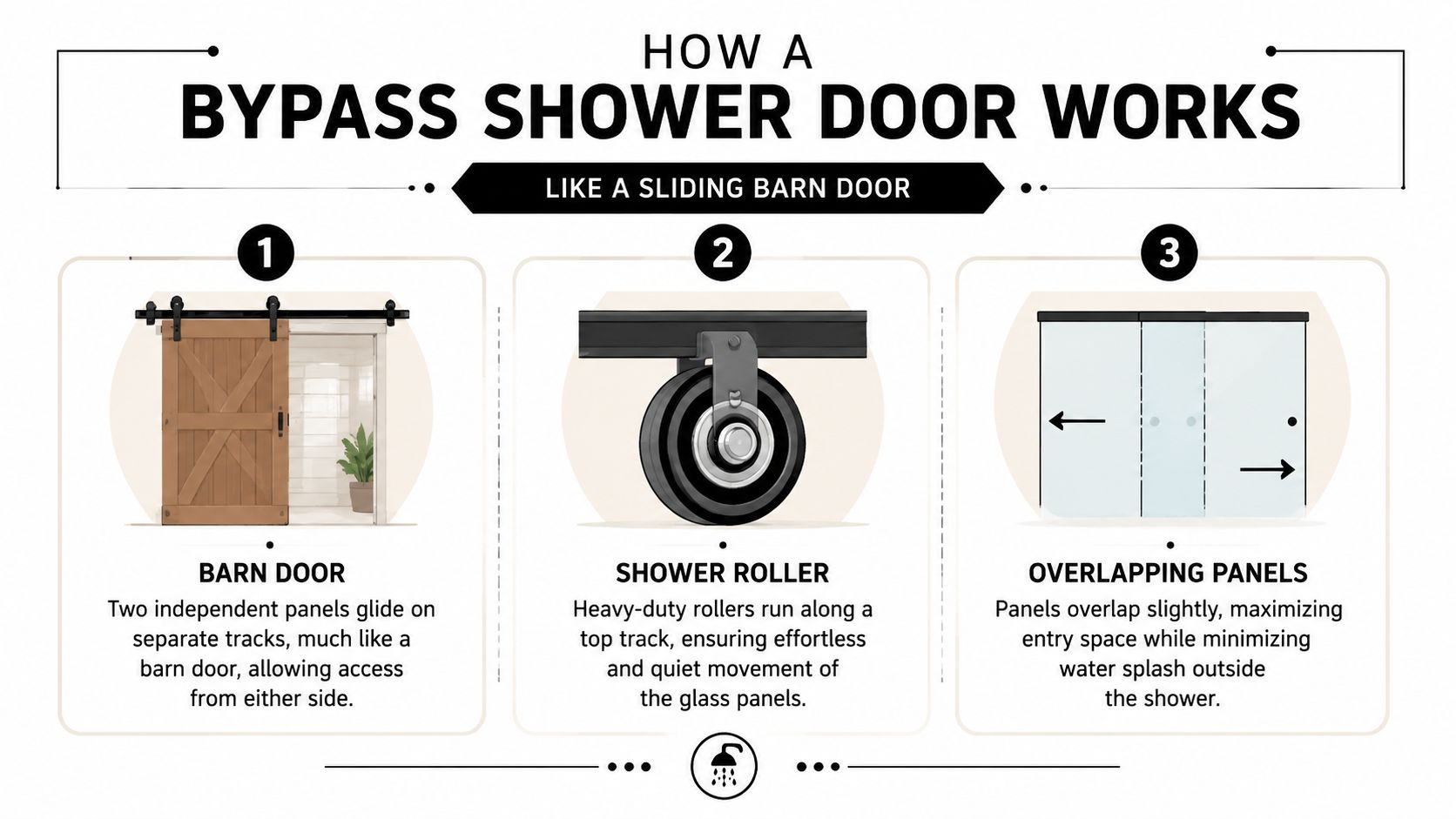
At its simplest, a bypass shower door is a sliding enclosure with two glass panels that move past each other on parallel tracks. That's the core definition. Instead of one panel hinging outward, each panel glides horizontally, much like a patio door or a modern barn-style door.
The parts that actually do the work
Homeowners usually focus on the glass first. Installers look at the moving parts.
A bypass system shifts the load differently than a hinged door does. The panel weight is carried through rollers, tracks, guides, and anti-jump hardware rather than through hinge torque at one fixed point. That's one reason installation details matter so much. Technical guidance for these systems emphasizes roller adjustment, securing the guide, and adding anti-jump components so the panel can't lift off during use, as outlined in this explanation of how bypass doors transfer weight and stay aligned.
The core components are straightforward:
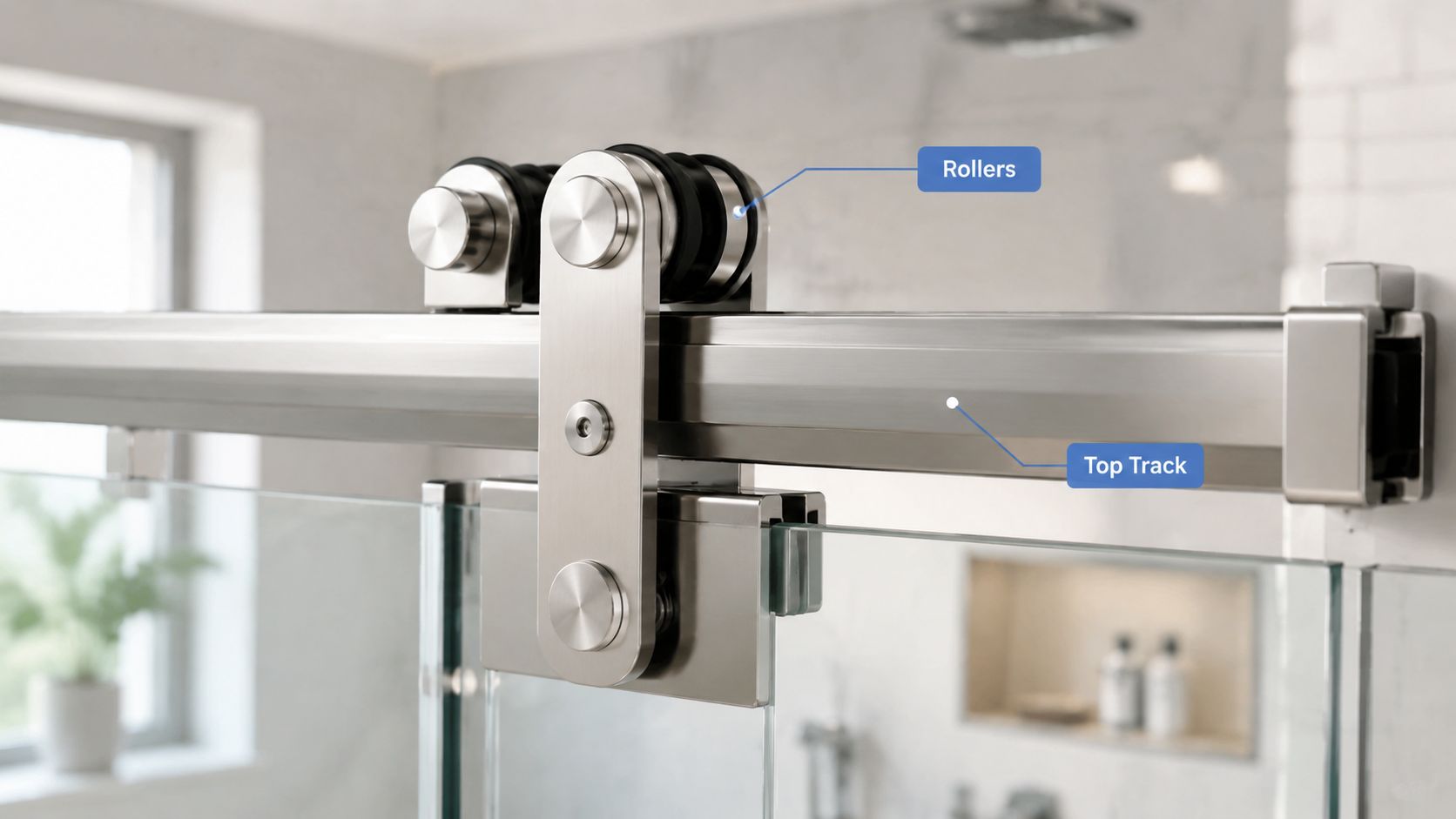
- Top track or header carries the motion system and helps manage the panel travel
- Rollers let the glass move smoothly instead of dragging
- Bottom guide keeps the panels aligned so they don't wander or rub
- Anti-jump hardware helps prevent lift-off during operation
Why the sliding motion saves space
The biggest advantage comes directly from that side-to-side movement. Since the panels stay within the opening, you don't need clearance in front of the shower. That's why bypass doors are a natural fit for tub enclosures and for showers in tighter bathrooms.
What doesn't work is assuming any sliding system will feel smooth forever on its own. If the rollers aren't adjusted well, the guide isn't secured, or buildup starts collecting where the panels travel, the door can start to feel heavy, noisy, or uneven. Routine shower door maintenance helps preserve that smooth glide and catches small alignment issues before they turn into bigger service calls.
If a bypass door rattles, scrapes, or takes effort to move, that usually points to installation or maintenance issues, not to the concept itself.
A good bypass door should open with control, stay on line, and feel stable all the way through the travel.
Anatomy and Styles of Bypass Doors
A bypass door can look clean and simple, but the parts behind that look decide whether it feels quiet and solid or light and fussy after a few months of use. In Southwest Florida, that difference shows up fast. Humidity, salt air near the coast, and hard water all punish cheap finishes and poorly matched hardware.
Hardware quality shows up in daily use
Good bypass doors are built around hardware that matches the glass weight and the width of the opening. If the rollers are undersized, the finish is thin, or the header flexes, homeowners start noticing wobble, scraping, and panels that never quite meet the way they should.
The top assembly carries the work. The bottom guide keeps the panels tracking where they belong. On a custom installation, I look for tight tolerances, consistent panel reveal, and roller movement that stays controlled from one end to the other. If the opening is out of square and nobody corrects for it during installation, the door may still slide, but it will never feel right.
Glass thickness changes the feel and the look
Homeowners usually notice glass thickness the first time they put a hand on the door. Heavier frameless glass feels steadier in motion and gives the enclosure a more finished look. Thinner glass keeps cost and weight down, but it reads more like a standard builder package.
A quality bypass door also shows clean fabrication. Look at the edge polishing, the consistency of the tempering marks, and how well the hardware sits on the glass. Sloppy cutouts, rough edges, and mismatched finishes are all signs that the enclosure was sold to hit a price, not built to hold up.
In Southwest Florida homes, glass choice also affects maintenance. Hard water spotting is a real issue here, especially in bright bathrooms where mineral residue shows quickly. Clear, well-finished glass paired with quality protective coatings is easier to keep looking sharp than bargain glass with basic hardware.
The main style categories
Bypass doors usually fall into three visual groups:
| Style | What it looks like | Where it fits |
|---|---|---|
| Framed | Metal around most glass edges | Straightforward replacements and cost-sensitive remodels |
| Semi-frameless | Reduced metal with some visible structure | Bathrooms that want a cleaner look without full frameless pricing |
| Frameless | Minimal metal, heavier glass, refined hardware | Higher-end bathrooms where tile, stone, and sightlines matter |
Framed units are practical, but they show more metal and usually collect more buildup around the frame over time. Semi-frameless systems split the difference. Frameless bypass doors cost more and ask more from the installer, but they suit the bright, open look many Southwest Florida homeowners want.
That is also why homeowners comparing layouts often look at inline door and panel glass configurations in other parts of the bath. The operating style may change, but the cleaner glass-forward appearance stays consistent.
The best bypass door for a SWFL home is the one that fits the opening correctly, uses hardware that can handle the glass, and will still look good after months of hard water exposure and daily use.
Bypass vs Hinged and Pivot Shower Doors
Most homeowners aren't really choosing between “good” and “bad” shower doors. They're choosing which compromise fits their room better.
A hinged or pivot door can look clean and open. A bypass door can solve floor-space problems that a swinging panel never will. The right answer depends on layout first, then cleaning habits, then style preference.
Where bypass doors clearly win
Bypass doors are often selected when a project needs a wide shower opening without increasing the bathroom footprint. Commercial specifications also show these systems are available across a broad range of layouts, with published product dimensions commonly falling in the 40-70 inch width range and 60-96 inch height range, as noted in this summary of bypass shower door specifications and installation guidance.
That matters in bathrooms where a swinging panel would create daily friction.
A bypass door is usually the better fit when:
- The bathroom is tight and there's no room for door swing
- The enclosure spans a wider opening such as an alcove or tub setup
- Entry from either side helps because fixture placement makes one side more convenient
Where hinged and pivot doors have an edge
A frameless hinged door often gives you a simpler cleaning profile because there's less track hardware involved. If the bathroom has enough room for the panel to open freely, hinged doors can feel more open visually and physically.
That doesn't mean they're automatically better. It means they work best in layouts that support them.
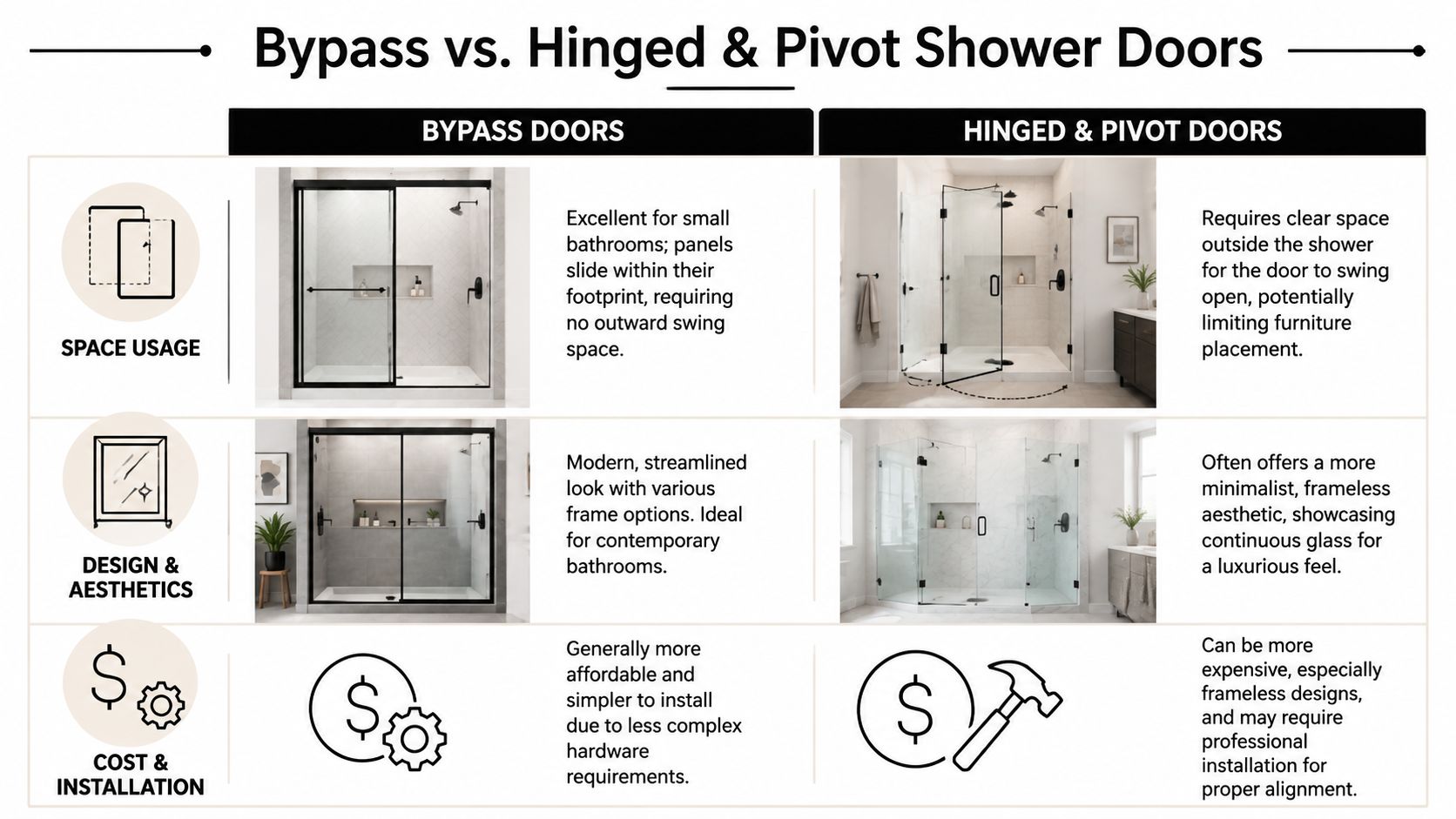
Here's a practical side-by-side view:
| Decision point | Bypass door | Hinged or pivot door |
|---|---|---|
| Space use | Stays within the enclosure footprint | Needs swing clearance outside the shower |
| Entry pattern | Access from either side depending on panel position | One main opening path |
| Cleaning | Track area needs attention | Fewer track-related cleaning points |
| Look | Can be modern, especially in frameless versions | Often reads more minimal in fully frameless applications |
A quick visual can help if you're weighing the options in a remodel:
What works in Southwest Florida bathrooms
In many local homes, especially condos and guest baths, the floor plan decides the answer before aesthetics do. If a hinged panel would open into a vanity corner, towel bar, or toilet clearance zone, it usually becomes a nuisance fast.
Bypass doors tend to be the practical winner in those rooms. Hinged and pivot doors tend to shine where the bathroom is open enough to let the glass swing without creating a traffic problem.
Design Installation and Material Insights
Good bypass doors are built on measurement and layout discipline. In Southwest Florida, I see the same trouble spots over and over: walls that are slightly out of plumb, curbs with uneven pitch, and tile work that looks straight until a level goes on it. A bypass system can handle a lot, but only if the opening is measured correctly and the hardware is selected for the actual conditions, not the showroom version of the opening.
That matters most in remodels. Alcove showers often look standard from across the room, yet the left wall may be off, the curb may hold water, or the tile build-out may pinch the panel overlap. Those details affect panel travel, water control, and how refined the finished installation feels.
What quality installation actually looks like
A clean install starts before the glass arrives. The opening needs to be checked for plumb, level, curb pitch, and enough backing where the hardware will land. If those checks are rushed, the installer usually has to force alignment later, and that is when sliding doors start to scrape, rattle, or leak at the wrong points.
In a properly installed bypass door, the panels move smoothly and stay on line. The guide is secure. The overlaps are consistent. The silicone at the curb and wall joints is neat and purposeful, because in our humid climate, sloppy sealing shows up fast.
Watch for these signs of careful workmanship:
- Even panel movement with no chatter, drag, or jump at the rollers
- Uniform gaps and reveals along both walls and where the panels overlap
- Straight, tight hardware placement that follows the tile lines instead of fighting them
- Clean silicone work at the curb and vertical joints, without skips, bubbles, or heavy smears
- Positive water control so spray stays in the shower and does not creep toward the bath floor
One more practical point. If the shower valve, drain location, or niche placement is still being sorted out, coordinate those decisions early. Expert plumbing for baths and kitchens can help keep fixture layout and enclosure planning aligned, which avoids awkward clearances and last-minute compromises.
Material choices that change the finished look
Glass choice has a bigger effect than many homeowners expect. Standard clear glass often carries a noticeable green cast, especially against white tile, light stone, and bright paint colors that are common in Southwest Florida homes. If the goal is a cleaner, lighter look, ultra-clear glass for frameless shower enclosures usually reads sharper and lets the tile and stone do the visual work.
Hardware finish deserves the same attention. Brushed finishes tend to hide spotting and fingerprints better, which matters in areas with hard water. Polished hardware can look excellent, but it asks for more upkeep to stay crisp. Matte black works in the right room, though it can feel too stark if the plumbing trim, lighting, and cabinet hardware are all pulling in a different direction.
AmeriGlass Industries offers custom frameless bypass options for Southwest Florida projects, including field measurement, glass selection, hardware choices, and installation. The difference shows up in the details. Panels fit the opening correctly, the sightlines are cleaner, and the door feels solid in daily use instead of loose after a few months.
Understanding Cost Maintenance and Long-Term Value
The first question is usually about price. The better question is what you're paying for.
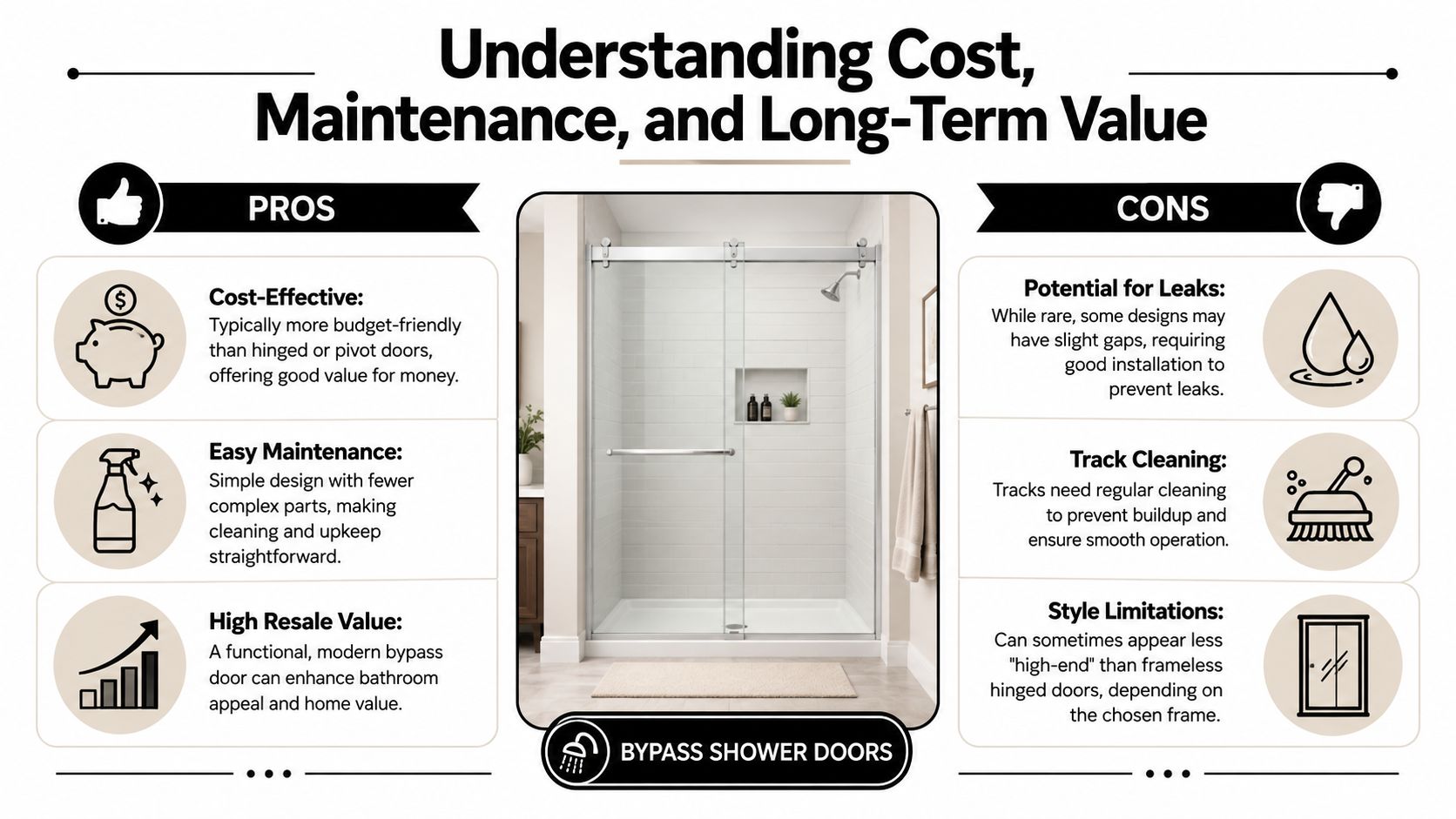
With bypass doors, cost is driven by the style category, the glass thickness, the hardware quality, the finish, and whether the opening is straightforward or custom. A framed unit and a heavier frameless unit may share the same basic sliding concept, but they won't look, feel, or age the same way. Since no verified pricing data is provided here, the most honest way to think about cost is by tier. Framed is usually the entry point, semi-frameless sits in the middle, and frameless lands at the premium end because the glass and hardware demands are higher.
What adds value and what only adds cost
Some upgrades improve daily use. Others are just line items.
The upgrades that usually earn their keep are:
- Better rollers and hardware because the door gets used every day
- Heavier glass in premium systems because the enclosure feels more stable and refined
- Protective glass coatings because they reduce the effort needed to keep glass looking clear
- Accurate custom fabrication because poor fit creates recurring service issues
In Southwest Florida, hard water is a real maintenance factor. It leaves mineral spotting, film, and edge buildup faster than many homeowners expect. That's one reason protective coatings are worth discussing. They don't eliminate cleaning, but they can make regular wipe-downs easier and help preserve clarity over time.
What maintenance actually matters
Bypass doors aren't high-maintenance, but they are not no-maintenance.
The track area needs periodic attention because soap residue, grit, and mineral deposits can build where the panels travel. If that buildup sits too long, the rollers don't move as cleanly and the system starts to feel rough.
A simple routine works best:
- Wipe glass after use if spotting is a recurring issue in your area
- Clean the guide and track area before residue hardens
- Check roller feel if the door starts sounding different or taking more force
- Address leaks early because water almost always tells you where the install or seal needs attention
The homeowners who stay happiest with bypass doors are usually the ones who treat cleaning as light routine care, not as a rescue project every few months.
If you're budgeting a larger renovation and trying to compare where bathroom dollars go overall, a broader planning resource like this luxury basement bathroom cost guide can help frame how enclosure choices fit into finish-level decisions across a project.
Long-term value comes from getting the basics right the first time. Good glass, good hardware, good measuring, and a layout that suits the room will outlast a cheaper enclosure that never really operated correctly.
Is a Bypass Door Right for Your SWFL Home
A bypass door is usually the right choice when the bathroom needs to stay functional without giving up a clean glass look. It works especially well in tub enclosures, alcove showers, guest baths, and floor plans where a swinging panel would constantly compete with nearby fixtures.
For Southwest Florida homeowners, the decision usually comes down to a short checklist.
It's a strong fit if these sound familiar
- Your bathroom is tight and you can't spare outward swing space
- You want glass instead of a curtain but don't want the room to feel cramped
- The shower opening is wide enough to benefit from a sliding format
- You prefer practical daily use over the drama of a large swinging panel
It may not be the best fit if these matter more
Some homeowners care most about the most minimal frameless appearance possible, or about having one broad, unobstructed opening path. In those cases, a hinged or pivot layout may suit the room better if the floor plan allows it.
Bypass doors also ask you to accept one reality. You'll need to keep the track and guide area reasonably clean. In Southwest Florida, with humidity and hard water in the mix, that's part of ownership.
For local homeowners comparing options for a remodel or replacement, seeing how frameless shower doors are installed in Fort Myers Beach homes can help clarify what style and configuration fit the space best.
A well-built bypass door should feel quiet, stable, and deliberate. If your bathroom has a tight layout, a standard alcove opening, or a tub enclosure that needs a cleaner finish, it's often the most sensible answer.
If you're in Naples, Fort Myers, Bonita Springs, or nearby Southwest Florida communities and want help deciding whether a bypass enclosure fits your bathroom, contact AmeriGlass Industries. A careful site measure and a practical conversation about layout, glass, hardware, and maintenance will tell you more than a showroom photo ever will.
Considering a bypass door? AmeriGlass Industries installs sliding, bypass and frameless shower doors across Naples, Fort Myers, Bonita Springs and Cape Coral. Call (239) 426-6884 for a free estimate.