

You clean the shower on Saturday, and by Tuesday the glass already looks tired again. In Southwest Florida, that's normal. Hard water leaves a white, chalky haze. Humidity keeps the enclosure damp longer. Soap, shampoo, body wash, and mineral residue build on each other until clear glass starts looking permanently cloudy.
That's why homeowners here ask about a water repellent for glass shower doors so often. In this climate, it isn't just about making glass easier to wipe down. It's about protecting a finish that can otherwise lose its clean, bright look far too quickly.
The Endless Battle with Hard Water Stains
In Naples, Fort Myers, Bonita Springs, and the rest of Southwest Florida, shower glass takes a beating every single day. A new frameless enclosure can look sharp at install, then start showing spotting almost immediately if the water is mineral-heavy and the bathroom stays damp after every shower. Most homeowners try the usual cycle first. Spray cleaner, scrub, rinse, repeat.
The problem is that hard water residue doesn't behave like simple dust or surface dirt. It dries onto the glass, mixes with soap scum, and starts creating that dull film you can see even when the door is technically “clean.” In high humidity, the enclosure doesn't get much recovery time between uses. The glass stays wet longer, and that gives minerals more opportunity to stick.
Homeowners who deal with well water in other parts of the country describe a similar headache. If you want a broader look at how mineral-heavy water affects household surfaces, this pool well water guide for Peoria gives useful context on what hard water can do beyond the shower.
Why scrubbing alone stops working
Initially, the thought turns to stronger cleaner and more elbow grease. That works for a while. Then the door starts looking etched, streaked, or uneven no matter how often it's wiped down.
Hard water doesn't just dirty the glass. It changes how the glass looks after repeated exposure.
That's the point where a protective treatment starts making sense. Not as a gimmick. Not as a luxury add-on. As a practical layer between your glass and the local water conditions that keep trying to mark it up.
What homeowners usually notice first
- The lower half clouds over fastest because water sits there longer after each shower.
- Door edges and corners collect residue where airflow is weaker and wiping is less consistent.
- Fresh cleaning never lasts because the next round of mineral deposits starts as soon as the glass gets wet again.
In Southwest Florida, untreated shower glass usually turns into a maintenance project. Treated glass is still glass, but it behaves differently, and that difference matters.
How Water Repellent Coatings Work
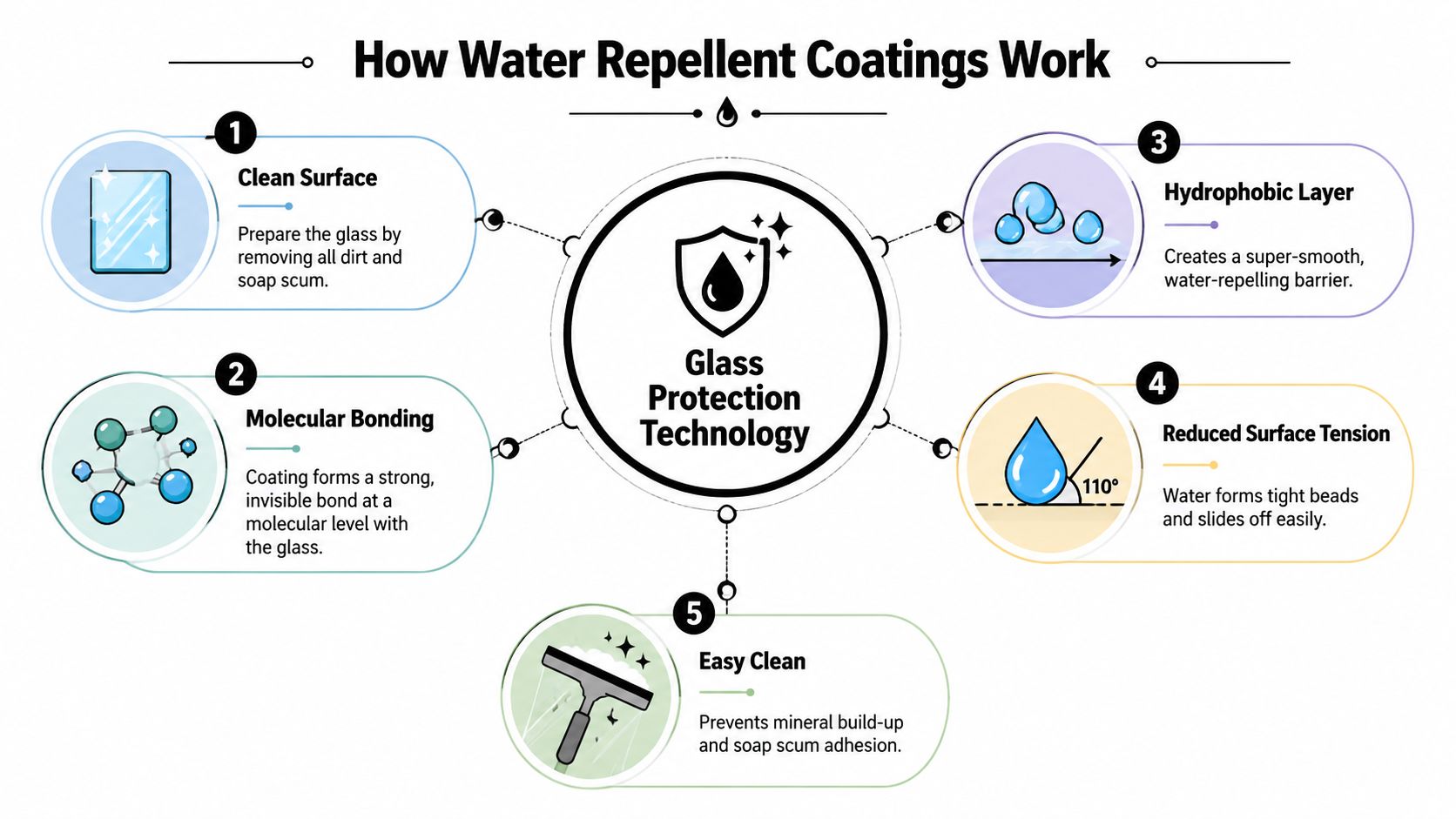
A good way to think about a glass coating is to compare it to a freshly waxed car hood. Water hits the surface, tightens into beads, and slides away instead of flattening out and lingering. That same principle is what makes a water repellent for glass shower doors effective.
These treatments are hydrophobic, which means they resist water. On shower glass, the coating reduces the surface tension of the glass to a nanoscale level so water droplets bead and roll off rather than spread out and cling. That matters because the minerals and soap residue in the water have less opportunity to dry onto the panel. According to this overview of hydrophobic coating performance, these coatings can minimize hard water stains and lime scale deposits by up to 90 percent in hard water conditions.
It's not just a film sitting on top
The better coatings don't act like a temporary layer of oily residue. They're designed to bond to the glass surface and create an ultra-thin, transparent barrier. That's why the glass still looks like glass. It doesn't turn hazy, tinted, or plastic-looking when it's done right.
If you're already comparing glass types for a shower project, it also helps to understand how clarity and protection work together on different materials. This look at ultra-clear glass options is useful if you want the cleanest possible appearance from the start.
What the coating changes in real use
Once the surface is treated, three things happen:
Water beads faster
Instead of creating broad sheets that dry slowly, water gathers into droplets.Residue has less grip
Soap scum, minerals, and grime sit higher on the surface, so they rinse away more easily.Routine cleaning gets lighter
You're usually wiping off what's left on top, not scrubbing bonded buildup out of the glass.
Practical rule: A coating doesn't stop water from hitting the door. It changes what happens after the water hits it.
That distinction matters. A shower coating is preventive, not magical. It reduces adhesion so the mineral load in Southwest Florida has a harder time turning clear glass into a permanent chore.
Comparing Your Water Repellent Options
Southwest Florida is hard on shower glass. Hard water dries fast, humidity keeps surfaces damp longer, and that combination gives mineral residue more chances to stick. The right water repellent is less about convenience here and more about slowing down a predictable wear pattern.
Some products buy you a little time. Others change the maintenance burden for years.
Water Repellent Treatment Comparison
| Attribute | DIY Sprays | DIY Kits | Professional Coatings (e.g., Diamond-Fusion) |
|---|---|---|---|
| Typical longevity | Reapplication every few weeks to months depending on product, usage, and water quality | Up to three years | Up to ten years |
| Application effort | Low per application, but repeated often | Moderate, with careful prep and more steps | Highest upfront, but handled by trained installers |
| Cleaning benefit | Noticeable at first, often drops off as product wears | Stronger than sprays | Longest-lasting reduction in residue adhesion and cleanup effort |
| Best fit | Budget-conscious homeowners who do not mind constant upkeep | Owners willing to prep carefully and maintain periodically | New shower installations and premium glass where long-term protection matters most |
DIY sprays give quick relief
Spray-on and wipe-on repellents are the easiest place to start. They go on fast, they are easy to find, and they usually improve water beading right away.
In this climate, that improvement often fades sooner than homeowners expect. Daily showers, mineral-heavy water, and persistent humidity wear down temporary products quickly. Once the surface loses that slick feel, spotting returns and routine cleaning gets heavier again.
That does not make sprays useless. They are a reasonable short-term option for a guest bath, a rental, or an older enclosure you are trying to maintain without putting much money into it.
DIY kits can work, but prep decides everything
A semi-permanent kit sits in the middle. It offers more staying power than a spray, but it also demands much more from the person applying it.
Prep is where these jobs succeed or fail. Any leftover soap film, hard water haze, or residue near the edges can interfere with bonding and leave the finish uneven. In Southwest Florida, where mineral deposits build fast, fully cleaning the glass before application is usually harder than it looks.
That is why reviews on DIY kits are all over the place. Two homeowners can use the same product and get very different results because one coated clean glass and the other coated over contamination.
Professional coatings are built for long-term use
Professional treatment makes the most sense when the shower itself is a long-term investment. On a frameless enclosure, clear glass is part of the look you paid for, and hard water can take that away faster than many owners realize.
As noted in DFI's explanation of shower glass protective coatings, professionally applied hydrophobic coatings can cut cleaning time substantially and last much longer than DIY options. That longer service life matters in Southwest Florida because the glass is under constant pressure from mineral-rich water and moist air, not just occasional use.
If you are comparing enclosure choices and protection at the same time, reviewing frameless shower and glass product options helps put the coating decision in context.
A cheaper product is only cheaper if you ignore reapplication, extra scrubbing, and the cost of letting hard water etching get worse.
For homeowners who want a quick improvement, sprays can do the job for a while. For homeowners who want lower maintenance and better long-term glass appearance in a Southwest Florida bathroom, professional coating is usually the better fit.
DIY Application Versus Professional Treatment
The DIY appeal is obvious. Buy a product, spend a weekend on it, and save money upfront. For some showers, that's a reasonable path.
But there's a difference between applying a product and getting a durable result on a piece of glass that's exposed to hard water every day.
What DIY usually underestimates
Most application failures happen before the coating step. The glass looks clean, but it still has embedded residue, cleaner film, silicone haze near the edges, or old mineral spotting that was never fully removed. Once a coating goes over contamination, it can lock that problem in visually and reduce performance.
DIY also demands a steady hand and a consistent process. Miss a section, overwork an area, or apply to glass that isn't fully prepped, and the result can become patchy. In a small guest bath, that may be acceptable. On a large frameless enclosure in a primary bath, it usually isn't.
Why professional treatment performs differently
Professional application isn't just about labor. It's about preparation standards, product handling, and accountability. Factory-applied and professionally applied systems are designed around consistency.
According to Basco's protective coating benchmarks, factory-applied hydrophobic treatments can prevent permanent etching and water stains by forming an invisible shield, and factory-applied versions such as AquaGlideXP carry a 10-year warranty. The same source notes that Clear-Fusion™ V requires no cure time and is ready for immediate use.
That kind of benchmark matters most on custom work, especially if you're protecting a high-visibility enclosure like a frameless shower door installation in Fort Myers Beach, where clarity and finish are a major part of the design.
If the shower glass is one of the focal points of the bathroom, the coating should be treated like part of the installation, not an afterthought.
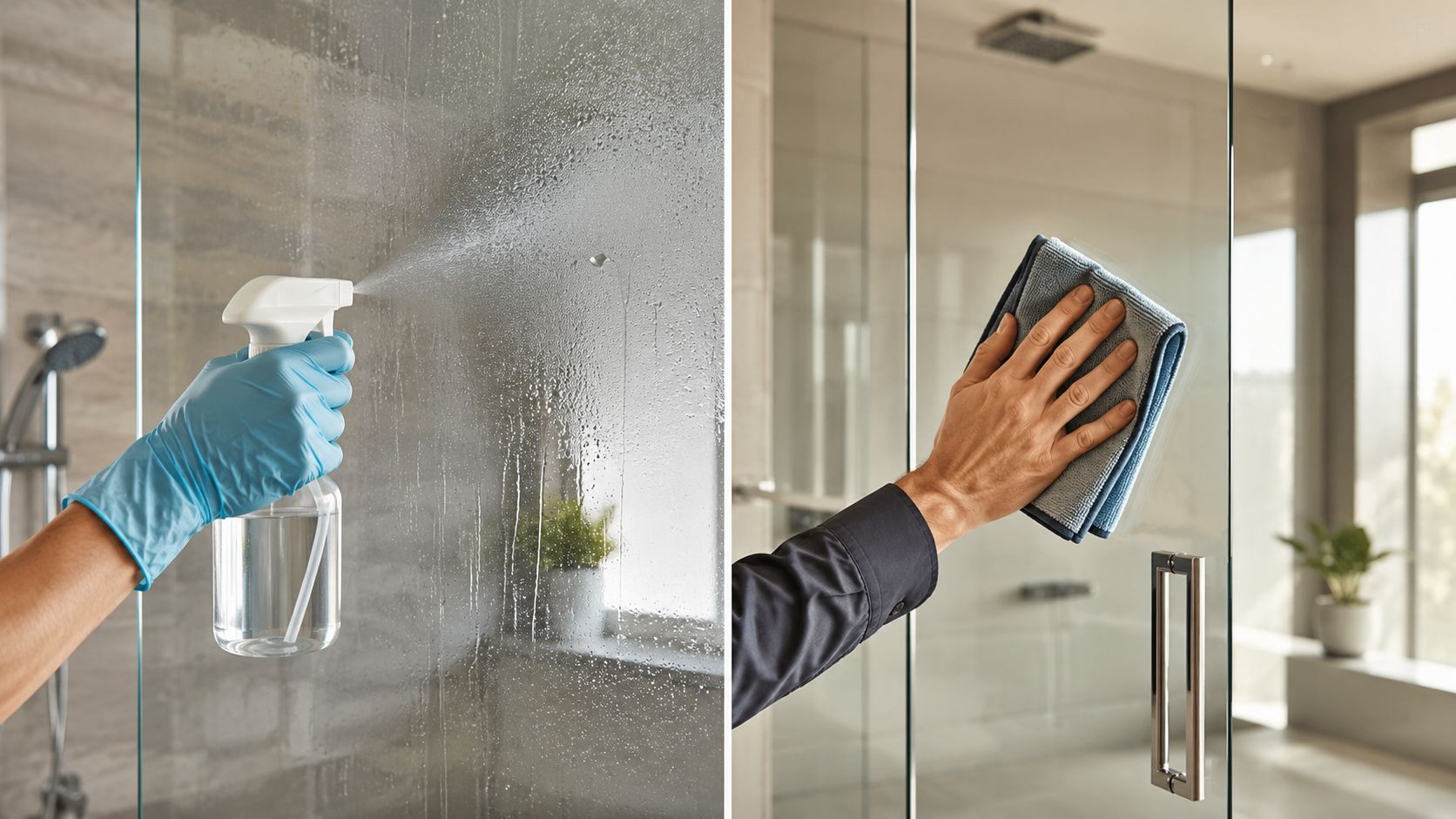
A quick visual helps show what proper care and protection are aiming to prevent over time.
When DIY makes sense and when it doesn't
- DIY is reasonable for older shower glass, secondary bathrooms, rentals, or homeowners who don't mind periodic reapplication.
- Professional treatment makes more sense on new frameless installations, custom glass, luxury bathrooms, and homes with persistent hard water spotting.
- Warranty matters when you want documented long-term protection rather than a best-effort maintenance routine.
If the goal is just “better than nothing,” DIY can get there. If the goal is clean-looking glass that stays easier to maintain in Southwest Florida conditions, professional treatment is the stronger choice.
Care and Maintenance in Southwest Florida
In Southwest Florida, shower glass starts collecting minerals almost as soon as the water dries. Add high humidity, limited airflow, and daily use, and even coated glass can haze over faster than many homeowners expect.
That does not mean the coating failed. It means the environment is doing what it always does here.
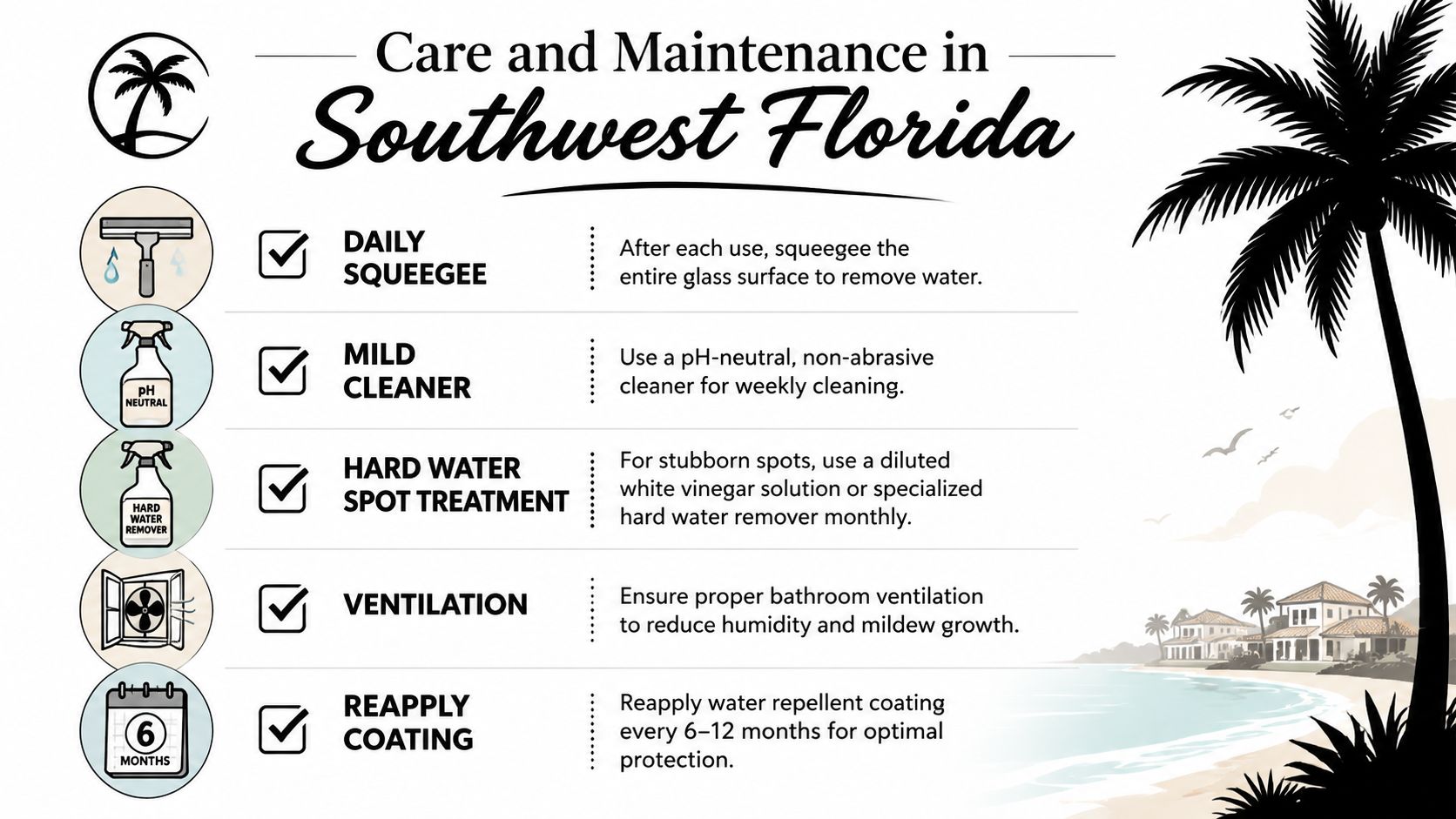
A water repellent treatment reduces how tightly minerals and soap residue stick to the glass. It still needs support from a simple routine. In this climate, the goal is to remove water before it sits long enough to leave a mineral outline or feed mildew around the edges.
The routine that works
The best routine is short enough to keep doing.
After each shower
Squeegee the full panel, including the bottom edge, corners, and around the handle area. Those are the spots that get missed and crust up first in hard water homes.Once the room settles
Wipe leftover droplets with a microfiber cloth, especially if the bathroom stays damp for hours after use.On cleaning day
Use a mild, non-abrasive cleaner made for finished glass surfaces. If you want lower-toxicity options, Fillaree's top bathroom cleaner picks are a good place to start.
In my experience, consistency matters more than intensity. A quick daily pass prevents the kind of buildup that later pushes people toward harsh scrubbing.
What shortens coating life
The biggest problems usually come from overcorrecting. Once spotting shows up, many homeowners reach for abrasive pads, powdered cleaners, or strong acids. That may strip off residue for the moment, but it also wears the coating down and can leave the glass looking dull.
Avoid these habits:
- Scrubbing with abrasive pads that can scratch the surface and wear protective treatments prematurely
- Using harsh chemical mixes unless the coating manufacturer specifically allows them
- Letting moisture sit in a closed bathroom with no fan, no window, and no drying step afterward
Ventilation matters more in Southwest Florida than it does in drier regions. If the room stays wet, residue stays active longer.
For homeowners who want a more detailed upkeep plan, this shower door maintenance resource lays out the basics clearly.
A coated shower door stays easier to clean when the maintenance is light and regular.
Why local conditions change the maintenance schedule
A homeowner in a dry climate can skip a few days and get away with it. In Southwest Florida, skipped upkeep shows up fast. Mineral spotting builds in layers, humidity slows evaporation, and the lower sections of the enclosure often stay damp long after the shower is over.
That is why these treatments are more than a cosmetic upgrade here. They buy time. They reduce labor. They help protect the clarity of the glass in a region that is hard on shower enclosures year-round.
Keep the routine simple, and the coating has a much better chance of doing its job for the long haul.
Is a Protective Coating Worth the Investment
For most Southwest Florida homeowners, the answer is yes if the shower glass matters to you visually and you don't want to fight it every week.
A protective coating adds cost upfront. According to Angi's cost overview for shower glass clear coatings, water repellent coatings typically increase the total cost of a shower door installation by about 30 percent, with an average added cost of about $500. The same source notes that base shower door costs range from $190 to $3,300, while installation spans from $160 to over $2,000 for custom setups.
Why the math works in hard water areas
In a mild water environment, some homeowners can postpone this decision and still keep the glass looking decent with regular effort. Southwest Florida isn't that kind of market. Here, the coating isn't just buying convenience. It's buying resistance against the local conditions that make shower glass age poorly.
The same Angi source explains that these coatings chemically bond to the glass, forming an ultra-thin transparent barrier that causes water to bead up and roll away instead of spreading. Users report easier maintenance, reduced cleaning time and frequency, and preserved clarity over the long term.
What you're really paying for
The dollars matter, but the bigger return is usually elsewhere:
- Less scrubbing because buildup has a harder time bonding to the surface
- Better appearance because clear glass stays clearer
- Protection of the enclosure itself because the glass is less vulnerable to permanent-looking residue problems
- Better daily use because the shower still looks finished instead of constantly halfway dirty
On a custom shower, the coating often costs far less than the frustration of watching beautiful glass lose its crisp look.
For homeowners spending real money on frameless glass, skipping protection can be a false economy. You save on the front end, then spend the next several years fighting the exact problem the coating was designed to reduce.
Frequently Asked Questions
Can a professional coating be applied to existing shower doors
Yes, if the glass can still be restored to a clean, stable surface.
The key issue isn't age alone. Condition decides the outcome. In Southwest Florida, I often see older shower doors covered with mineral scale, soap film, and early-stage etching from hard water sitting on the glass day after day in a humid bathroom. A coating can still help in many of these cases, but it will not hide damage that has already worked into the surface. The glass has to be cleaned and prepared properly first, and some doors will improve more than others.
If you want a clearer idea of what applies to your enclosure, this AmeriGlass FAQ page for shower glass questions answers the questions homeowners ask most often.
Will a coating make my glass look cloudy
No, not when the product is applied correctly.
A quality hydrophobic coating is clear. It should not make the glass look frosted, dull, or hazy. When a door looks cloudy after treatment, the usual cause is contamination left on the glass, poor prep work, or an uneven application. In trade terms, that is an installation problem, not a coating problem.
Does a coating mean I never have to clean the shower again
You still need to clean it.
What changes is the amount of effort required and how fast the glass starts looking worn. In Southwest Florida, hard water spots form quickly and humidity keeps surfaces wet longer, so no coating turns a shower into a zero-maintenance surface. The value is that residue releases more easily, routine wipe-downs go faster, and the glass is less likely to slide into that constant half-clean, half-spotted look.
Should builders and designers specify coatings from the start
For this region, that is usually the right call.
New glass gives you the best starting point, especially on frameless and custom enclosures where clarity is a big part of the finished look. Adding protection at the beginning is more predictable than trying to correct stain buildup after occupancy. It also helps set realistic maintenance expectations before the homeowner starts dealing with Southwest Florida water and humidity.
Will a coating affect project use right after installation
Sometimes, yes.
Some products are ready for normal use quickly. Others need a cure period or have specific care instructions for the first day or two. Confirm that before handoff. If the owner uses the shower too soon or cleans it with the wrong product right away, the finish may not perform the way it should.