

If you're staring at a shower door track that never looks clean, you're not alone. In Southwest Florida, that bottom channel becomes a magnet for soap residue, mildew, hard water deposits, and the rust-colored grime that shows up faster than expected in humid bathrooms.
Homeowners usually call it a cleaning problem. Installers see something else. It's a design problem.
A trackless shower door gets rid of the part that causes the most daily frustration. It also changes how the whole bathroom feels. The room looks more open, entry is easier, and the shower stops reading like a metal box dropped into a nice tile job. That matters in Naples, Fort Myers, Bonita Springs, and anywhere else people are investing in bathrooms that need to feel clean, bright, and current.
The End of the Ugly Shower Door Track
You can tell a lot about a shower by the bottom rail.
In older framed units, the track usually starts the same way. A little standing water. Then the corners darken. The metal loses its finish. The caulk stains. Someone scrubs it, gets part of it clean, and the next week it looks bad again.
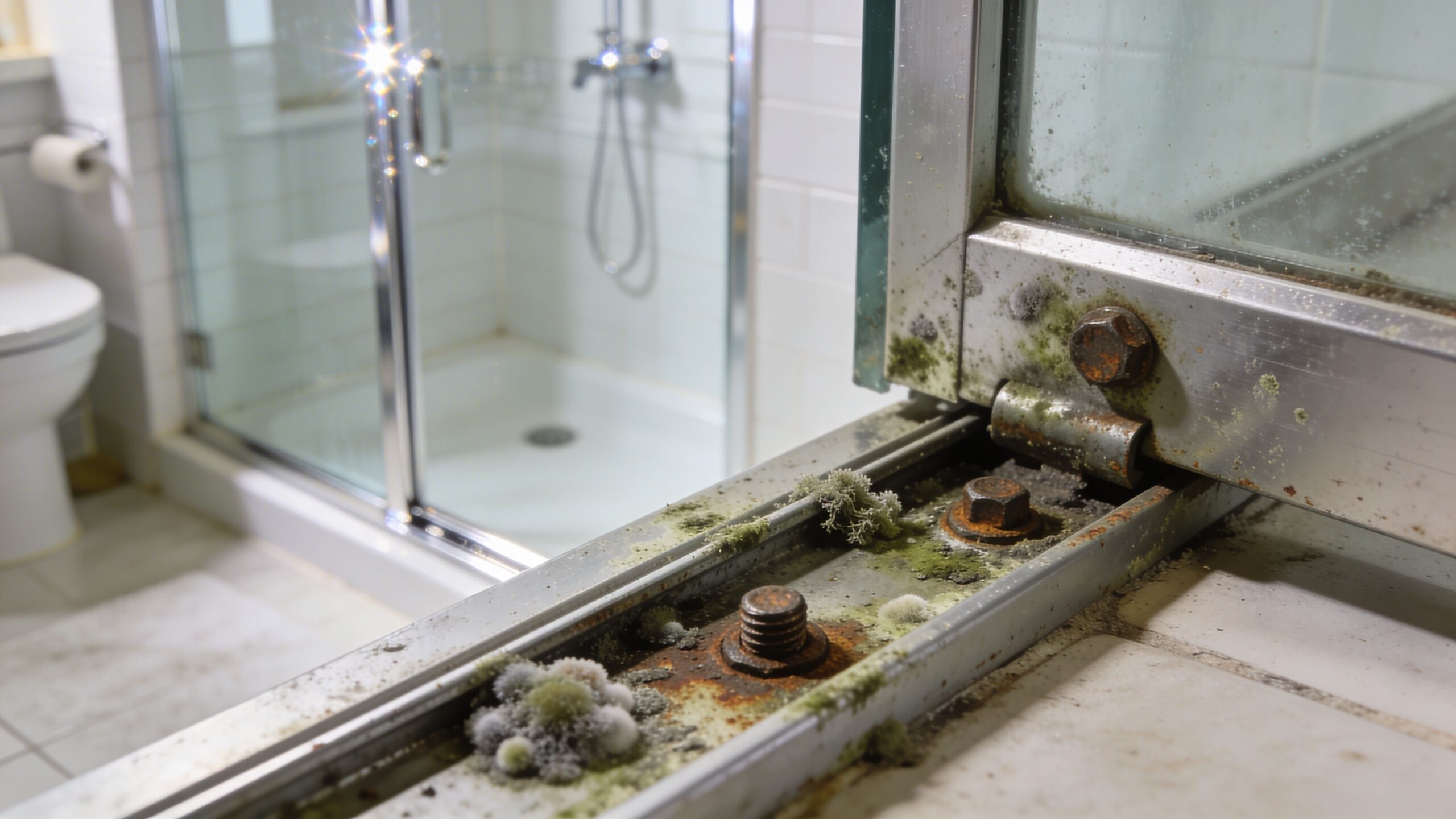
That cycle is why so many remodels now start with one sentence from the homeowner: “I never want to clean that track again.”
They're not being picky. They're reacting to a real weak point in traditional shower design. The bottom track catches everything your shower produces. Water. Soap. body oils. hair. Florida humidity doesn't help, and hard water leaves behind mineral film that clings to every edge and screw head.
A trackless layout fixes the issue at the source. Instead of trying to make the track easier to clean, it removes the bulky floor channel entirely. The shower looks sharper, but the bigger win is practical. There are fewer places for grime to hide.
The market has moved in that direction for a reason. The global frameless shower door market, which includes trackless designs, was valued at US$ 5.12 billion in 2024 and is projected to reach US$ 9.80 billion by 2033, according to this market analysis. Homeowners aren't just chasing a trend. They're choosing simpler maintenance and a more modern look.
Why the old track ages a bathroom fast
A dirty shower track pulls down the whole room. It doesn't matter if the tile is new or the fixtures are expensive. Your eye goes straight to the stained metal at floor level.
That becomes more obvious in high-end homes, where clean lines matter. In many Southwest Florida remodels, owners want the bathroom to feel lighter and more architectural. Heavy framing works against that.
A lot of people who don't want a full door also consider fixed glass panels and fixed splash guards. That's a smart option in the right layout, especially when you want a more open shower entry without the visual clutter of framed hardware.
Practical rule: If the part of the shower you clean the most is also the part you hate the most, it's time to question the design, not your cleaning routine.
What homeowners usually notice first
The first reaction is rarely technical. It's emotional.
The bathroom feels calmer. The glass reads cleaner. The tile becomes the feature again. Entry feels smoother because there's no bulky ridge underfoot reminding you that you're stepping into a dated enclosure.
For many homeowners, that change is enough to justify the upgrade before we even get into hardware, glass thickness, or installation details.
What Exactly Is a Trackless Shower Door
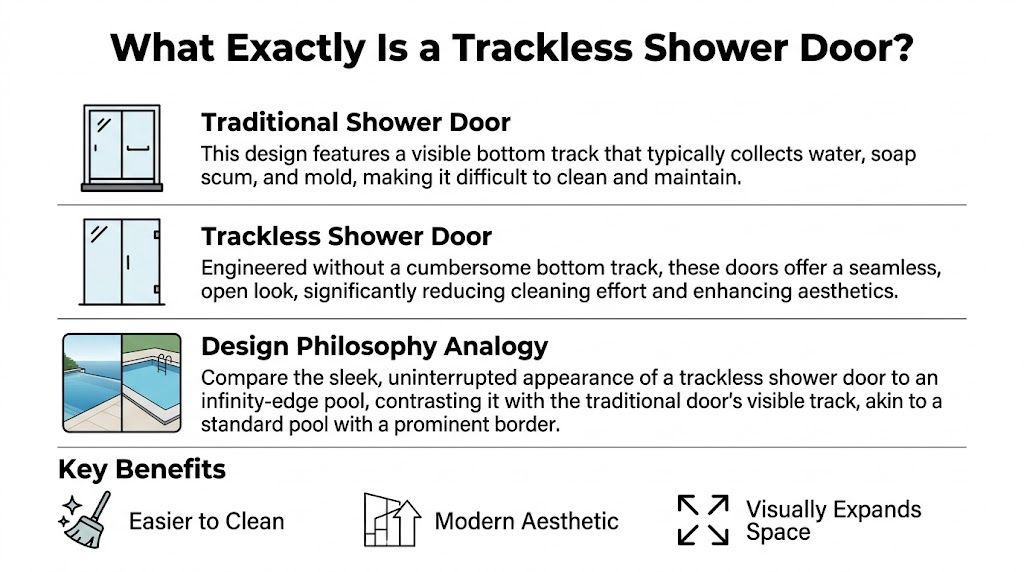
A trackless shower door is a shower enclosure designed without the full bottom track found on traditional framed sliders. The cleanest way to think about it is this. A trackless door is to a shower what an infinity-edge pool is to a backyard. You notice the uninterrupted line first.
Traditional shower doors rely on a visible metal channel at the base to guide the door and contain water. Trackless systems avoid that bulky floor hardware. Depending on the design, the door may swing on hinges, pivot from mounted hardware, or slide from an overhead support with only a minimal floor guide.
The side-by-side difference
The easiest comparison is between three categories.
| Type | What you see | What you live with |
|---|---|---|
| Framed door | Full metal perimeter and bottom track | More visual weight, more places for buildup |
| Semi-frameless door | Reduced metal, but still more structure than frameless | Cleaner look than framed, but still some maintenance points |
| Trackless shower door | Minimal hardware and no bulky bottom channel | Easier wipe-downs, more open look, simpler entry |
The practical advantage isn't subtle. Trackless and frameless shower doors can cut cleaning time by up to 50% compared to framed doors because they eliminate the tracks where 70% of grime and mildew accumulate, according to this shower door market summary. The same source notes that removing the raised threshold also removes a common tripping hazard.
Why homeowners call everything trackless
Such usage leads to confusion.
Some homeowners use “trackless” to mean “frameless.” Others use it to mean “no bottom rail.” In the trade, those aren't always the same thing. A frameless shower can still include some guide hardware. A true trackless hinged door has no full floor track. A near-trackless slider often has a small guide at the bottom to keep the panel aligned.
That's not a sales trick. It's just mechanics.
A good trackless shower door should disappear visually, but it should never hide how it actually works.
Why it feels more modern
Trackless design works because it removes interruption at eye level and floor level.
The glass doesn't get boxed in by metal. Tile lines stay visible. The shower floor reads as part of the room instead of a separate compartment. In smaller bathrooms, that visual continuity makes a noticeable difference.
A trackless setup also suits the kinds of bathrooms many Southwest Florida homeowners want now. Light stone, large-format tile, quieter hardware finishes, and open layouts all benefit from less metal around the enclosure.
If your goal is a bathroom that looks current for years, not just for this remodel cycle, this is the standard against which everything else is compared.
Exploring Your Trackless Design Options
Not every trackless shower door works the same way. The right choice depends on your opening, your swing clearance, who uses the bathroom, and how much true barrier-free access you want.
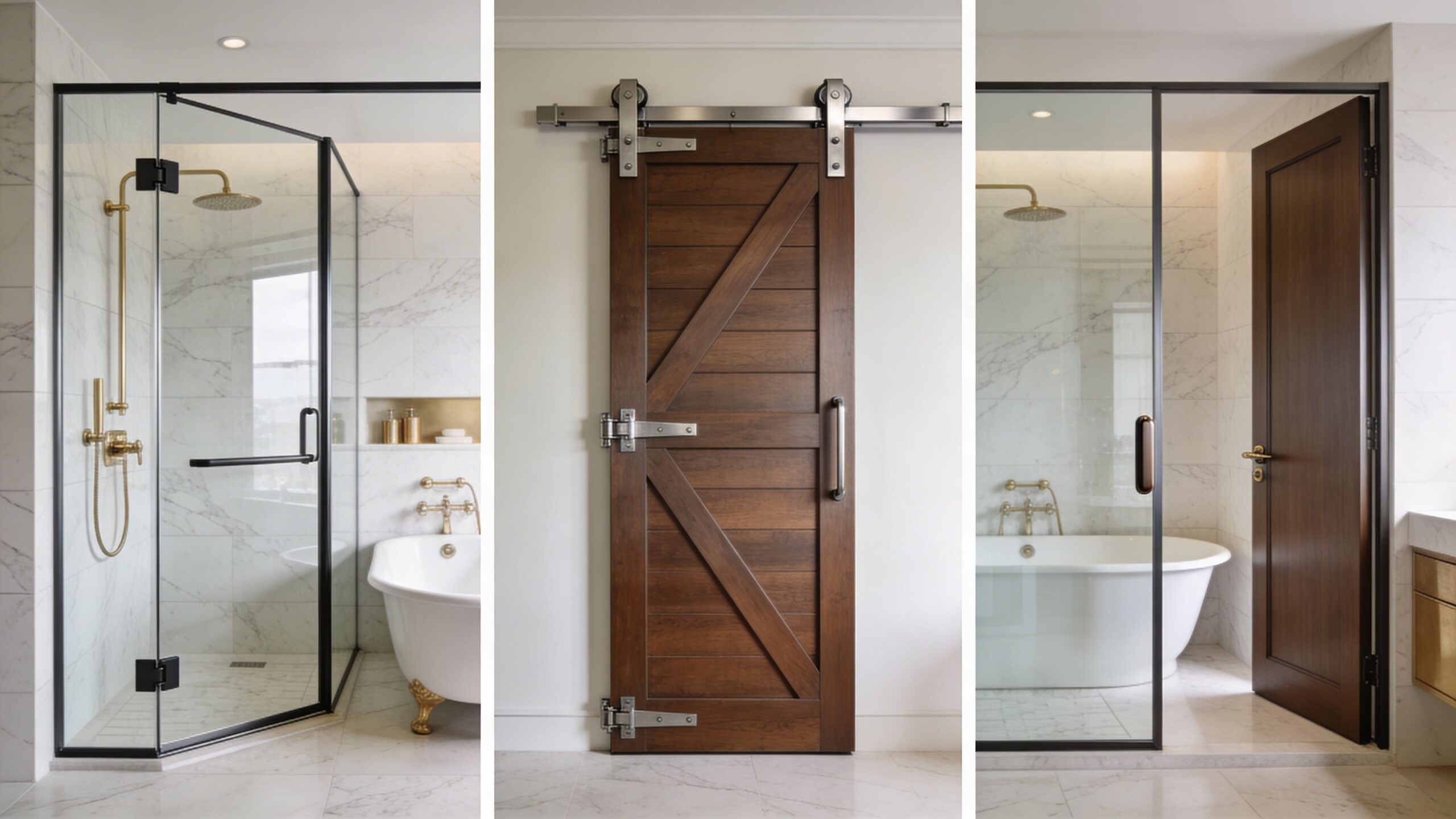
A lot of bad decisions happen when people shop by style name first. Barn-door look. Pivot look. Euro look. Those labels matter less than how the door moves in your actual room.
If you're still checking layout basics, a quick review of typical shower stall dimensions helps frame what will realistically fit without forcing the opening or crowding nearby fixtures.
Hinged and pivot doors
This is the purest version of trackless.
A hinged or pivoting glass door opens without a bottom track, which makes it the cleanest answer for homeowners who want the easiest floor transition and the least hardware. It also gives the widest unobstructed entry in many layouts.
These work best when you have enough clearance for the door to swing. In a roomy primary bath, that's often the best-looking option. In a compact guest bath with a vanity directly in front of the shower, it can become annoying fast.
Best fit
- Wide openings: Good when the entry isn't pinched by a toilet or vanity.
- Aging-in-place planning: Better for easier step-in access.
- Luxury tile work: Lets the tile stay visible without extra framing.
Watch for
- Swing path: The door can't hit a cabinet, light fixture, or person.
- Water direction: Showerhead placement matters more when there isn't a track acting as a catch point.
Top-hung sliding systems
This is the category that creates the most confusion.
Homeowners often ask for a “trackless slider.” What they usually mean is a sliding door with no bulky bottom rail. That does exist, but most sliding designs still use a small floor guide for stability. It's far less intrusive than an old framed track, but it isn't the same as a fully trackless hinged door.
That nuance matters most in accessibility planning. According to this discussion of trackless sliding shower door options, hinged doors are trackless, while most sliding options retain minimal floor guides. The same source notes that emerging heavy-duty top-hung roller systems have seen a 15% adoption rise in accessible remodels and can support over 300 lbs, making them a strong near-trackless option for zero-barrier showers when the floor is properly sloped.
That last part is not optional. The hardware can be excellent and the shower can still fail if the floor and drainage weren't planned for it.
A lot of homeowners like seeing how these systems operate before committing to a layout. This video gives a useful visual reference for modern sliding hardware in action.
Bi-fold and space-saving solutions
Bi-fold doors don't get enough attention.
When a bathroom is tight and a full swing isn't practical, a folding door can create a usable opening without demanding much clearance. These are often useful in guest baths, pool baths, and secondary bathrooms where every inch matters.
They're also worth considering for homeowners who want easier entry but don't have the wall room for a broad hinged panel.
Corner and angled layouts
Not every shower opening is straight across. In Southwest Florida homes, especially remodels, angled entries and tighter corners show up all the time.
For those spaces, a custom configuration is often smarter than trying to force a standard door type into an awkward footprint. A neo-angle shower door layout can solve entry issues cleanly when the shower is tucked into a corner and a standard hinged approach would crowd the room.
If you want true barrier-free access, start with the floor plan. The door choice comes second.
The best trackless system isn't the most expensive one. It's the one that matches the room, the users, and the way water will behave in that enclosure.
Customizing Your Glass and Hardware
Once the door style is set, the project shifts from mechanics to finish quality. These decisions determine if a trackless shower door looks intentional or like generic glass with random hardware attached.
The two decisions that matter most are the glass itself and the metal holding it together.
Glass thickness and feel
Homeowners often focus on whether they want clear or frosted glass. Installers focus first on thickness and weight, because that determines how the door behaves over time.
For professional-grade trackless systems, the benchmark is clear. These systems are engineered for 3/8-inch tempered safety glass, with doors typically not exceeding 34 inches in width or 127 lbs. Hardware in solid brass or 304 stainless steel is critical for smooth operation and durability, according to CRL's technical specifications.
That matters in the field. Heavy glass feels better because it is better. It swings with more control, vibrates less, and gives the enclosure a finished, architectural feel.
Here's how homeowners usually experience the difference:
| Choice | What it affects most |
|---|---|
| 3/8-inch glass | Strong balance of stability, appearance, and hardware compatibility |
| Clear glass | Keeps the room bright and shows off tile |
| Ultra-clear glass | Reduces the green cast common in standard glass edges |
| Privacy glass | Softens visibility, useful in shared bathrooms |
If you want the tile color to read accurately, especially with white, cream, or pale stone, ultra-clear glass is worth looking at. Standard clear glass often has a green edge that becomes more noticeable on thicker panels.
Hardware finish is not a minor detail
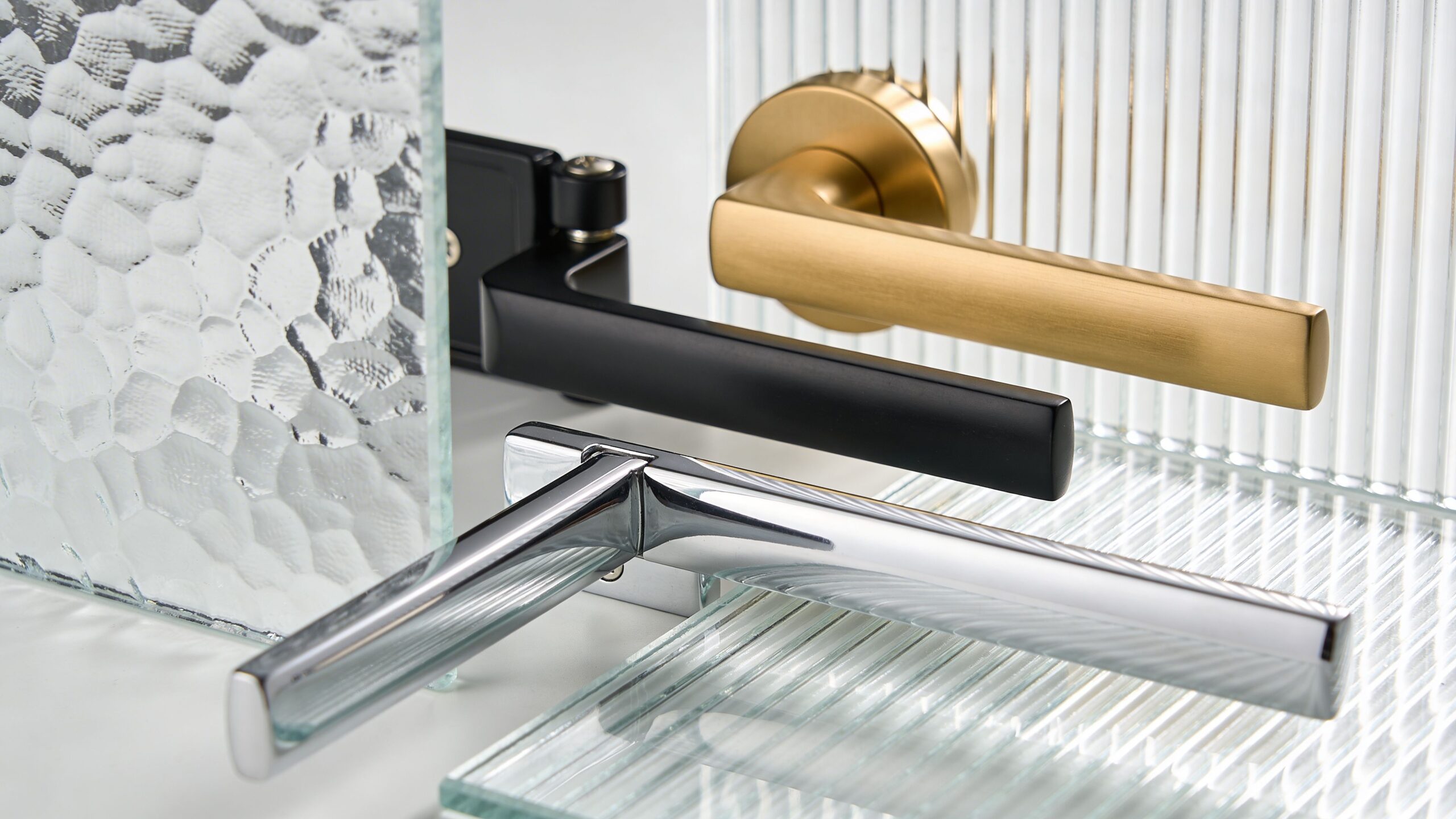
Hardware acts like the jewelry of the enclosure. It should connect to the rest of the bathroom, not compete with it.
Some combinations work almost every time:
- Brushed nickel: Forgiving, quiet, and easy to coordinate with common bath fixtures.
- Polished chrome: Crisp and bright, especially in cleaner contemporary spaces.
- Matte black: Strong contrast, best when the room already has black accents.
- Brass tones: Warmer look, often a good choice in softer, more layered bathrooms.
The mistake I see most often is mixing styles, not finishes. For example, a minimalist glass enclosure with ornate traditional handles can look off even if the metal color matches.
What works in Southwest Florida
Local conditions change the conversation.
Bathrooms here deal with humidity, frequent use, and water spotting that shows up quickly on both glass and metal. That makes durable finishes and good hardware materials more important than whatever looks best in a showroom photo.
Field note: If the hardware feels light in your hand or the finish looks thin on a sample, it won't age well in a high-moisture bathroom.
This is also why custom isn't just about appearance. Good customization means choosing glass and hardware that fit the room visually and hold up to how the room is used.
Why Professional Installation Is Not Optional
A trackless shower door looks simple when it's finished. That's why homeowners underestimate the install.
What you're seeing is the end result of accurate measurements, proper wall anchoring, level and plumb correction, gap management, hardware selection, and water control. If any of those are off, the enclosure tells on itself right away.
The problems show up fast
A poor installation usually fails in one of four ways.
- The door doesn't close cleanly: That often means the opening wasn't measured correctly or the walls weren't accounted for.
- Water escapes at the edges: Seals, sweep placement, curb pitch, and showerhead direction all matter.
- The glass feels unstable: That points to bad anchoring or the wrong hardware for the weight.
- Metal corrodes or stains early: Cheap components and poor material selection show up quickly in humid bathrooms.
Most homeowners don't notice out-of-plumb walls until a rigid glass panel is introduced. Tile can look straight and still be off enough to create binding, uneven gaps, or a door that slowly drifts.
Site conditions matter more than the door
The enclosure can only perform as well as the opening allows.
Before a trackless system goes in, a pro should verify that the mounting surfaces are solid, the curb or threshold is correct, and the finished opening has been measured exactly as built, not as drawn. Remodel bathrooms are rarely perfect squares. Older homes are even less forgiving.
Here, DIY enthusiasm often clashes with physics. Heavy tempered glass doesn't flex to hide mistakes. It exposes them.
| Installation issue | What it causes |
|---|---|
| Weak wall backing | Loose hinges or unsafe mounting |
| Out-of-level curb | Uneven door gaps and leak paths |
| Bad silicone work | Hidden water intrusion |
| Inaccurate measuring | Delays, re-fabrication, or poor fit |
A shower door is not trim carpentry. You don't shave glass in the field to make a bad measurement work.
The finish depends on the process
A well-installed trackless shower door feels effortless. The door lines up, the gaps are consistent, the hardware sits square, and the water stays where it belongs.
That doesn't happen by luck. It comes from disciplined measurement and experienced installation. If you're comparing options, it's smart to review a professional design and measurement process before the order is placed. A custom planning tool like design your shower door helps homeowners think through glass, configuration, and hardware decisions before fabrication starts.
The best install is the one nobody notices after day one. The door just works.
Ensuring Lasting Clarity and Easy Maintenance
A trackless shower door solves the biggest cleaning problem at floor level. It doesn't make the glass maintenance-free.
In Southwest Florida, the long-term enemy is hard water combined with humidity. Water dries on the glass, minerals stay behind, and repeated buildup can leave the surface looking cloudy if it isn't protected or maintained properly.
Why coatings matter
Hydrophobic protection proves its value here.
According to this overview of protective benefits for trackless enclosures, trackless enclosures with a hydrophobic coating like Diamond-Fusion reduce cleaning time by 40% over 5 years, resist 99% of water spots, cut mildew risk by 25% in humid climates, and can help the door's lifespan exceed 15 years.
Those numbers line up with what installers see in real bathrooms. Coated glass sheds water better. Residue doesn't grip the surface as aggressively. Routine cleaning stays routine instead of turning into restoration.
What maintenance should actually look like
A good maintenance plan is simple.
- Wipe the glass regularly: A soft cloth or squeegee keeps minerals from drying in place.
- Use mild cleaners: Harsh abrasives can damage glass coatings and hardware finishes.
- Keep seals clean: Bottom sweeps and vertical seals work better when residue isn't building on them.
- Check ventilation: Good airflow helps the whole enclosure dry faster.
If you've already dealt with stubborn mineral buildup on other glass in your home, professional cleaners use similar principles when explaining how to get water spots off windows. The same basic issue applies in shower glass. Prevention is easier than correction.
What doesn't work well
The worst approach is waiting until the glass looks permanently dull, then attacking it with aggressive cleaners and rough pads. That often damages finishes without fully solving the problem.
Untreated glass can still look good for years if it's cared for consistently. But in coastal and humid environments, protection is one of the few upgrades that keeps paying you back after installation.
Clean glass is mostly a habit problem. Clear glass that stays clear for years is usually a coating and maintenance problem.
For homeowners who want to preserve the look, proper care instructions matter as much as the enclosure itself. A practical reference point is a dedicated shower door maintenance guide that covers daily care, cleaner selection, and what to avoid on coated glass.
Your Local Expert for Trackless Showers in Southwest Florida
A trackless shower door is one of those upgrades that looks simple from across the room and gets complicated the moment real conditions enter the job. Humidity, salt air, hard water, custom tile, older walls, tight clearances, and barrier-free planning all change what will work.
That's why local experience matters.
A big-box approach usually treats the door as a product. In Southwest Florida, it needs to be treated as a custom glass installation tied to the room, the climate, and the people using it. Naples and Fort Myers homes often have design expectations that leave very little room for clumsy hardware, uneven reveals, or generic layouts.
The right local glass team understands that a beautiful enclosure still has to manage water correctly in a humid environment. They also know that many homeowners are planning beyond style. They're thinking about aging in place, easier maintenance, safer entry, and how the bathroom will hold up over time.
For builders, designers, and property managers, that local knowledge matters just as much. Scheduling, insurance, measurement accuracy, and clean jobsite practices are not extras. They're part of whether the project stays smooth.
What to look for in a local installer
Choose a company that can show more than product photos.
Look for:
- Licensed and insured crews: Heavy glass work needs real accountability.
- Custom measurement capability: Standard openings are rare in remodels.
- Knowledge of local conditions: Humidity and mineral-heavy water affect both design and maintenance choices.
- Finish options that fit the home: High-end bathrooms need coordinated hardware and glass choices.
- Clear communication: Homeowners and contractors should know exactly what is being ordered and installed.
The best local specialist doesn't just install glass. They help prevent the common problems that make shower doors disappointing after the first few months.
If you're investing in a trackless shower door in Southwest Florida, the finish line isn't getting glass on the wall. It's getting a door that looks right, works right, and still feels like the right decision years later.
Frequently Asked Questions About Trackless Doors
Are all frameless shower doors trackless
No. Many frameless doors are trackless at the bottom, especially hinged and pivot designs. Some frameless sliding systems still use a small floor guide for stability. Frameless and trackless overlap, but they aren't always identical.
Do trackless shower doors leak more
Not when they're designed and installed correctly.
A trackless shower door controls water through proper panel sizing, door sweeps, seals, threshold design, and smart showerhead placement. Most leak complaints come from layout mistakes, bad measurements, or poor installation, not from the idea of trackless design itself.
Are sliding trackless doors a good idea for accessibility
Sometimes. It depends on what “trackless” means in the specific system.
True trackless access is easiest with hinged or pivot doors because there is no bottom track. Near-trackless sliding systems can still be a strong choice where swing clearance is limited, but they usually include a minimal guide and require careful floor planning.
Can a trackless shower door work in a small bathroom
Yes. Some of the best applications are in smaller bathrooms because less metal helps the room feel more open.
The catch is door motion. A hinged panel needs swing space. In a tight bath, a top-hung slider or bi-fold configuration may make more sense than a full swing door.
What glass should I choose
Most homeowners do well with clear 3/8-inch tempered glass and quality hardware. If you want the cleanest, brightest appearance, low-iron glass is a strong upgrade. If privacy matters more, textured or obscured glass may be the better fit.
Is a protective coating worth it
In Southwest Florida, yes.
Humidity and hard water make glass harder to keep spotless over time. A hydrophobic coating helps water sheet off, reduces spotting, and lowers cleaning effort. For many homeowners, it's one of the smartest upgrades in the whole enclosure.
Can you install a trackless shower door on a tub
Sometimes, but tub applications are more limiting than walk-in showers.
The wall conditions, tub deck, and opening width all matter. Some tub setups are better served by other door styles, especially if the walls aren't straight or the mounting conditions aren't ideal.
How do I know if my shower opening is suitable
A real answer requires field measurement.
The installer needs to check plumb, level, backing, tile finish, curb condition, and clearance around the opening. Two showers with the same rough size can need very different solutions once those details are measured.
If you're ready to plan a trackless shower door that fits your bathroom, your layout, and Southwest Florida conditions, talk with AmeriGlass Industries. They provide free estimates, custom measurement, licensed and insured installation, and expert guidance for frameless shower doors, ultra-clear glass, and low-maintenance protective coatings throughout Naples, Fort Myers, Bonita Springs, and the surrounding area.
Want a trackless door? AmeriGlass Industries designs and installs track-free frameless shower doors across Naples, Fort Myers, Bonita Springs and Cape Coral. Call (239) 426-6884 for a free estimate.