

You're probably looking at a beautiful idea right now. A frameless shower that disappears into the tile. A glass railing that keeps the Gulf view open. A custom wine enclosure that feels crisp, quiet, and architectural.
Attention often goes to the big visual choices first. Clear or ultra-clear glass. Heavy hardware or minimal hardware. Matte black, brushed brass, or polished chrome. Then the fabrication starts, and one of the most important decisions is sitting in plain sight the whole time. The edge.
That clear, refined line around the perimeter of the glass tells you a lot about the piece before anyone says a word. It tells you whether the fabricator treated the glass like a finished architectural material or like a cut panel that just needed to get out the door. In Southwest Florida, where humidity, salt air, hard water, and strong light expose every shortcut, that edge matters even more.
The Unseen Detail That Defines Luxury Glass
A client in Naples might spend weeks selecting porcelain slab, fixtures, lighting, and stone, then assume the glass will "look clean" once it's installed. That's understandable. On a finished shower or railing, the eye reads the whole composition first.
But when the work is done well, your eye lands on the edge almost immediately.
A luxury installation has a certain calm to it. The line is straight. The corners feel intentional. Light passes through the glass without drawing attention to chips, haze, or roughness. That's one reason architects and designers put so much weight on material detailing. Resources like Invilla Architecture speak to that larger truth in luxury homes. The smallest visible surfaces often decide whether a room feels custom or merely expensive.
The glass edge is one of those surfaces.
In a frameless shower, you touch it every day. On a stair or lanai railing, you see it against sunlight and water. On a partition, mirror, or wine room, the edge becomes part of the design language. It's not trim. It's the finish itself.
A polished glass edge should feel resolved, not just smooth.
There's another layer that most homeowners never get told. The edge isn't only about appearance. In tempered glass edge finishing, the finish you choose affects how the glass is prepared before heat treatment, and that directly affects strength and reliability. The pretty edge you see at the end is the visible result of a much more serious fabrication decision made early in the process.
That's also why luxury and performance usually travel together. If you're thinking broadly about how refined materials change a home's feel, this look at luxury glass design choices in the home gives useful context. Good glass doesn't just fill an opening. It sharpens the whole room.
The Anatomy of a Perfect Glass Edge
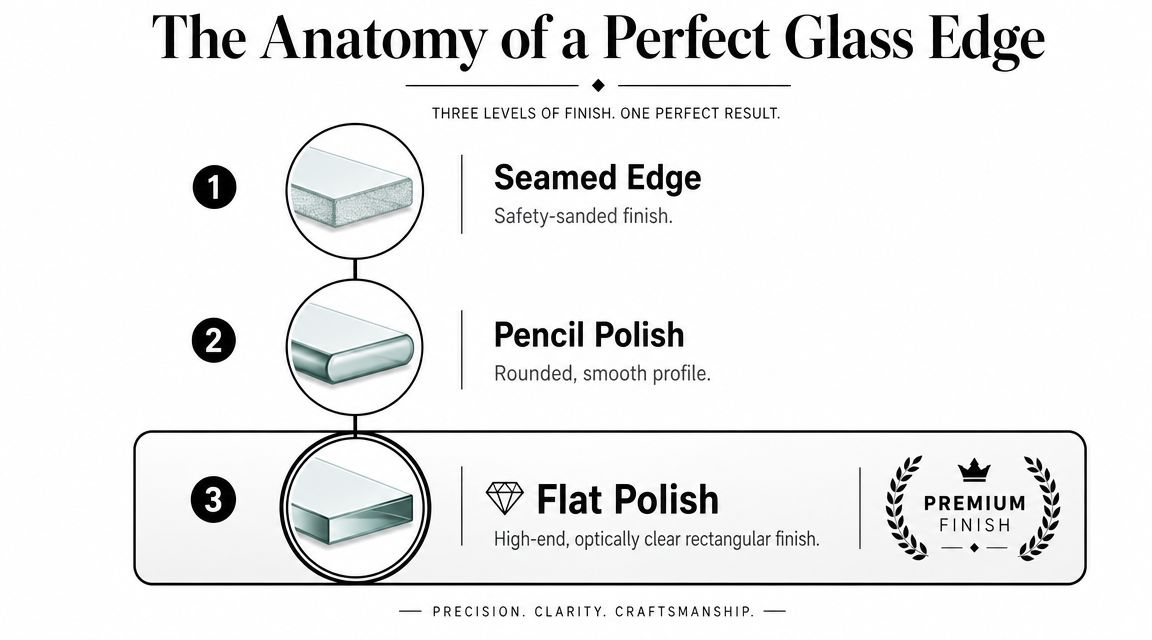
Before choosing a finish, it helps to know what each profile looks and feels like in daily use. Clients often use the word “polished” as a catch-all, but several edge styles fall under that broad idea, and they don't read the same once installed.
Seamed edge
A seamed edge is the basic safety prep. This process removes the dangerous sharpness from a freshly cut edge, similar to sanding the splinters off a board, but it isn't meant to be admired.
If the glass will disappear into a frame or channel, a seamed edge can be perfectly appropriate. If the edge will remain exposed, it usually looks unfinished.
Flat polish
A flat polished edge has the clean, crisp feel often associated with high-end architectural glass. It's the diamond-facet option. Straight, bright, and deliberate.
This is often the right choice when you want the edge to visually disappear by being perfectly consistent. It works especially well in contemporary showers, partitions, and shelving, especially with ultra-clear glass applications where edge clarity becomes part of the aesthetic.
Pencil polish
A pencil polished edge softens the perimeter into a rounded profile. It feels more like a smooth river stone than a faceted crystal. You still get a refined finish, but with less visual sharpness.
That softer profile can work beautifully in traditional interiors, family spaces, and pieces where a rounded touch feels more inviting.
Beveled and cushion edges
A beveled edge is decorative by nature. It creates a framed effect along the perimeter and catches light differently than a straight polish. It's common in mirrors and feature pieces where you want the edge to announce itself.
A cushion edge sits somewhere between crisp and soft. It's eased, comfortable, and subtle. Not every project calls for it, but in the right setting it can read as well-suited without feeling stark.
Tempered Glass Edge Finish Comparison
| Finish Type | Aesthetic | Best For | Relative Cost |
|---|---|---|---|
| Seamed | Functional, minimal, not display-oriented | Framed glass, concealed edges | Lower |
| Pencil Polish | Soft, rounded, approachable | Exposed edges with a gentler look | Moderate |
| Flat Polish | Crisp, modern, optically clean | Frameless showers, partitions, railings | Higher |
| Beveled | Decorative, light-catching | Mirrors, accent panels | Higher |
| Cushion | Subtle, eased, tailored | Select exposed-edge custom work | Moderate to higher |
Selection rule: If the edge will be seen, touched, or lit from the side, treat the edge as a design surface, not an afterthought.
Why Edge Finishing Is a Critical Safety Process
A lot of glass content treats edge finishing like a style upgrade. In practice, that's the wrong way to think about it.
For tempered glass, the edge is part of the safety story from the beginning.
What tempering does to glass
Tempering heats glass to a very high temperature, then cools it rapidly so the outer surfaces go into compression while the core remains in tension. That stress pattern is what gives tempered glass its safety behavior and improved performance in demanding applications.
It also means the glass has to enter the furnace in the right condition.
Any tiny edge damage from cutting can become a serious weakness once heat treatment begins. Those micro-flaws don't disappear just because the panel gets tempered. If anything, they become more consequential. That's why edge grinding and polishing aren't cosmetic extras for exposed tempered glass. They're part of responsible fabrication.
Industry guidance tied to ASTM C1048 states that exposed-edge heat-treated glass should be polished before tempering, because the polished edge is the final visible finish for monolithic tempered glass and helps reduce edge flaws that can act as crack initiators, as outlined in this Glass Association guidance on edge grinding and heat-treated glass.
Why the order of operations matters
The sequence matters more than many buyers realize. Glass is typically cut first, then ground and polished, then tempered. That order isn't just tidy shop logic. It's what helps remove cutting damage before the panel goes through the stress of heat treatment.
If you're specifying a frameless enclosure, this is one reason a proper frameless shower door installation in Fort Myers depends on more than measurements and hardware. The quality was decided upstream, at the fabrication stage, long before the panel reached the bathroom.
Edge quality changes performance
One of the most useful technical findings in this area is that pre-temper heat treatment can heal edge flaws enough to materially improve minimum edge strength. In a 2020 AIS Glass paper, slow heat treatment at about 630°C was reported to run at roughly 0.07°C/sec versus 5.1°C/sec for industrial tempering, yet it still improved minimum edge strength by 19% for Sandbelt edges, 61% for Twin Seam edges, and 76% for Twin Cut at 12 m/min edges. The same paper noted that 660°C produced further gains, but also warned that higher temperature can harm optical quality because glass may deform between rollers, as detailed in the AIS Glass paper on edge flaw healing before tempering.
That matters because it confirms something fabricators have seen for years. The edge isn't passive. The condition of that edge changes how the glass behaves.
The best-looking edge is often the byproduct of the safest process, provided the shop controls heat, handling, and finishing correctly.
What doesn't work
What doesn't work is treating exposed tempered glass as if edge finishing can be casual. A rough edge may pass a quick visual check in the shop, then look poor in daylight, feel wrong to the touch, and carry unnecessary risk into service.
It also doesn't work to think “tempered” automatically fixes everything. Tempering is not a rescue plan for bad edgework. It's a process that demands good edgework.
Matching the Right Finish to Your Project
Different projects ask different things from the glass edge. A shower needs daily cleanability and a refined touch. A railing needs visual discipline across multiple panels. A wine enclosure needs edge clarity because the glass is part display case, part architecture.
Frameless showers
For most frameless showers, a flat polished edge is the strongest aesthetic answer. It gives you a straight, clean perimeter that aligns with modern tile work and quality hardware. It also feels finished in the hand and reads well in strong Florida light.
A polished edge matters in use, not just on install day. In a coastal home, hard water spotting and soap residue have a way of finding every irregularity. A cleaner, more uniform edge is easier to live with. If you're planning dimensions and layout, a custom shower door design guide helps tie the edge choice back to hinges, clips, and sightlines.
Railings and stair glass
Railings demand discipline. The edge is at eye level, often backlit, and often repeated panel after panel. Any inconsistency stands out.
For exposed-edge railing glass, polished edges usually make the most sense because they combine touch comfort with a cleaner visual line. In Southwest Florida, where salt air is relentless, you want a finish that doesn't look raw or incomplete after a season of bright sun and airborne moisture.
There's a practical laminated-glass issue here too. Even with high-quality edgework and heat treatment, laminated glass for railings can have up to a 1/8" mismatch between plies, which is why tight fabrication tolerances matter so much for an exposed edge, as noted in Viracon's edgework guidance for laminated and exposed-edge assemblies.
Mirrors and feature glass
Mirrors often benefit from a different attitude. A bevel can be elegant when the goal is a more decorative, furniture-like look. In powder rooms, dressing areas, and formal interiors, that prismatic perimeter can add just enough detail without adding bulk.
If the room is cleaner and more contemporary, a flat polish usually wins. It keeps the mirror from feeling dated and lets the surrounding finishes carry more of the design.
Wine rooms and partitions
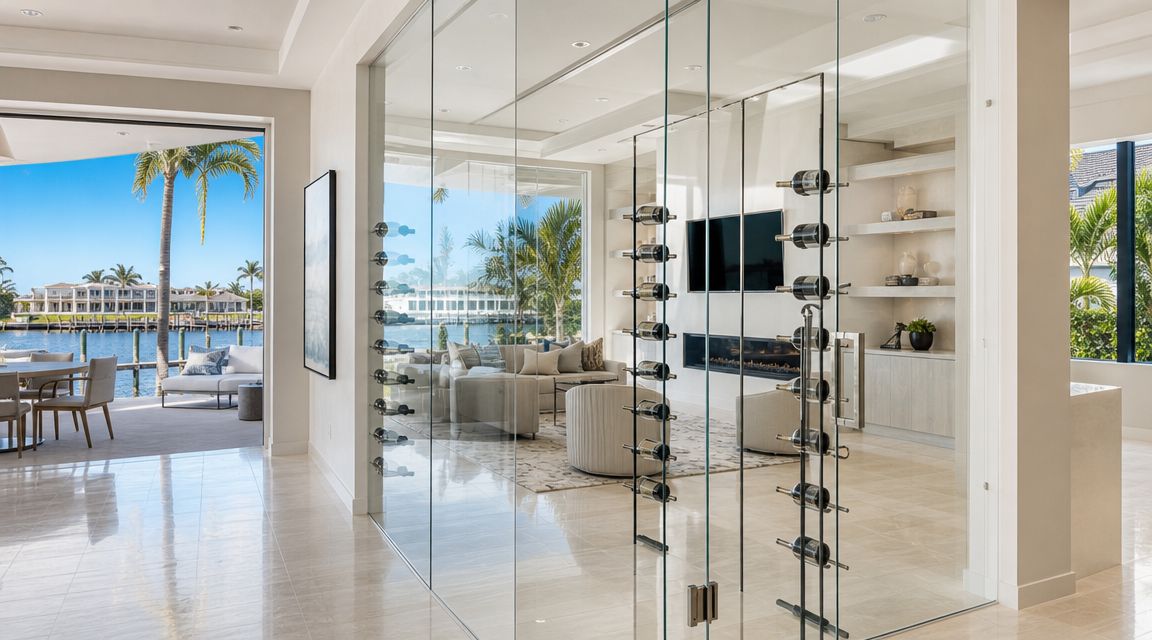
Wine enclosures, office partitions, and interior dividers usually look best when the edge supports the architecture rather than competing with it. A flat polish gives the strongest minimal line. A pencil polish can soften things if the surrounding design has warmer or more traditional cues.
For these projects, the question isn't just “Which edge looks best?” It's “Which edge disappears into the room while still holding up under inspection?” In premium work, that's the better standard.
Comparing Finishes on Aesthetics Cost and Maintenance
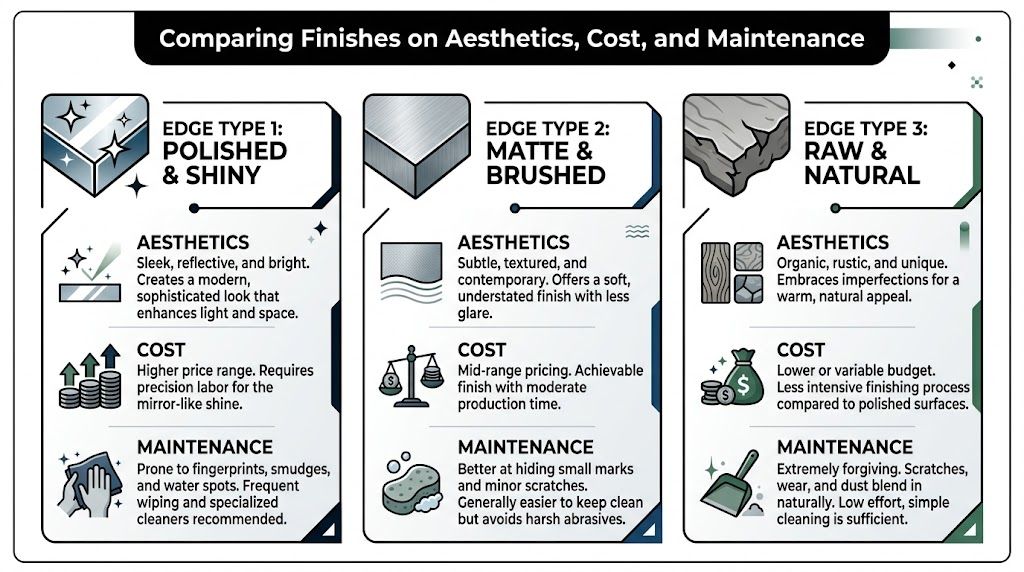
The finish decision usually comes down to three things. How it looks, what it costs to fabricate well, and how much work it creates later.
Aesthetics
A flat polish gives the most architectural look. It reads sharp, straight, and deliberate. If your home leans modern, coastal contemporary, or minimalist, this finish usually feels the most aligned with the rest of the design.
A pencil polish is softer. It's still refined, but less severe. That can be the right answer where you want exposed edges that feel gentle and approachable.
A seamed edge is rarely the finish you choose for beauty. It's the finish you accept when the edge won't be seen.
Cost
A better edge costs more because it asks more from the shop. More precise machinery. More passes. More inspection. More skill at corners and consistency.
That's not a markup for appearance alone. It's the price of getting the line right.
Consider a practical perspective on this process:
- Lower fabrication effort usually means seamed edges for concealed applications.
- Moderate effort often points to pencil polish where you want an exposed but softer profile.
- Higher effort tends to mean flat polish or bevel work where visual precision is part of the final result.
Maintenance
Maintenance is where polished work pays back over time. A well-polished edge is smoother and easier to wipe clean than a rougher, less refined finish. In bathrooms, that matters. In humid coastal homes, it matters even more.
If the glass also carries a protective treatment, surface preparation becomes part of the long game. Clean, properly finished glass gives coatings a better foundation than a poorly prepared panel. For homeowners who want less scrubbing and fewer water marks, routine care still matters, and a good shower door maintenance guide helps keep the finish looking the way it should.
Bottom line: Cheap edgework doesn't stay cheap. You pay for it later in appearance, cleaning frustration, and replacement risk.
Quick side-by-side view
| Finish | Visual impression | Fabrication effort | Ongoing upkeep |
|---|---|---|---|
| Seamed | Functional and hidden | Lower | Best when concealed |
| Pencil polished | Soft and refined | Moderate | Easy to maintain |
| Flat polished | Crisp and premium | Higher | Very favorable for exposed use |
| Beveled | Decorative and classic | Higher | Good, with more visible detailing |
What to Ask Your Glass Contractor Before You Hire
Most buyers ask about price, lead time, and hardware. Those matter, but they won't tell you whether the fabricator controls quality.
The better questions go straight to process.

Ask how they handle edgework before tempering
A serious contractor should be able to explain, plainly, that exposed edges are finished before heat treatment. If the answer sounds vague, that's a warning sign.
Ask questions like these:
- What edge finish do you recommend for this specific application? The answer should change depending on whether it's a shower, railing, mirror, or partition.
- Is all exposed edgework completed before tempering? You want a clear process answer, not a sales answer.
- How do you inspect the finished edge before installation? Look for mention of consistency, chips, optical quality, and corner quality.
Ask about consistency, not just finish names
A finish name on a quote doesn't guarantee a good result. One of the most important findings from technical testing is that process quality can matter more than the named finish itself.
A 2020 study on optical quality and strength of glass edges reported 33 test series and found only two series with 5% fractiles below the suggested characteristic edge strength for annealed glass of 36 N/mm², with the maximum fractile reaching 64.84 N/mm². The authors concluded that the manufacturer's impact was greater than the finishing method alone, and that a well-cut edge could outperform a poorly ground edge with many defects, as summarized in this study on process quality and glass edge strength.
That gives you a better hiring lens. Don't just ask, “Do you offer flat polish?” Ask, “How do you ensure your flat polish is consistent from panel to panel?”
A shop can sell the right finish name and still deliver the wrong finish quality.
Ask how they deal with large or exposed-edge projects
This matters for railings, partitions, and long shower runs where the eye catches alignment problems fast. A capable contractor should talk comfortably about tolerances, repeatability, and visual review across multiple lites.
If you're evaluating builders and specialty trades more broadly, resources like SEGC insights for custom homes are useful because they reflect the same principle. Good custom work comes from disciplined process, not from polished marketing language.
Good answers usually sound like this
A strong contractor won't hide behind jargon. They'll explain the order of fabrication, why a given edge is appropriate, where aesthetic compromises may appear, and what they inspect before installation.
A weak one usually leans on broad assurances.
Your Vision in Glass Executed Flawlessly
A glass edge looks simple when it's done right. That simplicity is earned.
The finish you choose affects how the glass feels in the hand, how it catches light, how easily it cleans, and how well it belongs in the room. In tempered applications, it also ties directly to the fabrication sequence that supports strength and long-term reliability. That's why tempered glass edge finishing deserves more attention than it usually gets.
In Naples and across Southwest Florida, details don't stay hidden for long. Salt air, humidity, bright sun, and daily use expose shortcuts quickly. A clear, polished edge is more than a visual luxury. It's evidence that the panel was made with care before it ever reached your home.
When the edge is right, the entire installation feels right. Cleaner. Safer. More permanent.
For homeowners, designers, and builders who want that level of precision, AmeriGlass Industries delivers custom glass and mirror work with the kind of craftsmanship exposed edges demand. From frameless showers and railings to mirrors, partitions, and wine enclosures, their team serves Naples and Southwest Florida with expert measuring, fabrication coordination, and professional installation that gets the details right from the edge up.