Glass is beautiful right up until you need it not to be.
A lot of Southwest Florida homeowners and business owners run into the same problem. They want bright interiors, open sightlines, and clean modern lines, but they also need privacy at specific moments. That could be a Naples primary bath with a big window wall, a Fort Myers conference room that goes from client-facing to confidential in seconds, or a Bonita Springs home office where a clear partition looks great until a video call starts.
That's where switchable privacy glass doors make sense. They let a space stay open and full of light, then turn private with a button, remote, or automation trigger. In our climate, that flexibility matters even more because sun, humidity, salt air, and storm requirements all change what works on paper versus what works in a real Florida installation.
The Future of Privacy is Here and Its Clear
You may be in that exact spot now. You're remodeling a bathroom, designing a home office, or updating a commercial space, and every option feels like a compromise. Frosted glass gives you privacy but blocks the visual openness all the time. Blinds solve the privacy issue but add dust, cords, fabric, and clutter. Traditional doors can feel heavy in a space that's supposed to feel airy.
Switchable privacy glass doors solve that tension cleanly. In the clear mode, the room feels larger, brighter, and more connected. In the private mode, the glass turns frosted and the whole space changes character without changing the layout.
That's a big reason the product fits so well with current design preferences. If you want to explore 2024 home design trends, you'll notice how often open interiors, cleaner sightlines, and multi-use spaces show up. Switchable glass works with those goals instead of fighting them.
Where it feels natural in Southwest Florida
In Naples and the surrounding area, this isn't a novelty product anymore. It fits naturally into:
- Primary bathrooms where homeowners want daylight without permanent exposure
- Home offices that need visual openness most of the day, then privacy on demand
- Luxury closets and wine rooms where glass should showcase the space at one moment and soften it the next
- Conference rooms and executive offices where appearance matters just as much as discretion
If your goal is maximum clarity in the transparent state, pairing the concept with ultra-clear glass options is often worth discussing early in the design phase.
Smart glass works best when you want one opening to do two jobs well, stay visually open, and become private without adding another layer to clean, repair, or hide.
How Switchable Glass Technology Works
A switchable privacy door looks like standard architectural glass until you cut into the assembly details. Inside, a PDLC interlayer, short for Polymer-Dispersed Liquid Crystal, sits between pieces of glass and changes how light passes through the panel.
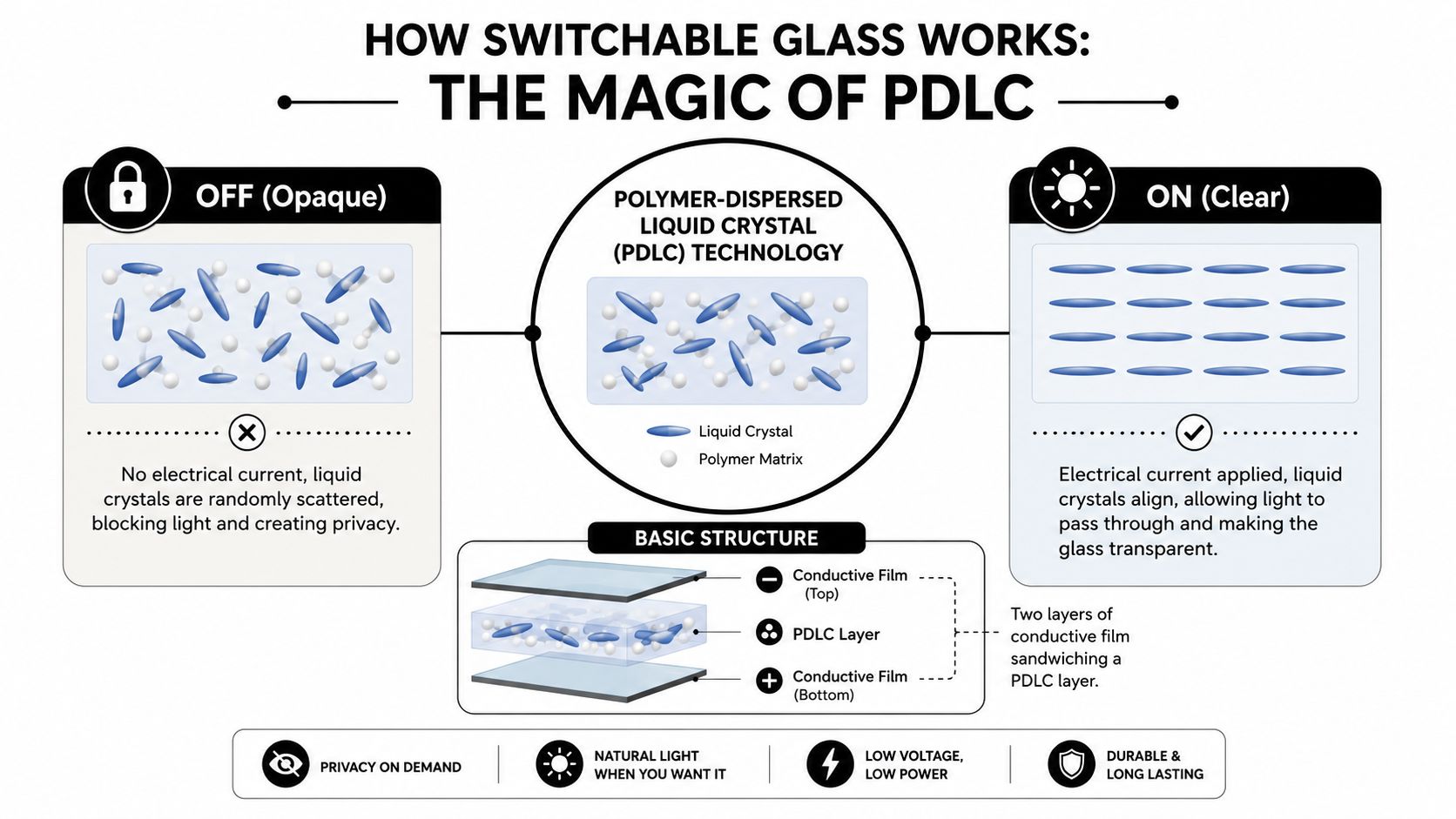
In the off position, the liquid crystal particles stay disordered, which scatters light and gives the glass a frosted appearance. In the on position, a low-voltage current aligns those particles so the panel turns clear.
That sounds simple because it is. The installation details are where projects succeed or fail.
What changes when power is applied
Here is the process in plain language:
- Power off. The PDLC layer diffuses light, so the glass reads as private.
- Power on. The particles align and the glass becomes transparent.
- Control signal. A wall switch, remote, sensor, or automation system tells the transformer when to change states.
Most systems use low-voltage power routed through a transformer and concealed wiring. For a new build in Naples or Bonita Springs, that is usually straightforward if the electrician, glass fabricator, and trim carpenter coordinate early. Retrofits are less forgiving, especially when the door stile is narrow or the surrounding opening was not designed to hide wiring cleanly.
What matters in actual use
Clients usually ask about appearance first. I tell them to ask about behavior.
- The change is fast enough for everyday privacy use. You press a switch and the glass changes state right away in practical terms.
- The viewing area has no blinds, cords, or fabric. That removes a common maintenance issue in damp rooms.
- The default setting is typically frosted when power is off. In a power outage, privacy remains in place.
That last point matters in Southwest Florida. Summer storms, generator transfers, and brief power interruptions are part of the local reality. A privacy system that stays private without power makes more sense here than one that depends on someone remembering to pull a shade.
Why assembly quality matters more in Southwest Florida
Our climate is hard on anything installed near exterior openings. Humidity, salt air closer to the coast, strong UV exposure, and wind-driven rain all expose weak edges, poor seal details, and rushed wiring work.
For that reason, factory-made switchable glass is usually the better choice for higher-end homes and commercial spaces here. The components are built as one glass assembly instead of relying on a field-applied layer that can be more vulnerable at the edges over time. If the opening is part of an exterior envelope, impact requirements and product approval become part of the conversation early, not after the glass order is placed.
Homeowners chasing a cleaner, higher-end look often pair this technology with other luxury glass design choices for the home. The glass can look minimal on the surface, but the project behind it should be engineered with the same care as any other premium door system.
Smart glass versus smart film
The two options get grouped together, but they are not the same product.
| Option | What it is | Best use |
|---|---|---|
| Factory-made switchable glass | PDLC built into a finished insulated or laminated glass assembly | New custom doors, larger partitions, and projects where durability and cleaner detailing matter |
| Applied smart film | A switchable film installed onto existing glass | Select retrofit situations where replacing the full glass unit is not practical |
I usually steer Southwest Florida clients toward sealed glass assemblies whenever the budget and opening allow it. In this climate, shortcuts tend to show up later as edge issues, haze, service calls, or a finished look that never feels quite right.
The Unseen Benefits of Smart Glass Doors
A Naples homeowner wants the front office to feel open all day, then private for one client meeting. A restaurant owner in Marco Island wants a glass divider that looks clean during service and gives a back room privacy before an event. Those are the projects where switchable glass starts to make sense. The value is not only privacy. It is the ability to change how a space works without adding shades, curtains, or a second layer of hardware that fights the design.
Design stays clean
In practice, this is one of the biggest reasons clients choose it.
Blinds and drapery can solve visibility issues, but they also add bulk, maintenance, and visual clutter. In a modern bath, a glazed office, or a refined entry, that extra layer often feels like a workaround instead of part of the architecture. Switchable glass keeps the opening simple. You still get daylight, clean sightlines, and the look people wanted when they chose glass in the first place.
Static frosted glass has its place. I use it on plenty of jobs. But it commits the room to one condition all the time. Smart glass gives you clear glass when the view matters and privacy when the room changes use.
It adds function beyond privacy
The frosted state can also do real work in the room. On commercial projects, I have seen clients use the opaque surface as a projection backdrop for presentations, branded visuals, and temporary displays. It is not a replacement for a dedicated theater screen, but in the right conference room or showroom, it gives the partition another job without adding more equipment to the wall.
That can be useful in:
- Conference rooms where the divider also needs to support presentations
- Retail and hospitality spaces where the room shifts from open display to controlled privacy
- Residential media or multipurpose rooms where one glass panel needs to do more than separate spaces
Homeowners looking at luxury glass design choices for the home usually respond to that same idea. The glass is part of the design, but it also earns its footprint.
The Florida-specific benefits people overlook
Southwest Florida is hard on soft materials. Humidity hangs around for months. Salt air reaches farther inland than people expect. Strong sun exposes every shortcut.
That changes the privacy conversation.
A sealed glass surface is easier to clean than slatted blinds or fabric panels that collect dust, moisture, and residue. In bathrooms, wellness spaces, medical offices, and coastal homes, that is a practical advantage you notice after installation, not just on day one. Products with cords, folds, stitched edges, or many moving parts usually need more upkeep here.
I tell clients this all the time. If a privacy solution is annoying to clean in July, they stop using it.
Speed, discretion, and real-world limits
The privacy change is fast, which matters in offices, treatment rooms, and homes where people want control without walking over to close a shade. Another plus is discretion. From a design standpoint, there is no visual scramble when the room shifts from open to private.
Still, smart glass is not a cure for a bad layout. If sightlines are wrong, if the door system is underbuilt, or if the opening should never have been transparent to begin with, switchable glass will not fix that. In Southwest Florida, exterior applications also need to be evaluated like any other serious glazing system, especially where wind load, impact requirements, and corrosion resistance come into play. The product works best when it is part of a well-planned opening and specified for the conditions it will face.
Inspiring Residential and Commercial Applications
The easiest way to judge switchable privacy glass doors is to stop thinking about the product and think about the moments when the room changes use.
A lot of spaces in Southwest Florida do double duty. A bathroom has to feel open and spa-like, then private. A home office has to stay integrated with the rest of the house, then close off for calls. A commercial showroom has to invite people in, then create discretion for a meeting or a VIP consultation.
In the home
The strongest residential use cases usually have one thing in common. The homeowner doesn't want to lose daylight.
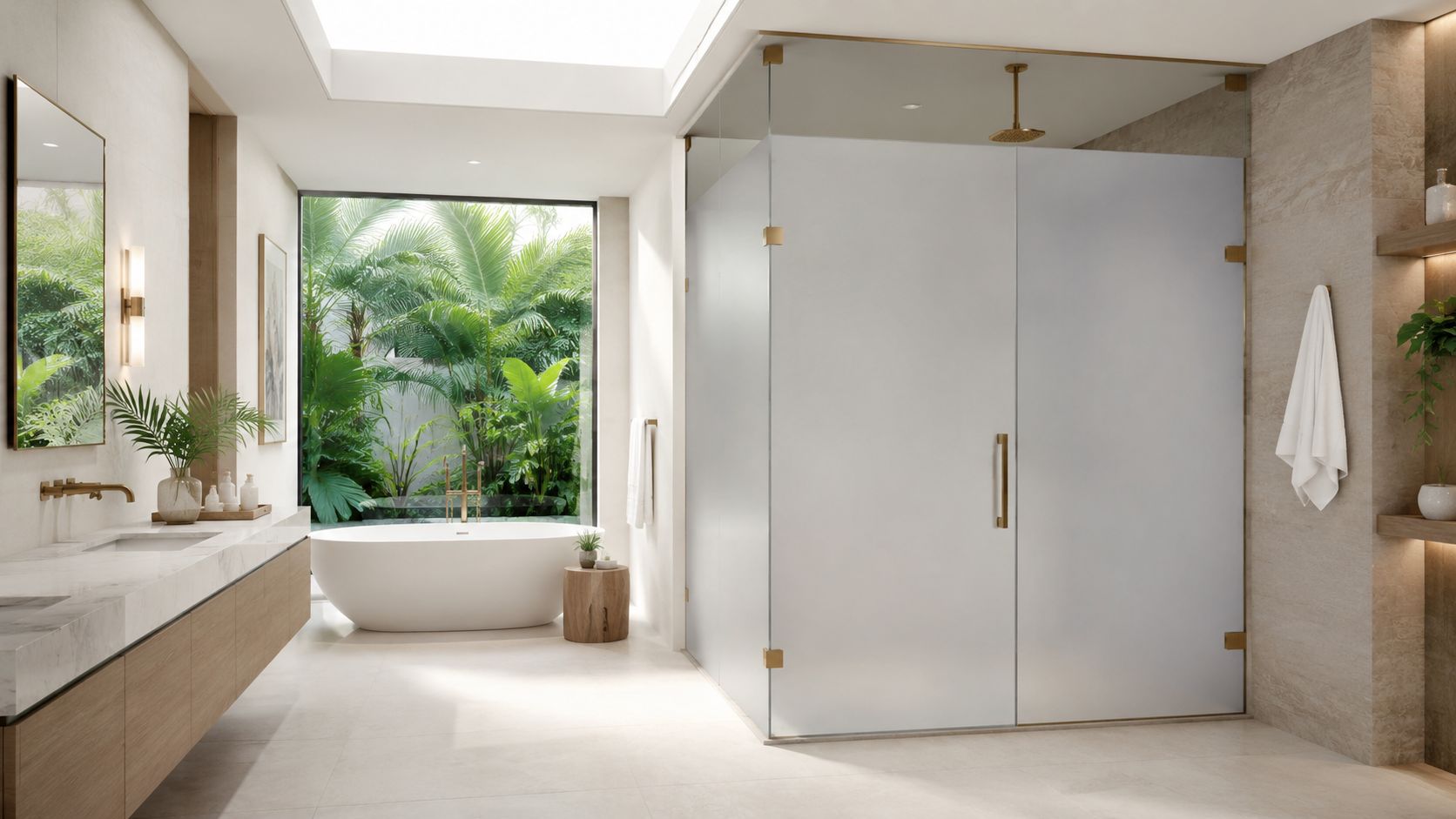
A frameless shower enclosure is a perfect example. In clear mode, the bath stays bright and open. In private mode, the enclosure frosts over and gives the room a more secluded feel. That works especially well in larger Naples homes where the primary bath is designed like a retreat instead of a purely functional room.
Home offices are another smart application. A glass office off the main living area feels modern and connected. It also avoids the closed-off look of a traditional study. But when a client call starts or family activity is distracting, one switch changes the room from visual extension to private workspace.
Then there are the statement applications. Wine enclosures, dressing areas, and interior passage doors can all use switchable glass to create reveal-and-conceal moments that feel custom without adding visual clutter.
In business settings
Commercial spaces tend to get the most immediate return from the flexibility.
A conference room is the clearest example. During part of the day, the room can stay visually open and pull borrowed light deeper into the floor plan. When a negotiation, HR conversation, or strategy meeting starts, the same glass turns opaque. No one has to pull blinds or interrupt the room's rhythm.
Executive offices also benefit because they often need to signal openness without sacrificing confidentiality. In a high-end office buildout, switchable glass keeps the architecture polished while still giving leadership teams control over visibility.
Retail and hospitality spaces can use the same idea differently. Clear glass showcases a space. Opaque glass shifts the mood, blocks direct views, or creates a more exclusive feel for a product launch, fitting room zone, private event area, or guest suite.
What tends to work best locally
In Southwest Florida, the best applications usually share these traits:
- Interior use first where humidity can be managed and wiring paths are cleaner
- Open layouts where visual continuity matters
- Premium finish packages where blinds would look like an afterthought
- Spaces with changing privacy needs instead of permanently private rooms
The strongest smart glass projects aren't the ones with the most glass. They're the ones where privacy changes hour by hour.
Exterior use can work too, but that's where the details get more demanding. For coastal homes and commercial entries, the unit specification has to account for weather exposure, impact requirements, and long-term moisture protection. That's not the place for guesswork.
Comparing Your Privacy Options
Switchable privacy glass doors aren't the right answer for every budget or every room. Sometimes permanent frosted glass is exactly what the space needs. Sometimes a good shade is enough. The key is knowing what you gain and what you give up with each option.
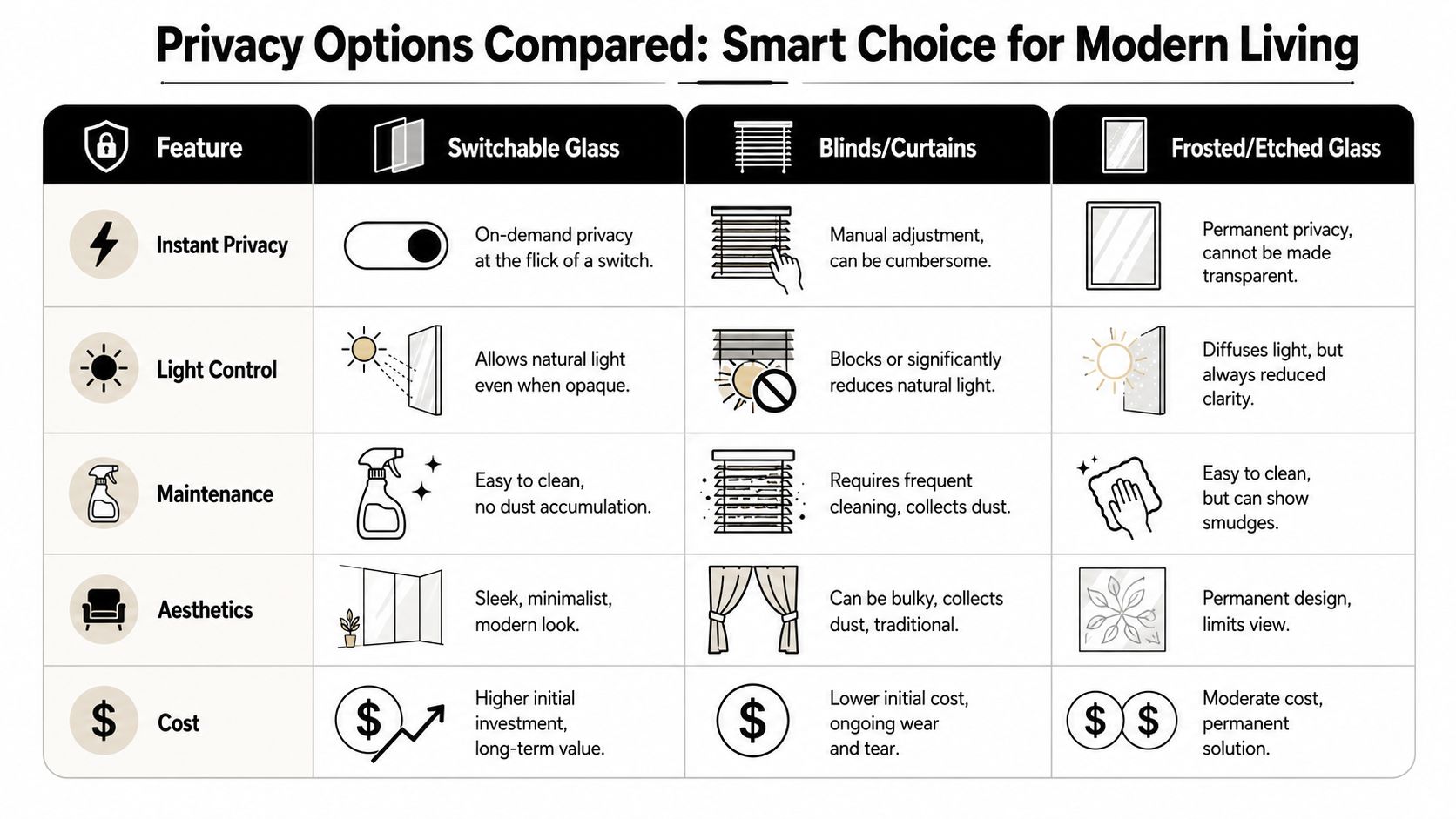
Switchable Glass vs. Traditional Privacy Options
| Feature | Switchable Glass | Blinds / Curtains | Permanent Frosted Glass | Adhesive Privacy Film |
|---|---|---|---|---|
| Dynamic privacy control | Changes on demand from clear to private | Manual open and close | Always private | Usually fixed once applied |
| Aesthetics and space | Clean, minimal, built into the opening | Adds visual bulk and hardware | Simple look, but static | Can look acceptable at first, less refined over time |
| Maintenance and hygiene | Smooth surface, easy to clean | Dust, fabric care, bent slats, moisture issues | Easy to clean | Edges can become the problem area |
| Light transmission | Keeps a bright feel while changing privacy mode | Often blocks or heavily interrupts light | Lets in diffused light only | Diffuses light, often changes the look of the glass |
| Long-term value | Highest flexibility and premium feel | Lower upfront cost, more wear items | Reliable permanent solution | Better for temporary or budget-driven situations |
If you want to compare specialty glass products more broadly, reviewing available glass product categories can help frame where switchable systems sit relative to standard custom glass options.
Where each option wins
Permanent frosted glass is hard to beat in spaces that are always meant to stay private. A powder room door, a back-of-house partition, or a room with no need for openness may not benefit from a dynamic system.
Blinds and curtains still make sense when cost comes first and the room doesn't demand a polished architectural look. They're easy to replace and familiar to everyone. The trade-off is that they rarely improve the design of the opening itself.
Adhesive privacy film has a role too. It can be a practical short-term measure or a lower-commitment upgrade. But in Florida, edge quality and long-term appearance matter. If the film starts bubbling, lifting, or showing wear, the opening looks tired fast.
Where switchable glass earns its price
Smart glass makes the strongest case when all of these are true:
- You want openness and privacy in the same opening
- The room design is modern enough that coverings would look out of place
- Maintenance matters
- The project values finish quality over the lowest upfront cost
That last point matters. Switchable glass is usually a premium choice. It's not the cheapest path to privacy. It's the best path when flexibility, appearance, and integration all matter at once.
Installation and Smart Home Integration
Many projects encounter success or challenges based on the following considerations. The glass itself gets most of the attention, but the success of switchable privacy glass doors depends just as much on measurement, wiring, framing conditions, and control planning.
New install versus retrofit
New construction or a full remodel gives you the cleanest path. You can plan the glass thickness, frame details, power routing, and control location before anything gets closed up. That usually leads to a better finished look.
Retrofit work is possible, but it needs an honest assessment first. Some existing frames can accommodate a switchable unit. Some can't without compromise. In older homes around Naples and Fort Myers, the challenge is often hidden in the jamb conditions, available wire path, or the amount of tolerance the opening really has once you measure it precisely.
For wet areas and frameless applications, measurement isn't a small detail. It is the project. If you've ever looked into frameless shower door installation in Fort Myers, you already know how much exact sizing affects the final fit. Switchable glass raises the stakes because the panel also has electrical components to protect and route.
Electrical planning matters more than people think
The system runs on low voltage, but it still needs proper planning. That usually means:
- A transformer placed where it's accessible and protected
- Clean wire routing so cables don't look improvised
- A licensed electrical connection because this is not a shortcut item
- Controller placement that makes sense for how the room is used
For swinging doors, exterior conditions and moving connections need careful attention. Every point where wiring changes direction, crosses a frame, or sits near moisture deserves respect. Florida humidity doesn't forgive sloppy sealing.
The prettiest glass in the room won't stay impressive if the power path was treated like an afterthought.
Smart home control that actually helps
The control side can be simple or advanced. A wall switch works well for many homeowners. A handheld remote can be useful in conference rooms or multi-user spaces. Full automation is where the product starts feeling effortless.
Common integrations can include scene-based controls through platforms used by home automation professionals, and if you want a broad overview of how those systems are typically organized, DLG Electrical's guide to automation gives a useful high-level look at the logic behind connected spaces.
In practice, the most useful scenes are simple:
- Work mode turns office glass clear
- Call mode switches it private
- Guest mode opens sightlines through shared areas
- Night mode closes off selected glass panels for privacy
Southwest Florida installation reality
Local climate changes what should be specified.
Humidity means edge sealing and component protection matter. Salt exposure near the coast pushes hardware and accessory quality higher on the priority list. Strong sun means the orientation of the opening should be part of the conversation, especially when glare, heat, and visibility are all in play.
Exterior applications bring another layer. If the door is part of the building envelope, the assembly has to satisfy the actual demands of weather and local code expectations. For many projects, switchable glass performs best indoors where you can enjoy the feature without forcing it to solve every exterior challenge at once.
Your Southwest Florida Smart Glass Checklist
A smart glass door can look great in a showroom and still be the wrong fit for a Naples or Fort Myers project. The ultimate test is how the system is specified, installed, and supported after the job is done.
That matters more here than it does in milder climates. Southwest Florida puts pressure on details. Humidity exposes weak edge sealing. Salt air is hard on lower-grade hardware. If the opening is near the coast or part of a high-end bath, office, or condo renovation, small shortcuts tend to show up fast.
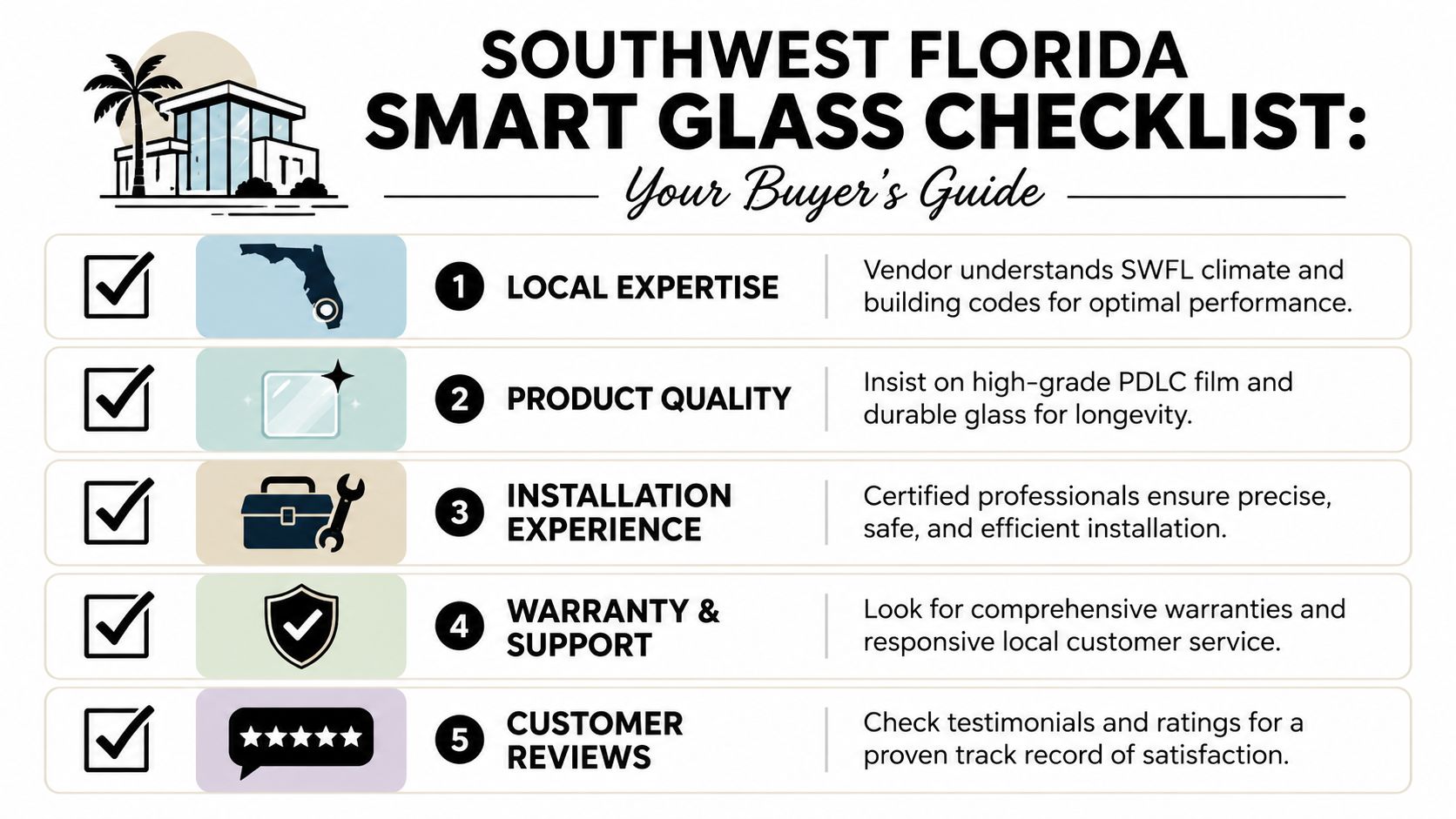
Five things to verify before you buy
- Local climate experience. Ask whether the company has real project experience in Naples, Fort Myers, Bonita Springs, and nearby coastal areas. Product choices that work in a dry climate may not hold up the same way here.
- Accurate field measuring. Smart glass doors are not a grab-and-go product. The installer should measure the opening precisely and explain how the jamb, header, and hardware will be built or adjusted.
- Electrical planning. The glass, transformer, switch location, and control method need to be coordinated early. If the answers stay vague, expect delays or change orders later.
- Photos of comparable projects. Ask to see finished bathrooms, offices, partitions, or interior door systems that match your level of design and complexity. Generic marketing photos do not tell you how that company builds.
- Service after the install. Controls and low-voltage components need support from someone who knows the system. You want one team that will respond, not a back-and-forth between the glass company, electrician, and automation contractor.
One more point for Southwest Florida properties. If you are considering an exterior application, ask the hard questions up front about impact requirements, weather exposure, and code compliance. In many cases, smart glass makes the most sense indoors, where you get the privacy feature without forcing the assembly to solve hurricane and envelope demands at the same time.
A quick gut check
A good installer should be able to speak plainly about glass build-up, edge protection, hardware compatibility, lead times, and where the project could get complicated. If that conversation feels slippery, keep looking.
If you want pricing, site-specific advice, or a second opinion on whether smart glass is the right choice for your layout, request a smart glass quote from AmeriGlass Industries.
Frequently Asked Questions
Does switchable glass use a lot of electricity
No. It uses a low-voltage current, and the powered state is what makes the glass clear. In day-to-day use, the electrical demand is modest. What matters more than the utility impact is making sure the transformer and controls are installed properly and kept accessible.
Will it hold up in Florida humidity
It can, if the product is specified correctly and installed carefully. The main issues aren't “Florida air” in a general sense. They're edge protection, moisture management, hardware quality, and whether the opening was built with the right details from the start. Humid climates expose weak workmanship faster than mild ones do.
Can switchable privacy glass doors be used outside
Yes, but only when the system is designed for exterior conditions. For Southwest Florida, that means the conversation has to include weather exposure, insulated construction where needed, and impact-rated requirements when applicable. Exterior smart glass is not a place to improvise with interior-grade materials.
Is it better for homes or for businesses
Both can benefit, but the reasons differ. Homes usually value the clean design and light-filled privacy. Businesses often get the most out of the flexible use of space, especially in conference rooms, executive offices, and client-facing interiors.
What usually goes wrong on these projects
Most problems trace back to one of three things. Bad measurements, weak wiring plans, or trying to force a premium glass system into a frame or application that doesn't suit it. The technology is solid. The mistakes usually happen around it.
If you're considering switchable privacy glass doors in Naples, Fort Myers, Bonita Springs, or nearby Southwest Florida communities, AmeriGlass Industries is a strong place to start. Their team handles custom glass with the kind of precise measurement, clean installation, and local jobsite experience these systems demand, whether you're planning a luxury bathroom, office partition, wine enclosure, or another specialty glass project.