

A sliding shower door usually starts bothering you long before it fails.
First it drags a little. Then the bottom track starts collecting grime that never seems fully clean. Then someone in the house gives the door a harder shove than they should because it sticks near the middle. In Southwest Florida, that pattern shows up all the time. Humidity hangs in the bathroom, hard water leaves deposits behind, and coastal air adds another layer of wear that generic maintenance advice usually ignores.
Most homeowners look at the glass first because that’s what they see. The track is what determines whether the whole enclosure feels smooth, solid, and worth the investment. If the track is poorly designed, made from the wrong material, or installed out of alignment, the shower never feels quite right no matter how nice the glass looks.
The Unsung Hero of Your Daily Shower
A lot of shower door complaints sound cosmetic at first.
The track looks dingy. The corners stay wet. The door rattles. Water sneaks onto the floor even though the glass itself seems fine. In practice, those are usually track-system issues before they’re glass issues.
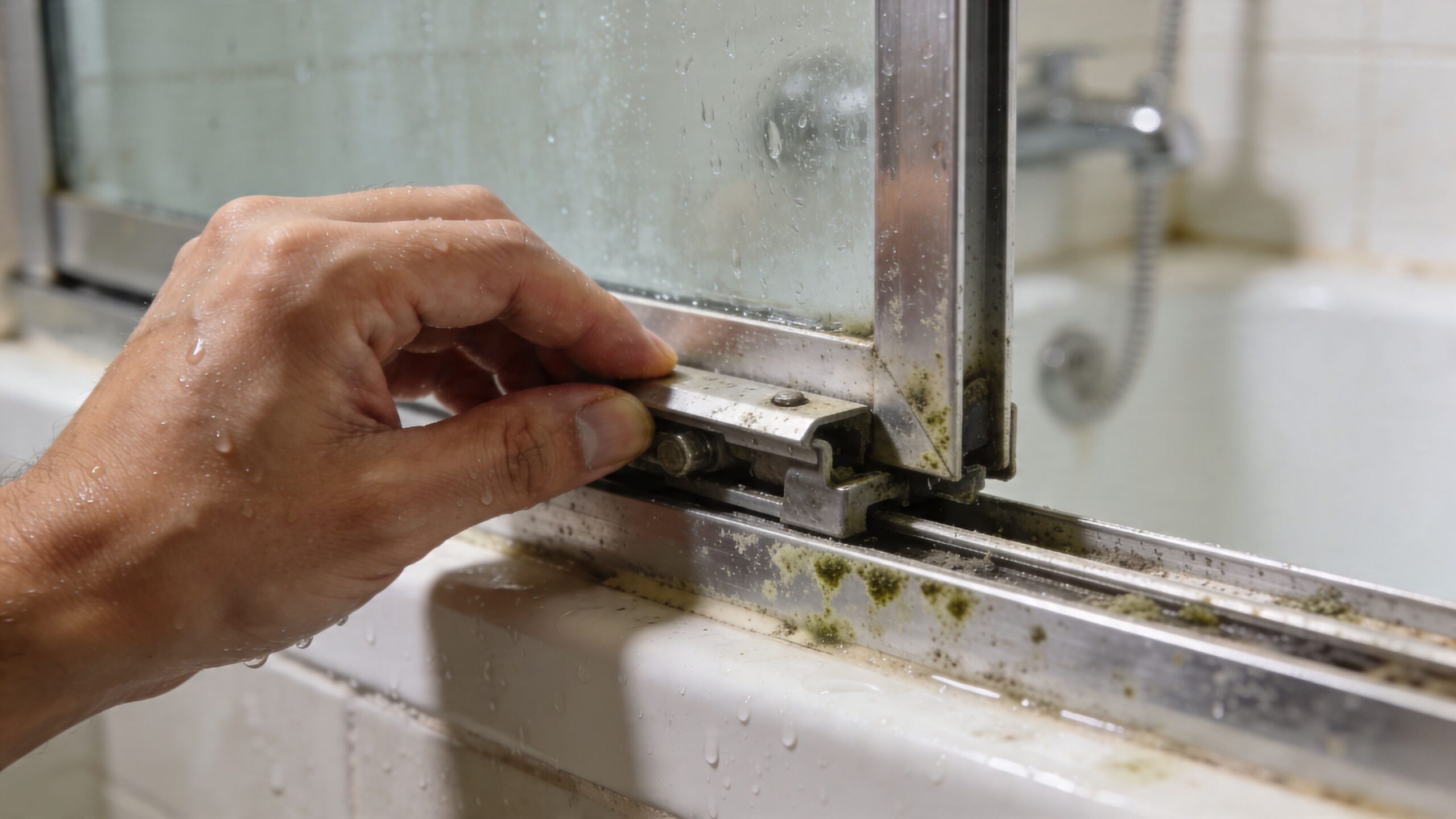
In real homes across Naples, Fort Myers, and Bonita Springs, the track does the dirty work. It guides movement, manages runoff, supports alignment, and helps keep water inside the enclosure. When it’s doing its job, nobody thinks about it. When it isn’t, the shower starts feeling cheap and troublesome fast.
That’s one reason sliding systems became so important in the first place. In 1963, an Ohio-based company pioneered the commercial production of glass shower stalls with transparent walls and sliding doors using tempered glass that was at least 500% more durable than standard window glass, helping move bathrooms away from curtains and toward enclosed units. Sliding tracks also made these enclosures practical in compact bathrooms during the postwar housing boom, as noted in this history of glass shower doors.
What the track actually controls
A good track system affects more than one thing at once:
- Door feel: Whether the panel glides or grinds and jerks.
- Water control: Whether runoff stays contained or ends up on the tile outside.
- Cleaning burden: Whether soap residue sits in corners and seams.
- Safety: Whether the panel stays guided and stable through daily use.
Practical rule: If a sliding shower door needs force, something is already wrong.
In a high-humidity climate, that small detail matters even more. A track that allows standing water, traps debris, or corrodes early will keep creating the same problems no matter how often you wipe it down.
Decoding the Types of Sliding Track Systems
Think of a shower door track like a rail system.
The glass panel is the load. Rollers or guides control movement. The frame and track geometry determine how much wobble, friction, drainage, and cleaning effort you’ll live with every day. Once you look at sliding shower door tracks that way, the differences between systems become much easier to judge.
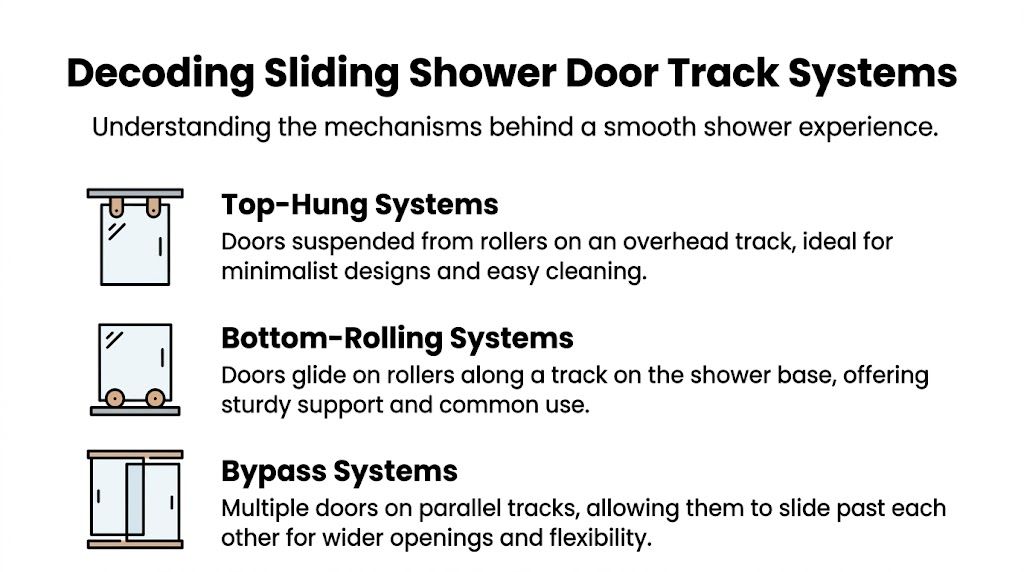
Traditional framed systems
This is the older, familiar style. The glass sits within more visible metal framing, and the system usually relies on a more pronounced bottom track.
These enclosures can still work well when they’re built correctly, but they tend to have more places for water and residue to collect. That’s the trade-off. You get structure and a straightforward mechanical layout, but you also get more edges, more corners, and more cleaning.
Traditional framed systems make sense when:
- Budget control matters: They can be a practical fit for secondary baths or straightforward remodels.
- The opening is conventional: Standard alcove layouts often adapt easily.
- You want a more enclosed visual line: Some homeowners prefer a defined frame.
What doesn’t work well is pairing a framed layout with low-grade hardware in a coastal bathroom. The frame can outlast the moving parts, but if the rollers and track finish wear prematurely, the door won’t feel good to use.
Semi-frameless systems
Semi-frameless systems sit in the middle.
You’ll usually still see some perimeter metal, but less of it. The look is cleaner than a fully framed unit, and the shower generally feels more open. These can be a smart compromise if you want a lighter appearance without going to the most minimal setup.
In practice, this category varies a lot. Some semi-frameless systems are thoughtfully engineered. Others are mostly a marketing label applied to a framed product with slightly slimmer profiles. That’s why the hardware details matter more than the label.
Check these points closely:
- Track profile: A slimmer track is only helpful if it also drains well.
- Roller quality: The door should glide evenly without chatter.
- Bottom geometry: Fewer crevices usually means easier upkeep.
- Finish durability: Bathrooms near the coast punish decorative finishes fast.
Modern frameless and top-guided systems
Most premium installations have gravitated to this.
Frameless sliding shower doors with minimal track framing emerged in 1970, removing the bulky metal and rubber framing that used to trap water, soap scum, and mildew. User reports cited in this shower door history noted cleaning was simplified by over 50%, and frameless designs now account for over 70% of premium installations in major markets.
That shift makes sense from a practical standpoint. Minimal framing gives water fewer places to sit. It also lets the tilework carry the visual weight of the bathroom instead of the metal around the glass.
A premium shower should feel smooth before it looks impressive.
Top-guided and modern bypass systems can be especially appealing when you want a cleaner sightline and less maintenance around the lower portion of the enclosure. They also fit the design language many homeowners want now: quieter hardware, less visual clutter, and more glass.
For homeowners comparing layouts, it helps to look at real product configurations instead of generic labels. AmeriGlass lists several enclosure styles and hardware approaches on its shower door product page, which is useful for seeing how different sliding systems change the feel of an opening.
Bypass versus single-direction movement
Not every slider operates the same way.
Some systems use bypass panels, where one door slides past the other on parallel tracks. Others use a more simplified guided arrangement with a fixed panel and one active panel. The right choice depends on opening width, user preference, and how you want access to feel.
A simple way to understand it:
| System type | What it feels like in use | What to watch for |
|---|---|---|
| Framed bypass | Familiar and sturdy | More track cleanup |
| Semi-frameless bypass | Cleaner look with visible hardware | Quality varies widely |
| Frameless guided slider | Minimal and upscale | Measurement and alignment must be exact |
The important part isn’t chasing a trend term. It’s choosing a track system whose mechanics fit the room, the climate, and the level of maintenance you’re willing to do.
Choosing Track Materials That Conquer Florida's Climate
Walk into a Southwest Florida bath six months after installation and the difference between a good track and a cheap one is easy to spot. One still wipes clean and slides true. The other already shows staining at the corners, roughness along the rail, and finish wear where moisture sits longest.
Track material decides how a sliding enclosure ages in this climate.
What cheaper materials tend to do
Low-cost plastic tracks usually save money only at the start. They scratch easily during normal cleaning, and those scratches hold soap film, hard-water residue, and fine grit. Once that surface gets roughed up, the track is harder to keep looking clean no matter how often it is wiped down.
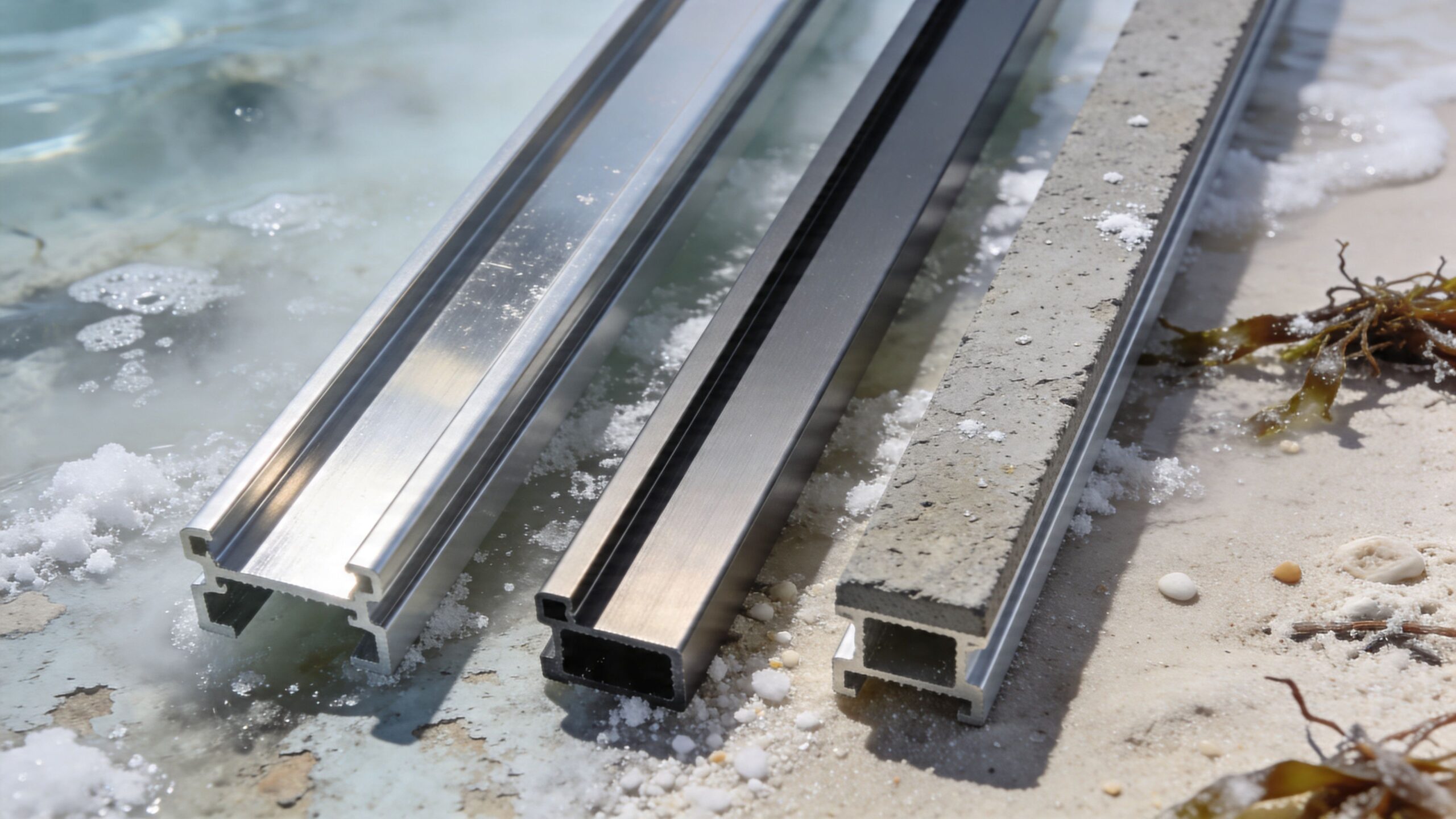
Lower-grade metal creates a different problem. In inland, drier conditions, you may get acceptable service life from it. Along the Gulf Coast, humid air and salt exposure shorten that timeline. The finish starts to dull, then pit, and the track becomes harder to clean because the surface is no longer smooth.
I see one mistake often. Homeowners choose glass and hardware finish carefully, then treat the track like a generic part. In this region, it is one of the parts that takes the most abuse.
Why anodized aluminum makes sense here
For most Southwest Florida installations, anodized aluminum is the practical choice. The protective oxide layer on anodized aluminum improves resistance to oxidation and salt spray, as noted in this product specification document.
That matters in bathrooms exposed to year-round humidity, frequent condensation, and coastal air.
A good anodized track helps address the conditions that usually shorten service life here:
- Constant moisture around the lower rail
- Airborne salt that settles on metal surfaces
- Mineral residue that dries on the track and gets scrubbed off repeatedly
Material alone is not enough, though. Profile shape matters just as much. A well-finished track with deep corners or water-trapping pockets will still collect residue and stay wet longer than it should. That is why better systems pair corrosion-resistant material with a shape that sheds water and gives you access to clean it properly.
In coastal bathrooms, the best-performing track is the one with a finish that resists corrosion and a profile that does not trap runoff.
Matching the track to the look of the enclosure
A stronger track does not have to look bulky. Quality anodized aluminum can be fabricated into slimmer, cleaner profiles that support a more refined enclosure design.
That becomes more noticeable with low-iron glass. If you are using ultra-clear glass for a brighter, cleaner enclosure appearance, the track finish and shape need to stay visually quiet. A rail that stains, pits, or develops dark buildup quickly becomes the first thing your eye sees.
Long-term value matters more than showroom appearance. A less expensive track can look acceptable on day one and still cost more over time if it needs early replacement, creates cleaning headaches, or contributes to water escaping where the frame should be directing it. Homeowners already dealing with moisture problems elsewhere in the bath often learn that lesson after searching for leaking shower repair.
For Southwest Florida homes, track selection is a durability decision first and a design decision second. The best result is a system that handles salt air, cleans up without a fight, and still looks right with the rest of the room years from now.
Recognizing the Warning Signs of Track Failure
Most sliding shower door tracks don’t fail all at once.
They give signals first. The problem is that many homeowners normalize those signals because the door still technically opens. By the time the panel jumps, leaks, or grinds hard enough to force a repair, the wear has usually been building for a while.
What you can see
Visible deterioration often starts with the track finish.
Look for discoloration, pitting, rough spots, or areas that no longer wipe clean. In coastal homes, corrosion can begin subtly. A track may first look chalky or stained before it looks obviously damaged.
You should also look at the corners and low points where water sits. If residue keeps returning to the same spot even after cleaning, the track may have a drainage issue or surface wear that’s beginning to hold buildup.
What you can feel
Door movement tells you a lot.
A healthy system should slide with controlled resistance, not with drag, chatter, or a grinding sensation. If the panel sticks in one section, the cause is often one of these:
- Debris inside the track
- Worn rollers
- Misalignment
- Track deformation or corrosion
If the door wobbles as it moves, don’t ignore it. That can mean the guide system is no longer holding the panel consistently.
A smooth glide that suddenly turns rough is usually a hardware problem, not “just age.”
What the water is telling you
Water outside the enclosure is one of the clearest warning signs.
That doesn’t always mean the glass is wrong. It can mean blocked weep paths, a poorly pitched track, worn seals, or track geometry that no longer manages runoff properly. Homeowners trying to sort out whether they have a door issue, waterproofing issue, or broader enclosure issue may also find value in reading about leaking shower repair, especially for understanding how water symptoms can be misdiagnosed.
When it becomes a safety issue
A door that lifts, skips, or comes off its intended path needs immediate attention.
That can happen when rollers are worn, adjustment points loosen, or the track is no longer supporting the panel correctly. With glass, “still usable” is not the standard you want. Stable, aligned, and predictable is the standard.
If you’re seeing more than one symptom at once, replacement is often smarter than repeated minor fixes.
A Maintenance Routine for a Flawless Glide
A good maintenance routine for sliding shower door tracks in Southwest Florida needs to do more than remove visible soap scum.
It has to manage humidity, salt exposure, and hard water residue, because those three conditions work together. Generic cleaning guides usually treat every bathroom the same, but that misses the local reality. As noted in this discussion of track-cleaning limitations in humid coastal regions, homeowners in places like Southwest Florida face accelerated oxidation, mold growth, and mineral buildup.
Your basic weekly routine
Keep this simple enough that it gets done.
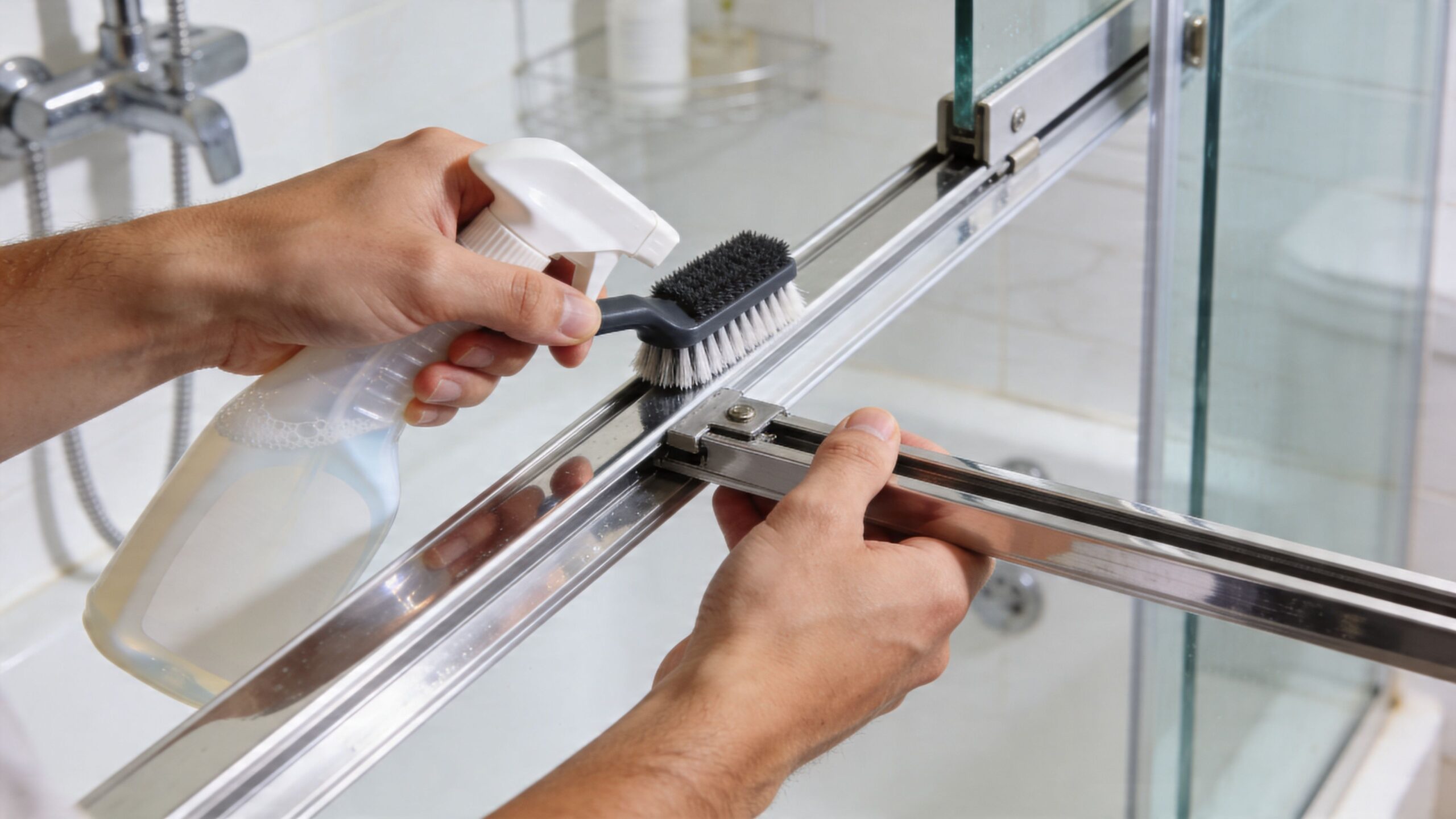
- Rinse the track first: Flush away loose hair, sand-like grit, and soap film before scrubbing.
- Use a soft brush or cloth: Nylon detail brushes work well for corners and narrow channels.
- Clean the low points carefully: That’s where mineral residue and biofilm usually start.
- Dry the track after cleaning: Leaving moisture behind defeats part of the effort.
Avoid abrasive pads and anything likely to scratch the track finish. Once the finish gets marred, future buildup tends to cling more aggressively.
What deserves monthly attention
Weekly wiping helps. Monthly inspection prevents bigger problems.
Focus on these areas:
- Weep holes: Make sure they aren’t blocked by residue.
- Roller path: Check for rough travel or noise changes.
- Corners and joints: Look for early signs of corrosion or dark buildup.
- Seals: If they’re stiff, loose, or deformed, water control suffers.
A lot of water-on-floor complaints start with clogged drainage points in the track, not with catastrophic enclosure failure.
Service note: If cleaning improves the door only briefly, the issue may be mechanical rather than cosmetic.
For homeowners who want a reference point for care practices, AmeriGlass has a straightforward shower door maintenance page that outlines upkeep basics.
What helps in a coastal home
The local environment changes the right routine.
If your home is close to the coast, rinse and dry matter more because salt residue doesn’t need to be visible to be harmful. If you have hard water, mineral film builds in the track before it becomes obvious on the glass. If the bathroom ventilation is weak, moisture lingers longer along the bottom channel and corners.
That’s why maintenance should include habit changes, not just cleaner:
- Run ventilation after showers
- Leave enough airflow for the enclosure to dry
- Wipe the bottom track more often than the glass if buildup starts there first
A short visual demonstration can help if you want to see cleaning technique and track access in action.
Coatings and surface protection
Protective coatings can reduce how aggressively water and minerals cling to the enclosure surfaces. That doesn’t eliminate maintenance, but it can make routine cleaning less stubborn and help preserve clarity and finish appearance over time.
For many homeowners, the benefit isn’t that a coating makes the shower maintenance-free. It’s that the track and surrounding glass stay easier to recover before buildup becomes baked on.
How to Measure for a Sliding Track Replacement
Measuring for sliding shower door tracks looks simple until you get to the point where the glass has to fit reality exactly.
That’s where many replacement projects go wrong. Homeowners measure the opening width once, assume the walls are square, and shop for a kit. Then the track can be trimmed, but the glass can’t, and the project turns into a mismatch.
Start with the opening width
Measure the enclosure width in more than one place.
Take one measurement near the top and another near the bottom. If those numbers differ, the walls may be out of plumb or the opening may not be perfectly parallel. That matters because the track system has to accommodate the actual field condition, not the ideal one.
Universal sliding shower door track kits typically fit widths from 43-3/8 inches to just under 60 inches, according to Delta’s guidance on sliding track sizing. That same source notes that tracks can be cut to size, but tempered glass cannot.
Check height and wall conditions
Width is only part of it.
You also need to confirm that the enclosure meets the required wall-height conditions for the system being considered. Delta’s guidance specifies wall heights over 71.25 inches for shower enclosures and 59 inches for tub enclosures, along with door-size requirements tied to the selected opening range.
A quick homeowner checklist helps:
- Measure finished opening width at top
- Measure finished opening width at bottom
- Confirm wall height
- Check whether the curb or sill is level
- Identify stud locations before fastening points are planned
Don’t skip the stud and sill layout
Stud position matters more than many people expect.
The same installation guidance states that studs must be located and marked, with the outer edge of the sill positioned at least 1.5 inches away from the stud center. That’s not a fussy detail. It affects structural fastening and long-term stability.
If you’re planning a custom enclosure rather than a basic kit, professional field measurement proves its worth. A good fabricator or installer accounts for real wall conditions, not just nominal dimensions.
Use the numbers to start the conversation, not finish it
Homeowners should absolutely measure before requesting quotes. It helps narrow options and spot obvious fit issues.
But those first measurements are a planning tool, not fabrication approval. Shower openings often have small conditions that matter a lot in glass work: wall bow, curb pitch, tile lippage, and out-of-square corners. A custom planning tool like AmeriGlass’s shower door design page can help you organize preferences, but field verification is still what protects the final fit.
If there’s one rule worth remembering, it’s this: cut metal last, order glass later, and trust nothing until the opening is measured carefully.
DIY Project or Professional Precision A Checklist
A sliding shower track can look simple on the floor of a home center. It gets less simple once it meets tile, glass weight, and a Southwest Florida bathroom that stays warm and damp most of the year.
The key question is not whether a homeowner can screw in a track. The question is whether the opening, hardware, and installation tolerances leave enough room for error. In coastal homes, that margin gets smaller because salt air, hard water, and constant humidity punish light-duty materials and sloppy alignment.
Cheap replacement kits can work for a while. They also tend to show wear faster. Plastic guides groove out, thin finishes pit, and lower-grade rollers lose their smooth travel sooner in wet environments. A better track system costs more up front, but it usually buys quieter operation, fewer service calls, and a longer gap before replacement.
DIY versus pro in real terms
| Consideration | DIY Approach | Professional Installation (AmeriGlass) |
|---|---|---|
| Upfront cost | Lower initial purchase if no specialty tools or rework are needed | Higher initial spend for field measurement, fabrication coordination, and installation labor |
| Material selection | Usually limited to stocked kits and common finishes | Access to better-matched hardware, finish options, and custom-fit track systems |
| Measurement responsibility | Homeowner owns every dimension and every cut | Installer verifies site conditions before installation decisions are finalized |
| Risk of error | Misaligned rollers, poor anchoring, and bad cuts are your responsibility | Installer handles fit, adjustment, and correction strategy |
| Time required | Shopping, trimming, drilling, sealing, cleanup, and troubleshooting | Homeowner involvement is mostly selection and scheduling |
| Performance over time | Depends heavily on product grade and installation accuracy | More consistent door travel, drainage control, and hardware alignment |
| Finished look | Fine for a basic opening if everything goes right | Usually cleaner reveals, straighter lines, and tighter visual fit |
DIY usually makes sense in a narrow set of cases
DIY is reasonable on a basic framed slider with standard sizing, sound walls, and a simple replacement scope. It also helps if the existing enclosure is not high-value glass and the homeowner already has the right tools for accurate drilling and careful trimming.
Even then, the project has to stay simple. If the track needs modification to compensate for uneven tile, out-of-plumb walls, or a curb that sheds water unpredictably, the job stops being routine.
Professional installation makes more sense when failure will be expensive
Heavier glass, custom finishes, coastal exposure, and premium bathrooms all raise the cost of a small mistake. One bad hole in tile, one track cut that comes up short, or one roller system set slightly out of square can turn a straightforward replacement into a patch-and-reorder project.
Appearance matters too. A sliding enclosure should close cleanly, shed water where it should, and keep a consistent sightline across the opening. If the bathroom is part of a broader remodel, it helps to look at the enclosure in the context of the full project, including related decisions around renovating shower stall.
Here is the practical checklist I use.
Choose DIY if the enclosure is basic, the replacement parts are an exact fit, the wall condition is reliable, and you are comfortable owning any broken tile, bad cuts, or follow-up fixes.
Choose professional installation if the shower uses heavier glass, the home is close to the coast, the opening has any irregularity, or you want the track and door system set up for long service in a humid environment. Homeowners who want pricing based on actual site conditions can start with an AmeriGlass shower door quote request.
Upgrade Your Shower with AmeriGlass Industries
A sliding shower system succeeds or fails at the track level.
The right sliding shower door tracks need the right material, the right drainage profile, and careful installation for real field conditions. In Southwest Florida, those details matter more because moisture, minerals, and salt exposure punish shortcuts.
If you’re planning a broader bathroom update, it can also help to review adjacent renovation considerations such as renovating shower stall, especially when door selection is only one part of the remodel.
For homeowners, contractors, and designers in Naples, Fort Myers, and nearby communities, AmeriGlass handles precision measurement, custom fabrication, and installation for shower enclosures built around long-term performance. If you’re ready to price out a replacement or upgrade, request a consultation through the AmeriGlass quote page.
Frequently Asked Questions about Shower Door Tracks
Can I replace just the track and keep the existing glass
Sometimes, but not always.
That depends on the condition of the glass, roller compatibility, hole placement, enclosure dimensions, and whether the old system’s geometry matches the new hardware. If the original installation was proprietary or the glass edge conditions don’t match the replacement system, trying to reuse the panel can create more problems than it solves.
Why does my track look dirty again right after cleaning
Usually because the problem isn’t just surface dirt.
A worn finish, standing water, blocked drainage, or mineral-heavy residue can make buildup return quickly. If the same area stays dark or rough after repeated cleaning, inspect the track profile and the hardware movement, not just the visible residue.
Are frameless sliders harder to maintain
Not necessarily.
Minimal framing often gives grime fewer places to hide. The key is whether the bottom system is well designed and properly installed. A clean frameless layout with good drainage is usually easier to live with than a bulky track that traps moisture.
How often should a track be inspected
In Southwest Florida, a quick visual check during regular cleaning is smart.
Pay attention to glide quality, recurring residue, corrosion spots, and water escaping the enclosure. Those symptoms usually appear before a full failure.
What matters most for long-term value
Three things. Material quality, accurate measurement, and installation discipline.
If any one of those is weak, the enclosure may still look fine on day one but become frustrating in daily use.
If your shower door drags, leaks, or never feels as polished as the rest of the bathroom, it’s time to look at the track system, not just the glass. AmeriGlass Industries helps Southwest Florida homeowners with precise measurement, custom shower door solutions, and professional installation built for coastal conditions.