

You’re probably staring at a bathroom that works, but doesn’t feel right. The old framed enclosure looks heavy. The shower curtain sticks to your leg. The swing door eats up floor space you don’t have to spare. You want the room to feel cleaner, brighter, and more expensive without making it harder to live with.
That’s exactly where a sliding shower door kit enters the conversation. It gives you the clean lines homeowners want now, and it solves a practical problem at the same time. In a tighter guest bath, condo primary bath, or a renovation where every inch matters, a sliding system keeps the entry clear because the panels move within the enclosure instead of swinging out into the room.
That demand isn’t a niche trend. The global shower doors market was valued at US$ 18.8 billion in 2023 and is projected to reach US$ 39.5 billion by 2034, while the U.S. glass shower door sector is forecasted to hit USD 4,514 million by 2026, according to P&S Market Research on the shower glass door market. Homeowners are choosing cleaner, space-saving designs because they fit the way modern bathrooms are built.
In Naples and across Southwest Florida, that choice has another layer. A good-looking shower door has to stand up to humidity, hard water, coastal air, and daily use. If you’re remodeling the shower, it’s also smart to make sure the plumbing behind the wall is right before the glass goes in. If your trim, temperature control, or shutoff is questionable, this guide to trusted residential shower valve repairs is worth reviewing before final measurements happen.
If you’re still deciding on layout, glass style, and hardware direction, it helps to design your shower door around the opening you have, not the one you wish you had.
Your Bathroom Remodel Starts with the Right Vision
A bathroom remodel goes wrong when the homeowner picks the door last.
I see it often. The tile is beautiful, the niche is centered, the fixtures are upgraded, and then someone tries to force a generic enclosure into an opening that calls for a more precise solution. The result is a shower that looks like an afterthought. A sliding shower door kit should be part of the design vision early, because the door changes how the room feels every single day.
What homeowners usually want
End-users typically don’t ask for “a bypass enclosure with premium hardware.” They ask for a bathroom that feels open. They want to see the tile they paid for. They want less visual clutter. They want a door that doesn’t swing into a vanity, toilet, or bath mat.
That’s why sliding systems are so popular in remodels here. In many Naples homes, especially where bathrooms need to feel airy and upscale, sliding glass gives you a modern look without demanding extra clearance.
A shower door should make the room feel larger, not more crowded.
Where the vision needs discipline
A sleek result doesn’t come from picking the thinnest metal or the cheapest boxed kit. It comes from matching the enclosure style to the opening, the wall conditions, and the finish level of the room.
A strong plan usually comes down to a few decisions:
- Opening type: A wall-to-wall opening behaves differently than a return panel or corner enclosure.
- Visual goal: Some bathrooms need near-invisible hardware. Others look better with a little structure and finish contrast.
- Daily use: A primary bath gets far more wear than a guest shower. That changes what hardware I’d trust.
- Climate exposure: Coastal homes need finishes and coatings that hold up better over time.
The right vision isn’t just “frameless looks nice.” It’s understanding what kind of sliding shower door kit will still look right after years of use in a humid Florida bathroom.
Deconstructing the Sliding Shower Door Kit
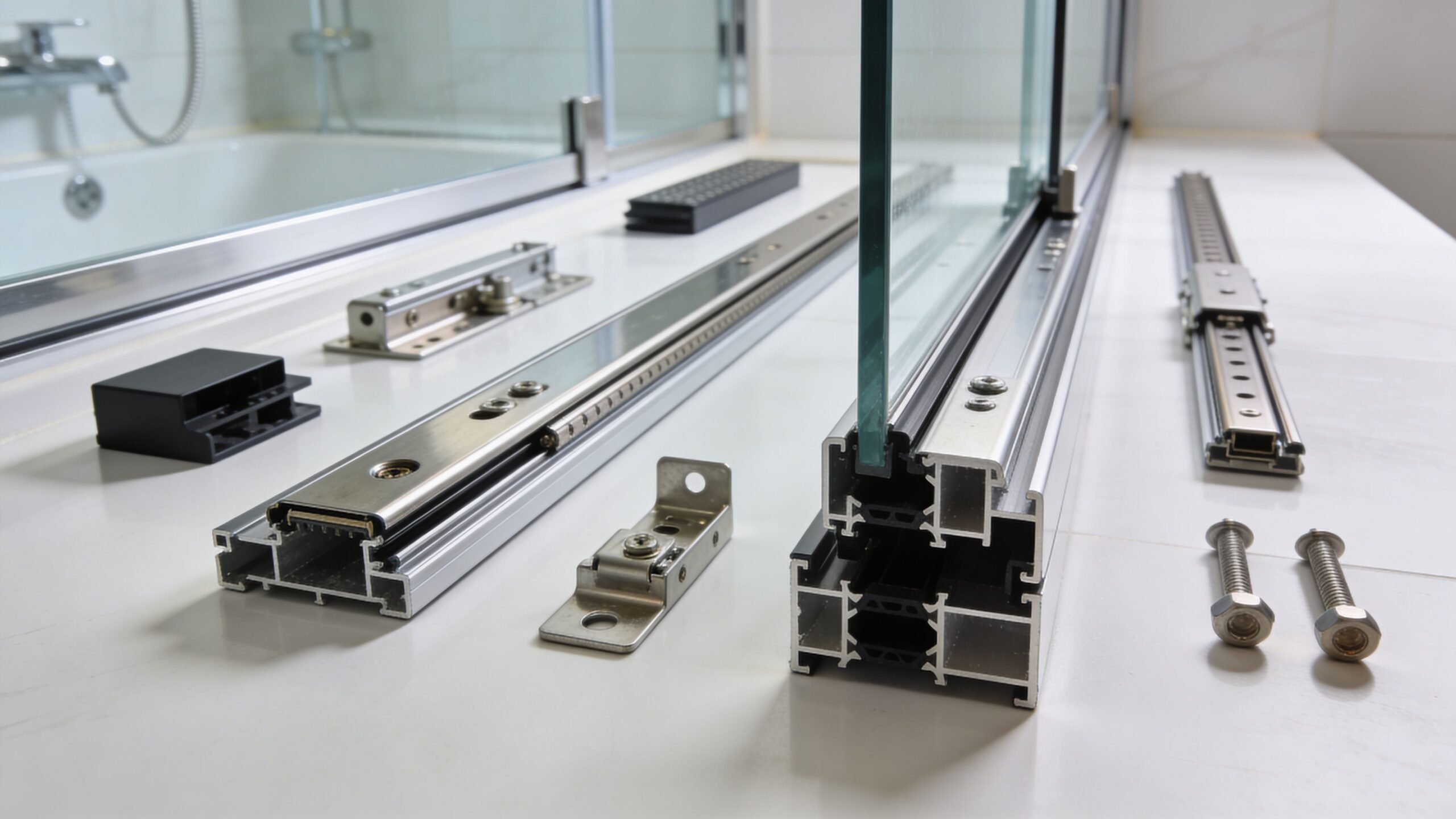
A good sliding shower door kit is a system, not a box of parts.
It functions like a precision machine. If the track is off, the rollers fight it. If the rollers are cheap, the glass never glides right. If the seals are wrong, the water finds the weak point. Every component affects the feel of the finished shower.
If you want to see what a refined system looks like in practice, this Hydroslide sliding shower door overview is a useful reference point.
The track carries more responsibility than most homeowners realize
On a quality kit, the upper track does more than guide movement. It sets alignment, supports the operating load, and helps the glass panels travel smoothly without chatter or sag. In better systems, you’ll see anodized aluminum track paired with more substantial fittings instead of thin, flexible metal that twists during installation.
The track has to stay true. If it doesn’t, the whole door tells on it. You’ll hear it in the rollers and feel it in the drag.
Rollers separate premium kits from forgettable ones
This is one of the first places I look when evaluating a sliding shower door kit. Cheap rollers usually feel fine for a short time. Then the door gets noisy, starts to hesitate, or drifts out of alignment.
Higher-quality systems use better engineered roller assemblies and stronger hardware materials. That matters because the door moves under load every day, in a wet environment, with soap residue, humidity, and cleaning chemicals all working against it.
Practical rule: If the hardware feels light in your hand, it will usually feel light-duty in use.
Glass isn’t just glass
The panels are the visible star of the enclosure, but they’re also part of the structural performance. Glass thickness affects rigidity, movement, and the overall visual impression.
A high-end frameless system doesn’t hide weakness behind metal. It relies on properly fabricated tempered safety glass, clean edgework, and hardware rated for the weight it will carry.
Here’s how the major components work together:
| Component | What it does | What goes wrong when it’s cheap |
|---|---|---|
| Upper track | Controls alignment and supports movement | Binding, sag, noisy travel |
| Rollers and hangers | Carry door weight and create smooth glide | Rough operation, wear, derail risk |
| Glass panels | Define structure and appearance | Flex, poor fit, cheap look |
| Handles or towel bars | Provide grip and daily usability | Loose feel, awkward operation |
| Seals and guides | Keep water in and stabilize travel | Leaks, rattling, poor closure |
Seals, guides, and finishes matter in real bathrooms
The least glamorous parts of the kit often determine whether you like living with it. Bottom guides, side seals, and threshold details are what keep the bathroom floor dry. They also affect how finished the installation looks.
A sliding shower door kit should feel intentional when you touch it. The handle should feel solid. The motion should be quiet. The glass should stop where it’s supposed to stop. If any of that feels loose, hollow, or improvised, the problem usually isn’t “the design.” It’s the kit quality.
Choosing Your Style Frameless Semi-Frameless and Framed
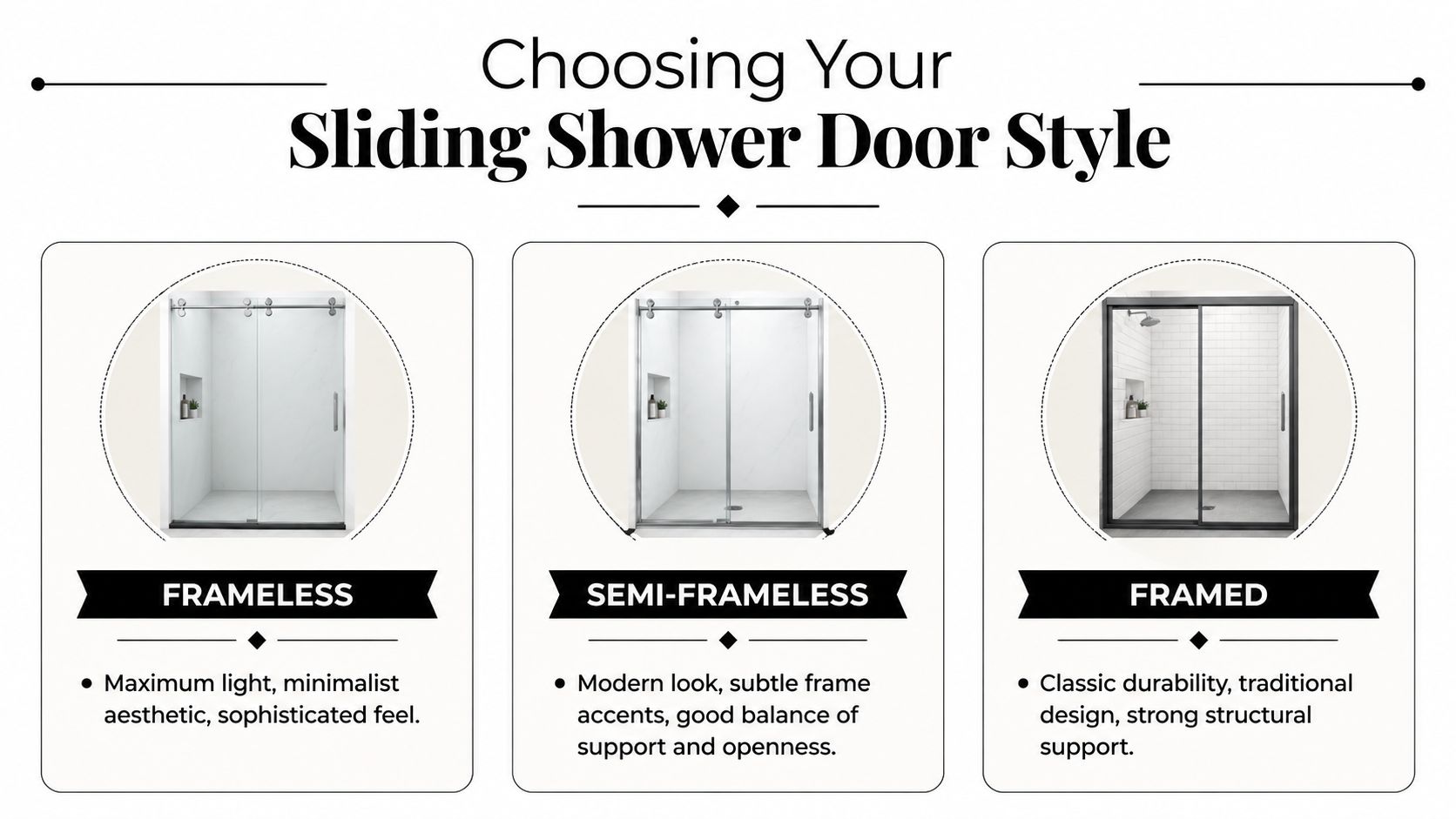
Not every sliding shower door kit belongs in every bathroom. Style choices affect appearance, cleaning effort, hardware exposure, and how high-end the finished room feels.
The biggest mistake homeowners make here is comparing these categories only by price. Price matters, but the daily experience matters more.
Framed kits give structure, but they also add clutter
A framed sliding shower door kit surrounds the glass with metal on more edges. That gives it a familiar look and can help mask minor inconsistencies in the opening. For some utility bathrooms, rentals, or lower-priority spaces, that approach can make sense.
The trade-off is visual weight. Framed doors break up the sight lines, collect more residue in more corners, and rarely deliver the open feeling people are after in a remodel. They solve a budget problem, but they don’t usually create a premium bathroom.
Semi-frameless kits sit in the middle
Semi-frameless systems try to split the difference. You still have some frame elements, but less than a full framed enclosure. They can look cleaner than a traditional framed door while keeping more structure visible than a true frameless design.
This category works for homeowners who want a modern direction without going all the way to a heavier glass frameless system. It’s a compromise, and sometimes compromise is the right answer. The key is to understand that it will still read as a metal-accented enclosure, not as a clean sheet of glass.
Frameless is where the bathroom starts to feel custom
A frameless sliding shower door kit is the option that most often makes a remodel look finished at a higher level. You see more tile, more light, and fewer visual interruptions. The enclosure feels lighter even though the materials are often more substantial.
That clean look doesn’t happen because frameless doors are delicate. It happens because the engineering shifts from visible frame to stronger glass and better hardware. High-quality frameless systems such as the Hydroslide are built to support 3/8" (10 mm) tempered safety glass, with a maximum door weight of 88 lbs so the solid brass rollers and anodized aluminum track operate safely without deformation over time, according to the Hydroslide shower enclosure specifications.
That matters for two reasons. First, heavier, thicker glass looks and feels better. Second, the hardware has to be worthy of it.
A quick side-by-side view
| Style | Best for | Main upside | Main downside |
|---|---|---|---|
| Framed | Utility-focused spaces | More traditional structure | Bulkier look, more metal to clean |
| Semi-frameless | Middle-ground remodels | Balanced appearance | Still not fully open visually |
| Frameless | Premium renovations | Minimalist, airy, custom feel | Demands better measurement and installation |
Privacy can still fit a modern design
Some homeowners love frameless glass but don’t want full visibility. That’s reasonable, especially in shared baths or homes where the shower sits in direct sightline from the doorway. In those cases, reviewing different privacy shower door options can help you decide whether clear, frosted, or partially obscured glass fits the room better.
If your goal is the cleanest, most upscale result, frameless remains the benchmark. A well-designed frameless shower door installation in Naples Florida shows why. The tile stays visible, the room feels larger, and the shower stops looking like a separate box inside the bathroom.
The more beautiful the tile work, the less sense it makes to hide it behind heavy framing.
A Perfect Fit Starts with Perfect Measurement
A sliding shower door kit doesn’t forgive sloppy measurement.
Homeowners often assume the opening width is one number. It isn’t. Tile, wall bow, curb slope, and out-of-plumb conditions all change what the glass and hardware need to do. If you measure once and order from that single number, you’re gambling with expensive tempered glass.
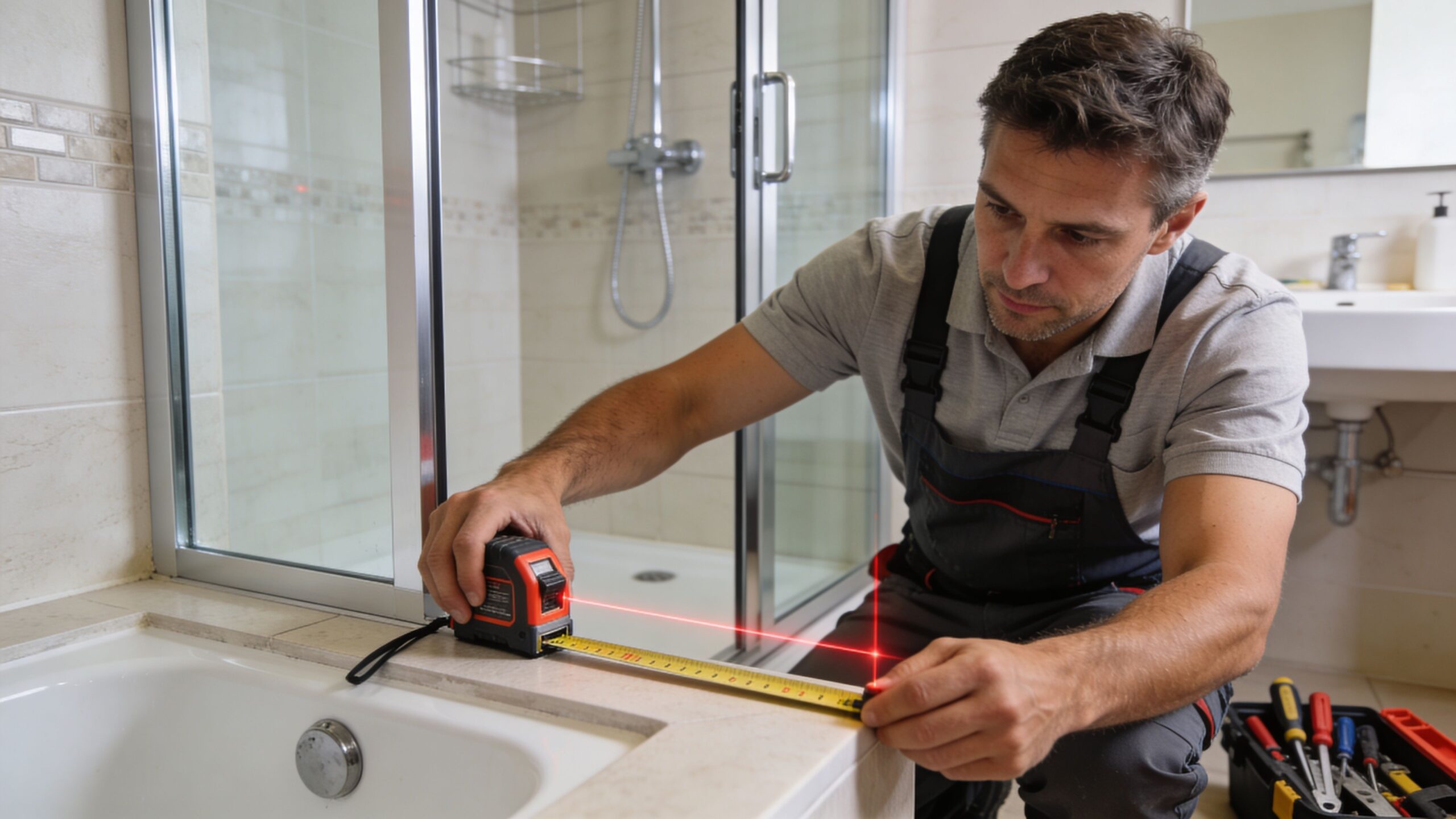
A frameless sliding system also has minimum dimensional realities. These kits require a minimum opening width of 48 inches for proper panel overlap, and walls that are more than 3/8" out-of-plumb can increase roller friction by up to 20%, potentially cutting hardware life in half, as noted in San Mateo Glass guidance on sliding shower door requirements.
The measurements that actually matter
A proper field measure checks more than overall width and height.
For a straightforward opening, I want to know:
- Width at multiple points: Top, middle, and bottom. Walls are rarely perfectly parallel.
- Wall plumb: A level or laser shows whether the jamb areas lean in or out.
- Curb level: If the curb isn’t right, the whole enclosure can look wrong even when the glass is fabricated correctly.
- Tile conditions: Lippage, edge build-up, and trim detail affect hardware seating.
A homeowner can take rough dimensions for planning. That’s useful. Final fabrication dimensions are another matter entirely.
Why small errors become big problems
A quarter-inch mistake in a framed product can sometimes be disguised. In a frameless sliding shower door kit, that same mistake shows up fast. The panels don’t overlap correctly. The vertical seals don’t meet cleanly. The rollers don’t track the way they should. Water escapes from the place you thought looked “close enough.”
That’s why opening conditions matter just as much as width. If the walls lean, if the curb pitches wrong, or if the tile setter left one side proud, the door won’t behave like the showroom sample.
For a look at enclosure configurations where alignment and glass relationships become even more critical, these inline door panels give a good sense of how precision affects the final result.
Before ordering glass, it helps to watch how pros approach layout and fit in the field:
What careful installers do differently
Professionals don’t just read numbers. They read conditions.
They check the opening at several points, verify the mounting surfaces, account for hardware tolerances, and compare all of that against the actual operating requirements of the selected sliding shower door kit. That’s the difference between a door that glides and a door that needs excuses.
The Installation Decision DIY vs Professional Installer
A boxed kit can make shower door installation look easy. In the bathroom, it usually isn’t.
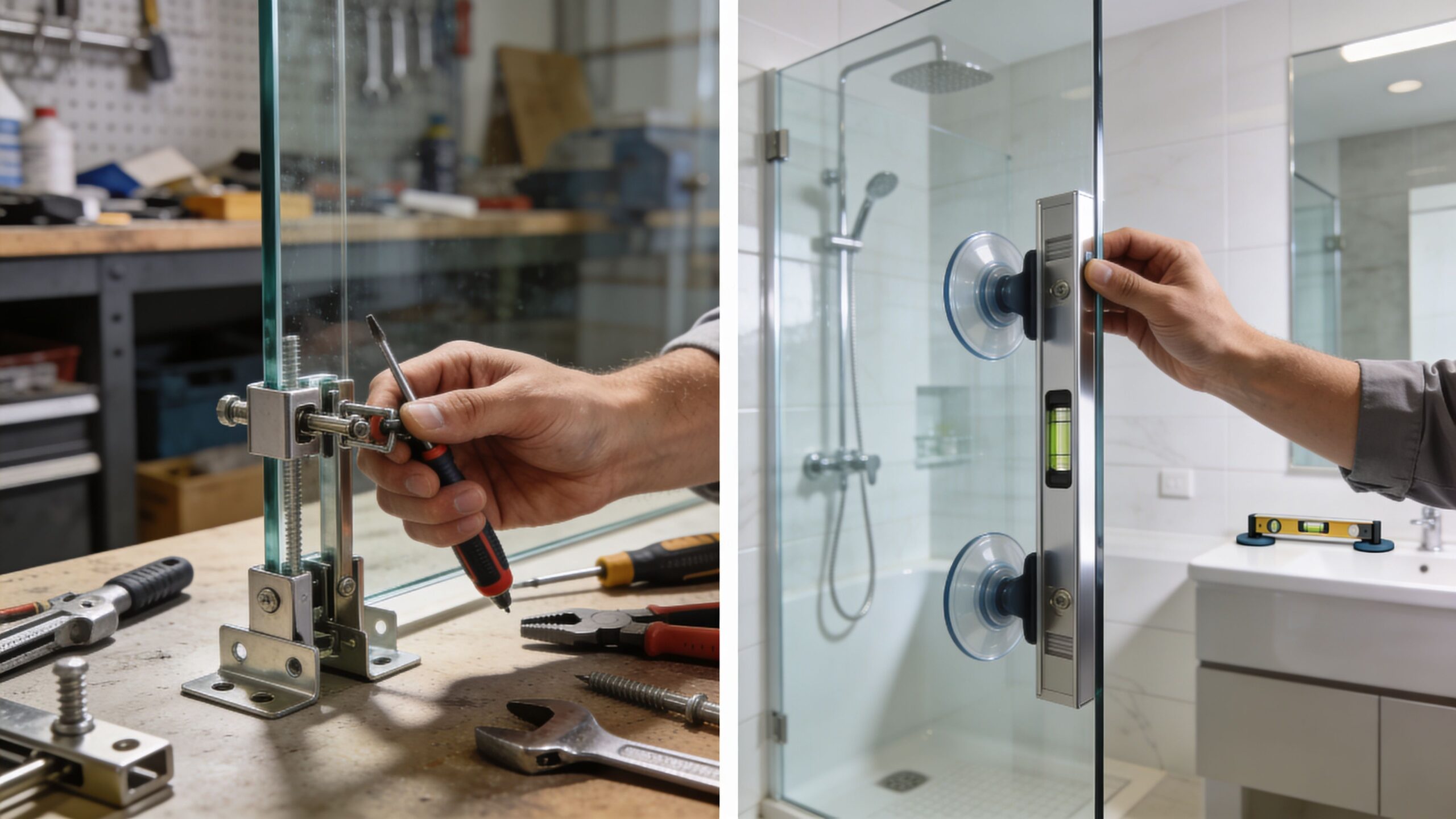
The appeal of DIY is obvious. You buy the kit, set aside a weekend, and hope to save on labor. That sounds reasonable until you’re carrying heavy glass through a finished house, drilling tile that can crack, and trying to align hardware on walls that aren’t perfectly plumb.
What DIY usually underestimates
Tempered glass is strong in service and vulnerable at the wrong moment. One careless bump on an exposed edge can end the project immediately. Even before the glass goes up, the installer has to identify studs or suitable backing, choose the right anchor approach, and keep every drilled location aligned with the actual hardware geometry.
Then there’s the tile itself. Porcelain, natural stone, and large-format surfaces don’t all drill the same way. A bad bit, poor cooling, rushed pressure, or slight walking at the start of the hole can leave you with a cracked finish and a much bigger repair than a shower door problem.
Where professionals earn their keep
Professional installation is about risk control as much as labor. The installer has to set the track and supports correctly, protect the finished materials, align the panels, tune the roller travel, and seal the enclosure so it performs in real use.
That matters even more on specialty openings. Neo-angle sliding shower doors require extreme measurement precision for the angled panels to meet properly, and homeowner installation often leads to water leakage at the seams and improper door operation, as reflected by the product category gap noted on Home Depot’s neo-angle sliding shower door listings.
When a shower door leaks, binds, or drags, the problem usually started long before the first bead of silicone.
A practical comparison
| Decision point | DIY approach | Professional approach |
|---|---|---|
| Measuring | Usually tape-based and optimistic | Condition-based and fabrication-aware |
| Tile drilling | High risk for inexperience | Controlled technique and proper tooling |
| Glass handling | Physically difficult and unforgiving | Managed with trained handling methods |
| Alignment | Often adjusted by trial and error | Set intentionally from the start |
| Final performance | Can work, can also disappoint | More consistent operation and finish |
When DIY makes the least sense
If the kit is framed and the opening is simple, a very capable homeowner may get acceptable results. I still wouldn’t call it easy, but it’s more forgiving.
DIY becomes a poor bet when the project includes any of the following:
- Heavy frameless glass: The tolerances are tighter and the handling risks are higher.
- Uneven walls or curbs: The opening already needs correction or compensation.
- Angled or custom geometry: Neo-angle work punishes small errors.
- High-end tile and finishes: The cost of one mistake can exceed the labor you tried to save.
The installation decision isn’t just about convenience. It’s about whether the shower will feel refined or improvised once the room is done.
Understanding Your Investment Costs and Long-Term Value
Most homeowners start with the product price. That’s normal, but it’s incomplete.
A sliding shower door kit isn’t like buying a faucet off the shelf. You’re paying for glass, hardware quality, finish durability, fit, fabrication tolerances, and installation judgment. Two doors can look similar online and perform very differently after daily use in a real bathroom.
What drives the price
The major price factors are easy to spot once you know what to look for:
- Glass specification: Thicker glass and cleaner edgework usually signal a more premium system.
- Hardware quality: Better rollers, stronger brackets, and more corrosion-resistant finishes cost more because they hold up better.
- Configuration complexity: Straight wall-to-wall openings are simpler than angled or custom layouts.
- Installation conditions: Tight spaces, difficult tile, and imperfect openings increase labor because they increase care and time.
Frameless systems usually sit at the higher end of the range because they rely less on forgiving frame structure and more on glass quality and precise hardware integration.
Cheap upfront often means expensive later
I’ve seen homeowners save on the front end and then pay for it in other ways. They fight with rough-gliding doors. They replace worn seals sooner than expected. They call for service because the alignment was never right. In some cases, they replace the whole enclosure after realizing the lower-priced option never matched the room.
That’s why I prefer the total-cost view. A shower door should be judged by how it performs over years, not just what it costs on invoice day.
If you’re trying to coordinate your broader renovation budget and timeline, it helps to understand the bigger project window too. This overview of average bathroom remodel duration is useful as a planning reference for sequencing trades and avoiding rushed finish decisions.
Value in Naples is tied to finish level
In this market, buyers notice bathrooms. They notice whether the glass looks custom, whether the hardware matches the room, and whether the enclosure makes the space feel larger. A well-chosen sliding shower door kit supports resale appeal because it reads as part of a finished design, not as an add-on.
That doesn’t mean every bath needs the most expensive option available. It means the right investment is the one that fits the room, performs properly, and still looks right after years of Florida use.
Preserving Clarity in the Southwest Florida Climate
Southwest Florida is hard on shower glass.
Humidity hangs in the room. Hard water leaves deposits. Near the coast, salt exposure doesn’t help hardware finishes either. If you install a beautiful frameless sliding shower door kit and ignore those conditions, the glass can lose its clean look much faster than homeowners expect.
Why local bathrooms age differently
In a dry climate, many shower doors stay presentable with basic cleaning. Here, residue builds faster and sticks harder. The problem isn’t only appearance. Once minerals and soap film settle in repeatedly, the surface becomes harder to keep clear, and the enclosure starts demanding more work than it should.
Indeed, homeowners often regret treating protection as an optional extra. On a premium door, it shouldn’t be an afterthought.
Coatings are part of the value equation
Protective glass treatments make a real difference in day-to-day maintenance. Diamond-Fusion can reduce cleaning effort by up to 90% and help prevent sealing degradation, which directly addresses long-term durability concerns that many DIY-style product pages don’t discuss, as noted in VIGO’s neo-angle enclosure collection context.
That matters more in Naples than it might somewhere else. Less residue clinging to the glass means less aggressive scrubbing, less frustration, and a better chance the enclosure still looks crisp years from now.
In coastal bathrooms, a protective coating isn’t a luxury feature. It’s part of protecting the finish you paid for.
What actually helps over time
A coated door still needs care, but the routine is easier and more forgiving.
Here’s what works best:
- Use a squeegee consistently: It reduces standing water before deposits can form.
- Choose hardware finishes carefully: Some finishes hold up better in humid, salty air than others.
- Clean with the right products: Harsh abrasives can work against the surface and the hardware.
- Stay ahead of seals: Worn sweeps and seals should be addressed before they create bigger issues.
If you want the glass to stay clear and the hardware to keep operating the way it should, consistent care matters. This guide to shower door maintenance is a practical place to start.
The main point is simple. In Southwest Florida, maintenance isn’t separate from installation quality. They work together. The right coating and the right care routine preserve the look that made you choose frameless glass in the first place.
Your Partner for a Perfect Shower Transformation
A sliding shower door kit can transform a bathroom fast, but only when the decision is made with clear eyes. The best result comes from matching the style to the room, choosing hardware and glass that belong in a wet coastal environment, and refusing to accept “close enough” on measurement or installation.
Framed, semi-frameless, and frameless systems all have their place. But if your goal is a bathroom that feels open, refined, and built around quality, the details matter more than the box label. The track has to be true. The rollers have to be worthy of the load. The glass has to fit the opening you have. And in Naples, the finish has to survive humidity, hard water, and salt exposure.
That’s why homeowners who care about long-term value usually land in the same place. They stop thinking only about product selection and start thinking about execution. A shower door isn’t just purchased. It’s measured, specified, installed, sealed, and maintained.
If you want a result that looks custom, operates smoothly, and holds up over time, work with a specialist who insists on precision.
If you're ready to upgrade your bathroom with a precision-measured, professionally installed sliding shower enclosure, contact AmeriGlass Industries for a free consultation and estimate.