

You're probably here because you've seen both ends of the glass market.
One company promises a “luxury frameless shower” at a bargain price. Another talks about custom mirrors, railings, and enclosures, but the photos all look the same. Meanwhile, a neighbor may already be dealing with the result of a cheap install: cloudy shower glass, loose hardware, uneven gaps, or a panel that never looked quite level from day one.
That's the core problem behind the search for Quality Glass Near Me. Most homeowners aren't just buying glass. They're buying clarity, safety, fit, and a finish that still looks sharp long after installation day.
Finding Quality Glass In A Crowded Market
A bad glass job usually looks fine at first. The trouble shows up later.
A frameless shower starts collecting mineral stains that won't wipe off. A mirror has a slight color cast that makes the whole vanity feel off. A railing feels sturdy enough, but the detailing around the edges tells a different story. Homeowners often blame the material when the issue was a weak combination of material choice, fabrication quality, and installation discipline.
That matters in a large, competitive industry. The U.S. glass manufacturing industry was valued at USD 22.9 billion in 2024 and is expected to reach USD 34.9 billion by 2034, which reflects strong demand and heavy competition in construction-driven regions such as Southwest Florida, according to Growth Market Reports on the U.S. glass manufacturing industry. In a market that big, some companies compete on craftsmanship, and some compete on speed and price alone.
What homeowners usually miss
The phrase “quality glass near me” sounds simple, but it hides three separate decisions:
- Material quality: Is it standard clear glass or low-iron ultra-clear glass?
- Fabrication quality: Are the edges polished properly, are cutouts clean, and is the tempering appropriate for the application?
- Installation quality: Was the opening measured precisely, and did the installer account for wall variation, humidity, hardware load, and long-term maintenance?
If even one of those fails, the whole project suffers.
Practical rule: Judge a glass company by what the work looks like a year later, not what the quote looks like today.
Marketing claims versus real standards
Plenty of local companies say they offer custom work. That word means very little on its own. A serious provider should be able to explain how they measure, how they choose hardware, how they handle site protection, and what they recommend for long-term care in a Florida home.
Homeowners can also learn a lot by watching how service companies present expertise online. The same signals that help buyers identify established contractors are often discussed in broader strategies to dominate home service market guidance. If a company can't clearly explain its process, that usually shows up on the jobsite too.
A good starting point is to review a company's background, scope of work, and project philosophy on its About Us page for a Southwest Florida glass specialist. You're looking for signs of precision, not adjectives.
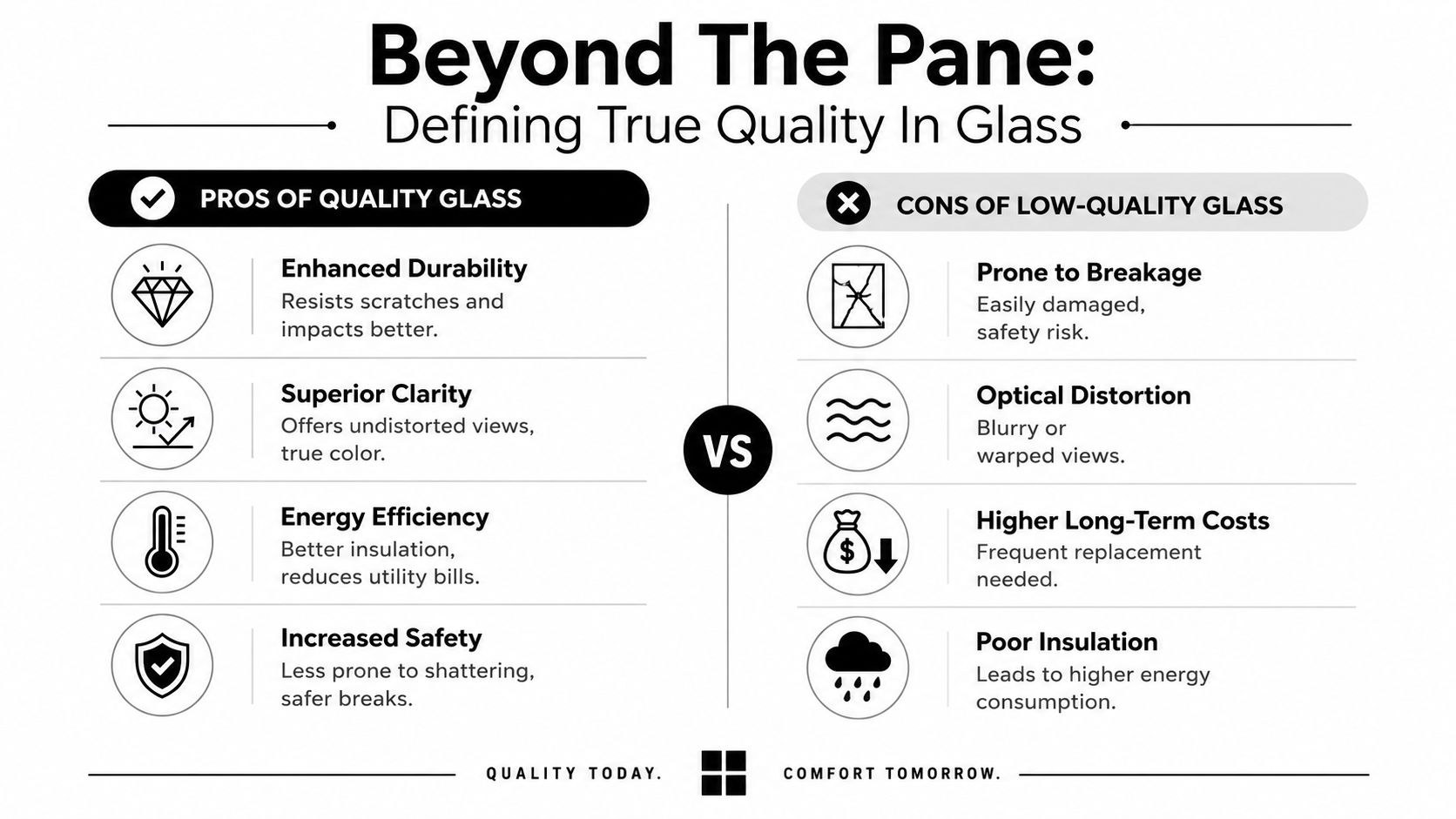
Beyond The Pane Defining True Quality In Glass
A shower can look sharp on install day and start looking tired within months if the glass choice was wrong from the start. In Southwest Florida, quality shows up later. You see it in color accuracy, edge finish, how the panel handles daily use, and how well it holds clarity in heat, humidity, and hard water.
Homeowners often focus on style first. The better question is how the glass will perform after a year of cleaning, steam, and mineral exposure.
Standard clear versus low-iron ultra-clear
Standard clear glass usually carries a noticeable green cast, especially along the edges and in thicker pieces. In some projects, that tint is minor. In others, it changes the way white tile, natural stone, paint, and lighting read through the panel.
Low-iron glass reduces that color shift and gives a cleaner view of the materials behind it. That difference is easy to spot in frameless showers, railings, partitions, and mirror applications where the design depends on crisp lines and true color. Homeowners comparing options often get the clearest sense of that difference by looking at ultra-clear glass for residential and commercial applications before they choose hardware or layout details.
That is how premium projects are usually built. Start with the right material, then match the hardware and fabrication to it.
Safety glass is not optional
Railings, larger enclosures, and many shower designs require more than a good appearance. They require the correct safety glass for the application, whether that means tempered, laminated, or a specific thickness and edge treatment that fits the opening and the hardware.
Good shops can explain those choices in plain language. They can also explain where code ends and good practice begins. Minimum compliance may get a panel installed. Long-term performance depends on proper fabrication, accurate sizing, hole placement, edge quality, and hardware that does not put unnecessary stress on the glass.
That distinction is important in a large, competitive industry where some quotes are built around getting to the lowest acceptable number.
Here's a quick comparison that helps:
| Feature | Standard work | Premium work |
|---|---|---|
| Visual clarity | More tint, less color accuracy | Cleaner, more true-to-design look |
| Edge finish | Often acceptable, sometimes rougher in detail | Crisp polishing and cleaner detailing |
| Safety approach | Meets minimum expectations if specified correctly | Built around the exact use case |
| Longevity | More vulnerable to visible wear | Better appearance retention with the right material and coating |
Florida changes the maintenance equation
Southwest Florida is hard on glass. Humidity stays high. Showers run hot. Water leaves minerals behind. Salt air can also shorten the life of lower-grade hardware near the coast.
That changes what "quality" means.
A panel that looks fine in a showroom may become a maintenance problem in a Florida bathroom if the surface is harder to keep clean or the hardware finish is not suited to the environment. Homeowners who want long-term clarity should ask two direct questions: how easily will this glass show buildup, and what has the installer done to reduce that problem over time?
Protective coatings can help, but they are only part of the answer. The base glass still matters. The cut quality still matters. The installation still matters. If the panel is out of plumb, poorly fabricated, or paired with the wrong hardware, premium material will not save the job.
Good glass can still look bad if it is not selected and installed for the climate it lives in.
The best projects are built for real conditions, not showroom conditions. That is the difference between glass that looks good on day one and glass that still looks right after years of daily use in Florida.
From Showers To Wine Cellars Popular Glass Applications
A homeowner calls after a remodel and says the new shower already looks tired. The tile is beautiful, but the glass spots fast, the door feels slightly off, and the hardware finish does not match the rest of the room anymore. That usually comes back to selection, not just installation. Different rooms ask different things from glass, especially in Florida, where humidity, hard water, and salt air expose weak choices quickly.
Frameless showers and custom mirrors
Frameless showers are where quality shows up every day. The panel has to be fabricated accurately, the door has to swing cleanly, and the hardware has to hold up in a wet environment. Homeowners also need to think past day-one appearance. In Southwest Florida, shower glass that is easier to maintain and paired with corrosion-resistant hardware usually keeps its clarity longer and asks for less work week to week.
Low-iron glass is often worth the upgrade in a shower because it cuts the green edge tint and keeps the enclosure looking cleaner and lighter. A protective coating can help with mineral buildup too, but only if the glass, hardware, and fit are right from the start. As noted earlier, coatings help. They do not fix poor fabrication or rushed installation.
A custom mirror solves a different problem. It has to reflect cleanly, fit the wall exactly, and avoid the slight color shift that can make a vanity or home gym feel less finished. On larger mirror walls, edge quality and sizing matter just as much as the reflection itself because even small flaws become obvious.
Here's how that work often shows up in finished interiors:
Railings, partitions, and design-driven enclosures
Railings have less forgiveness than homeowners expect. If panel heights drift, gaps vary, or the polish is inconsistent, the whole run looks sloppy. Good railing work depends on accurate measurements, the correct safety glass, clean edges, and hardware layout that respects the lines of the house.
Interior partitions have a quieter job. They separate space without making the room feel boxed in. That only works when the glass is clear, the fittings are restrained, and the installer pays attention to floor slope, ceiling variation, and adjacent finishes.
Wine enclosures sit somewhere between performance and display. They need to look sharp from across the room, but they also need doors that close properly, joints that stay clean, and glass that does not distract from the collection inside. Homeowners comparing options can review examples of custom glass wine enclosures and cellar designs to see how fit, sightlines, and hardware choice change the final result.
Matching the glass to the room
The right choice depends on how the room is used and how much maintenance you want later.
- For showers: Choose glass that stays visually clean, hardware rated for wet conditions, and fabrication that accounts for out-of-plumb walls.
- For mirrors: Prioritize reflection quality, exact dimensions, and polished edges that suit the room.
- For railings: Ask what safety glass is being used, how edges are finished, and how alignment will be controlled across the full run.
- For wine enclosures: Focus on door fit, visual balance, and details that support long-term performance, not just showroom appeal.
Homeowners who are comparing companies should also pay attention to the business behind the work. The complete guide for Florida business insurance gives useful context on what proper contractor coverage looks like before you sign a proposal.
The best glass application is the one that fits the room, the climate, and the level of upkeep you can live with for years.
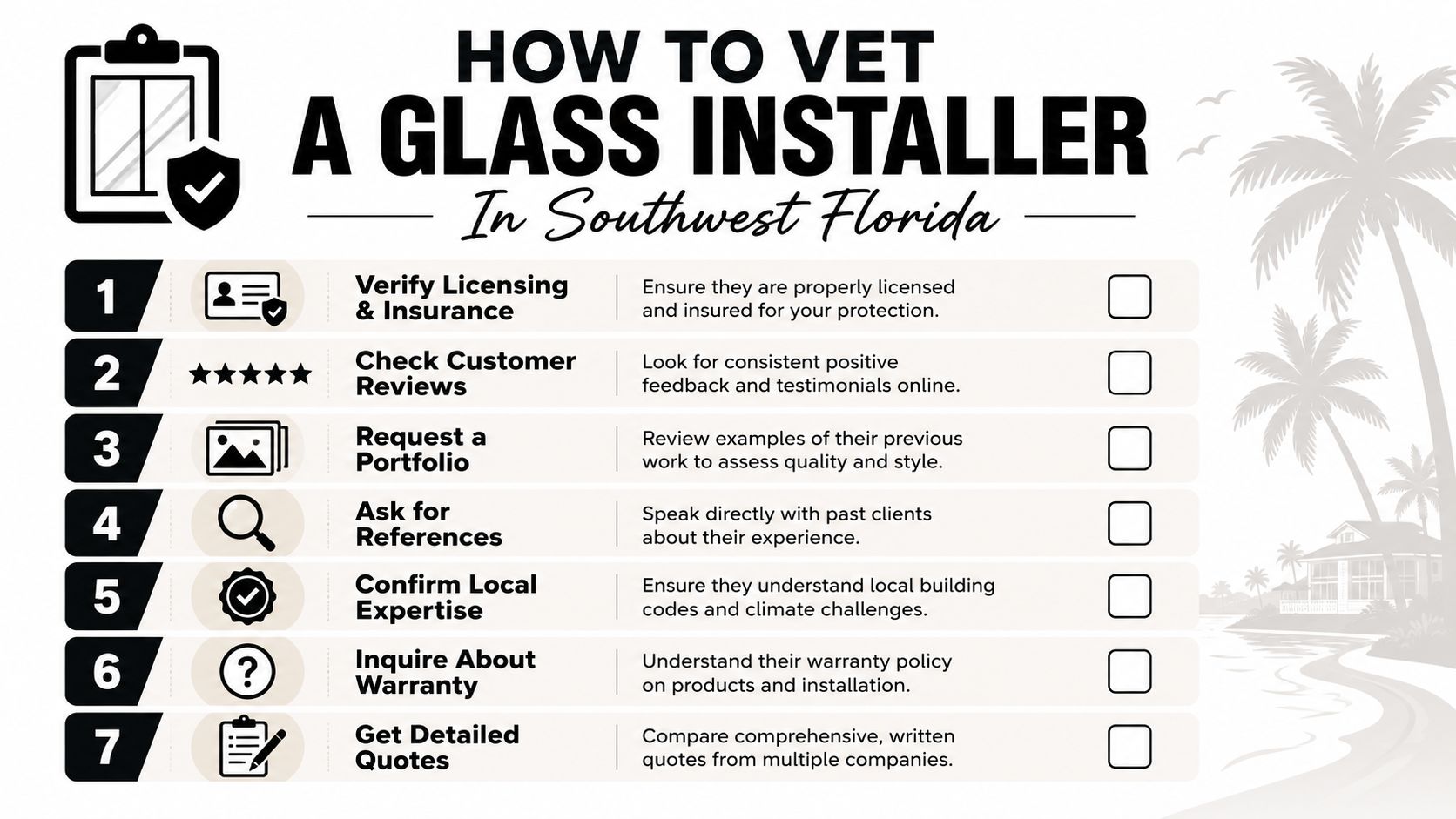
How To Vet A Glass Installer In Southwest Florida
A high-end glass panel installed poorly is still a poor job.
Homeowners often spend most of their time comparing products and almost no time comparing installation standards. That's backward. Glass is unforgiving. If a measurement is off, if the walls are out of plumb and no one plans for it, or if hardware placement is rushed, the finished result tells on the installer every day.
What to ask before you sign
Start with the basics. Licensing and insurance are not optional. Neither is a written scope of work.
If you want to understand what proper coverage should include, this complete guide for Florida business insurance gives useful context for homeowners evaluating any contractor, not just glass companies. A company that's vague about insurance usually isn't just vague about insurance.
Then go deeper:
- How do they measure? A careful installer doesn't treat every opening as square.
- Who performs the install? In-house crews usually provide more consistency than loosely managed subcontractors.
- How do they protect the home? Ask about floors, countertops, tile, and cleanup.
- What happens if adjustments are needed? Good companies answer this directly, without dodging.
- Do they explain maintenance? This matters more in Florida than most buyers realize.
A useful sign of professionalism is whether the company talks about care after installation. Verified industry analysis notes that fewer than 15% of residential glass providers in high-humidity regions explicitly address maintenance protocols, which leaves many homeowners uninformed about preserving clarity and finish over time.
Look at more than finished photos
Portfolio photos are helpful, but they don't tell the whole story. Ask to see examples of tighter-detail work such as mitered mirror layouts, oversized panels, corner shower returns, or complex railing runs. Those projects reveal whether the company works with discipline or just photographs well.
This short video gives a visual sense of the type of workmanship details homeowners should pay attention to during evaluation.
A simple screening table
| Question | Why it matters | Weak answer | Strong answer |
|---|---|---|---|
| Are you licensed and insured? | Protects your property and project | Vague or delayed | Immediate, documented |
| How do you handle out-of-square openings? | Prevents fit and alignment problems | “We'll make it work” | Specific measuring process |
| What do you recommend for maintenance? | Affects long-term clarity | Little guidance | Clear care instructions |
| Is there a written warranty? | Defines accountability | Verbal promises | Written labor and material terms |
Homeowner check: If a company rushes past measurement, maintenance, or warranty questions, slow the process down. Those are the details that decide whether the install ages well.
Local knowledge matters too. Southwest Florida homes deal with humidity, salt air, and intense sun exposure. An installer should be comfortable discussing those conditions without sounding rehearsed.
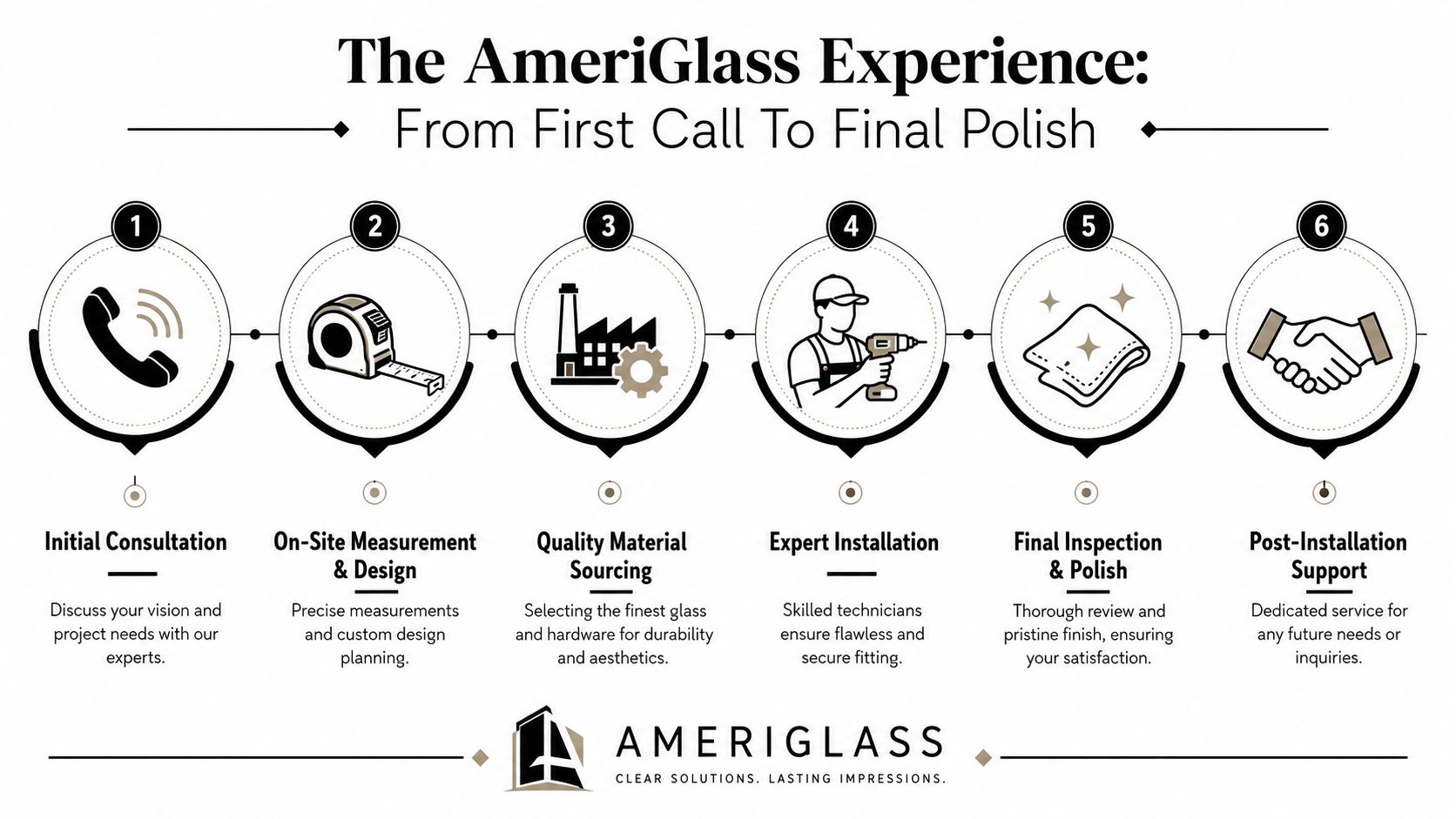
The AmeriGlass Experience From First Call To Final Polish
A homeowner calls after getting three glass quotes that all look close on price. Six months later, the difference shows up in the details. One shower door drags, one panel hazes faster than expected, and one still looks square, clear, and quiet every time it opens. That gap usually comes from process, material selection, and local judgment, not sales language.
What a disciplined process looks like
A proper first call should sort out more than width and height. The right shop asks where the glass is going, how the room handles moisture, what finish level you expect, and whether the opening has any movement, slope, or framing limitations. In Southwest Florida, those questions matter because humidity, salt exposure, and hard water can shorten the life of a good-looking install if the glass type or finish is chosen poorly.
Then the field work starts. Final measurements need to happen after tile, stone, or finished surfaces are complete, and they need to account for walls that are out of plumb or corners that are not perfectly square. Frameless glass does not forgive lazy measuring. Premium work starts with accurate dimensions and a fabrication plan that matches the opening you have.
Technical knowledge shows up before installation
A capable glass company should be able to explain why one product will stay clearer or perform better than another in Florida conditions. For exterior glass, the U.S. Department of Energy explains that in cooling-dominated climates, windows with a lower Solar Heat Gain Coefficient can reduce unwanted heat gain, and lower U-factors reduce heat flow overall, both of which matter in hot climates like Florida, as noted in the Energy Saver guidance on energy-efficient window attachments. That conversation tells you whether the company understands glass as a performance product, not just a cut piece of material.
That same mindset carries into interior work. In showers, for example, the better recommendation may be clearer low-iron glass, a protective coating, or hardware finishes that hold up better in a damp bath. In a wine room, seal quality and panel layout can matter more than a lower upfront number. Good installers explain those trade-offs before fabrication starts, because changes are expensive once the glass is ordered.
Clean execution matters
Install day should look controlled. Panels arrive protected, floors and adjacent finishes are covered, hardware is staged, and the crew checks alignment before final tightening. Clean reveals, consistent gaps, and smooth door swing do not happen by accident.
The closeout matters too. Homeowners should leave with care instructions, warranty terms, and a clear understanding of what was installed and how to keep it looking right in a humid climate. If you also need help with exterior glass care, it helps to find quality window washing services that understand surface protection and proper cleaning methods.
For homeowners comparing companies, the fastest way to judge process quality is to request a custom glass project quote in Southwest Florida and pay attention to the questions asked before any price is finalized.
Maintaining A Flawless Finish And Frequently Asked Questions
Six months after a shower install, the difference between standard work and premium work gets obvious. One enclosure still looks clear with basic upkeep. Another already shows haze near the bottom edge, spotting around the handle, and hardware that never looks fully clean in Southwest Florida humidity.
Good glass helps, but maintenance is what protects the investment. The goal is simple. Keep minerals, soap residue, and moisture from sitting on the surface long enough to leave a permanent mark.
Daily habits that keep glass looking better
For shower glass, a short routine beats occasional heavy scrubbing. Pull a squeegee across the panel after use. Wipe down the metal. Leave the enclosure open long enough for the space to dry out.
That matters more in Florida than it does in drier climates. Warm, damp air gives residue more time to cling to glass and hardware, especially in bathrooms with weak ventilation.
A few practical rules make a real difference:
- Use soft tools: Microfiber cloths, non-abrasive sponges, and approved cleaners protect the finish.
- Avoid aggressive products: Gritty powders, harsh acids, and rough pads can scratch glass or wear down protective coatings.
- Clean the hardware too: Hinges, handles, and clips collect moisture and residue just like the glass does.
- Follow the installer's care instructions: Coated glass, low-iron glass, and different hardware finishes do not all get cleaned the same way.
Homeowners who want a more detailed care routine can review this frameless shower door maintenance guidance to keep clarity longer and avoid common cleaning mistakes.
If you need outside help with surrounding glass or exterior panes, it also helps to find quality window washing services that understand proper cleaning methods instead of treating every glass surface the same way.
Frequently asked questions
Is frameless glass safe for a family bathroom?
Yes, if the enclosure uses the correct safety glass, proper hardware, and accurate installation. Safety comes from the full system, not the frameless style alone.
Is ultra-clear glass worth the extra cost?
Usually, yes, if appearance matters. Standard clear glass often carries a green cast, especially at thicker edges. Low-iron glass gives a cleaner look, which is why homeowners notice the upgrade most in showers, wine rooms, and large mirrors.
Do protective coatings matter in Southwest Florida?
Yes. They reduce how quickly minerals and soap film bond to the surface. They do not eliminate cleaning, but they make routine care easier and help the glass stay clearer between cleanings.
What is the biggest mistake homeowners make after installation?
Using the wrong cleaner and waiting too long to remove buildup. Once staining or etching sets in, cleaning gets harder and results are less predictable.
How long should a quality installation keep its appearance?
With the right glass, the right coating, and consistent care, it should hold its appearance for years. A quality glass installation maintains its value and appearance long after the project is complete.
If you want a glass company that treats clarity, fit, safety, and long-term performance as part of the same job, AmeriGlass Industries is worth contacting. They serve Southwest Florida homeowners and commercial clients with frameless shower doors, custom mirrors, railings, partitions, and wine enclosures built for demanding conditions and finished with care.