
Outside noise in Southwest Florida rarely arrives one sound at a time. It layers. A pool pump kicks on before sunrise. A yard worker starts up a leaf blower across the street. Traffic keeps a steady rumble in the background. By afternoon, you close the windows and still hear more than you want.
That's usually when people start searching for laminated glass soundproofing. They're not chasing a technical upgrade. They want a bedroom that feels calm again, a home office where calls sound professional, or a living room where the TV doesn't compete with the road outside.
The good news is that laminated glass can help. The part that confuses people is how it helps, how much it helps, and why the final result depends just as much on the install as the glass itself.
From Noisy Distraction to Peaceful Sanctuary
If you live near a busy corridor, a school route, or a neighborhood where service trucks seem to rotate all day, you already know the pattern. The sounds aren't always deafening. They're repetitive. That repetition is what wears on you.
A homeowner might call and say, “My windows look fine, but the house still sounds open.” That's a smart observation. Noise control isn't only about having glass in the opening. It's about having the right glass, in the right build-up, installed the right way.

Many people assume laminated glass is automatically “soundproof.” That's the first misconception to clear up. Data summarized by Burton Acoustix on laminated glass sound control notes that laminated glass alone typically improves sound reduction by only 1 to 3 dB over single-pane glass, that a 6.5 mm laminated sheet reaches about 32 dB at 400 Hz, and that the stronger results usually come from asymmetric insulated glass units with 16 to 20 mm air gaps reaching STC 38 to 45, while laminated glass alone lands around STC 34 to 37.
That doesn't mean laminated glass is overrated. It means you need realistic expectations. Laminated glass is often the start of a quieter room, not the whole answer by itself.
People don't usually need “perfect silence.” They need the outside world to stop dominating the inside of the house.
If you're comparing products before talking to a local installer, it can help to see how other manufacturers frame acoustic options. Resources like Cascade window options for sound can help you understand the kinds of configurations that matter before you commit to any specific system.
The Science of Silence in Laminated Glass
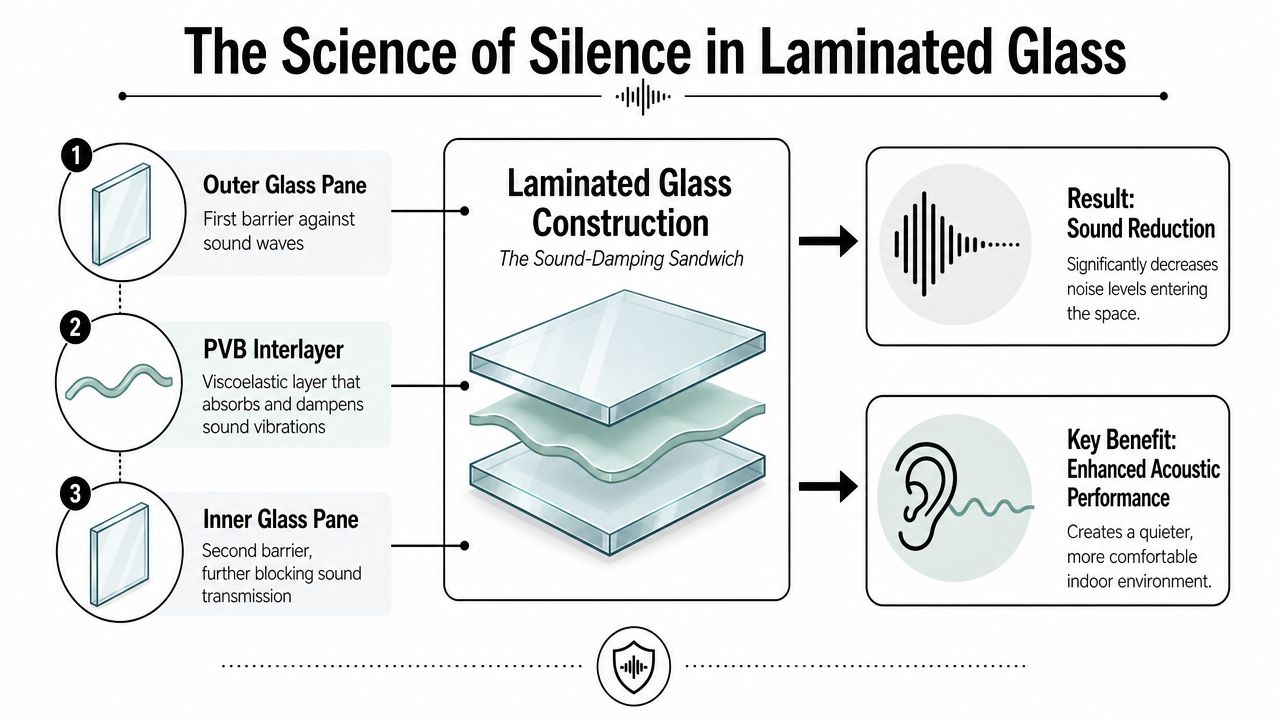
Laminated glass works best when you think of it as a sound-damping sandwich.
You have one layer of glass on the outside, one layer on the inside, and between them sits a flexible plastic interlayer. That interlayer is usually PVB, short for polyvinyl butyral. The two glass layers provide structure and mass. The interlayer changes how vibration moves through the panel.
What the interlayer actually does
Sound is vibration. When noise hits ordinary glass, the pane vibrates and passes part of that energy through to the room. Laminated glass interrupts that transfer. The PVB layer flexes, absorbs part of the vibration, and dissipates energy instead of letting the whole sheet behave like one rigid drum surface.
That's why laminated glass often performs better than people expect against speech, television noise, and many common neighborhood sounds. It isn't just “thicker glass.” It's glass with a built-in damping layer.
A useful everyday comparison is a vehicle suspension. A rigid frame transmits every bump. A shock absorber softens the movement before it reaches the cabin. The interlayer plays a similar role inside the glass build-up.
The numbers behind the concept
A standard benchmark from Thermawood's laminated glass soundproofing guide shows that a single 6.5 mm sheet of laminated glass provides about 32 dB of noise reduction at 400 Hz, and a single laminated pane with a PVB interlayer reaches STC 34 to 36. Those figures give you a realistic baseline for what a single laminated panel can do on its own.
That baseline matters because homeowners often jump from “laminated” to “silent.” The physics doesn't work that way. Laminated glass improves acoustic control by damping vibration, but the rest of the opening still matters.
Practical rule: If the room is bothered mostly by voices, TV noise, and general neighborhood activity, laminated glass often makes a noticeable difference. If the room is battling deeper traffic rumble or aircraft noise, the full window assembly matters more than the pane alone.
Why glass type isn't the only design decision
The interlayer is only one piece of the puzzle. The frame, glazing method, perimeter seal, and surrounding wall condition all influence what you hear after installation. That's true whether you're replacing an exterior window, building a partition, or selecting specialty products such as custom mirrors and specialty glass styles for interior applications where privacy and comfort matter.
Here's the simple version:
- Glass adds mass
- PVB adds damping
- The overall assembly determines the final experience
Once you understand that sequence, laminated glass soundproofing becomes much easier to specify correctly.
Understanding STC Ratings and Acoustic Performance
When people see an STC rating, they often don't know whether the number is impressive or ordinary. The easiest way to think about STC is this. It's like an SPF rating for sound. Higher numbers mean better protection, but only if the product is installed and used as intended.
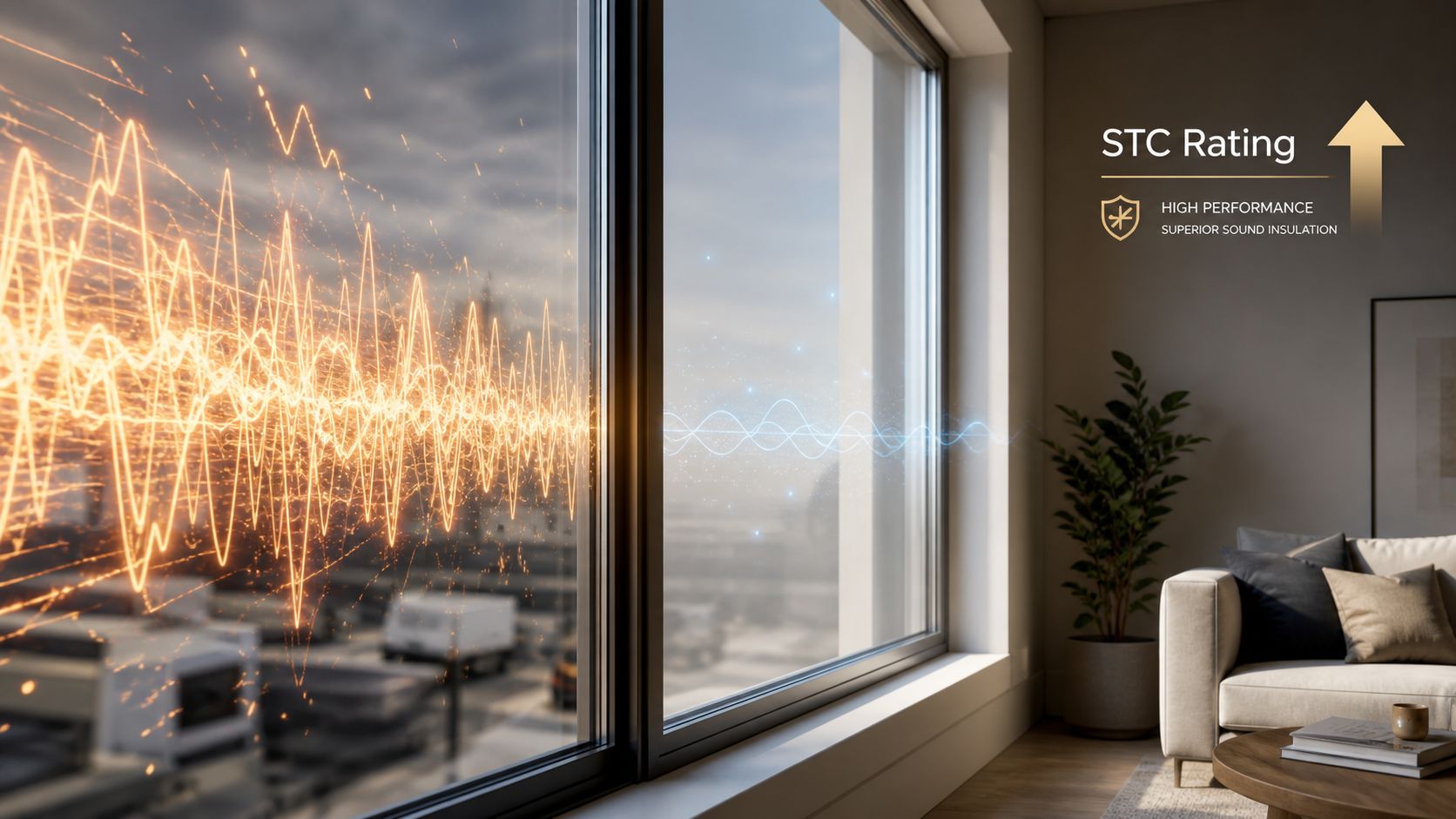
A homeowner doesn't need to memorize testing methods. They need to know what the rating means in daily life. As STC rises, outside sound becomes less intelligible and less intrusive. At lower levels, you still hear speech clearly. At stronger levels, that same noise fades into the background.
How to read the rating without overthinking it
Use STC as a comparison tool, not a magic promise. If one option is rated significantly higher than another, it will usually perform better in controlled conditions. But lab numbers assume the full assembly works properly.
That's where people get tripped up. They shop by glass spec alone, then judge the final result in a real house with frames, joints, sealants, and installation variables.
A good way to evaluate STC is to ask three questions:
- What noise am I trying to reduce
- Is this a single pane or part of a larger insulated unit
- Will the installer protect the rating in the field
What real performance depends on
Acoustic laminated glass with the right interlayer can deliver strong measured performance, but execution still decides whether those numbers make it into the room. According to Activ Glass on laminated glass sound reduction and installation quality, laminated glass systems with acoustic interlayers can achieve 30 to 50 dB of reduction depending on thickness and interlayer composition, but poor installation can reduce the SRI by 5 to 10 dB or more.
That's not a minor detail. A glass package can test well on paper and still disappoint after installation if the perimeter leaks sound.
This video gives a useful visual overview of how sound insulation principles play out in glazing assemblies:
A better way to use STC in a buying decision
Don't ask only, “What's the STC?” Ask:
- What assembly produced that rating. A single panel and a multi-part unit won't behave the same.
- What assumptions were made in testing. Lab performance isn't the same as a field retrofit.
- How will the opening be sealed. Sound control is frequently won or lost depending on this.
A strong STC rating tells you the glass can perform. It doesn't guarantee the installed opening will.
That distinction is what separates a good product choice from a successful noise-control project.
Laminated Glass Compared to Other Window Types
Most buyers don't choose laminated glass in a vacuum. They compare it to what they already have or what a builder already quoted. Usually that means standard single-pane glass, tempered glass, or a regular double-pane insulated unit.
The important point is simple. These products may look similar in a frame, but they do not handle sound the same way.
What changes from one type to another
Standard single-pane glass is the baseline. It's common, economical, and easy to understand. Acoustically, it doesn't do much beyond providing a physical surface between indoors and outdoors.
Tempered glass improves impact behavior and safety, but that doesn't automatically make it an acoustic upgrade. For sound control, tempered glass doesn't bring the damping benefit that laminated glass does.
A standard double-pane IGU adds an airspace between panes, which helps in many assemblies. But if the panes are too similar and the build-up isn't designed for acoustics, it won't always solve a serious noise complaint.
Where laminated glass pulls ahead
According to Expert Glass Repair's guide to soundproofing glass, acoustic laminated glass reaches STC 34 to 38 for a single panel, compared with STC 26 to 28 for standard single-pane glass. The same source notes that when laminated glass is built into a double-pane IGU with one or both panes laminated, the system can reach STC 42 to 50.
That last point is the one many homeowners miss. The best answer is often not “laminated versus double-pane.” It's laminated inside a well-designed double-pane unit.
Glass Type Acoustic Performance Comparison
| Glass Type | Typical STC Range | Best For | Key Benefit |
|---|---|---|---|
| Standard single-pane glass | 26 to 28 | Basic openings where sound control isn't the priority | Lowest baseline option |
| Acoustic laminated glass, single panel | 34 to 38 | Speech, general neighborhood noise, interior partitions | Vibration damping from the interlayer |
| Double-pane IGU with one or both panes laminated | 42 to 50 | Exterior openings with heavier noise exposure | Combines damping with air-gap separation |
The practical buying takeaway
If you're choosing between “just thicker glass” and a true acoustic build-up, focus on the mechanism.
- Single-pane standard glass relies mostly on basic mass.
- Tempered glass changes break behavior, not sound damping.
- Laminated glass reduces vibration transfer.
- Laminated IGUs combine damping with the separation effect of the airspace.
That's why the strongest acoustic packages usually look layered on paper. They are layered by design.
For homeowners and designers also comparing visual clarity in premium interiors, ultra-clear glass options are worth reviewing separately from acoustic performance, since appearance and sound control don't always come from the exact same specification.
Specifying Laminated Glass for Your Naples Home
Noise problems in Southwest Florida aren't all the same. A home near a main road deals with a different sound profile than a condo facing shared amenities or a property under a flight path. The right laminated glass soundproofing approach starts with the source, not the product brochure.
Match the glass to the noise you actually hear
If the problem is mostly conversation, intermittent neighborhood activity, or sound moving between interior spaces, a single laminated panel may be enough. That kind of application is common for offices, interior partitions, and areas where the goal is better privacy and a more composed feel.
If the problem is exterior noise with more force behind it, the smarter move is usually a laminated insulated unit. That gives you the damping benefit of the interlayer plus the additional control that comes from a properly designed multi-pane assembly.
A few common examples help:
- Home office near neighborhood activity. A laminated panel may reduce distraction and improve speech privacy.
- Bedroom facing traffic corridors. A laminated IGU is usually the stronger choice.
- Home near airport activity or persistent road rumble. Ask for an acoustic laminated configuration, not just “upgraded glass.”
- Interior divider in a luxury home. Laminated glass can support privacy without making the space feel closed in.
Southwest Florida buyers often need dual-purpose performance
In this region, people rarely shop for glass based on acoustics alone. They also care about storm durability, safety, and how the finished product looks in the home. That's one reason laminated products keep coming up in serious conversations. They can support multiple goals in a single specification.
If your exterior opening has a real noise problem, don't let anyone reduce the conversation to “single pane or double pane.” The better question is how the full assembly is built.
For builders, remodelers, and homeowners comparing systems across the house, it helps to review the broader range of glass product applications available for residential and commercial projects. The right acoustic strategy often sits inside a larger design and performance decision.
Ask better questions before ordering
A useful consultation should cover more than thickness.
Ask about:
- The dominant noise source
- Whether the pane is laminated with acoustic interlayer material
- Whether the glass is going into a full insulated unit
- How the frame and perimeter will be sealed
- How the assembly fits your home's safety and storm requirements
Those answers usually tell you more than a one-line quote ever will.
The Critical Role of Installation and Sealing
This is the part most articles underplay.
A premium laminated glass unit can arrive at the jobsite with excellent acoustic potential and still underperform after installation. Sound behaves like air and water. It follows the easiest path. If that path is a gap at the frame, a weak perimeter seal, or a poorly fitted glazing bead, the noise doesn't care how expensive the glass was.
Where performance is usually lost
The biggest failures are often small and hard to spot:
- Perimeter gaps that were never sealed tightly
- Loose or poorly fitted beads that let vibration bypass the glass package
- Low-quality weatherstripping that compresses and stops doing its job
- Frame cavities left without the right acoustic treatment
According to Expert Glass Repair's soundproof glass guide, poor installation can undermine 50 to 80% of noise reduction potential, and compression weatherstripping such as bulb-type or fin-type maintains acoustic performance better than foam tape, which can compress permanently within 1 to 2 years.
That single point changes how you should evaluate any quote. You're not buying glass alone. You're buying the installed result.
What a sound-focused installation looks like
A proper acoustic installation pays attention to the entire opening, not just the insulated unit in the middle.
The installer should think through fit, compression, edge conditions, and how the frame meets the surrounding wall. They should also understand where routine cleanup and remedial work can damage seals or leave residue behind. If you've ever dealt with old sealant smears or cleanup after glazing work, practical guides like Pine Country Window Cleaning's advice on silicone removal from glass show why detail work around glass matters long after installation day.
The quietest glass in the catalog won't beat a noisy gap around the perimeter.
Why installer skill matters beyond windows
The same discipline shows up in other precision glass work. Anyone who has seen a carefully fitted frameless shower door installation in Naples understands the principle. Good results depend on exact measurement, proper hardware alignment, clean sealing, and respect for tolerances. Acoustic glazing demands that same mindset, just with sound control added to the checklist.
If the goal is true quiet, installation is not an afterthought. It's part of the acoustic system.
Begin Your Journey to a Quieter Home Today
The journey often begins with a simple frustration. They're tired of hearing too much from outside. By the time they've looked into laminated glass soundproofing, they usually realize the better question isn't “Does laminated glass work?” It's “What assembly and installation will solve my specific noise problem?”
That's the right way to think about it.
A smart project starts with identifying the type of noise, then choosing the right laminated configuration, then making sure the installer protects that performance at the frame, seal, and perimeter. That sequence is what turns a promising product into a room that feels calmer.

If you're ready to move from research to action, the next step should be simple. Gather your questions, identify the loudest rooms, and request a professional evaluation of the full opening, not just the glass. A clear starting point is to request a custom glass project quote so you can compare options based on performance, fit, and installation approach.
A quieter home isn't just a nicer feature. It changes how you sleep, work, and relax inside your own space.
If you want expert help evaluating laminated glass soundproofing and other custom glass solutions in Southwest Florida, contact AmeriGlass Industries. Their team can help you review the opening, the glass specification, and the installation details that make the difference between “better” and quieter.