

You know the bathroom. The one with the oversized plate mirror, the tired vanity light, the framed shower door with a track that never looks fully clean, and finishes that make the whole room feel older than the rest of the house. In Southwest Florida, that dated look gets worse fast because humidity is unforgiving. Caulk stains sooner, metal finishes show wear, and anything that traps moisture starts to look tired.
Most homeowners don't hate their bathroom enough to gut it. They just want it to stop feeling stuck in another decade.
That’s why learning how to update bathroom without remodeling matters. You can change the way the room looks and feels without moving plumbing, tearing out tile, or living through weeks of dust. The biggest wins usually come from surfaces, sightlines, and light. When you choose the right updates, the bathroom reads cleaner, brighter, and more current almost immediately.
Tired of Your Dated Bathroom? Transform It Without Demolition
A full remodel is expensive, disruptive, and often unnecessary when the layout still works. According to HomeAdvisor cost data summarized here, the average bathroom remodel costs around $10,911. That same source notes This Old House has featured bathroom updates completed for less than $1,000 when homeowners focused on construction-free changes like paint, hardware swaps, and lighting.
That gap is the opportunity.
If your tile is intact, your vanity is usable, and the plumbing works, you don't need to treat every outdated bathroom like a demolition project. You need to identify the visual offenders. In most bathrooms, those are easy to spot:
- Bulky shower framing that chops up the room
- Flat, builder-grade mirrors that add no style
- Yellow or harsh lighting that makes finishes look worse
- Old hardware and faucets that date the entire vanity
- Worn caulk and dingy grout lines that signal neglect
The mistake I see most often is homeowners spending money in the wrong order. They start with decor, buy rugs and accessories, and hope the room feels transformed. It usually doesn't. Accessories can soften a bathroom, but they won't fix a dark mirror wall, an awkward light fixture, or a heavy shower enclosure.
Practical rule: Update what your eye lands on first. In a bathroom, that’s usually the mirror, the vanity lighting, and the shower.
A smart refresh works because it improves the room’s architecture without changing the architecture. Better reflection, cleaner glass, coordinated metal finishes, and lighter visual lines can do far more than people expect. If you want to understand why glass makes a room feel more luxurious, this guide on how glass features make a home feel luxurious is a useful reference.
The goal isn't to fake a remodel. It's to stop paying remodel-level money for problems that don't require remodel-level solutions.
Weekend Wins Cosmetic Upgrades for an Instant Refresh
A bathroom refresh should start with quick wins. These are the projects that change the room by Sunday night and help you decide what deserves professional attention later.
Paint the parts that date the room
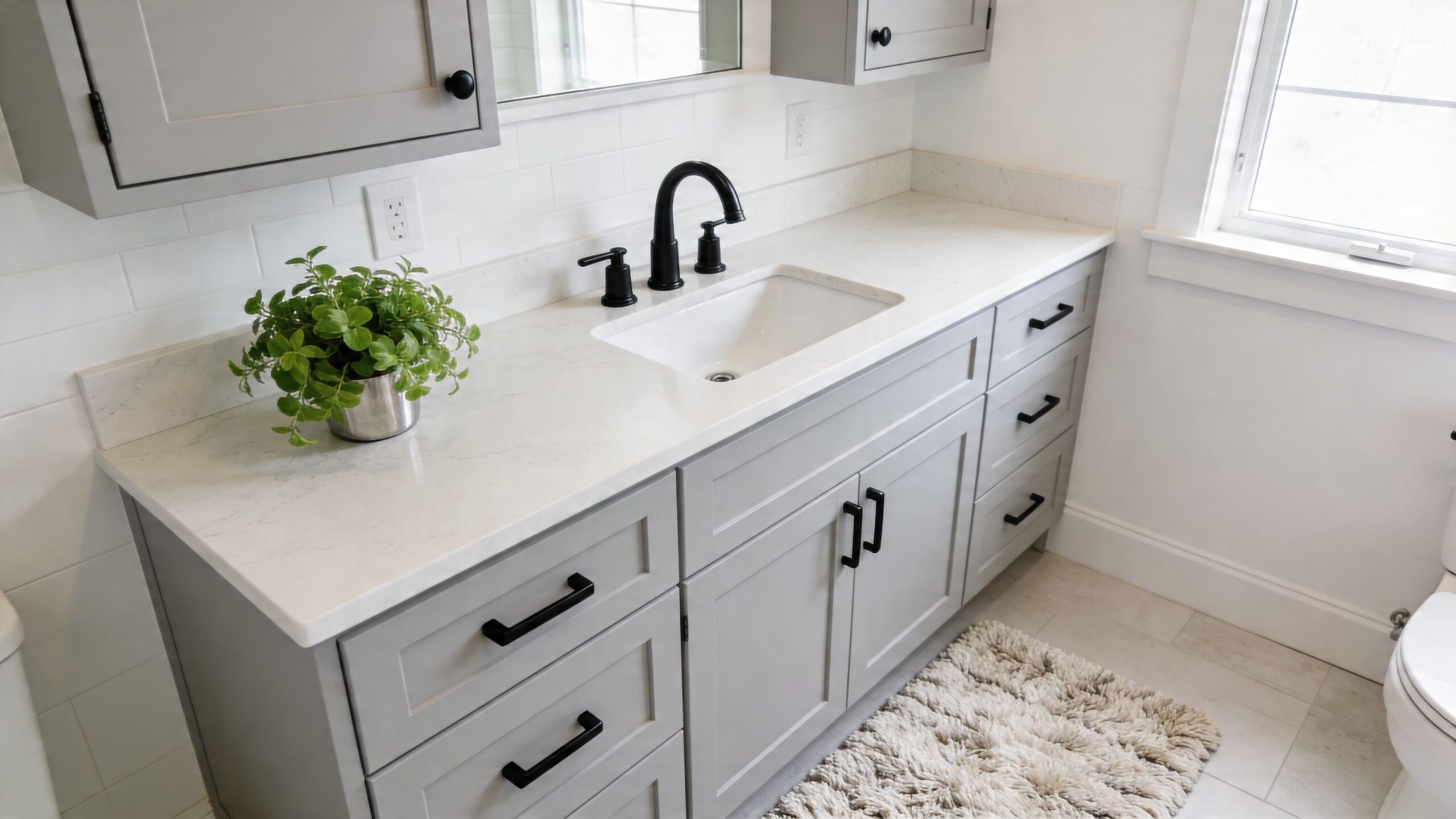
If the vanity is solid but the finish looks tired, paint is often the fastest visual upgrade. In humid bathrooms, prep matters more than color. Clean off residue, lightly sand glossy surfaces, and use products designed for cabinetry and moisture-prone rooms. Skip shortcuts. Paint over soap film or old hairspray buildup, and the finish won't hold.
Walls matter too, but vanity paint usually delivers more visible change. A fresh vanity color can make old counters, floors, and even basic mirrors feel less dated.
What doesn't work? Painting everything the same trendy shade without considering undertones already in the tile. Warm beige tile and icy gray paint usually fight each other. In Southwest Florida homes, especially condos with older flooring, a softer, more balanced palette often ages better.
Swap hardware like a project manager
Hardware is a small line item with outsized impact. Cabinet pulls, knobs, towel bars, robe hooks, and the toilet paper holder should look like they belong to the same room.
Before you buy anything, measure existing holes and spacing. That step avoids turning a simple swap into patching and drilling. The same rule applies to faucets and replacement parts. According to this fixture upgrade guide, a construction-free fixture update depends on buying pieces with identical measurements and connection points, and a faucet replacement can take 15 to 30 minutes when dimensions match.
A good sequence looks like this:
- Measure first: Check pull center-to-center spacing, faucet hole layout, and escutcheon coverage.
- Choose one finish family: Chrome, brushed nickel, or matte black can all work. Mixing finishes by accident looks messy.
- Test one item before buying the full set: This is the simplest way to avoid return headaches.
If the new faucet leaves exposed marks, gaps, or unmatched holes, it wasn't a cosmetic update. It became a repair job.
Fix the details people notice subconsciously
Old caulk and dirty grout make a bathroom feel older than it is. Fresh white caulk around a sink, tub, or backsplash sharpens every surface around it. Grout cleaning or touch-up pens can also make tile look far better without replacing a single piece.
This is the part many homeowners skip because it's not glamorous. It's also the part that makes the rest of the update read as clean instead of half-finished.
A few more low-effort improvements help:
- Replace the shower curtain and liner: If you aren't changing the enclosure yet, crisp fabric and a clear liner help the room feel cared for.
- Change out worn switch plates: Yellowed plastic is a quiet detail that dates the wall.
- Edit the countertop: One tray, one soap dispenser, one plant is enough.
If you want a visual walkthrough before tackling the vanity area, this video is a helpful starting point.
Expand Your Space With Strategic Lighting and Mirrors
Most dated bathrooms don't just have old finishes. They have bad light and weak reflection. That combination makes even a clean room feel cramped.
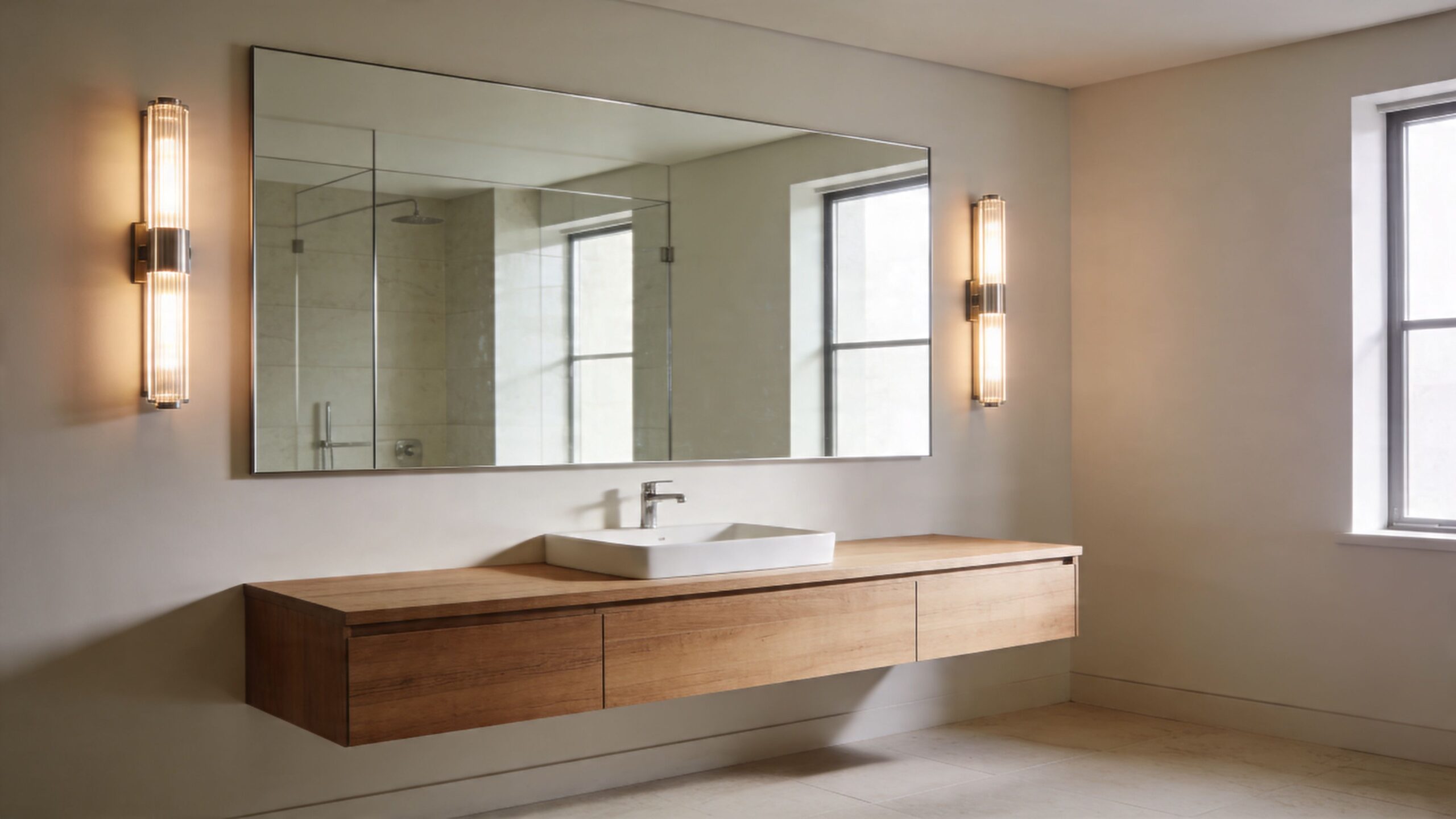
Interior designers consistently lean on one pairing because it works fast. According to Realtor.com’s bathroom update guidance, a large vanity mirror paired with warm white bulbs at 2700K can create the illusion of more space, and that change can be installed in under two hours.
Use warmer light, not harsher light
Older bathrooms often have cool, glaring bulbs that flatten skin tones and emphasize every outdated finish. Warm white light at 2700K is more flattering and more comfortable. It softens the room and gives mirrors, tile, and metal finishes a calmer look.
That doesn't mean the bathroom should feel dim. It should feel layered. If your vanity light is poor, changing bulbs alone may not solve the problem. You may need a fixture that spreads light across the face instead of creating shadows above it.
In bathrooms with low ceilings or no natural light, overhead circulation can help comfort as much as brightness. If you're comparing fixture options for small spaces, this guide to ceiling fans with lights gives useful context on combining airflow and illumination without cluttering the ceiling plan.
Stop treating the mirror like an afterthought
The mirror is one of the largest visual surfaces in the room. It shouldn't be the last decision. A custom mirror can make a compact bathroom feel taller, wider, and cleaner because it reflects more light and removes the awkward proportions common with off-the-shelf pieces.
A few options work especially well:
- Oversized vanity mirrors for single-sink bathrooms where the existing mirror feels underscaled
- Clean-edged frameless mirrors when you want a more modern line
- Metal-rimmed mirrors when the room needs definition against a plain wall
- Backlit styles when you want a softer glow without adding visual bulk
If you're comparing shapes, edge details, and specialty options, these mirror and specialty glass styles show how much range there is beyond the typical builder mirror.
A bathroom can keep its old footprint and still feel larger if the mirror reflects light well and the fixture stops casting shadows.
What usually fails is going too small. Tiny decorative mirrors may look charming online, but in a real bathroom they often make the vanity wall feel fragmented. Larger, properly scaled mirrors almost always produce a more expensive result.
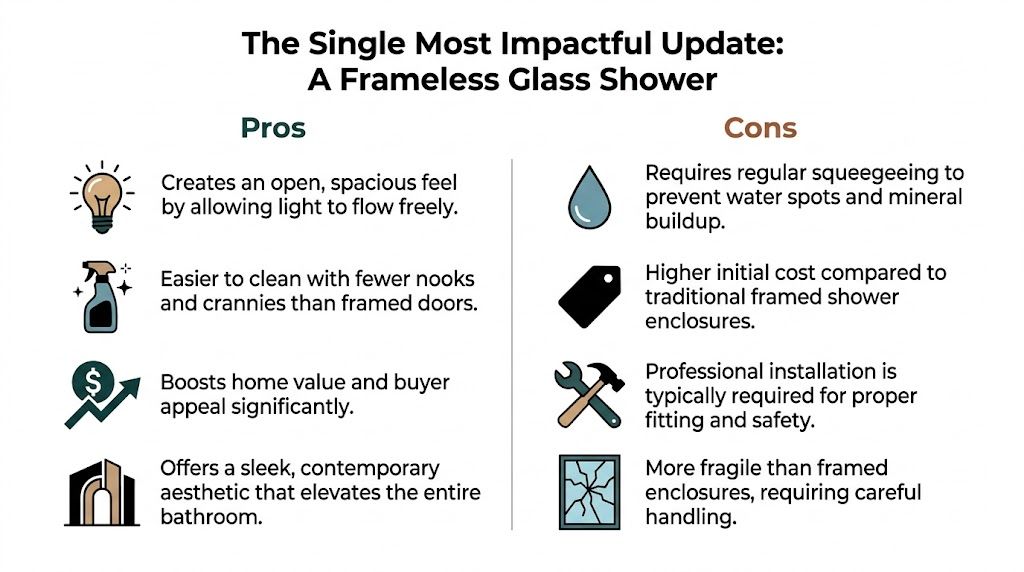
The Single Most Impactful Update A Frameless Glass Shower
If I had to choose one upgrade that changes a bathroom fastest without turning it into a remodel, it would be the shower enclosure.
Most online advice stalls out at shower curtains, new towels, and paint. Those can help, but they don't address the largest visual barrier in the room. A framed shower door, especially an older one with metal tracks, cuts the room into pieces. It blocks sightlines, traps grime in channels, and dates everything around it.
According to a future-dated claim cited in this Houzz-linked roundup, a 2025 NKBA survey found frameless glass updates delivered 25% higher perceived value than paint or lighting alone. The same source notes frameless replacement is a no-demo upgrade, and says ultra-clear glass with protective coatings has grown in popularity in humid climates like Southwest Florida.
Why frameless changes the whole room
Frameless glass does four things at once.
- It opens the sightline: You see tile, wall, and light beyond the enclosure instead of a metal boundary.
- It removes bulky visual weight: Less framing means the room feels cleaner and more current.
- It simplifies maintenance: Fewer crevices and tracks means fewer places for grime and moisture to collect.
- It upgrades the room’s style immediately: Even older tile can look more intentional when it's fully visible.
This matters even more in Southwest Florida. Humidity punishes framed tracks and older seals. Mineral spots also show quickly. That's why protective coatings and glass selection matter. If maintenance is a concern, ask about low-maintenance surface treatments up front instead of treating them like an add-on after installation.
When this is worth the investment
A frameless enclosure is worth it when the tile is serviceable and the room feels visually cramped. It’s also a strong choice when the shower is the thing making the bathroom look old, not the vanity or floor.
It may not be the right first move if the shower opening is out of square, the curb has water management issues, or there are active plumbing leaks. Those problems need to be addressed before any glass goes in.
A few practical trade-offs matter:
Frameless glass looks cleaner because it is cleaner visually. It also asks more of the installation. Measurement, hinge placement, and hardware alignment have to be exact.
That precision is why this isn't a DIY category. Heavy glass, level tolerances, and door swing clearance all matter. If you also need valve work, drain changes, or other shower-side plumbing adjustments before a new enclosure goes in, it helps to coordinate with professional shower installation services so the opening is ready before glass is measured.
What homeowners should ask before ordering
Not every shower opening needs to be rebuilt to accept frameless glass. Many can be measured and fitted as-is if the surrounding surfaces are sound. Before moving ahead, ask:
- Is the tile stable and well-bonded?
- Is the curb pitched correctly so water returns to the shower?
- Will the door swing clear nearby vanities, toilets, or towel bars?
- Do you want ultra-clear glass or standard clear glass?
- Would a protective coating reduce your maintenance burden?
If you want to see what a professionally fitted option looks like in this market, this page on frameless shower door installation in Fort Myers, Florida is a useful benchmark.
Planning Your Project and Knowing When to Call a Pro
Good bathroom updates don't start with shopping. They start with triage. What looks old, what functions poorly, and what can stay for now are three different questions.
In 2024, about 50% of homeowners who renovated their master bathrooms cited outdated style as their main motivation, according to Statista’s bathroom renovation summary. The same source notes the Remodeling 2023 Cost vs. Value Report found midrange bathroom remodels can recoup about 60% to 70% of project costs upon resale. That’s one reason strategic updates make sense. Buyers respond to bathrooms that feel current, even when the layout hasn’t changed.
Prioritize by visibility, not by category
The best planning method is simple. Start with what you see first and what bothers you most every day. Usually that means the vanity wall and the shower, not the floor mat or wall art.
If your budget is tight, do the updates in a sequence that preserves flexibility:
- Clean, repair, and paint
- Change hardware and basic fixtures
- Replace lighting and improve the mirror
- Finish with custom glass or other precision installs
That order prevents rework. You don't want fresh mirror glass splattered with vanity paint, and you don't want to choose hardware finishes before you've settled the larger visual pieces.
Bathroom Update Cost vs. Impact
| Update Type | Estimated Cost | DIY Friendliness | Visual Impact |
|---|---|---|---|
| Paint walls or vanity | Lower than a full remodel | High | Medium to high |
| Hardware and faucet swaps | Lower than a full remodel | Medium if measurements match | Medium |
| Lighting and mirror upgrade | Lower than a full remodel | Medium | High |
| Frameless glass shower installation | Higher than basic cosmetic updates, but below a full remodel scope | Low | Very high |
Know the DIY line
Some tasks are realistic for homeowners. Others are not worth the risk.
- DIY is usually reasonable for painting, caulk replacement, hardware swaps, grout cleaning, and decor edits.
- Proceed carefully with faucet changes and light fixture swaps. They can be simple, but only when existing conditions are straightforward.
- Call a pro for new electrical runs, wall repair behind oversized mirrors, and any heavy custom glass installation.
One bad measurement on a glass panel or one poorly supported mirror can turn a refresh into a safety issue. Bathrooms have hard surfaces, tight clearances, and moisture. Precision matters more here than in most rooms.
Decision shortcut: If the update depends on exact templating, anchoring into tile, or safe handling of heavy glass, it belongs in professional hands.
When you're ready to price out the professional part of the plan, getting a bathroom glass and mirror quote early helps you make better decisions about everything around it.
Your Bathroom Update Questions Answered
Can a very small bathroom still look updated without remodeling?
Yes. Small bathrooms often show improvement faster than large ones because every surface has more visual weight. A larger mirror, better vanity lighting, a cleaner shower line, and tighter color coordination can completely change how the room reads. In powder rooms, scale matters even more. Undersized mirrors and fussy accessories usually make the room feel busier.
What order should I do these updates in?
Do the messy work first. Paint, patch, recaulk, and clean grout before you install replacement lighting, mirrors, or glass. After that, change hardware and faucets, then finish with the mirror and shower enclosure so measurements reflect final conditions.
That sequence avoids damage and keeps the finished work looking intentional instead of pieced together.
Is reglazing a tub or tile worth it?
Sometimes. Reglazing can be a reasonable short-term cosmetic fix when replacement isn't in the budget and the surface is structurally sound. It can improve appearance, but it doesn't change layout, sightlines, or the overall visual weight of older bathroom elements.
If the room still feels dated after reglazing, it's usually because the problem wasn't just the finish. It was the mirror, the lighting, the enclosure, or all three.
What works best in humid Southwest Florida bathrooms?
Choose updates that reduce moisture traps and simplify cleaning. That usually means cleaner glass lines, fewer bulky frames, durable finishes, and materials that don't struggle in damp air. This is also why precise fit matters. Gaps, loose seals, and poor alignment age badly in humid conditions.
How do I know when custom mirror or glass work is worth it?
It's worth it when standard products leave awkward gaps, poor proportions, or a compromised fit. Bathrooms don't hide those problems well. A mirror that's too small or a shower door that's visually bulky affects the whole room every day.
If you're sorting through common questions about fit, measurement, and installation details, this bathroom glass and mirror FAQ page is a useful place to start.
If your bathroom feels dated but the idea of a full remodel makes no sense right now, start with the updates that change light, reflection, and sightlines first. That’s where the biggest visual return usually is. For homeowners in Naples and Southwest Florida who want professionally measured frameless shower doors, custom mirrors, and specialty glass that fits the space correctly, AmeriGlass Industries is a smart next call.