
You're close to the finish line on a bathroom remodel. Tile is in. The vanity is set. Lighting looks right at night and in the morning. Then one detail stalls the whole room: should the shower door be hinged or pivoting?
That question matters more than most homeowners expect. The wrong choice can make a tight bath feel tighter, interrupt a clean sightline, or create an awkward swing path next to a tub, vanity, or toilet. The right choice makes the enclosure feel custom, effortless, and proportioned to the room.
In Naples and across Southwest Florida, that decision also lives in a real-world context. Bathrooms here often lean coastal, transitional, or sharply modern. Many homes fight humidity year-round. Coastal properties also put hardware under extra pressure from salt air. A shower door isn't just a sheet of glass with metal attached. It's a moving system that has to look right, feel right, and hold up.
Choosing Your Frameless Shower Door
Most homeowners reach this decision at the same moment. The major construction work is done, and now every remaining choice feels more visible because it's tied to the finished look of the room. A frameless shower door seems simple until you realize the opening style changes both function and appearance.
A hinge door feels familiar. It reads like a traditional door translated into glass. In many bathrooms, that familiarity is a strength. It can feel crisp, precise, and timeless.
A pivot door feels more architectural. The motion is different, the hardware is placed differently, and the glass often presents as a larger uninterrupted feature in the room. In contemporary Naples homes, that can be exactly the effect a designer or homeowner wants.
Here's the fast side-by-side view before getting into the details:
| Feature | Hinge shower door | Pivot shower door |
|---|---|---|
| How it moves | Swings from side-mounted hinges | Rotates on top and bottom pivot points |
| Best fit | Classic layouts with clear swing space | Tighter layouts or larger statement glass |
| Visual feel | Traditional frameless elegance | More minimalist and architectural |
| Wall demand | Relies on strong wall anchoring | Relies more on top and bottom support |
| Space use | Needs a full swing path | Often works better where clearance is tight |
| Maintenance focus | More hardware at the side | Fewer side hinge areas to clean |
The right answer usually shows up when you stop looking at the door as a product and start looking at the room as a whole. Entry width, nearby fixtures, tile lines, sightlines from the vanity, and the style of the home all push the decision one way or the other.
If you're still sorting through shapes, panel configurations, and door options, a good starting point is this shower door design guide. It helps narrow the conversation before hardware even enters it.
A frameless shower door is one of the few elements in a bathroom that affects movement, maintenance, and visual balance every single day.
Understanding the Core Mechanics
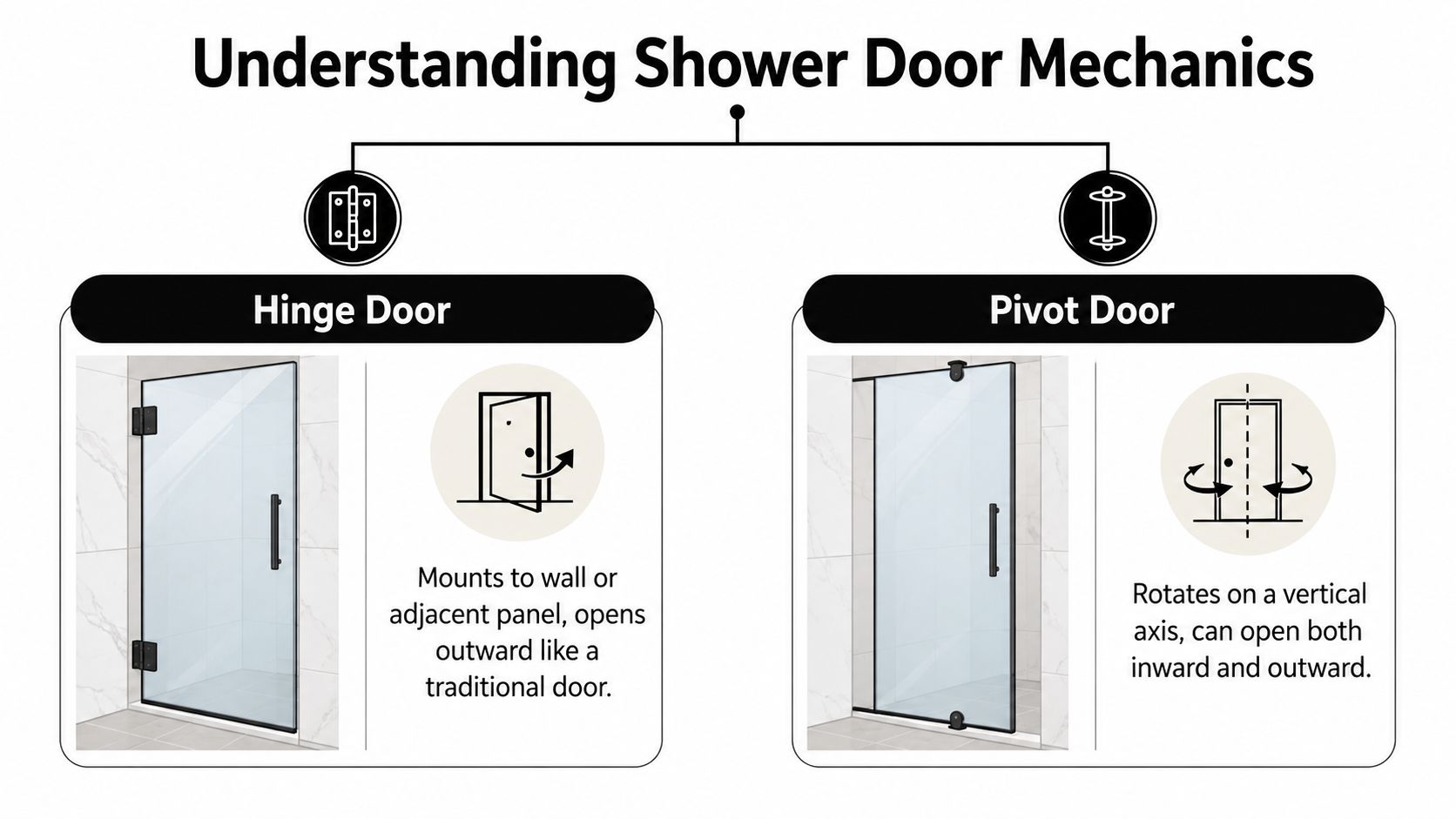
A frameless shower door either asks the wall to carry the work or shifts that work into the door system itself. That mechanical difference affects how the door feels in daily use, how large the glass can be, and what kind of installation the opening can support over time in a humid coastal home.
How a hinge door carries load
A hinge shower door hangs from the side. The hinges fasten to the wall or, in some layouts, to a fixed glass panel, so the supporting surface has to manage the repeated pull of the door opening and closing.
That sounds simple, but in the field it matters a lot. In a Naples bath with large-format porcelain, floated walls, and expensive finished surfaces, the hidden structure behind that tile is part of the decision. A hinge door needs accurate backing, clean fastener placement, and precise alignment. If any of that is off, the problems usually show up as sag, uneven reveals, or a door that stops feeling crisp.
The upside is familiarity. A good hinge door has a straightforward swing and a solid, traditional feel that many homeowners still prefer, especially on a well-proportioned opening.
How a pivot door carries load
A pivot door rotates from hardware at the top and bottom instead of relying only on side-mounted hinges. As explained in this comparison of pivot vs hinged shower door systems, that setup changes how the load is distributed and reduces the demand on the wall alone.
That is why pivot doors often make sense for taller or wider glass. The system supports the panel in a more balanced way, so the door can stay controlled without asking one vertical edge to do all the work. In higher-end bathrooms, that mechanical advantage gives designers more freedom with larger glass and cleaner sightlines.
I also look at who is using the bath. Door motion matters for comfort and safety, especially for older homeowners or multigenerational families. This guide to bathroom safety equipment is broader than shower doors, but it is a useful reminder that ease of entry and predictable operation should be part of the hardware decision.
Why that matters in Southwest Florida homes
In Southwest Florida, mechanics are not abstract. Humidity, salt air, and frequent use put hardware under constant stress, especially in homes near the Gulf or in baths that stay warm most of the year. The better the load is managed and the better the hardware is matched to the opening, the better the door tends to hold its alignment and finish.
This is one reason we pay close attention to hardware selection at AmeriGlass. On a simple opening, a hinged setup may be exactly right. On a larger custom enclosure, a pivot system may be the cleaner engineering choice. If you are comparing formats for a narrower opening or a classic frameless layout, this single shower door option gives a useful reference point for where each approach fits.
Practical rule: Once the glass gets larger or taller, door mechanics stop being a style preference and start becoming an installation decision.
Space and Clearance for Your Bathroom Layout
A bathroom can look perfect on the plan and still feel wrong the first week you use it. I see that most often at the shower entry, where the door swing ends up too close to a vanity corner, a toilet, or the main walking path.
In Naples and throughout Southwest Florida, that matters because many baths are designed to feel open and airy, with larger tile, wider glass, and cleaner sightlines. Those rooms still need a door that clears nearby fixtures comfortably in real daily use, not just on a drawing.
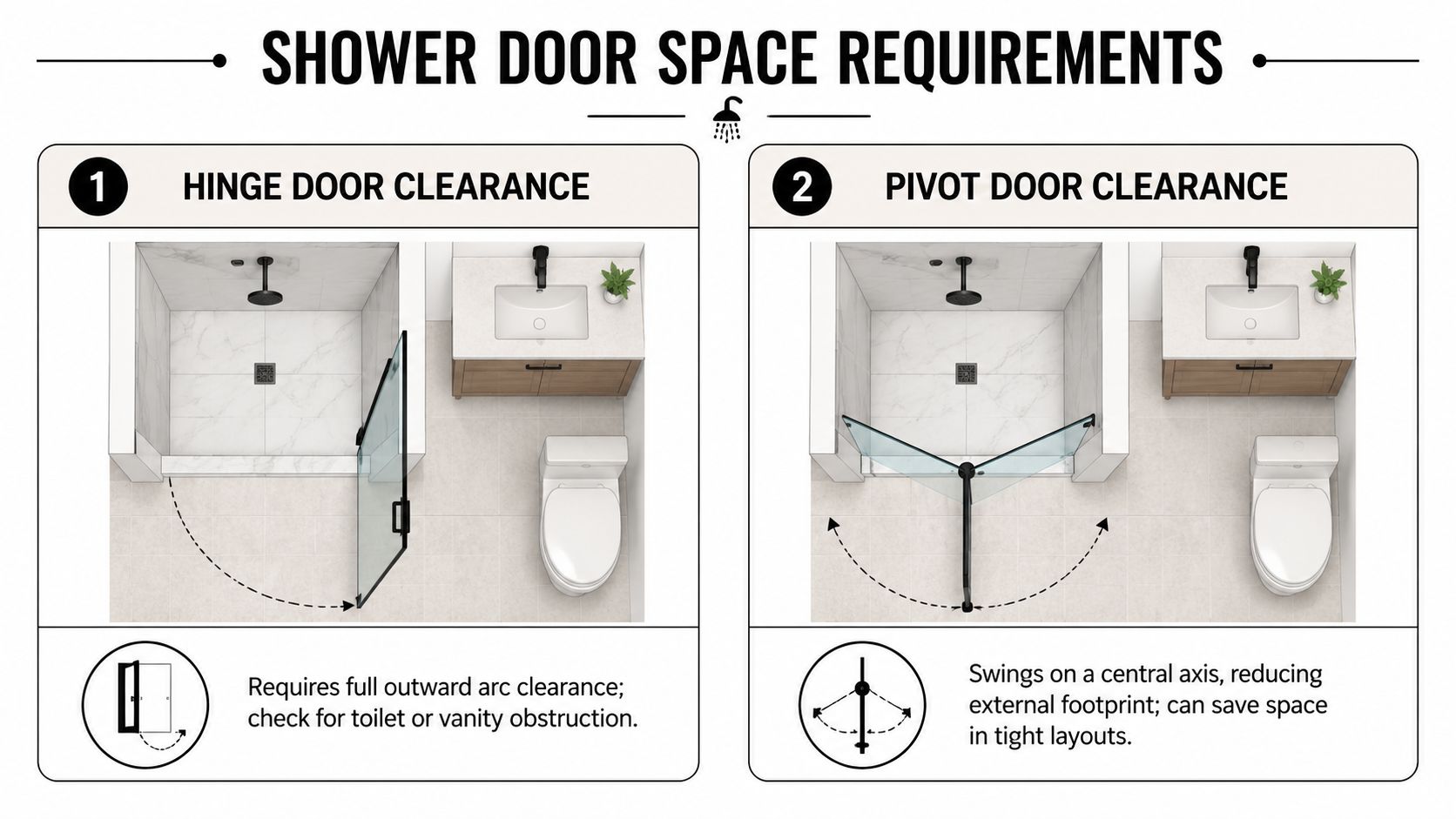
A hinge door needs room for the full swing of the panel. If the opening sits near a vanity, tub deck, or toilet, every inch counts. In a spacious primary bath, that full outward arc may feel natural. In a guest bath, pool bath, or tighter secondary bath, it can crowd the room fast.
A pivot door usually gives you more flexibility because part of the swing happens inward and part outward around the pivot point. The usable opening can still feel generous, but the door claims less floor area in front of the shower. That is often the difference between a layout that feels effortless and one that always feels slightly in the way.
Where hinge doors work well
Hinge doors make sense when the opening faces clear floor space and the user can approach the shower without stepping around another fixture.
- Wide primary bath entries with open circulation in front of the enclosure
- Walk-in shower layouts where the door can swing freely without clipping sightlines or traffic flow
- Traditional or transitional homes where a familiar side-hinged motion fits the room
They also pair well with glass that is meant to disappear visually. In a bath with bright stone, soft coastal light, and minimal metal, ultra-clear frameless shower glass helps the enclosure read cleaner, but the swing still has to work on the floor plan first.
Where pivot doors solve layout problems
Pivot doors tend to fit better when the bathroom has tighter clearances or competing elements close to the opening.
- A toilet near the shower entry
- A vanity end panel close to the door path
- A tub or bench adjacent to the enclosure
- A narrower room where the main walkway passes the shower
That comes up often in Southwest Florida remodels, especially in older Naples homes where the footprint stays the same but the finishes get upgraded. Homeowners want larger glass, better hardware, and a more current look without relocating plumbing or stealing space from the rest of the bath. A pivot door can solve that constraint cleanly.
Ease of entry matters too, especially for older homeowners and multigenerational families. If aging in place is part of the plan, this guide to bathroom safety equipment is useful for thinking beyond the shower door alone.
This short video helps visualize why swing paths matter more than people expect:
The best shower door layout feels obvious once it is installed. Getting there takes careful measuring, tested clearances, and hardware that suits the room instead of fighting it.
Aesthetics and Modern Design Impact
The hinge vs pivot shower door question changes the room visually even before anyone touches the handle. Hardware placement, sightlines, and the amount of visible metal all affect how “clean” the enclosure looks.
What your eye notices first
With a hinge door, your eye picks up the side-mounted hardware. That's not a flaw. In many bathrooms, visible hinge points lend the enclosure a custom, intentional appearance. They frame the door edge and make the motion feel familiar.
A pivot door tends to pull your attention toward the glass itself. Because the hardware is concentrated at the top and bottom pivot points, the door can read as a larger uninterrupted pane. That often suits minimalist interiors, modern coastal homes, and bathrooms with long tile runs or bookmatched stone where you want less visual interruption.
Matching the door to the house
In Southwest Florida, the surrounding architecture matters. A sleek new build in Naples with large-format porcelain, linear drains, and floating vanities often benefits from the more architectural look of a pivot system. A transitional home in Bonita Springs with warmer cabinetry, softer stone, and polished hardware may look more resolved with a hinge door.
Neither style is automatically more upscale. The stronger choice is the one that matches the language of the room.
Here's a quick design read:
| Design priority | Usually favors hinge | Usually favors pivot |
|---|---|---|
| Classic frameless look | Yes | Sometimes |
| Minimal visible hardware | Sometimes | Yes |
| Architectural glass statement | Sometimes | Yes |
| Traditional door feel | Yes | No |
| Modern coastal style | Sometimes | Often |
Glass choice changes the outcome
Hardware gets attention, but glass clarity matters just as much. In a bright bathroom with natural light, standard clear glass can show a green cast, especially at the edges. For homeowners aiming for a lighter, more refined finish, ultra-clear low-iron glass can make a noticeable difference.
That's especially true when the shower tile is pale, the room uses soft whites, or the goal is a clean coastal palette rather than a darker contrast. In those cases, the door style and the glass type need to be chosen together, not separately.
The best shower doors don't call attention to the hardware first. They let the room read as a whole.
Installation Water Containment and Maintenance
A Naples homeowner usually notices installation quality after the bathroom is finished. The door drifts slightly, a corner stays wet, or mineral buildup starts collecting around hardware that looked sharp on day one. Hinge and pivot doors can both perform well, but they need different support, different detailing, and different maintenance habits.
Installation demands are different
A hinge door puts its working load on the wall. That makes wall condition, blocking, tile drilling, and exact anchor placement especially important. In many Southwest Florida remodels, we are drilling through large-format porcelain or natural stone, and there is very little room for sloppy field work. If the opening is out of plumb and the glass is fabricated as if it were perfect, the door may open poorly, settle, or fight the strike side over time.
A pivot door changes the load path. More of the door weight is managed through the pivot points and the floor or curb interface, with alignment at the top doing its share of the work. That can be an advantage in some larger openings, but only if the curb, threshold, and surrounding surfaces are flat and properly prepared. A pivot system installed on a slightly twisted opening will show it quickly.
Water containment depends on the whole enclosure
Door style alone does not decide whether a shower leaks.
Water control comes from the full layout. The curb pitch, door sweep, strike-side seal, fixed panel position, panel overlap, and shower head location all matter. I have seen hinge doors stay dry for years because the opening was detailed correctly. I have also seen expensive pivot doors push water out onto the bath floor because the spray pattern was aimed right at the gap and the curb was pitched poorly.
Tile selection affects this more than many homeowners expect. If you are still choosing ceramic tile for your remodel, pay attention to how the tile size, grout joints, and curb finish will meet the enclosure. Those decisions affect both the finished look and how cleanly water is directed back into the shower.
For openings that need extra control at the edge, fixed splash guards for frameless shower enclosures can solve a real problem without making the enclosure feel heavy.
Maintenance is mostly about hardware access and water quality
In daily use, pivot doors often have fewer side-mounted hardware pockets where soap film and residue collect. That can make routine wipe-downs simpler. Hinge doors ask for a little more attention around the hinges and at the wall side, especially in bathrooms where hard water leaves spotting quickly.
In Southwest Florida, maintenance is not just about soap scum. Humidity slows drying time, and coastal air is harder on lower-grade finishes. Homeowners in Naples, Bonita Springs, and Marco Island usually get the best long-term results from quality hardware, consistent cleaning, and protective glass treatment from the start.
What tends to hold up best
The enclosures that age well usually have the same basics in place:
- Accurate field measurements: Frameless glass has almost no tolerance for bad dimensions.
- Proper backing and anchoring: The mounting surface has to support the door style selected.
- Intentional water management: Spray should not be directed at the weakest point of the opening.
- Quality hardware and finish: In Florida, material quality shows up fast.
- Protective glass treatment: It helps reduce buildup and keeps the glass easier to maintain.
Field note: Most shower door service calls trace back to layout, measurement, or mounting conditions, not whether the door swings on hinges or pivots.
Choosing for Southwest Florida Conditions
Southwest Florida changes the hinge vs pivot shower door conversation in ways many national articles miss. Here, the climate is part of the specification.
Humidity and salt air are hard on hardware
Inland and coastal homes both deal with moisture, but coastal properties add another layer. Salt air can be unforgiving on lower-grade finishes and poorly made hardware. In a shower enclosure, that matters because the hardware already lives in a wet, high-humidity environment.
This is why material choice isn't a decorative afterthought. It's a durability decision. In this region, homeowners should pay close attention to corrosion resistance, finish quality, and how the hardware is engineered for long-term exposure to moisture.
Door style and local design language
Southwest Florida homes also tend to fall into recognizable design patterns. Modern coastal residences often favor broad glass, lighter palettes, and cleaner lines. In those spaces, pivot doors usually fit naturally because the visual effect is restrained and architectural.
Transitional and classic coastal homes can work beautifully with hinge doors. The side-mounted hardware often complements more familiar forms, warmer finishes, and more layered material palettes.
That said, climate can override style preferences if the hardware quality isn't there. A pretty finish that doesn't hold up in Naples isn't the right finish.
Local expertise matters more here
A shower door in this region has to satisfy more than one condition at once. It has to fit the opening precisely, suit the home's style, contain water well, and resist a demanding environment. That's why local measurement and installation experience matter.
For homeowners comparing options in Collier and Lee County, this frameless shower door installation service in Naples shows the type of region-specific work involved in getting the details right for Southwest Florida homes.
Your Final Decision A Checklist
At this point, the choice usually gets clearer if you ask the room a few direct questions.
Start with the layout
- Is there clear floor area in front of the shower? If yes, a hinge door stays in play. If no, pivot often makes more sense.
- Will the door open near a toilet, vanity, or tub? If it will, test the swing path before choosing side hinges.
- Does the opening feel tight already? Pivot doors usually handle constrained entries more gracefully.
Then look at the visual goal
- Do you want the glass to feel like the main event? Pivot systems often create the cleaner architectural read.
- Do you prefer a familiar, classic door look? Hinge hardware may suit the room better.
- Are your finishes modern and spare, or warmer and more classic? Match the hardware style to the home, not just the shower.
Think about the daily use
- Do you want the simplest cleaning routine possible? Pivot doors can reduce side hardware cleanup.
- Is this a large or oversized glass door? That can push the decision toward pivot hardware.
- Do you care most about straightforward operation in a standard opening? Hinge doors are still an excellent answer in the right layout.
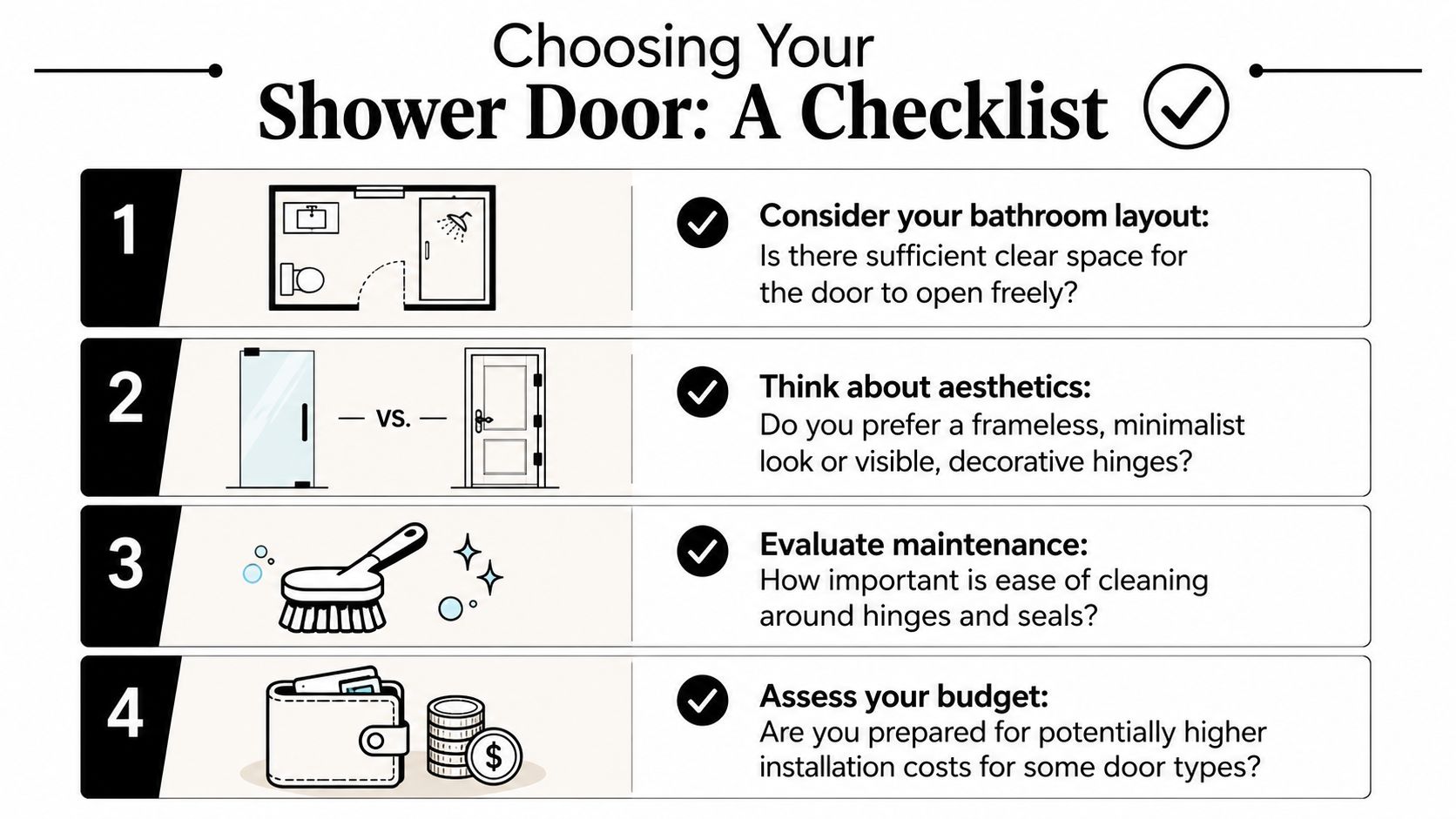
This quick checklist captures the major decision points:
The simplest way to decide
If your bathroom has generous clearance and you want a classic frameless look, a hinge door is often the cleanest answer.
If your layout is tighter, your glass is larger, or your design leans more modern, a pivot door often earns its place.
The final choice should be made from field measurements, not guesses from showroom photos. In luxury bathrooms, small dimensional details change everything.
For homeowners who want a precise answer instead of a generic one, AmeriGlass Industries is the right next step. Their team measures on site, evaluates the actual swing path, reviews hardware and glass options for Southwest Florida conditions, and helps you choose a shower door that fits the room both visually and structurally.