

You're probably standing in the exact spot where this decision becomes real. Maybe it's the wall off the dining room. Maybe it's the under-stair nook that's too good to waste. Maybe it's that open-plan living area in your Naples home where a glass wine cellar would look stunning, until one practical question ruins the mood: will it reliably protect the wine in Southwest Florida heat?
That's the right question.
A lot of homeowners fall in love with the look first. Clear panels. floating racks. a frameless door. labels facing outward like a gallery display. Then the harder parts show up. Sun exposure. humidity. condensation on the glass. cooling equipment that has to fight a much tougher environment than a shaded basement up north.
A good glass wine cellar design has to do two jobs at once. It has to look clean and architectural, and it has to behave like a controlled storage envelope. In Southwest Florida, those two goals only work together when the glass, seals, coatings, and cooling strategy are chosen as one system.
That's why a luxury glass enclosure should be planned more like a performance window wall than a decorative closet. If you've seen how a glass company can make your home feel luxurious, you already know glass changes the character of a room. A wine cellar asks more from that glass.
Introduction to Glass Wine Cellar Design
In Naples, homeowners usually start with a visual idea. They want the collection visible from the great room. They want the cellar integrated into the home, not hidden in a back corner. They want a feature that feels modern, custom, and worth talking about when guests come over.
That instinct makes sense. Glass wine cellars have become a design statement because they turn storage into architecture. Instead of a dark room with wood shelves, you get transparency, lighting, reflection, and a curated display that can anchor an entire living space.
Why Southwest Florida changes the conversation
The local climate changes the rules. In a cooler region, a glass enclosure may only need to manage indoor air and occasional sun. In Southwest Florida, glass often faces stronger solar gain, persistent humidity, and warmer surrounding spaces for much of the year. That means details that look optional on inspiration boards become essential in real homes.
Three issues tend to confuse homeowners first:
- Insulation versus clarity: Clear glass can look perfect and still perform poorly.
- Tempered versus UV-protected: Safety glass isn't automatically protective glass.
- Pretty cooling versus proper cooling: A sleek enclosure still needs serious environmental control.
A wine cellar isn't just a room with bottles in it. It's a small climate-controlled environment wrapped in materials that have to resist heat, moisture, and light.
What successful planning looks like
The best projects start with a few practical decisions before anyone talks about hardware finishes.
- Location first: Interior spaces usually give you an easier thermal starting point than walls facing hard afternoon sun.
- Display intent second: A collector aging bottles long term may need different glazing choices than a homeowner building a highly visible entertaining feature.
- Envelope before accessories: Racks and lighting matter, but they can't rescue weak glass specs or poor door seals.
When homeowners understand that sequence, the whole project gets easier. You stop shopping for “a glass room” and start designing a wine environment that happens to be beautiful.
Understanding Key Benefits and Design Goals
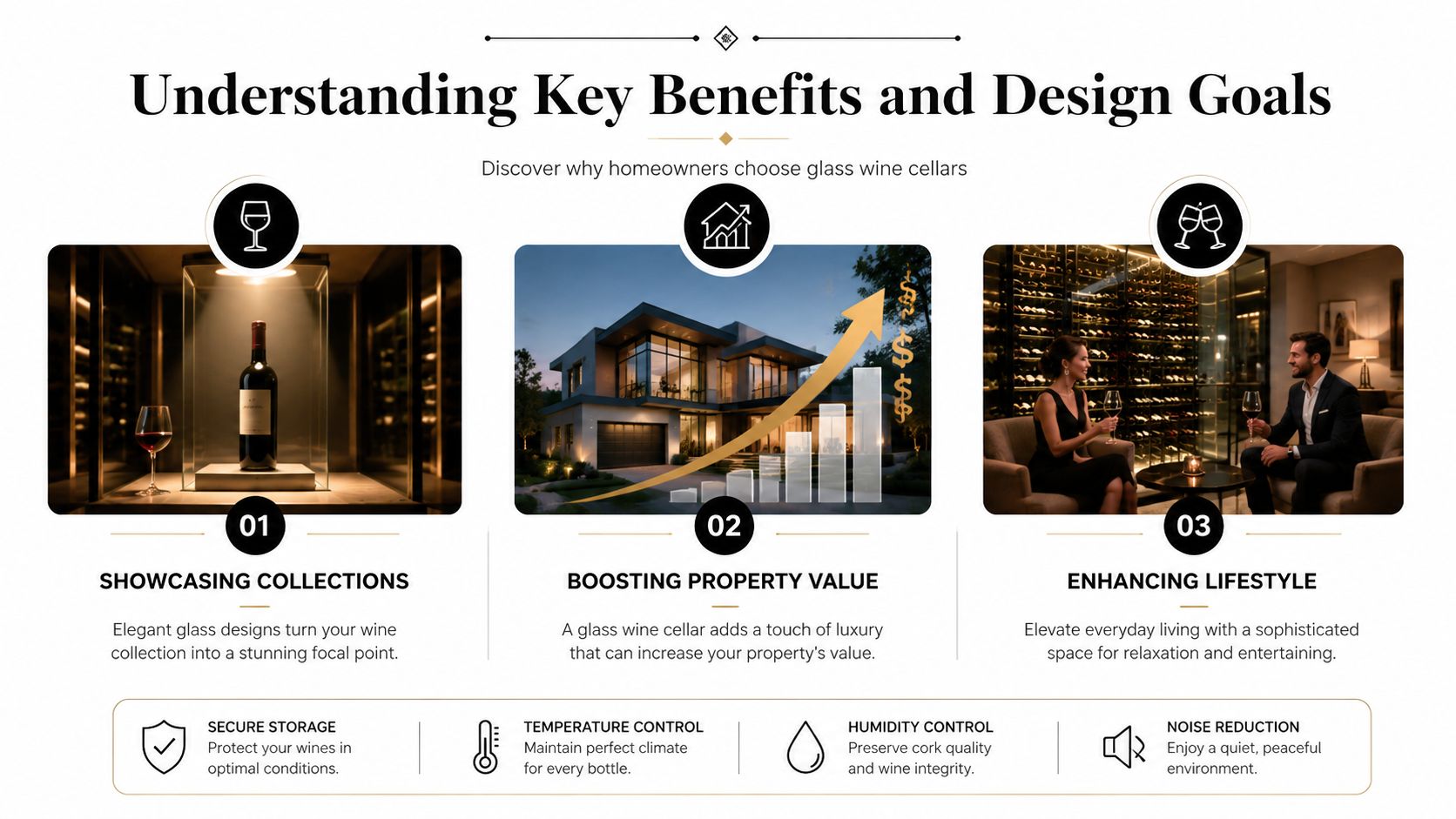
A homeowner in Naples or Sarasota often starts with the same idea. They want a glass wine cellar that looks striking from the dining room and keeps prized bottles in good condition year round. In Southwest Florida, those two goals have to be designed together, because the same glass that creates a clean view can also become the weakest part of the thermal envelope if it is underspecified.
A good project begins by deciding what the cellar needs to do in daily life, not just how it should photograph. For one family, the cellar is a showpiece beside the entertaining area. For another, it is long term storage with a refined appearance. Many want both. That mix matters, because every later decision, from glass package to door detailing, follows the priority you set here.
The three design goals that should stay in balance
Glass wine cellar design usually works best when you treat it like a three-part system. Appearance draws people in. Preservation protects the collection. Safety keeps the enclosure performing as a real room, not a decorative screen.
| Priority | What it means in practice | What happens if it is underplanned |
|---|---|---|
| Visibility | Clear sightlines, attractive bottle presentation, lighting that flatters labels and materials | The cellar feels busy, dark, or disconnected from the room |
| Preservation | Stable temperature, controlled UV exposure, limited air leakage, reduced condensation risk | Bottles face more heat stress, labels can fade, and moisture problems become more likely |
| Safety | Proper glass engineering, reliable anchoring, door swing planning, code-aware hardware choices | Panels feel less solid, doors can operate poorly, and long-term performance suffers |
Homeowners sometimes assume these goals compete with each other. In well-designed projects, they support each other. Better seals help preservation and reduce visible condensation. Better glass selection improves comfort and protects the display. Better structural planning lets the enclosure look cleaner because the support strategy is resolved early instead of added later as a patch.
Why glass cellars appeal to homeowners
A traditional wood cellar hides the collection. Glass puts it into the architecture.
That difference changes how the space is used. A glass enclosure can frame a hallway, define a dining room, or turn an underused corner into a feature people notice the moment they walk in. It works like a storefront window for a private collection, but the bottles behind that glass still need stable conditions.
There is also a practical real estate angle. Buyers tend to respond well to custom features that look built in and purposeful. A professionally designed wine cellar can signal craftsmanship, planning, and a higher level of finish, especially in luxury homes where entertaining space matters.
The Southwest Florida design goal that many guides miss
In this region, the cellar has to resist heat gain and moisture pressure for much of the year. That is the part many generic design articles gloss over.
A useful way to frame the goal is this. Your glass should not just look transparent. It should act as a controlled boundary between the cooled cellar and the warmer, humid room outside it. If surrounding indoor conditions sit around 75°F with high humidity, and the cellar is held near 55°F, even small weaknesses in glazing or door sealing can show up fast as condensation, temperature drift, or both.
That is why many Southwest Florida projects benefit from measurable performance targets early in design discussions. Homeowners should ask for numbers, not just style descriptions. Examples include:
- Tempered insulated glass units, rather than single-pane decorative glass
- Low-E coatings to reduce radiant heat transfer
- UV-reducing interlayers or coatings where the cellar is exposed to daylight
- Tight door perimeter seals and threshold detailing to limit humid air infiltration
- Glass and framing selections with published performance data, such as U-factor and solar heat gain coefficient, when the location is exposed to stronger light or warmer adjacent spaces
Those details are not upgrades for the sake of upgrades. They are how you keep a beautiful enclosure from behaving like a cold box in a humid room.
A simple way to set the design direction
Before choosing finishes, answer three questions:
Is the cellar mainly for aging, display, or equal parts of both?
That answer shapes the tolerance for daylight, visibility, and thermal exposure.How exposed is the enclosure to sun, warm walls, and household traffic?
A quiet interior location gives you more flexibility than a prominent wall near glass doors or afternoon light.What matters most five years from now?
Easy entertaining, label protection, quiet operation, low maintenance, or resale appeal all point to slightly different design choices.
A homeowner who answers those questions early usually gets a better result and fewer expensive revisions. The design becomes clearer because the project has a job description.
The best glass wine cellars do more than display bottles. They create a controlled environment that fits the house, handles local climate pressure, and still feels inviting every time someone walks by.
Choosing Glass Types and Hardware Options
A glass wine cellar can look crystal clear in a showroom and still be the wrong build for a Southwest Florida home. The reason is simple. Here, glass is doing more than showing off bottles. It is standing between a cooled interior and warm, humid air, and in many homes it is also dealing with strong daylight. Choosing glass and hardware is less like picking a window and more like choosing the walls and door system for a refrigerated display.
Frameless, framed, or a controlled mix
Homeowners who ask for “all glass” are usually asking for open sightlines. That goal makes sense. The question is how to get that look without creating weak points at the door, corners, or panel joints.
Frameless systems give the cleanest appearance. They work well when the opening is modest, the design priority is visibility, and the room allows careful control of door alignment and sealing. In a conditioned interior space away from direct sun, this can be a very attractive option.
Framed systems add visual definition, but they also give installers more places to support glass, tighten seals, and manage longer spans. In Florida homes with larger openings or heavier doors, that extra structure can help the enclosure behave better over time.
Many projects land in the middle. A hybrid layout uses framing where performance benefits are real, then keeps broad glass views where they matter most. That approach often gives homeowners the best balance of appearance, door stability, and day-to-day usability.
Standard clear glass versus low-iron clarity
Standard clear glass is not fully colorless. Along the edges, it often shows a green cast, and that tint can shift how white walls, pale oak, champagne bronze metal, and bottle labels read through the enclosure.
Low-iron glass reduces that cast and gives a cleaner, more neutral look. If the cellar is part of the main living area, the difference is often noticeable from across the room, not just up close. Homeowners comparing samples side by side usually see why low-iron ultra-clear glass for luxury interiors is often chosen for display-driven cellars.
A simple comparison helps here. Standard clear glass works like a camera lens with a slight color filter. Low-iron glass removes much of that filter, so finishes and labels look closer to their actual color.
Glass thickness affects feel as much as strength
Thickness changes how the enclosure feels the moment someone touches the door. A heavier panel usually feels more planted, swings with more control, and shows less flex. Industry guidance from Vinum Design commonly places wine cellar enclosure glass in the 1/2-inch to 3/4-inch range, depending on span, hardware, and design intent.
That range matters for several practical reasons:
- Rigidity. Thicker glass tends to deflect less across wider openings.
- Door experience. The door feels more solid and less delicate in daily use.
- Visual presence. Heavier glass often reads as more architectural and less like a partition.
- Hardware compatibility. Some pivots, hinges, and patch fittings are designed around specific thicknesses.
A rendering can hide these differences. Your hand will not.
UV protection is a separate decision
Safety glass and UV control are not the same specification. Tempered glass addresses breakage behavior. Laminated glass can add safety and, when built with the right interlayer, can also reduce UV exposure.
That distinction matters in Southwest Florida, where diffuse daylight can be strong even when the cellar is not in direct sun. A wine room near sliders, transoms, clerestory windows, or a bright great room may need UV-filtering laminated glass to help protect labels and reduce light-related stress on the display side of the collection. This article on glass wine cellar display design explains the difference between basic safety glazing and glass selected for presentation and protection.
If you remember one point, make it this one. Double-pane addresses thermal performance. Tempering addresses safety. UV filtering addresses light exposure. Those are three separate boxes to check.
Hardware has to match the climate, not just the sketch
Hardware is where many attractive designs start to feel disappointing. In a humid coastal region, finish durability, adjustability, and seal pressure matter just as much as appearance.
For doors, ask how the system handles repeated use, minor settling, and perimeter sealing. For fixed panels, ask how the channels or fittings support the glass and how visible those elements will be once the room is complete. Marine-grade or high-corrosion-resistance finishes are often the safer choice in homes that stay open to outdoor air, sit near the coast, or experience frequent humidity swings.
Good hardware choices usually support four practical goals:
- Reliable door alignment
- Strong perimeter sealing
- Corrosion resistance in humid air
- A scale that matches the glass thickness and style
A frameless enclosure with oversized shiny fittings can feel visually heavy. A large pivot door with undersized hardware can feel unsettled every time it opens. The right combination should look quiet and work with confidence.
Ensuring Structural Integrity and Insulation
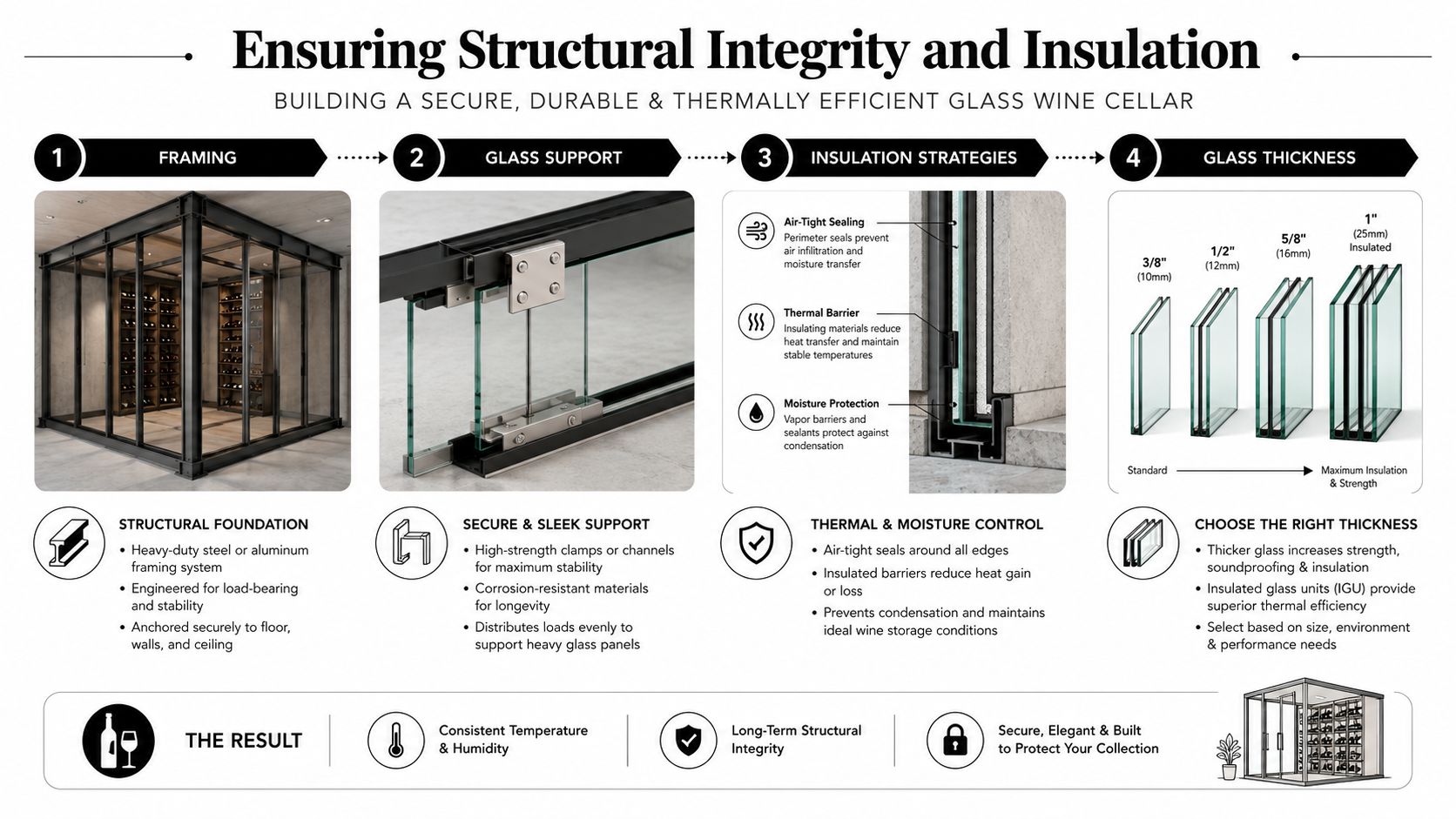
A beautiful wine enclosure can still fail if the support system is weak. In homes, that failure usually doesn't look dramatic at first. It shows up as slight panel movement, doors that drift out of alignment, seals that stop seating properly, or glass that sweats because the assembly wasn't designed as a full thermal envelope.
Start with the opening, not the glass
The first question isn't what panel you want. It's what the surrounding structure can carry.
If the enclosure spans a long opening or uses a heavy door, the supporting floor, side walls, and header all need to work together. A builder may frame a wall that's fine for drywall but not ideal for concentrated glass loads and door hardware. Wine enclosures ask for precision because small misalignments become visible immediately.
Consider it as hanging a very expensive, very heavy picture frame that also has to hold temperature. If the wall behind it isn't true, nothing on the front will behave well.
The insulation target that matters
For glass wine cellar walls to maintain proper storage conditions, insulated glass units must achieve at least R-3, with R-5 or higher being ideal, using argon or krypton fill and Low-E coatings to maintain 55 to 58 degrees Fahrenheit and 60% to 70% humidity, according to this guide to wine cellar glass performance.
That one specification clears up a lot of confusion. Not all insulated glass is equal. A generic dual-pane assembly may look similar on paper, but if it doesn't reach the right thermal performance, the cooling system has to work harder and the room becomes less stable.
How to check the assembly
When reviewing glass wine cellar design details, homeowners should ask for more than “insulated glass.” Ask what the unit includes.
Pane configuration
Double-pane or triple-pane sealed construction is what creates the insulating cavity.Gas fill
Argon or krypton improves thermal resistance inside the unit.Low-E coating
This helps reduce radiative heat transfer, which matters when nearby surfaces and sun load try to warm the cellar.Edge sealing
A weak seal can compromise the whole unit over time.
Where structural performance usually slips
Even a well-specified glass unit can disappoint if the supporting details are careless. The usual problem areas are simple.
| Detail | Why it matters | Common mistake |
|---|---|---|
| Header support | Carries load and keeps door alignment stable | Underbuilt framing above the opening |
| Bottom channel or base support | Controls panel seating and movement | Uneven floor or poor anchoring |
| Door seals | Protects thermal envelope | Gaps at latch side or threshold |
| Wall tie-ins | Keeps enclosure square | Relying on finish surfaces instead of structure |
A practical build sequence
Most successful installations follow a disciplined order rather than improvising in the field.
- Verify the space is plumb and level: Glass doesn't hide framing errors.
- Confirm reinforcement before fabrication: Once glass is made, there's very little room for adjustment.
- Match door type to real use: A showpiece pivot door needs precise support and sealing details.
- Coordinate with adjacent trades: Flooring, millwork, electrical, and cooling all affect enclosure tolerances.
A good place to review available enclosure components, hardware styles, and architectural glass options is a specialist product gallery for custom glass systems. It helps homeowners see that the enclosure is an assembly, not one product.
If the structure is casual, the glass will expose it. If the structure is precise, the glass will reward it.
Climate Control and Condensation Management in Southwest Florida
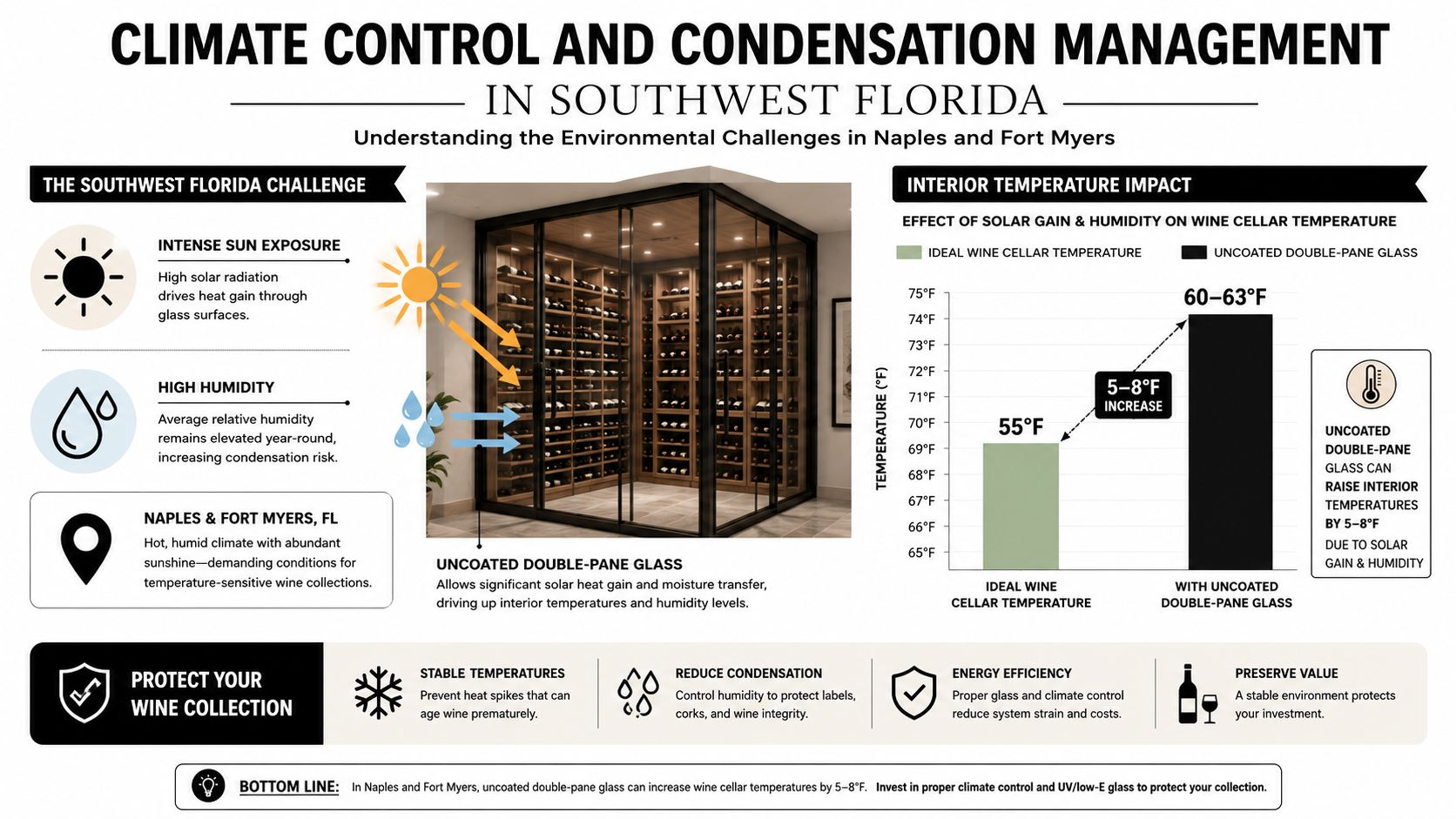
A homeowner in Naples calls after noticing water beads on the outside of a new glass wine cellar door every afternoon. The glass looks clean in the morning, the cooling unit seems to run, and nothing appears broken. By 3 p.m., the room side is fine, but the house side of the glass starts to sweat. That pattern is common in Southwest Florida because the problem is usually not the cellar alone. It is the meeting point between cold glass, humid indoor air, and strong solar exposure.
Why a glass cellar in Southwest Florida needs a different plan
A wine cellar performs more like a refrigerator with windows than a standard interior room. The goal is not only to cool the air. The goal is to keep the glass surface, door edges, and surrounding framing from becoming the cold plate that humid Florida air wants to condense on.
Solar gain makes that balancing act harder. The U.S. Department of Energy guide to energy-efficient window attachments notes that window coverings and glazing choices can significantly reduce solar heat gain. In a glass cellar, that heat has a direct cost. More heat entering through the enclosure means the cooling system has to remove more heat, and surface temperatures can swing enough to create wet spots on certain panes or near door rails.
A simple comparison helps. A cooler kept in the shade holds temperature with less effort than the same cooler left near a sunny window. Southwest Florida homes often have bright exposures, warm interiors, and long humidity seasons, so the enclosure has to be specified with that pressure in mind.
What condensation actually means
Condensation forms when a glass surface drops below the dew point of the surrounding air. Homeowners often read that as a defect in the glass. Sometimes the glass is fine. The house air is just carrying enough moisture that it gives up water the moment it touches a colder surface.
That happens for a few repeatable reasons:
- Indoor humidity is too high for the glass surface temperature
- Warm air leaks in around door edges, headers, or thresholds
- Supply air or return air placement creates a cold stripe on one area of glass
- Afternoon sun heats one section of the enclosure while the cooling unit overcorrects elsewhere
In plain language, condensation is a temperature and humidity math problem.
For homeowners trying to understand how regional HVAC pros talk about humidity, system behavior, and real-world cooling challenges, Heatwave's appearance on Tampa Bay news is a useful reminder that Florida climate control is never just about temperature.
Here's a short walkthrough that helps visualize the issue:
Specifications that make a measurable difference
In this region, broad advice like “use insulated glass” is too vague. Performance improves when the enclosure is set up to reduce heat gain and keep surface temperatures more stable.
- Use Low-E or spectrally selective glass: This cuts solar heat transfer more effectively than clear insulated glass alone.
- Aim for tighter indoor humidity control in the surrounding space: Many condensation complaints start with the home, not the cellar.
- Limit direct sun on the enclosure: Orientation, nearby windows, and shading matter more here than many online guides admit.
- Keep air movement intentional: You want even cooling, not a cold blast pointed at one pane.
- Treat seals like part of the cooling system: A small air leak can create a recurring wet edge.
One practical target helps homeowners judge risk. If the surrounding room drifts into high humidity, even well-built glass can sweat once the cellar side stays cold enough. That is why good projects in Fort Myers and Naples often pair the cellar with whole-home humidity control or at least verify the adjacent room conditions before blaming the enclosure.
One adjacent example of how close tolerances affect glass performance can be seen in frameless shower door installation in Fort Myers, Florida. The use is different, but the lesson is the same. In humid environments, alignment, seal quality, and edge detailing have a larger effect than homeowners expect.
In Southwest Florida, a glass wine cellar succeeds when heat gain is reduced, humidity is controlled, and glass surfaces stay above the dew point of the surrounding air.
Lighting and Racking Strategies
Once the enclosure performs correctly, the interior needs to earn its visibility. Many projects, depending on this step, either feel polished or oddly unfinished.
Lighting and racking should work together like a museum display. The racks hold the collection, but the lighting tells your eye where to go. Too much light and the room feels harsh. Too little and the labels disappear into a dark box.
Light the bottles, not the room
The goal isn't general room brightness. It's selective illumination.
A strong wine display usually uses layered LED lighting. Shelf-integrated strips help define rows. Vertical accent lighting can create depth behind label-forward racks. A few controlled overhead spots can add drama if they're aimed carefully.
Good lighting choices usually follow these principles:
- Keep fixtures low heat: You want visibility without adding thermal stress.
- Aim for indirect emphasis: Grazing light across labels often looks better than blasting light straight at them.
- Create contrast: A dim surrounding field with focused bottle lighting feels more elegant than uniform brightness.
Match rack style to how you actually collect
Racking shouldn't be chosen by silhouette alone. A wall of label-forward bottles looks great, but it may not suit someone who stores mixed case quantities, Champagne, larger formats, or everyday drinkers alongside collector bottles.
Three common directions work well in glass wine cellar design:
| Racking style | Best for | Watch for |
|---|---|---|
| Label-forward metal racks | Display impact and modern aesthetics | Needs careful spacing so it doesn't look busy |
| Wood racking | Traditional warmth and broader bottle support | Can feel visually heavier behind clear glass |
| Hybrid systems | Balancing show bottles and bulk storage | Requires a more deliberate layout plan |
Airflow matters more than people expect
Racking changes how air moves inside the cellar. If bottles are packed too tightly against glass or corners, airflow can become uneven. That doesn't mean the layout is wrong, but it does mean design should respect circulation.
A practical approach is to reserve the most visible zones for feature bottles and keep denser storage where it won't visually crowd the room. That way the display reads cleanly and the interior still works for real storage habits.
A cellar that looks sparse in photos can feel refined in person. A cellar packed into every inch often feels smaller, warmer, and harder to manage.
A few combinations that work well
Some of the best interiors use contrast on purpose.
- Black metal racks plus ultra-clear glass: crisp, architectural, and easy to light
- White oak accents plus restrained LED strips: softer and warmer in transitional homes
- Feature wall display plus side storage rows: strong focal point without visual overload
If you're unsure where to start, think in layers. First decide what guests should notice from across the room. Then decide what you need to store efficiently when nobody's looking.
Navigating Permits Security and Working With Professionals
A glass wine cellar may feel like an interior design feature, but local authorities and trades don't see it that way. They often see structural glass, electrical work, mechanical cooling, and sometimes modified walls or doors. That means coordination matters.
What to expect from permitting
Permit needs vary by municipality and project scope, but homeowners should assume a custom glass cellar can touch several review areas.
- Structural review: if the installation alters openings, adds reinforced support, or uses large custom panels
- Electrical review: if lighting, controls, or dedicated power are added
- Mechanical review: if a wine-specific cooling system or related drainage is installed
The easiest projects to approve are the ones documented clearly from the start. Clean drawings, product specs, and coordinated trade scopes reduce confusion.
Security deserves more thought than a lock alone
A visible wine collection is attractive for good reasons, but visibility also means the cellar shouldn't be treated casually. Security can stay discreet while still being effective.
Options often include keyed entry, electronic access, door position sensors, and integration with broader home monitoring. For readers comparing how security specialists frame layered protection for residences and small commercial settings, home and business security Perth offers a useful outside example of how access control and detection can work together.
Questions worth asking before hiring
Some contractors can install glass. Fewer can coordinate a functioning wine enclosure in a hot, humid coastal market.
Ask direct questions such as:
- Who verifies the final opening dimensions before fabrication?
- How are door seals and thresholds detailed?
- What coordination happens with the cooling contractor?
- Who handles field conditions if walls or floors are out of tolerance?
The answers tell you a lot. Good teams speak precisely about measurements, sequencing, and responsibility.
What professional collaboration should feel like
The best experience is calm, not chaotic. The homeowner should know when measurements happen, when fabrication starts, what must be complete before install day, and what gets checked at final walkthrough.
You don't need a contractor who talks in circles. You need one who can explain the enclosure in plain language, spot trouble before glass is fabricated, and coordinate with the other trades so the room works when it's done.
Cost Estimates Maintenance Best Practices Layout Examples and Checklist
A homeowner in Naples often starts with the visual idea first. Clear glass, warm lighting, a wall of bottles near the dining room. Then the real budgeting question shows up. What does it cost to build a room that still looks clear in August, seals properly, and does not fight Southwest Florida heat and sun every day?
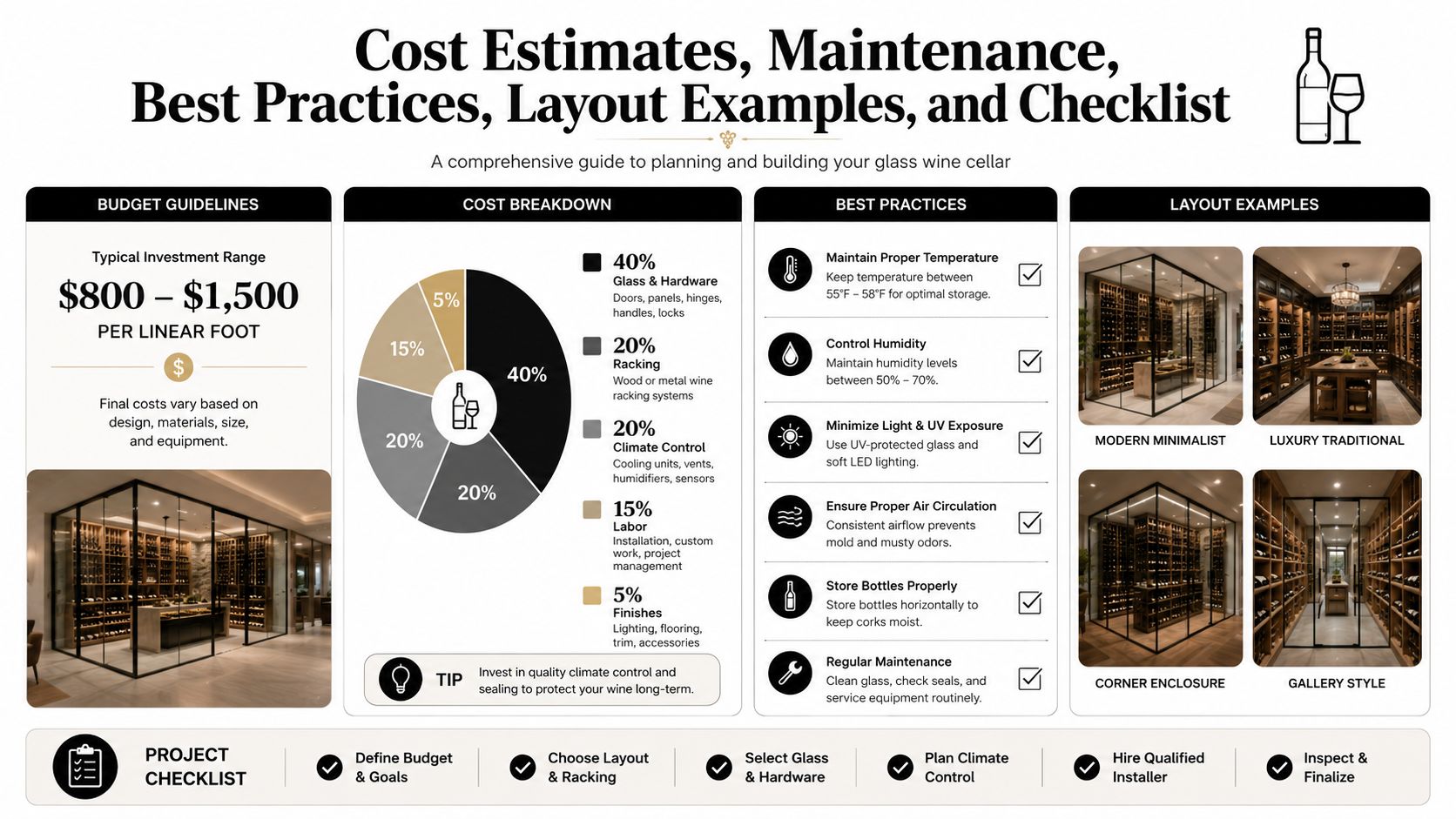
The useful way to price a glass wine cellar is to treat it like a system. The enclosure, door hardware, cooling equipment, racking, labor, and finish work all affect the final number. According to this cost breakdown for glass wine cellar enclosures, glass wine cellars often run $800 to $1,500 per linear foot, with costs commonly divided among glass and hardware, racking, climate control, labor, and finishes. The same source also notes a potential 50% to 100% resale return, which helps explain why buyers often see a well-built cellar as part storage and part architectural feature.
Where the budget usually shifts
In Southwest Florida, the biggest surprise is rarely the glass itself. It is the performance work behind the glass.
Sun exposure, long cooling seasons, and high outdoor humidity can push owners to spend more on low-e insulated units, better perimeter sealing, upgraded thresholds, and tighter coordination with the cooling installer. Those upgrades are not decorative. They are the difference between a cellar that stays clear and one that develops recurring fogging around the weakest points.
A practical budgeting mindset helps. Put money into the parts that control heat gain and moisture first, then use the remaining budget for visual upgrades.
- Enclosure cost is only one slice of the project: Racking and cooling can rival the visible glass package.
- High-performance glass can save trouble later: Better UV reduction and improved insulation help protect wine and reduce solar load near windows or bright exterior walls.
- Door details deserve close attention: A beautiful door with weak seals works like a cooler lid that never fully closes.
- Southwest Florida locations often need stronger specs: If the cellar sits near west-facing glass, a pool area, or a sunlit great room, ask for measurable performance values instead of choosing by appearance alone.
Maintenance habits that protect clarity and performance
Glass wine cellars do not require difficult maintenance, but they do reward consistency.
Clean the glass with products that do not leave residue, especially on low-e or specialty-coated surfaces. Check door alignment and gasket contact a few times a year. If the latch starts feeling different, or you notice a faint line of moisture near the door edge, treat that as an early warning sign instead of a cosmetic issue.
Watch the room the way you would watch a refrigerator seal. Small air leaks usually show up before major failures do.
A few habits make ownership easier:
- Wipe glass with non-abrasive cloths: This helps prevent haze and fine scratching.
- Inspect seals and thresholds: Florida humidity finds the smallest opening.
- Track temperature and humidity trends: A stable room should not show sudden swings or repeated condensation at the same panel edge.
- Keep the collection organized: If you are comparing top drink logging applications, digital inventory tools can help you manage bottle location, rotation, and drinking windows.
Three layouts that work well in real homes
Layout should match how the cellar is viewed, accessed, and cooled. A display that looks dramatic on paper can feel awkward in daily use if the door swing blocks circulation or the glass sits in direct afternoon sun.
| Layout idea | Best fit | Design note |
|---|---|---|
| Corner enclosure | Open-plan living areas | Gives strong visibility while limiting the total glass exposure |
| Built-in wall niche | Dining room or hallway transitions | Feels integrated into the architecture and is often easier to shade and cool |
| Walk-in with three glass walls | Larger homes with enough buffer space | Creates the strongest display effect but usually demands the tightest control of solar gain, seals, and condensation |
For early planning, a glass wine cellar layout reference page can help you study proportions, door placement, and viewing angles before fabrication starts.
Pre-order checklist
Use this checklist before approving final drawings:
- Location confirmed: Avoid heavy direct sun when possible.
- Glass spec selected: Ask for UV and insulation performance values in writing.
- Door and seal details reviewed: Threshold, swing, handle clearance, and gasket contact all matter.
- Cooling coordinated: The cellar should be sized and detailed around the mechanical plan, not treated as an afterthought.
- Lighting chosen: Keep heat output and bottle protection in mind.
- Racking plan finalized: Bottle count, display rows, and case storage should match how you collect.
- Permit scope clarified: Know who is handling approvals and inspections.
- Maintenance plan set: Cleaning method, seal checks, and climate monitoring should be simple enough to keep up with.
A strong design usually looks attractive on day one and still performs well through a Florida summer. That is the standard worth building toward.
If you're ready to turn an idea into a buildable, climate-conscious wine enclosure, AmeriGlass Industries can help you evaluate the space, narrow the right glass options, and plan a custom solution for Southwest Florida conditions. Their team serves Naples and the surrounding area with precise measurement, professional installation, and glass designs crafted to suit both the home and the environment.