
So, you’re thinking about a glass railing and the big question on your mind is: what’s the real glass railing installation cost? Let's get right to it. On a national level, you can expect to see prices ranging anywhere from $200 to over $500 per linear foot.
But that number is just the starting point. The final price is a reflection of your home's unique needs, your personal style, and a long-term investment in your property's safety, value, and modern appeal.
Your 2026 Guide to Glass Railing Installation Costs
When you’re budgeting for a glass railing, it's about more than just the glass itself. You're investing in a complete system. Every single component—from the thickness of the glass to the style of the mounting hardware—shapes the final quote. It's a premium upgrade that brings stunning, unobstructed views and immediately elevates your home's aesthetic.
Here in Southwest Florida, the demand for these elegant systems has never been higher, and 2026 pricing reflects that. Most projects we see in the Naples and Fort Myers area land somewhere between $4,000 and $10,000. Of course, more complex, custom designs can push a project over $20,000. This definitely makes it a more significant investment than traditional wood or metal railings, which often come in 30-50% cheaper.
Understanding the Investment
Think of this guide as a conversation with an expert, designed to give you the confidence to navigate every decision. We’ll pull back the curtain on what drives the cost so you know exactly where your money is going. By the end, you'll be able to:
- Decode Quotes: Confidently read the line items that make up a professional estimate.
- Compare Styles: Understand how framed, semi-frameless, and fully frameless designs affect the price.
- Visualize Real Costs: See real-world project examples from right here in our local area.
- Maximize Your Value: Learn how to make smart choices that achieve a high-end look without breaking the bank.
As you plan your project, it's always wise to understand how different home improvement costs are structured. For example, looking at a complete guide on turf installation costs shows how factors like site prep and material quality are universal principles, whether you're working on your yard or your balcony.
To help you get a quick snapshot of the variables at play, here's a simple breakdown of the main cost factors.
Quick Overview of Glass Railing Cost Factors
This table summarizes the key components that influence your total installation price.
| Cost Factor | Typical Price Range / Impact | What It Covers |
|---|---|---|
| Glass Type & Thickness | $$ – $$$$ | Tempered vs. laminated glass; standard 3/8" vs. 1/2" thickness. Thicker, laminated glass is a premium for safety and rigidity. |
| Hardware & Finish | $$ – $$$ | Stainless steel clamps, spigots, or posts. Finishes like brushed, polished, or matte black have different price points. |
| Mounting Style | $$ – $$$$ | Base shoe (most expensive), standoff, or post-mounted systems. Each requires different hardware and labor intensity. |
| Labor & Complexity | $$$ – $$$$ | Professional installation, site complexity (e.g., stairs, curves), and accessibility. The more intricate, the higher the labor cost. |
| Permits & Engineering | $ – $$ | Local building permits and, if required, engineering reports to ensure code compliance, especially for commercial or high-rise projects. |
Understanding these elements is the first step, but putting them all together correctly is what truly matters for a safe and beautiful result.
The most important decision you'll make isn't the glass or the hardware—it's choosing the right installer. A true professional gets it done right the first time, preventing costly mistakes and delivering a railing that is both stunning and structurally sound.
Here at AmeriGlass Industries, we're not just installers; we're your Southwest Florida neighbors. We believe in total transparency, not just in our glass, but in our pricing. You can learn more about our team and our deep commitment to quality craftsmanship on every single project. This guide is your first step, and we're here to help you take the next one with confidence.
Making Sense of Your Glass Railing Quote
When you first look at a quote for a new glass railing, it can feel a bit overwhelming. All those technical terms and line items can look like a foreign language, but don't worry—we're here to translate.
Think of it like commissioning a piece of custom furniture. Every detail, from the type of wood to the finish on the drawer pulls, plays a role in the final product and its price. Understanding what goes into your glass railing quote empowers you to make confident decisions and have a productive conversation with your installer.
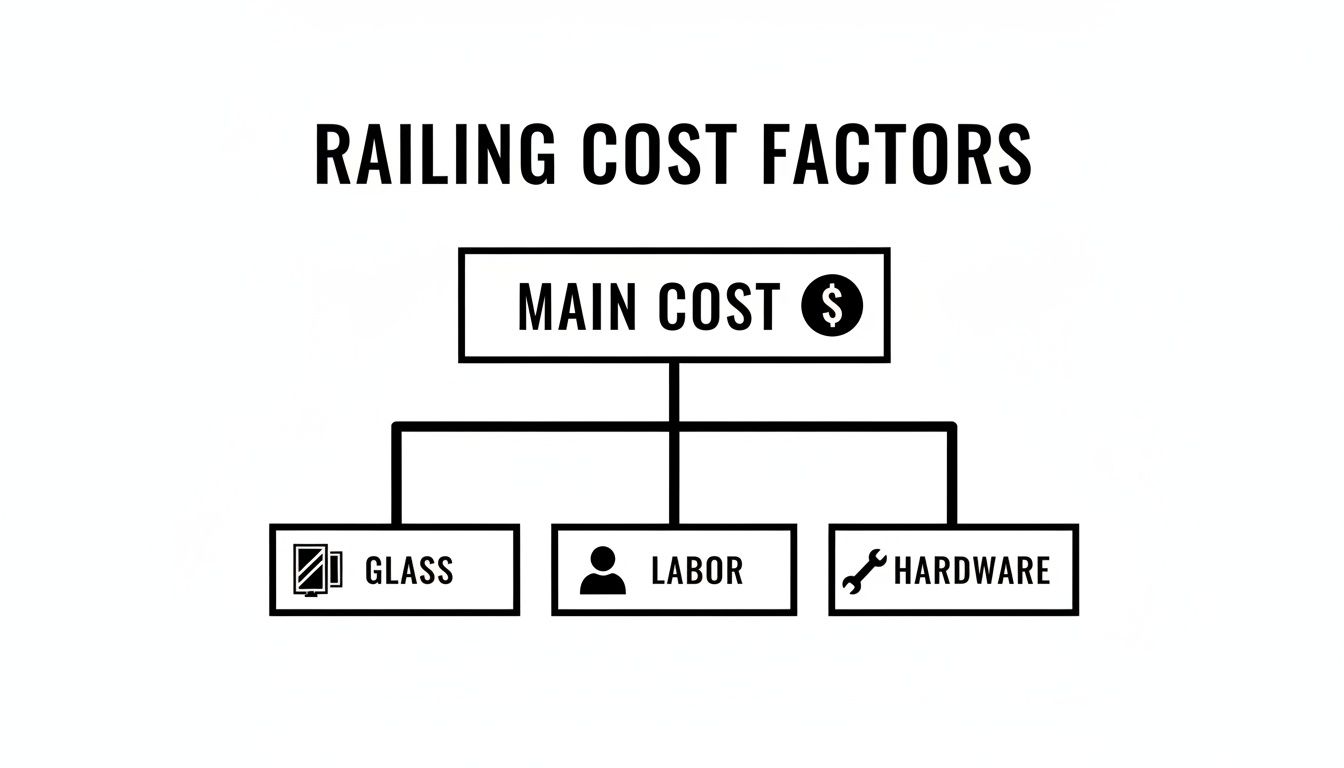
When you boil it all down, your final invoice is a balance of three main things: the glass panels, the hardware that secures them, and the skilled hands needed for a perfect installation. Let's dig into what each of those really means for your project.
The Glass Itself: Your Window to the World
The single biggest factor driving your quote is, unsurprisingly, the glass. But it's not a one-size-fits-all material. The type, thickness, and even the clarity you choose will have a major impact on both the safety of your railing and your budget. Here’s the inside scoop from an installer's perspective.
Tempered Glass: This is the workhorse of the industry, and for good reason. The glass is heat-treated to make it about four times stronger than standard glass. If it ever does break, it crumbles into small, relatively harmless pebble-like pieces. For most home projects, it’s the perfect, cost-effective blend of safety and performance.
Laminated Glass: Think of this as the next level of safety. We create a "glass sandwich" by bonding two layers of tempered glass together with a tough, clear vinyl interlayer. If a panel breaks, that interlayer holds all the pieces in place, preventing a hole from opening up in the railing. For high-traffic areas, commercial buildings, and especially here in hurricane-prone Southwest Florida, laminated glass is an essential upgrade.
Low-Iron (Ultra-Clear) Glass: Ever notice the slight green hue on the edge of a thick piece of glass? That's caused by iron in the glass. Low-iron glass removes almost all of it, resulting in breathtaking, crystal-clear transparency. If your goal is the most seamless, immaculate view possible, nothing beats this premium option.
Thickness is also a critical choice. While 3/8-inch glass is a common standard, upgrading to 1/2-inch provides a sturdier, more substantial feel. For sleek, frameless systems, this thicker glass is often a requirement, not just a preference.
The Hardware: Strength Meets Style
If the glass panels are the stars of the show, the hardware is the crucial supporting cast that provides both strength and style. These are the components that hold your railing together, and their design and finish—from brushed nickel and polished chrome to modern matte black—will affect the final price.
What really drives the cost, though, is the mounting style. A traditional post-supported system is a classic and cost-effective choice. But the breathtaking, fully frameless systems popular in luxury Naples homes require more sophisticated engineering. They use hidden base shoes or discrete metal standoffs, which demand more robust hardware and an expert touch to install, placing them at the higher end of the cost spectrum.
A frameless system isn't just a style—it's an engineered solution. The absence of a frame means the glass and mounting hardware must do all the work, demanding thicker glass and expert installation to ensure absolute safety and stability.
This is where you see a real jump in pricing. Looking at 2026 industry estimates, a basic framed system might range from $150-$300 per linear foot. A semi-frameless design pushes that to $250-$400, while a high-end frameless railing often starts at $400-$600 per foot because of the heavy-duty materials and precision required.
The Craftsmanship: Labor and Project Complexity
Finally, a significant portion of your quote is the labor. This number reflects the expertise, time, and precision required to transform a stack of glass and metal into a beautiful, secure part of your home. A simple, straight run on a balcony will naturally cost less to install than a complex, curved staircase that demands custom-cut glass and meticulous mounting.
Other factors that influence labor costs include:
- Site Accessibility: Is the work area easy to get to, or will our crew need to navigate tight corners, multiple floors, or other obstacles?
- Demolition: Is there an old railing that needs to be carefully removed and hauled away?
- Engineering: Does your project's scale or location require a licensed engineer's approval to meet building codes? This is common for high-rise condos and commercial jobs.
Investing in a professional, licensed, and insured team like AmeriGlass isn't an expense—it's peace of mind. It's your guarantee that the railing is not only stunning but also perfectly safe and up to every local code. When you're ready to see how these factors come together for your home, you can easily get a personalized and free estimate from our experts.
Framed vs. Frameless Railing Costs
When you’re planning a glass railing project, you'll face one decision that shapes everything else: framed or frameless? This choice is the biggest single factor impacting both the final glass railing installation cost and the look and feel of your space. It's more than just aesthetics; it’s a fundamental choice that guides the engineering, materials, and ultimately, your budget.
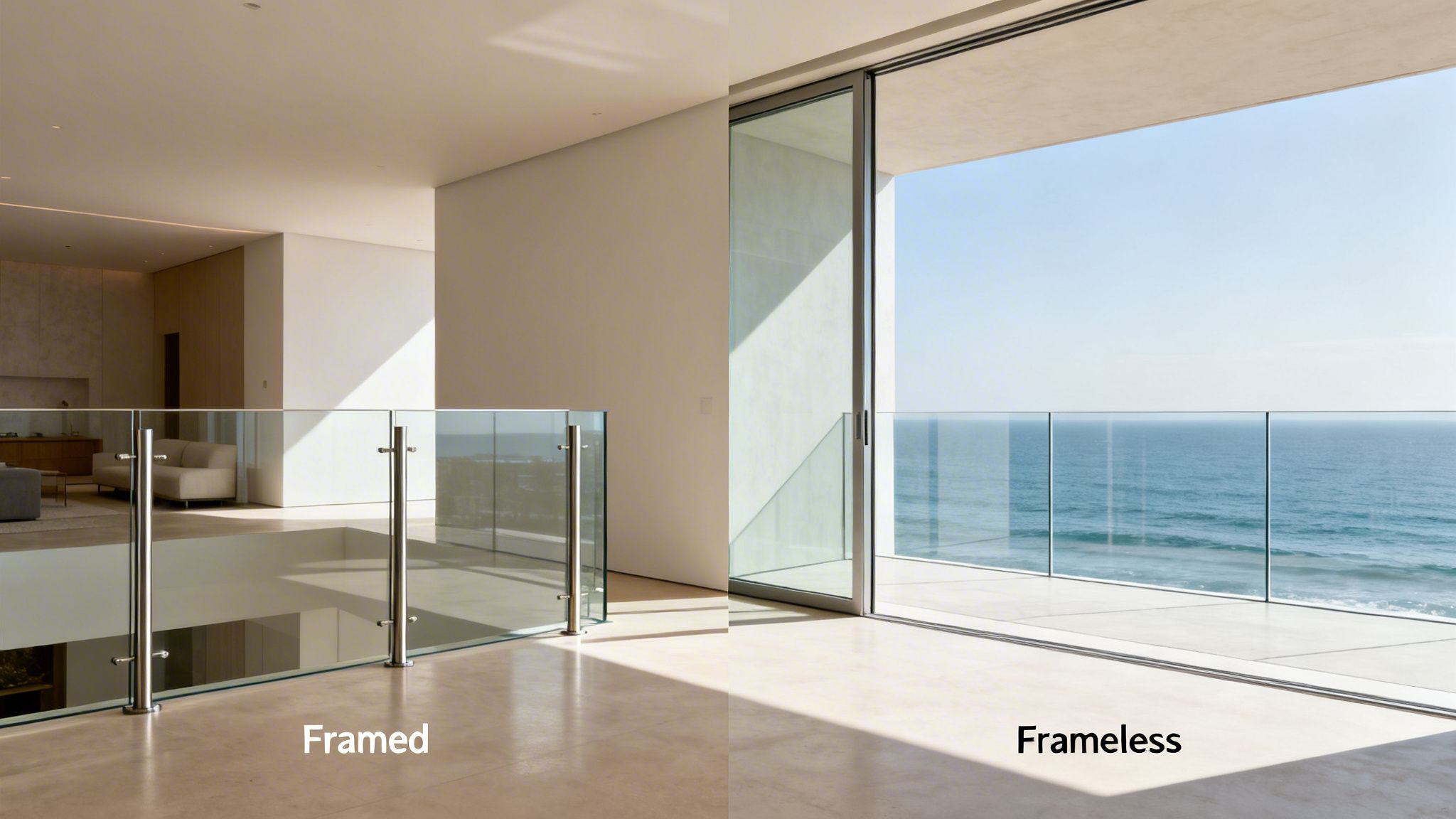
Think of it like displaying a beautiful painting. A framed railing is like a classic, sturdy frame. It defines the edges, adds a traditional design element, and provides a clear sense of structure. It’s an elegant and often more accessible way to achieve the open feel of glass.
A frameless railing, on the other hand, is like mounting that same painting so it appears to float on the wall. It's the infinity pool of railing design—pure, unobstructed views that create a seamless connection with your surroundings. This is the look that truly elevates a property into modern luxury, but achieving that "invisible" strength requires a different level of engineering and investment.
The Framed and Semi-Frameless Approach
In framed and semi-frameless systems, the structural work is done by metal posts and rails that hold the glass panels securely in place. This strong framework allows us to use slightly thinner and more economical glass, usually 3/8-inch tempered panels.
- A Budget-Conscious Choice: Since the frame provides the support, the demands on the glass and hardware are lower. This makes framed systems a more wallet-friendly option, typically landing in the $200 to $350 per linear foot range.
- A Reassuring Presence: For many homeowners, the visible posts and top rail offer a traditional sense of security and sturdiness you can see and feel.
- Versatile Style: The frames aren’t just for support; they're a design element. You can customize them with finishes like brushed stainless steel or modern matte black to perfectly match your home's style.
This is a fantastic option if you want the light, openness, and low maintenance of glass but need to work within a specific budget. It delivers a clean, high-end look without the engineering costs of a fully frameless system.
The Frameless Advantage—And What It Costs
A frameless system is the gold standard for minimalist design. It creates that jaw-dropping illusion of a floating barrier, giving you completely uninterrupted views. To make this happen safely, the system depends on superior materials and precision engineering from the ground up.
A frameless railing doesn't just "lose the frame." It’s an entirely different engineering philosophy. The glass panel itself becomes the primary structural component, which means it must be thicker, stronger, and anchored with incredibly robust hardware to guarantee safety.
This engineering is what drives the cost. Here’s a quick breakdown of why:
- Thicker, Heavier Glass: Frameless projects almost always require 1/2-inch thick tempered or laminated glass. This added thickness provides the rigidity that a frame would otherwise supply.
- Heavy-Duty Hardware: Instead of posts, we use specialized hardware like heavy-gauge stainless steel spigots bolted directly into the structure, or a continuous metal base shoe that grips the entire bottom of the glass. These components are meticulously engineered, more expensive, and demand flawless installation.
- Expert Installation: There is absolutely no room for error. Aligning heavy, thick glass panels to perfection requires a level of skill, specialized equipment, and time on-site that goes far beyond a standard installation.
Given these factors, a true frameless glass railing installation typically starts at $400 per linear foot and can easily climb past $600, particularly for complex layouts or curved designs.
Now, let's put this into perspective with a head-to-head comparison.
Framed vs. Frameless Railings: A Head-to-Head Comparison
| Feature | Framed Glass Railing | Frameless Glass Railing |
|---|---|---|
| Typical Cost | $200 – $350 per linear foot | $400 – $600+ per linear foot |
| View Obstruction | Minimal, but posts and rails are visible. | Virtually zero; completely unobstructed views. |
| Glass Thickness | 3/8-inch tempered glass is common. | 1/2-inch tempered or laminated glass is required. |
| Structural Support | A metal frame (posts, top/bottom rails) provides the primary structural support. | The glass panel itself is the structural element, secured by heavy-duty base hardware. |
| Best For | Budgets where cost-effectiveness is key; projects wanting a more traditional aesthetic. | Maximizing high-value views (ocean, landscape); achieving a pure, modern, high-end design. |
| Installation Complexity | Simpler and faster, requiring less specialized labor. | Highly complex, demanding expert precision, specialized tools, and more installation time. |
For those of us here in Naples and Fort Myers, maximizing those gorgeous coastal views is everything. The investment in a frameless system often pays for itself in both property value and the sheer joy of an unobstructed sunset. The clarity is breathtaking, and you can push it even further by exploring options like ultra-clear glass for your project.
Ultimately, your choice comes down to balancing your dream aesthetic with your budget. One gives you a practical, beautiful upgrade, while the other delivers the absolute pinnacle of luxury and seamless modern design.
Real-World Project Costs in Southwest Florida
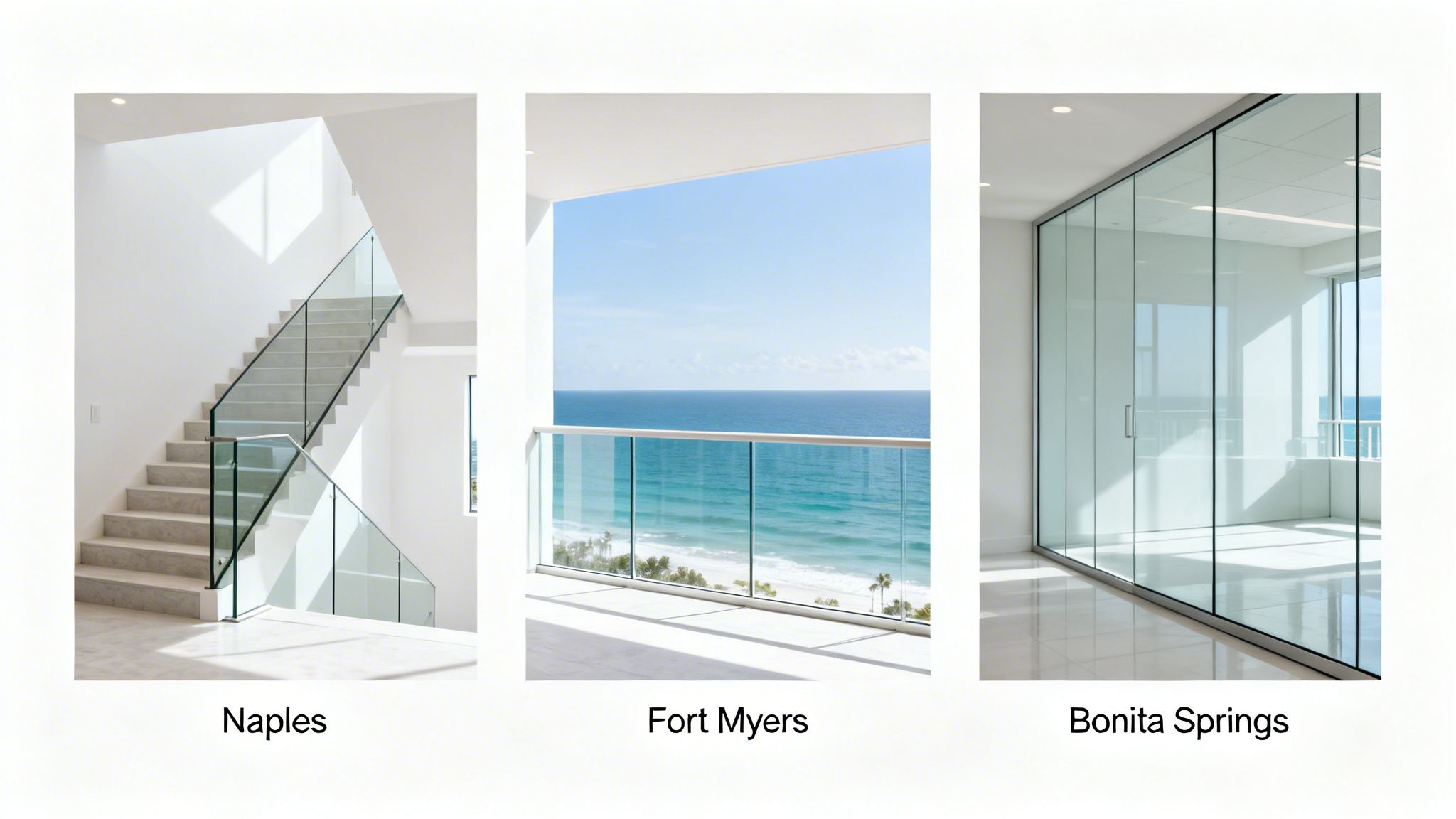
Alright, let's talk real numbers. Cost-per-foot estimates are a great starting point, but they don't tell the whole story of your final glass railing installation cost. The truth is in the details of the project itself. To give you a much clearer picture of what to budget, let's walk through three common scenarios we handle every day right here in Southwest Florida.
Think of this as moving from theory to reality. We'll look at how project size, location, and your design choices all intersect to shape the final investment. By seeing how these factors play out in actual projects, you can get a solid feel for your own plans and move forward with confidence. We'll compare a beautiful mid-range option against a stunning high-end system for each.
It's no secret that these systems are incredibly popular. The global glass railings market, valued at $3.9 billion in 2026, is projected to grow at a 7.80% CAGR through 2030. This demand is fueled by the architectural push for unobstructed views, especially in the luxury homes and high-rises that define our local market. You can dive deeper into these trends in this glass railing market report from Cognitive Market Research.
Project 1: Naples Interior Staircase (25 Linear Feet)
A 25-foot staircase in a Port Royal or Old Naples home is the perfect spot for a glass railing. It completely transforms a foyer, creating a breathtaking architectural feature. But make no mistake, staircases are more complex than a simple straight run—they require angled cuts, hyper-precise measurements, and often a continuous handrail, all of which adds to the intricacy of the job.
Mid-Range (Semi-Frameless): A popular choice is 3/8-inch tempered glass with classic stainless steel posts and a top cap rail. For a staircase like this, you’re typically looking at a total cost between $7,500 and $9,500.
High-End (Frameless): For that jaw-dropping, floating-glass look, a frameless system with thicker 1/2-inch low-iron glass and standoff hardware is the way to go. Given the added complexity of a staircase, this top-tier installation would come in around $12,500 to $16,000.
Project 2: Fort Myers Beach Ocean-View Balcony (40 Linear Feet)
When you have a 40-foot balcony overlooking the Gulf on Fort Myers Beach or Sanibel, the view is everything. Here, the railing has to do more than just look good; it has to stand up to our coastal weather. Exterior railings must meet strict wind-load and safety codes, which is why we almost always recommend laminated glass for superior strength and protection.
In a coastal environment, the railing isn't just about the view; it's part of your home's defense system. Opting for laminated glass and marine-grade hardware is a non-negotiable investment in safety and longevity.
Here’s how the numbers stack up for this must-have feature.
Mid-Range (Semi-Frameless): A system with 3/8-inch laminated glass panels, corrosion-resistant aluminum posts, and a top rail creates a secure and beautiful barrier. The total installed cost would likely land in the $14,000 to $18,000 range.
High-End (Frameless): To achieve that "infinity pool" effect where the glass just disappears, a frameless base shoe system with 1/2-inch laminated glass is the ultimate choice. This premier installation would be estimated between $22,000 and $28,000.
Project 3: Bonita Springs Commercial Partition (15 Linear Feet)
Picture a chic boutique or a modern office in Bonita Springs that needs to define a space without making it feel small or closed off. A 15-foot interior glass partition is the perfect answer. For commercial projects, the focus is usually on durability and a clean, professional look that elevates the brand.
Mid-Range (Semi-Frameless): Using 3/8-inch tempered glass with a minimal frame creates a sleek division that works with most budgets. A project like this would run approximately $4,000 to $6,000.
High-End (Frameless): For the cleanest possible aesthetic, a full-height frameless partition mounted in a recessed top and bottom channel is unmatched. Using heavier 1/2-inch tempered glass, this premium option would typically cost between $7,000 and $9,500.
As you can see, the specific details of a project can really influence the final price. For more ideas and to see how these different styles look in finished homes and businesses, head over to the AmeriGlass Industries project blog.
Thinking Beyond the Price Tag: The Real Value of a Glass Railing
It’s natural to focus on the initial glass railing installation cost. But the smartest homeowners I work with look at the bigger picture. They see it not as a simple expense, but as a serious investment in their home's future. When you start thinking about what a glass railing earns you over time, the whole decision looks different.
The real story isn’t about the number on the quote; it’s about what that railing gives back to you for years to come. A modern glass railing is a powerful upgrade that delivers returns in property value, maintenance savings, and priceless peace of mind.
Boosting Your Home’s Market Value
Here in the Southwest Florida real estate market, first impressions are everything. Buyers want homes that feel modern, open, and luxurious. A sleek, frameless glass railing does exactly that. It instantly tells a potential buyer that this is a high-quality, updated home.
More importantly, it makes your spaces feel bigger and brighter, and it absolutely maximizes those stunning Naples waterfront views or gorgeous golf course backdrops. It's a strategic upgrade that can seriously raise property value, much like a kitchen or bath remodel. It’s an improvement buyers see and feel immediately. And while trendy design choices come and go, the clean, elegant look of glass is timeless.
The True Cost of Maintenance (or the Beautiful Lack of It)
Now, let's talk about upkeep. If you've ever owned a wood railing in Florida, you know the drill. It’s a never-ending cycle of sanding, scraping, and re-staining every couple of years to fight off the humidity, rot, and pests. The time and money you pour into it adds up fast.
A glass railing, on the other hand, practically takes care of itself. All it needs is a simple wipe-down with glass cleaner to look brand new. This isn't just a small convenience—it saves you hundreds, if not thousands, of dollars and frees up countless weekends over the life of your home.
We always tell our clients to think of it as buying back your time. The money saved on painters and sealants is a real, tangible return, but getting your weekends back? That's priceless.
For the absolute best in low-maintenance living, we always recommend a protective coating.
A Smart Add-On: Diamond-Fusion Coating
- What it is: A patented, invisible shield that is professionally applied and chemically bonds directly to the glass.
- How it works: It creates an ultra-slick surface that water, salt spray, and grime can't stick to.
- The benefit: Water beads up and rolls right off, taking dirt with it. This can cut your cleaning time by up to 90% and protects your glass from the stubborn etching and spotting that’s so common in our coastal air.
An Investment in Unshakeable Safety
You simply can’t put a price on your family's safety. The tempered or laminated glass we use in our systems is incredibly tough. Wood can rot and weaken over time, and even metal fasteners can rust and fail. A professionally installed glass railing provides a solid, reliable barrier you can always count on.
This is absolutely critical for homes with children or pets, or for any second-story balcony where structural integrity is paramount. Knowing your railing was engineered to exceed Florida’s strict building codes provides a sense of security that other materials just can't offer. When you choose a quality glass system from a licensed professional, you're making an investment in your family's well-being.
How to Get the Best Value for Your Budget
Getting the most for your money on a glass railing project isn’t about chasing the lowest bid or using cheap materials. That’s a recipe for disappointment. Real value comes from making smart, informed decisions that give you that stunning, high-end look without paying for things you don’t truly need.
Think of it as finding the perfect balance between the design you’ve been dreaming of and a number that feels comfortable. With a little planning, a few key choices can easily save you hundreds, if not thousands, of dollars on your glass railing installation cost.
Smart Design and Material Choices
Believe it or not, the biggest savings are often locked in during the design phase. While a completely frameless system is the gold standard for that invisible, ultra-luxe feel, it's also the most expensive. A semi-frameless design, however, can give you a remarkably similar clean, modern look for a much more accessible price.
Hardware is another area where you can be strategic. Choosing a standard, high-quality stainless steel or aluminum finish over a custom powder-coated color or a specialty metallic finish can slash your material costs without compromising an ounce of quality or durability.
- Choose a Semi-Frameless Design: You still get a sleek, minimalist vibe, but the visible posts allow for slightly thinner (and less expensive) glass and simpler mounting hardware.
- Select Standard Hardware: Stick with timeless, popular finishes like brushed stainless steel. They're readily available and typically cost less than custom or niche options.
- Plan for Straight Runs: Every curve and corner adds complexity and cost. Simple, straight sections of railing are far easier to fabricate and install, making them the most budget-friendly layout.
The Most Important Investment You Can Make
While those tips will help you manage material costs, the single most critical decision for your budget has nothing to do with glass or steel. It’s about who you hire. It might sound backward, but going with a cheap, inexperienced, or unlicensed contractor is almost always the most expensive mistake you can make.
The surest way to get the best value is to do the job right the first time. Investing in a licensed, insured, and reputable professional like AmeriGlass prevents the costly mistakes, project delays, and frustrating re-work that plague poorly managed installations.
A true professional gets it right from the start. They ensure every measurement is precise, every anchor is secure, and the entire project sails through Florida’s strict building code inspections. This expertise is what prevents catastrophic-but-common errors like mis-cut glass, improper anchoring that leads to failure, or a failed inspection that brings your project to a screeching halt.
In the end, paying for professional installation isn't just another line item—it's the best insurance policy you can buy for a safe, gorgeous, and valuable addition to your home.
Common Questions About Glass Railing Costs
When you're thinking about a project like this, you're bound to have questions. And you should! It's a significant upgrade. We've been doing this for a long time, so we've heard them all. Here are some of the most common things people want to know before they get started.
How Long Does Installation Take?
This is always a big question, and the answer really depends on your specific project. For a straightforward job, like a single deck or balcony railing, our crew can often have the entire installation wrapped up in just one day.
If the project is more complex—think of a winding staircase with multiple levels or a curved design that requires custom-bent glass—it might take a bit longer. In those cases, you can typically expect the work to last between two and three days.
Are Glass Railings Safe for Kids and Pets?
We get this question all the time, and the short answer is a resounding yes. When installed correctly by a professional, glass railings are one of the safest options on the market. We exclusively use two types of safety glass.
- Tempered Glass: This isn't your standard window pane. It's heat-treated to be about four times stronger. If it were to break under extreme force, it crumbles into small, dull, pebble-like pieces, which minimizes the risk of serious injury.
- Laminated Glass: This is the top-tier option for safety. It’s like a glass sandwich, with a tough vinyl layer in the middle. If it cracks, the pieces stay stuck to that inner layer, keeping the barrier completely intact.
We also build to code, which means the gaps between panels are far too small for curious kids or pets to slip through.
The single most important factor for safety is hiring a licensed, local professional. An expert installer ensures every anchor is secure and that the entire system is built to handle the strict building codes we have here in Southwest Florida. Your family's safety is not the place to cut corners.
Do I Need a Permit in Naples or Fort Myers?
Yes, almost every single time. For a new railing system in Collier or Lee County, a building permit is required. This isn't just red tape; it's a crucial step that ensures your new railing meets all local safety regulations, especially the critical wind-load requirements for our coastal area.
The good news? A reputable installer handles all of this for you. We take care of submitting the plans, dealing with the building department, and scheduling the final inspections. It’s all part of the service. You can learn more about general requirements on our AmeriGlass Industries FAQs page.
Ready to see how a stunning glass railing can transform your home? The team at AmeriGlass Industries has been the trusted expert in Southwest Florida for decades. Reach out today for a free, no-obligation estimate, and let us help you bring your vision to life. Get Your Free Estimate Now.