

You’re probably looking at a space that already has good bones. A pool deck that deserves a cleaner opening to the lanai. A primary bath that feels dated because the enclosure chops up the room. A home office that needs separation without turning dark and closed off.
That’s where frameless sliding doors earn their place in Southwest Florida homes. They remove visual clutter, preserve light, and solve a practical problem at the same time. In a coastal home, every line matters. Bulky frames, raised tracks, and hardware that corrodes too quickly can make a premium space feel ordinary in a hurry.
In this climate, the details matter more than the brochure. Humidity settles into tracks. Salt air punishes finishes. Wind exposure changes what glass and hardware are appropriate. A frameless system can look effortless, but the ones that last are never casual in how they’re designed, measured, or installed.
The Allure of Uninterrupted Views and Open Spaces
The appeal is simple. Southwest Florida living works best when the house doesn’t feel cut off from the outdoors. You want the kitchen, great room, lanai, and pool area to feel connected, not divided by heavy framing and visual noise.
That’s why frameless sliding doors have become such a strong architectural move. They do for a room what an infinity-edge pool does for a backyard. They make boundaries feel softer without sacrificing function. The eye keeps moving, which makes the space feel calmer, wider, and more expensive.
Traditional framed doors do the opposite. They interrupt sightlines, stack visual weight at the perimeter, and often make an opening feel smaller than it is. Frameless systems reduce that interruption. In the right setting, the glass almost disappears and the room does more of the talking.
Why the sliding format still matters
Sliding doors have lasted for centuries because they solve a real problem. Archaeological evidence from Pompeii and Herculaneum shows sliding panels on overhead tracks in the 1st century CE, and those early systems were valued for their space-saving properties in compact Roman cities, as noted in the history of sliding doors. That same logic still applies in Naples, Bonita Springs, and Fort Myers.
A swing door needs clearance. A sliding panel doesn't. In tighter bathrooms, smaller transitions, and open-plan interiors, that difference matters every day.
Frameless sliding doors work best when you want openness without giving up control of the space.
What homeowners usually notice first
Many assume they’re buying glass. They’re really buying a feeling.
- More natural light: Clean sightlines let daylight travel deeper into the room.
- Better visual continuity: Flooring, cabinetry, tile, and exterior finishes read as one composition.
- Less visual hardware: The room feels designed, not assembled.
- A more luxurious rhythm: Openings feel intentional instead of purely functional.
If you’re already investing in upgraded finishes, a minimalist enclosure or partition often has more impact than one more decorative element. That’s especially true in modern coastal homes, where restraint reads better than excess. For homeowners thinking about the broader effect of glass on a space, this look aligns with the design principles behind making your home feel luxurious with glass.
A Door for Every Space Shower Patio and Partitions
Frameless sliding doors aren’t one product. They’re a category. The right system for a shower enclosure isn’t the same one you’d want for a patio opening or an interior partition between a den and a main living area.
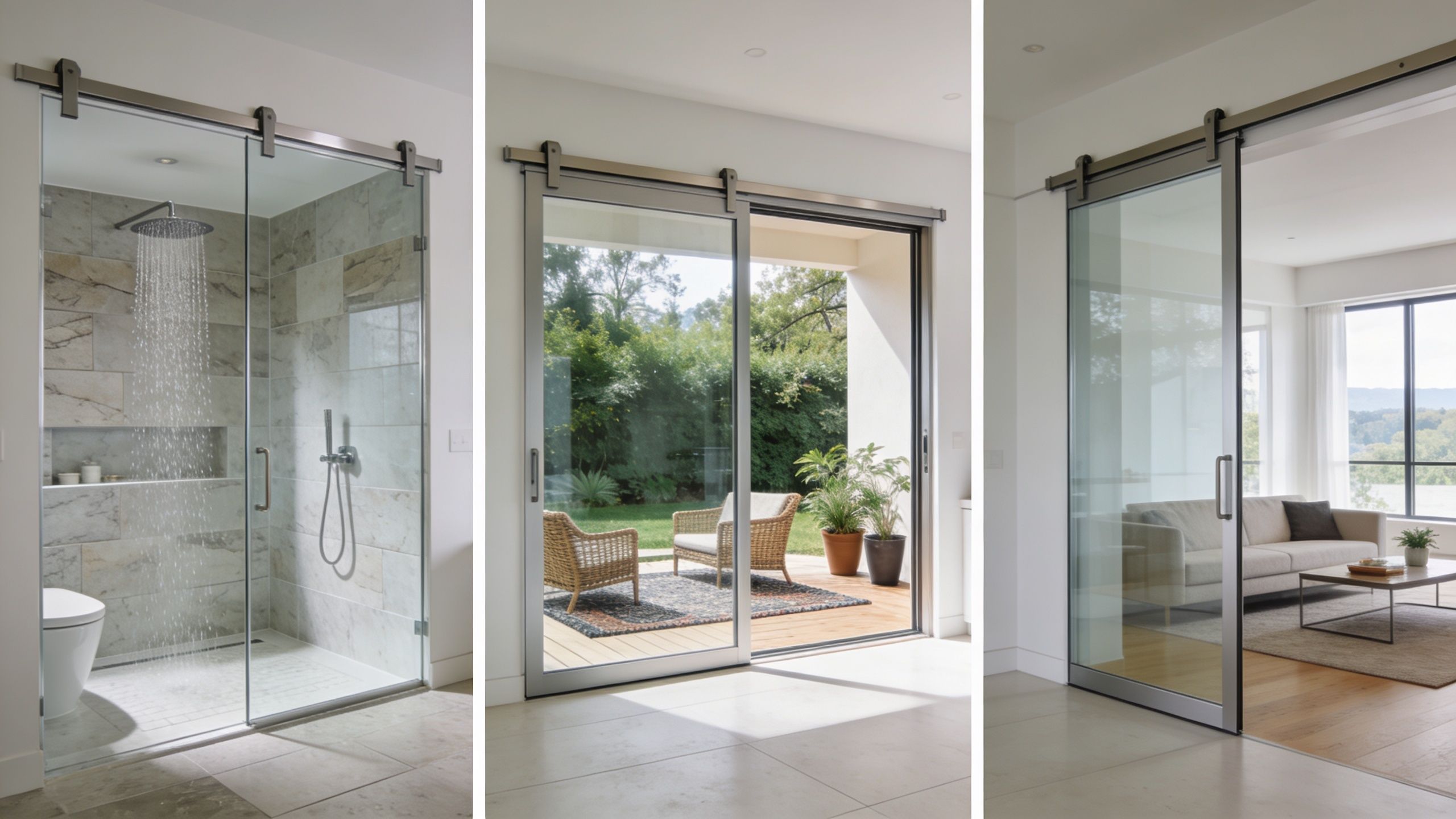
Three common applications that behave very differently
A shower door lives in constant moisture. A patio system faces sun, wind, and airborne salt. An interior partition deals more with layout, privacy, and sound control. Grouping them together is fine for inspiration. It’s not fine for buying decisions.
The modern sliding glass door itself was shaped by Japanese shoji screens and became widely popular for creating an integrated indoor-outdoor experience. Later, a 2010 patent shifted wheel mechanisms to reduce the derailment issues that had affected 80-90% of traditional installations, according to The Sliding Door Company’s history overview. That reliability story matters most when homeowners compare a modern frameless system against older sliders they’ve already learned to distrust.
Frameless Sliding Door Applications Compared
| Application | Primary Benefit | Common Glass Thickness | Key SWFL Consideration |
|---|---|---|---|
| Shower | Opens the bathroom visually and creates a spa-like feel | Varies by system and safety requirements | Hard water, humidity, and soap residue make glass protection important |
| Patio | Maximizes views and natural light | Varies by opening, engineering, and code requirements | Salt air, wind exposure, and proper hardware selection are critical |
| Interior partitions | Creates flexible rooms without closing off light | Varies by privacy and acoustic goals | Layout, privacy level, and ease of operation matter more than weathering |
Shower doors for daily use, not showroom photos
A frameless sliding shower door can make a standard bathroom feel custom fast. It opens the sightline, shows off the tile work, and avoids the swing clearance issues that can make a smaller bath feel cramped.
But in Southwest Florida, the finish line isn’t installation day. It’s how the enclosure looks after months of humidity, hard water, and daily use. At this juncture, homeowners either love their door or start regretting that they bought based on appearance alone.
For showers, pay attention to:
- Track design: Fewer places for residue to collect makes cleaning easier.
- Glass clarity: Cleaner low-iron options matter when you’ve invested in stone or specialty tile.
- Handle style: A beautiful pull that’s awkward with wet hands becomes irritating quickly.
Patio doors where the climate tests every shortcut
Patio frameless sliding doors carry the most visual reward and the most technical risk. They bring in light and preserve the view to the lanai, but they also face the harshest conditions.
If you like to leave the opening active during cooler months, insect control becomes part of the discussion too. Homeowners comparing options often benefit from a practical look at fly screens for sliding glass doors, especially when they want airflow without inviting every bug in the neighborhood inside.
A well-designed patio system should feel smooth, stable, and quiet. If it rattles, drags, or feels vague in the hand, something is wrong. If you’re exploring interior-grade and architectural sliding options, it also helps to see how HydroSlide sliding systems approach the balance between minimalism and daily usability.
A closer look at movement and finish is helpful here:
Interior partitions for flexible floor plans
Interior frameless sliders solve a different problem. They let you separate space without shutting it down. That works well for home offices, dining rooms, fitness rooms, wine displays, and commercial settings where you want division without heaviness.
A good interior partition doesn’t just close a room. It keeps the room connected to the rest of the house.
This is one of the strongest uses for frameless glass in newer homes. Open concept remains attractive until everyone in the house is on a call, watching a game, or trying to work. Sliding glass partitions let the layout adapt without committing to permanent walls.
Designing Your Door Glass and Hardware Decisions
The biggest mistake homeowners make is treating glass like a single choice. It isn’t. Hardware isn’t decoration either. It’s the operating system.
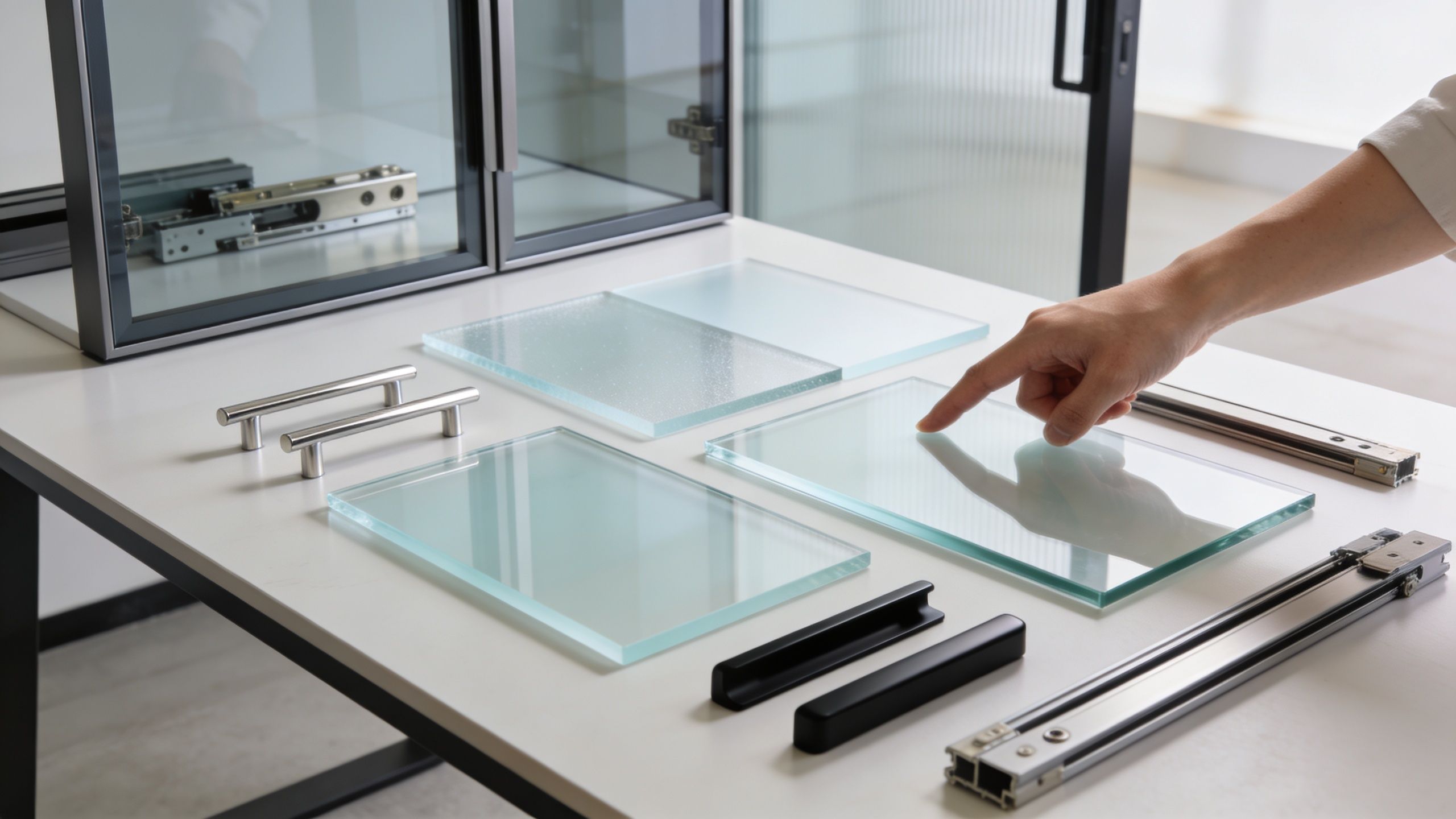
Start with the glass, not the finish sample
Clear glass is the baseline. In many homes, it works well. But when clients are putting frameless sliding doors beside white cabinetry, pale stone, or carefully selected tile, standard clear glass can show a noticeable green cast at the edge.
That’s why ultra-clear glass often makes sense in premium interiors. It reads cleaner, especially in bright Florida light, and it lets the materials behind it keep their true color. If visual purity matters, it’s worth reviewing the differences in ultra-clear glass options.
Privacy changes the conversation. For some applications, frosted or obscured glass is the right call. Not because it’s trendy, but because the room needs function more than full transparency. A home office facing a busy main hall, for example, may benefit from privacy glass while still preserving light transfer.
Then decide how the door should feel in the hand
A slider is something you use constantly. The handle style, pull depth, edge detail, and finish all affect that experience.
Some homeowners choose polished chrome because it feels crisp. Others prefer brushed nickel because it hides fingerprints better. Matte black can look excellent in a contemporary home, but not every black finish ages the same way in a humid environment. The wrong finish choice can look tired long before the glass does.
What I’d prioritize:
- Grip comfort: Recessed pulls look clean, but they need to feel natural in use.
- Finish durability: Coastal homes punish weak plating and low-grade coatings.
- Hardware consistency: Door hardware should relate to nearby plumbing, lighting, and cabinet finishes without becoming a perfect match exercise.
The track system determines whether the door ages well
Design and engineering intersect. A beautiful panel on poor hardware is still a poor installation.
Top-hung frameless systems are often the better answer in coastal settings because they avoid the bottom rolling assemblies that tend to collect grit, residue, and salt contamination. The engineering limits matter too. For example, the HAWA JUNIOR 120 GP supports frameless glass doors up to 264 lb per panel, and the EKU PORTA 100 G/GU/GM supports up to 220 lb per panel, according to the Richelieu specification document. Those numbers aren’t trivia. They shape what panel sizes are feasible and what installation details keep the system safe.
Practical rule: If the opening calls for large glass, start with load capacity and support conditions, then work backward to aesthetics.
This is one reason DIY thinking can get people into trouble with custom glass. The challenge isn’t just mounting a panel. It’s understanding structure, tolerances, and long-term operation. The same basic caution appears in other finish trades too, including this comparison of DIY vs. professional stair railing installation, where precision and safety matter far more than they appear to at first glance.
A simple decision order that works
If you want a process that keeps the project grounded, use this order:
- Define the room’s priority: View, privacy, separation, moisture resistance, or statement value.
- Choose the glass type: Standard clear, ultra-clear, frosted, or another specialty option.
- Match hardware to environment: Coastal durability matters as much as appearance.
- Confirm the suspension system: Weight, panel width, and support structure must align.
- Review how it will be cleaned: The best design still has to live well.
That sequence prevents a common problem. Homeowners fall in love with the look first, then discover the selected configuration doesn’t suit the opening or the environment.
Protecting Your Investment with Diamond-Fusion and Smart Maintenance
Glass looks permanent. In daily life, it’s vulnerable. In Southwest Florida, hard water, humidity, soap residue, and airborne contaminants start working on the surface almost immediately.
That’s why protective treatment matters. A frameless sliding shower or partition should be easy to maintain, but “easy” doesn’t happen on its own. If the glass is left unprotected, buildup bonds faster, cleaning gets more aggressive, and the surface can start looking older than it should.
Why protection matters more in Florida
A good protective coating does the same job wax does for a luxury vehicle. It gives the surface a sacrificial barrier so contaminants don’t grab as easily. That means less scrubbing, fewer harsh chemicals, and a better chance of preserving clarity over time.
Diamond-Fusion is often worth considering for exactly that reason. Not as a decorative upgrade, but as a practical defense against the kind of mineral spotting and film that shorten the “new glass” look in humid climates. Homeowners trying to compare approaches may also find value in reading about APEX NANO glass coating methods, because the broader coating category helps explain why untreated glass becomes a maintenance trap.
What smart maintenance actually looks like
You don’t need a complicated routine. You need a consistent one.
- Use a squeegee regularly: Especially on shower glass, this removes water before minerals dry on the surface.
- Clean with non-abrasive products: Harsh pads and aggressive chemicals can do more harm than the residue you’re trying to remove.
- Keep tracks and guides clear: Dust, hair, and residue affect operation over time.
- Address spotting early: Light film is easier to remove than established etching.
The goal isn’t perfection. It’s prevention.
For owners who want a straightforward care routine after installation, practical guidance on shower door maintenance can help keep the glass and hardware looking sharp without overcomplicating the process.
Treated glass still needs care. It just responds better to normal care and punishes neglect less severely.
That’s the value. Less effort, fewer restoration headaches, and a longer stretch where the enclosure still looks like a premium finish instead of a chore.
The Installation Journey from Measurement to Masterpiece
Most installation problems don’t start on install day. They start earlier, when someone assumes the opening is simple, the walls are straight, or the structure will “let us adjust it later.”
Frameless sliding doors don’t forgive that kind of thinking. They need accurate field conditions, proper support, and a plan that respects the way custom glass behaves once it’s fabricated.

The opening gets measured, then measured again
A good project usually begins with an in-home visit and a detailed site review. The goal isn’t just to capture width and height. It’s to understand plumb, level, substrate condition, adjacent finishes, structural support, and how the door will move in that space.
In real homes, openings are rarely perfect. Tile can be proud in one corner. A wall can drift. Finished flooring can change the threshold strategy. That’s why careful templating and laser-based measurement matter on custom work.
If you’re in the planning phase for a bath or enclosure project, a visual configurator like design your shower door can help clarify the look you want before fabrication details are finalized.
Fabrication is where precision becomes irreversible
Once glass is cut and tempered, there’s no casual trimming later. That’s why the earlier measurement phase has to be disciplined.
The glass choice also has to match the application. In South Florida, safety isn’t optional. Frameless doors use tempered or laminated glass for safety and structural integrity, and advanced glazing options with Low-E coatings can improve thermal insulation and sound reduction, according to this frameless glass sliding door guide. For residential and commercial projects alike, that combination of safety and performance matters.
Install day should feel controlled, not chaotic
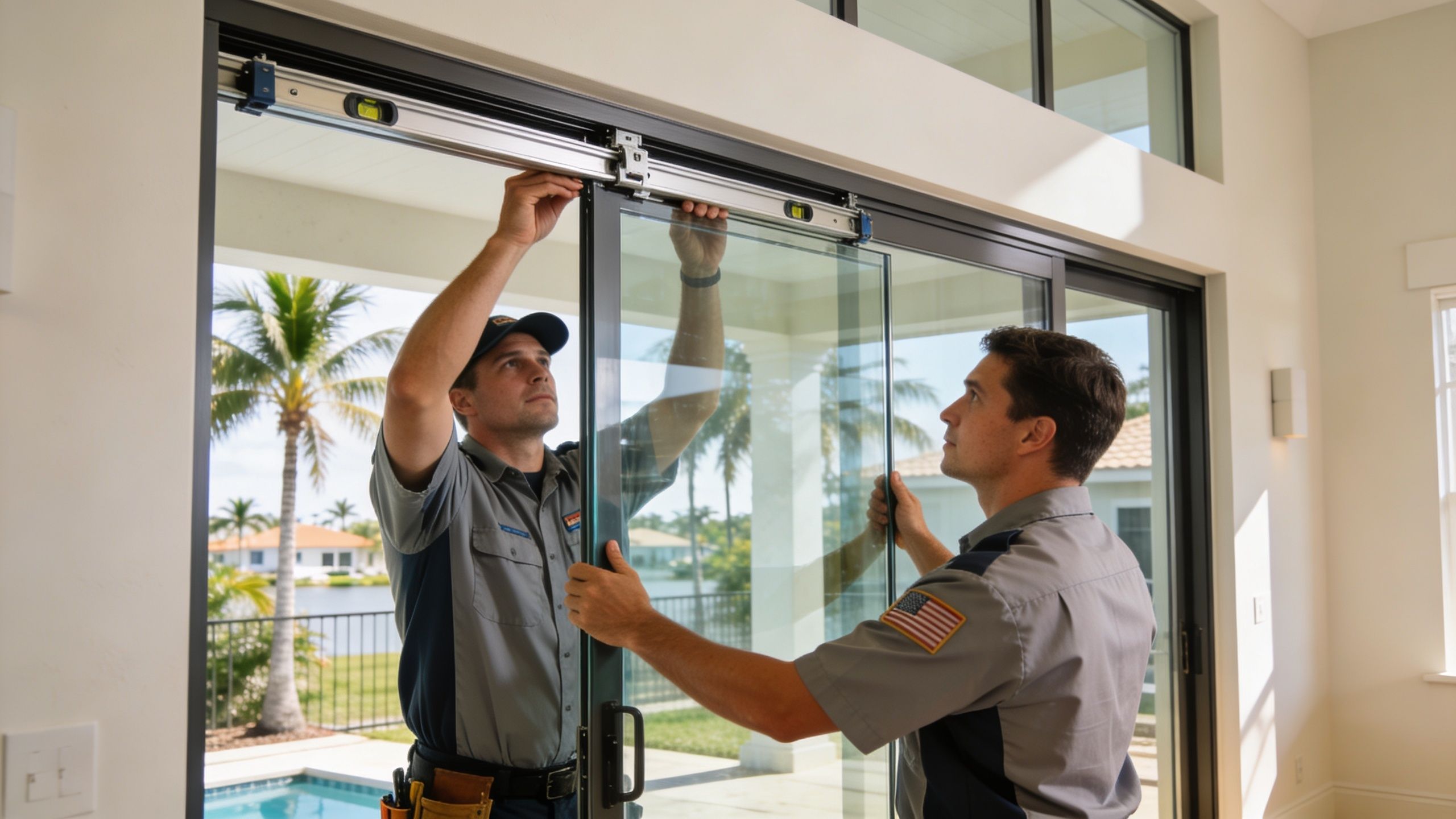
Well-run installs are quiet. The crew protects floors, stages panels carefully, checks hardware, and works through alignment methodically. There’s no forcing, no shimming as a substitute for planning, and no guessing once heavy glass is in motion.
A professional installation usually follows a clear sequence:
- Prepare the site: Protect nearby finishes and confirm final opening conditions.
- Set the hardware correctly: Tracks, anchors, and supports have to align before the glass goes in.
- Hang and adjust panels: The panel should move smoothly without drag, chatter, or visual drift.
- Test the system repeatedly: Operation, stops, reveals, and soft-close behavior all need review.
- Walk the client through care: Owners should know how the system works and how to protect it.
The quality of a frameless door shows up in the last few millimeters. Even reveals, smooth travel, and stable hardware are what separate custom work from expensive-looking work.
Building code and weather exposure change the details
This matters more in Southwest Florida than many national articles acknowledge. Large glass near exterior openings has to be evaluated through the lens of local code, exposure, and the realities of hurricane-prone construction.
Not every frameless concept belongs in every opening. Some applications want laminated glass. Some need a more sturdy assembly. Some should be reconsidered altogether if the support conditions aren’t right. Good installers don’t force a design to fit a bad condition. They redesign the condition or recommend a better solution.
That restraint is a sign of competence, not a lack of ambition.
Understanding Costs and Long-Term Value in Florida
Price matters. It should. But frameless sliding doors are one of those purchases where the cheapest quote often turns into the most expensive ownership experience.
The invoice is shaped by a handful of variables. Glass size. Glass type. Hardware complexity. Installation difficulty. The condition of the opening. Whether the project is a simple interior partition or an exposed exterior system in a coastal location. That’s why broad price talk without a site visit usually isn’t useful.
What actually drives the number up or down
Some cost differences are obvious. Larger panels require more material and more demanding handling. Ultra-clear glass adds cost because the visual result is better. Specialty finishes and premium hardware affect both appearance and durability.
Other factors are less visible:
- Support requirements: A beautiful top-hung system still needs structure that can carry it correctly.
- Field condition corrections: Crooked openings and imperfect surfaces increase labor and complexity.
- Access: Moving large glass through a finished home is very different from installing during construction.
- Exposure: Exterior applications in salt air require more careful hardware and finish decisions.
That’s why comparing two frameless door quotes line by line often tells you less than homeowners think. One proposal may include better glass, stronger hardware, cleaner detailing, and a more appropriate install method, even if the documents look superficially similar.
The thermal question most buyers overlook
This is the trade-off that deserves more attention in Florida. Many frameless door guides focus almost entirely on aesthetics and ignore thermal performance. For Southwest Florida homeowners, where cooling is a major expense, understanding how thick tempered glass and coatings affect solar heat gain and U-values is critical to evaluating long-term value, as discussed in this frameless sliding glass doors guide on thermal performance trade-offs.
That doesn’t mean frameless is a poor choice. It means the glass package should be discussed with the same seriousness as the profile and hardware.
Think in total cost of ownership
A useful way to judge value is to ask what the system is likely to cost you after it’s installed.
Consider the long-term picture:
- Will the hardware resist the coastal environment well?
- Will the glass be easy to maintain, or will buildup become a constant battle?
- Will the system stay aligned with normal use?
- Will the glazing choice make the room harder to cool?
- Will cheap installation lead to service calls and repairs?
A lower upfront number can hide a lot of future friction. Doors that derail, drag, stain easily, or require repeated adjustment stop feeling like a bargain very quickly.
Where value is usually found
The best return usually comes from selecting the right system for the opening, not the fanciest system in the catalog. In many homes, that means spending more on the glass and hardware that affect daily use, then avoiding decorative extras that don’t improve performance.
For example, a homeowner may get more lasting value from better glazing and corrosion-resistant hardware than from an elaborate finish detail no one notices after a week. The same is true for installation quality. A precise fit, stable movement, and well-chosen materials protect the investment better than any sales language ever will.
Choosing Your Installer The AmeriGlass Advantage in SWFL
A frameless sliding door can be manufactured well and still fail in the field. That usually happens when the installer treats custom glass like a commodity instead of a precision trade.
In Southwest Florida, that mistake shows up fast. Coastal air exposes weak hardware choices. Humidity punishes shortcuts in sealing and fit. Code and safety requirements leave little room for improvisation. The installer matters as much as the product.
Why specialization matters
General contractors can coordinate many trades well. Big-box retailers can sell recognizable products. But frameless glass has its own rules. Measurement has to be exact. Handling has to be deliberate. The crew has to understand how glass, hardware, substrates, and finished surfaces interact.
A dedicated glass specialist is more likely to catch the issues that derail projects later:
- Out-of-plumb openings
- Insufficient backing for top-hung systems
- Finish conflicts between adjacent materials
- Improper hardware selection for salt-air environments
- Unrealistic expectations about privacy, acoustics, or maintenance
Those aren’t small details. They’re the details that decide whether the door still feels premium after real use.
What to ask before you hire anyone
A discerning homeowner should ask practical questions, not just aesthetic ones.
Start here:
- Who measures the opening? The person measuring should understand the installation, not just the sales process.
- Who installs the glass? Subcontracted labor can be fine, but you want clarity and accountability.
- How do they handle protection of the home? Custom glass work shouldn’t leave behind damage and dust.
- What glass and hardware do they recommend for coastal exposure? The answer should sound specific, not generic.
- Are they licensed and insured? This is baseline, especially with heavy glass.
What separates a strong local installer
A good local company understands regional conditions without having to “research the market” on your project. They know what Southwest Florida sun does to interior temperatures. They know what salt does to finishes. They know that a beautiful design still has to survive day-to-day use in a lived-in home.
Choose the installer who talks most clearly about fit, support, glass specification, and maintenance. Not the one who talks most about trends.
That local experience also helps with communication. Homeowners and builders usually get better outcomes when the measuring team, fabrication planning, and installation crew all speak the same language from the start. Clean scheduling, accurate field review, and respectful work on site are not extras. They’re part of the product.
Why the relationship matters
The installer isn’t just supplying glass. They’re translating your opening, your style, and your conditions into a working system.
That requires judgment. Sometimes the right answer is yes. Sometimes it’s “yes, but with a different detail.” Sometimes it’s no, because the opening or support conditions won’t allow the design to perform well. Homeowners should value that honesty. It’s one of the clearest signs that the company knows the craft.
Frequently Asked Questions About Frameless Doors
Are frameless sliding doors only for luxury homes
No. They’re common in luxury homes because the aesthetic is clean and the effect is dramatic, but the format works in many settings. A compact bathroom can benefit from a sliding frameless enclosure because it saves space. A condo can benefit from an interior partition that brings in more light. The key is choosing a system that matches the opening and how the room is used.
Do frameless sliding doors work for commercial spaces
Yes, especially for offices, retail spaces, and other interiors where flexibility matters. They’re useful when a business wants to divide space without losing openness. In commercial settings, the conversation usually shifts toward durability, traffic pattern, privacy, and acoustic control rather than pure residential aesthetics.
Are they safe in Southwest Florida
They can be, if the glass and system are specified correctly for the application. Safety glass is essential. Exterior and exposed conditions may call for a different glass makeup than an interior partition or shower enclosure. The right answer depends on location, support, and code requirements, not just the look the owner wants.
Can a frameless sliding door be added to an existing home
Usually yes, but existing conditions decide what’s realistic. Remodeling often reveals imperfect walls, uneven floors, and structural limitations that don’t appear in inspiration photos. That doesn’t mean the project can’t happen. It means the measuring and design phase has to be more disciplined.
Are top-hung systems better than bottom-rolling systems
Often, yes, especially in coastal environments where debris and residue collect quickly in lower tracks. Top-hung systems can offer a cleaner floor condition and reduce some of the maintenance headaches that come with exposed bottom rollers. But they also require proper structural support above. The best system depends on the opening, panel size, and support conditions.
What’s the best glass choice for a premium look
For many upscale interiors, ultra-clear glass gives the cleanest visual result because it reduces the green edge tint that standard clear glass can show. It’s especially effective near white stone, pale tile, and light cabinetry. That said, privacy or performance needs may point you toward a different glass type.
Are frameless sliding doors hard to clean
They’re easy to live with when the design is right and the owner follows a basic routine. They become harder to maintain when the glass is left untreated, the hardware traps residue, or the owner uses abrasive cleaning methods. In Southwest Florida, hard water and humidity make regular care more important than many people expect.
Can they help with noise control
They can, particularly when the glazing and sealing strategy are chosen with that goal in mind. Interior partitions can reduce the feeling of full exposure in open floor plans. Some systems perform better acoustically than others, so this should be discussed upfront if the room is near traffic, a TV area, or a busy work zone.
How long does the process usually take
Lead time depends on design decisions, glass type, hardware availability, fabrication scheduling, and how ready the opening is when measured. Custom glass isn’t something to rush casually. The process moves best when selections are finalized early and the site is ready before fabrication begins.
What should I do before asking for an estimate
Have a clear idea of the room’s priority. Decide whether you care most about view, privacy, ease of cleaning, interior separation, or a statement look. Collect a few reference photos you like. Note whether the project is for a shower, patio, or partition. That makes the consultation more productive and helps the installer guide you toward a system that fits both the space and the climate.
If you’re ready to discuss frameless sliding doors with a local team that understands coastal conditions, custom measurement, and clean installation, contact AmeriGlass Industries. They serve Naples and the wider Southwest Florida region with precision glass solutions for homes and commercial spaces.