

You’re probably searching frameless shower enclosures near me because your current bathroom isn’t giving you what you want anymore. Maybe the old framed door feels bulky. Maybe the metal track never looks fully clean. Maybe the shower curtain makes the room feel smaller than it is. In Southwest Florida, a lot of bathrooms have good bones but still feel closed in.
A frameless enclosure changes that fast. You get clear sightlines, more light, and a shower that feels like part of the room instead of a box inside it. In higher-end remodels, that open look is one reason frameless glass has become so popular, and it can make the bathroom feel visually larger. According to Arizton’s U.S. glass shower door market report, frameless doors can enlarge perceived bathroom space by up to 20 to 30% visually.
In Southwest Florida, though, the buying decision shouldn’t stop at looks. Humidity, salt air, and hard water change what works long term. The right enclosure isn’t just the one that photographs well on install day. It’s the one that still opens smoothly, sheds water properly, and stays clear after months of daily use.
That’s where local project planning matters. A shower enclosure in Naples, Fort Myers, or Bonita Springs has to be measured precisely, fitted to real-world tile conditions, and specified with hardware that can handle a coastal bathroom environment. If you’re looking for the spa-like feel that custom glass brings, this overview on how glass can make your home feel luxurious is a useful starting point.
Your Guide to Upgrading Your Southwest Florida Bathroom
Most bathroom remodels start with a simple complaint. The room feels dated, darker than it should, and harder to clean than anyone expected. In many homes, the shower is the main reason. Heavy framing, cloudy glass, and stained tracks pull down the look of the whole space.
A frameless enclosure solves a visual problem and a practical one at the same time. The visual part is obvious. Less metal means your tile shows, natural and artificial light move through the room better, and the shower feels integrated with the rest of the bath. The practical part matters just as much. Fewer bulky frame sections mean fewer places for grime to collect.
What homeowners usually want
By the time individuals start looking for frameless shower enclosures near me, they’re usually trying to get to one or more of these outcomes:
- More openness: They want the bathroom to feel less crowded.
- Cleaner lines: They’re after a modern finish, not a builder-grade look.
- Easier upkeep: They’re tired of scrubbing around tracks and framed edges.
- A custom fit: They need glass that works with their exact tile layout, not a rough off-the-shelf compromise.
That last point is where many projects either go right or go sideways. Frameless glass only looks simple. Behind that clean appearance is a lot of exacting work. Walls may be slightly out of plumb. Tile may vary. Knee walls, benches, niches, and curbless entries all affect how the enclosure should be designed.
A frameless shower should look effortless when it’s finished. It never gets there by accident.
Why local conditions matter
Southwest Florida bathrooms put more stress on shower hardware and glass surfaces than many homeowners expect. Coastal moisture and regular daily heat cycles can expose weak hardware choices fast. Water quality can leave spotting and mineral buildup that turns “easy to clean” into “why am I wiping this again?”
That’s why the smartest approach is to design the enclosure around how you live in this climate, not just around a showroom photo. The right glass thickness, hinge style, seals, coating, and door swing all matter.
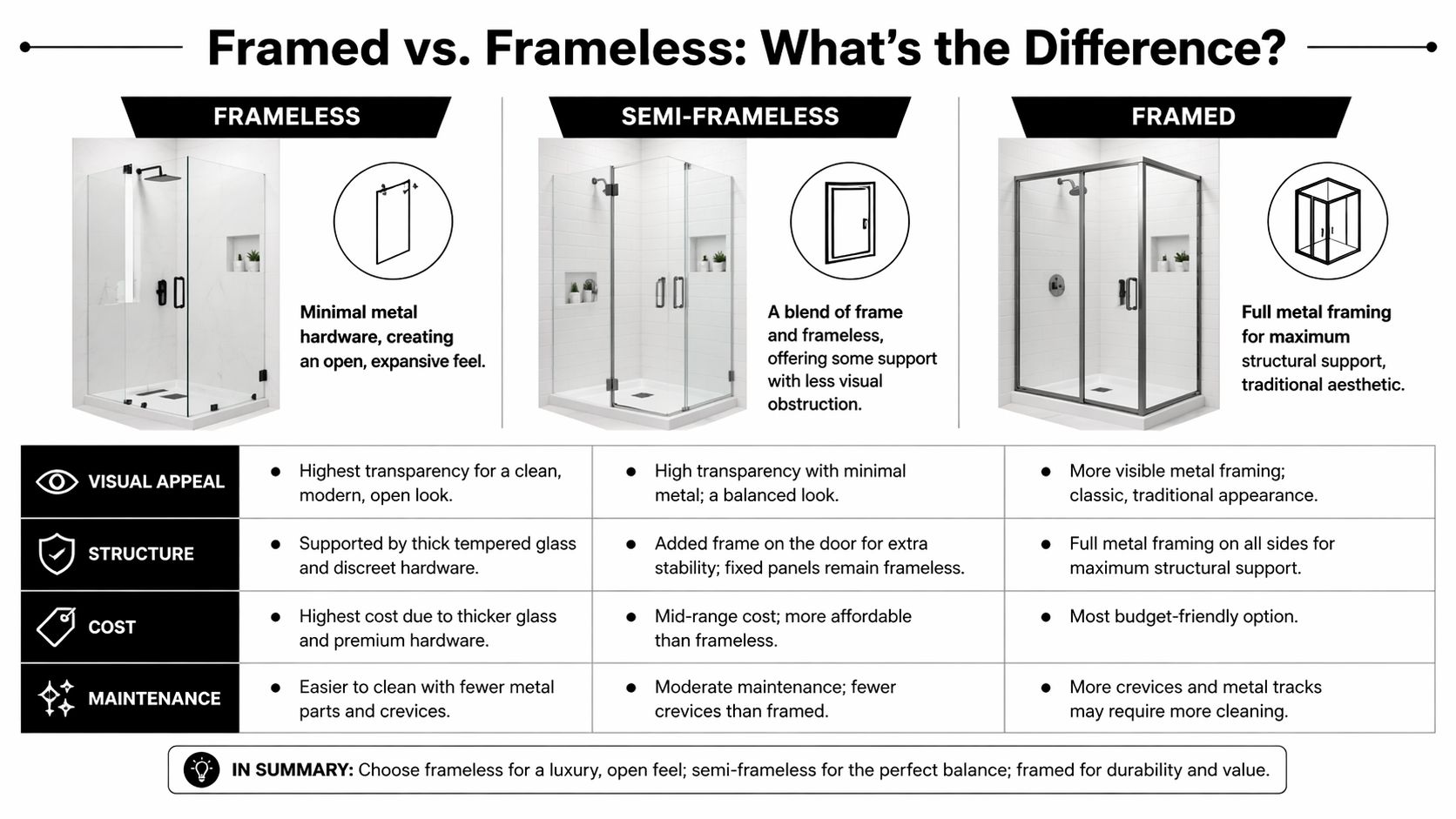
Framed vs Frameless What Is the Difference
A framed shower can do the job. A frameless shower has to be built right.
That distinction matters in Southwest Florida, where humidity, salt air, hard water, and daily use expose weak design choices fast. Homeowners often start by comparing appearance, but the better comparison is appearance, upkeep, and long-term performance.
What framed enclosures do well
Framed units use thinner glass supported by metal around the perimeter. That built-in structure usually keeps the upfront price lower and works well for straightforward replacements.
The trade-off shows up in cleaning and aging. Bottom tracks, vertical channels, and framed corners give soap residue, mildew, and mineral deposits more places to collect. In coastal Florida bathrooms, that extra metal also means more surfaces that can discolor, pit, or wear over time if the hardware quality is poor.
Where semi-frameless fits
Semi-frameless systems reduce some of that visual weight, but they still rely on framing in key spots. For some bathrooms, that middle-ground approach makes sense. It can lower cost while giving the shower a lighter look than a fully framed enclosure.
It still comes with some of the same maintenance points. You have fewer metal edges to clean, not zero.
What makes frameless different
A frameless enclosure uses thicker tempered glass and minimal hardware. The glass becomes the structure, which means the enclosure depends much more on accurate measuring, proper hinge placement, solid wall backing, and clean fabrication.
Done well, frameless gives you cleaner sightlines and fewer places for buildup to hide. Done poorly, it can leave you with door alignment problems, panel gaps that look sloppy, or hardware that works loose. I tell clients this all the time. Frameless is not forgiving of shortcuts.
In Southwest Florida, there is another practical issue many installers gloss over. Bare glass does not stay “clear and easy” on its own. Humidity, hard water spotting, and airborne salt exposure can leave the surface looking dull faster than homeowners expect. That is one reason many clients reviewing custom shower door design options at AmeriGlass end up focusing on glass protection, not just the enclosure style.
The side-by-side comparison
| Feature | Framed | Semi-Frameless | Frameless |
|---|---|---|---|
| Visual appeal | Traditional, more visible metal | Cleaner than framed, still shaped by metal elements | Minimal hardware, open modern look |
| Structure | Full perimeter frame supports thinner glass | Partial frame with some exposed glass edges | Thick tempered glass supported by clips, hinges, and precise layout |
| Cleaning | More tracks and edges to scrub | Moderate maintenance around remaining frame sections | Fewer dirt traps, but glass protection matters in humid coastal conditions |
| Bathroom feel | More enclosed | More open than framed | Cleanest sightlines |
| Customization | More limited by standard sizes | Moderate flexibility | High flexibility for custom tile, benches, knee walls, and curbless entries |
| Cost | Usually lower upfront | Mid-range | Higher upfront cost tied to glass thickness, hardware, and installation precision |
What shoppers often miss
Homeowners searching for frameless shower enclosures near me are usually comparing style first. The better question is what they want to live with for the next ten years.
Framed enclosures ask for more edge and track cleaning. Frameless enclosures reduce that clutter, but in this climate they should also be specified with a protective coating such as Diamond-Fusion if low maintenance is the goal. Without it, even a well-installed frameless shower can start showing water marks and mineral haze sooner than expected.
That is the main difference. Framed depends on metal to carry the load. Frameless depends on glass quality, hardware quality, installation accuracy, and surface protection.
Designing Your Perfect Shower Glass and Hardware Options
The fun part of a frameless project is that the enclosure doesn’t have to look generic. The glass, hardware finish, handle style, and layout all change the final result. Good design isn’t about adding random upgrades. It’s about choosing options that fit the room and hold up in daily use.
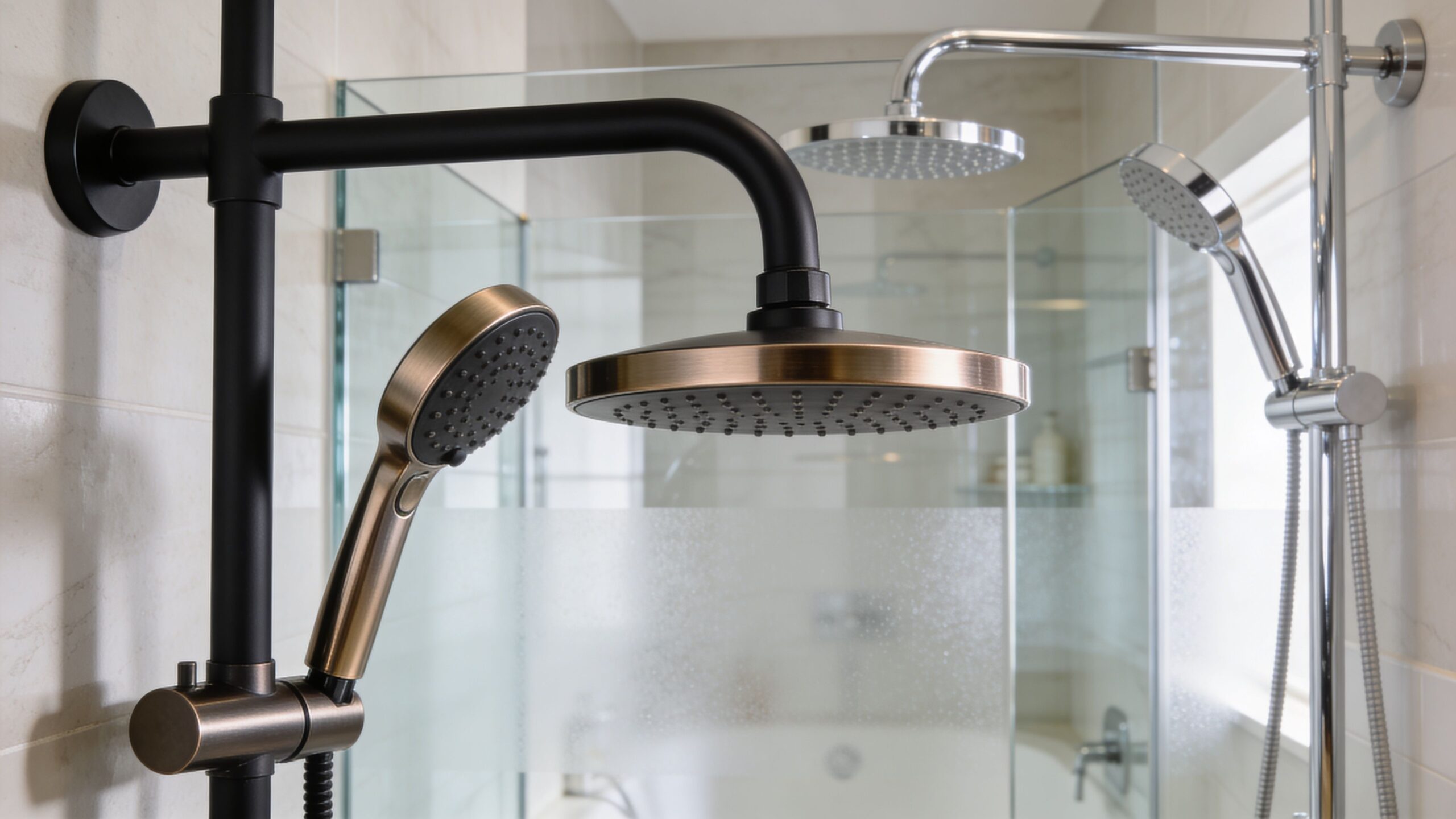
If you’re in the early planning stage, this shower design resource from AmeriGlass shower door design options helps you visualize how these decisions come together.
Choosing the right glass thickness
This isn’t a style-only decision. It’s structural. The industry standard for frameless enclosures is 3/8-inch or 1/2-inch tempered glass, and the right choice depends on panel dimensions and configuration. As outlined by Glass Magazine’s summary of the frameless shower design guide, 3/8-inch glass supports a maximum width of 30 inches for unsupported panels, while 1/2-inch glass extends that to 36 inches.
That matters because frameless systems rely on the glass itself. If the panel width, height, or adjacent door layout calls for thicker glass, that’s not an upgrade for looks alone. It’s part of safe design.
A few practical examples help:
- A smaller, straightforward opening: 3/8-inch glass may be the right fit.
- A wider unsupported panel: 1/2-inch often makes more sense.
- A door hinged from glass instead of a wall: The specification needs closer review because the load path changes.
Glass appearance choices
Clear tempered glass is the most common selection because it keeps the room bright and shows off tile work. But “clear” isn’t the only look available.
Some homeowners prefer ultra-clear low-iron glass because it reduces the green edge tint that standard glass can show, especially against light tile. Others want frosted or patterned privacy glass where direct sightlines are a concern. In a primary bathroom, that can be a design preference. In guest baths or shared-use settings, it can be a functional one.
The best choice depends on what you want the shower to do in the room:
| Glass option | Best fit |
|---|---|
| Standard clear | Open look, broad design compatibility |
| Ultra-clear | Light tile, bright palettes, detail-focused finishes |
| Frosted or patterned | Added privacy with softer visibility |
Hardware is not a small detail
Hardware does more than finish the look. It determines how the enclosure feels every day when you open the door, close it, and clean around it. Hinge type, handle shape, channel choice, and finish all affect the final result.
Common finish choices include:
- Chrome: Bright and classic
- Brushed nickel: Softer metallic tone that hides fingerprints well
- Matte black: Strong contrast, often used in contemporary bathrooms
- Polished brass: Warmer and more decorative
The right finish usually follows the rest of the bathroom hardware. If your shower fixtures and vanity hardware are already selected, the enclosure should coordinate rather than compete.
Hardware should match the bathroom, but it also has to survive the bathroom.
What works in Southwest Florida
In this region, hardware selection should always be filtered through moisture exposure. A finish may look great on a sample board and still be the wrong choice if the underlying hardware isn’t suited to a damp coastal environment.
That’s why door function and finish should be discussed together. A beautiful hinge with poor corrosion resistance is a short-term win and a long-term problem. The same goes for handles, clips, and channels. If the enclosure includes moving parts, those parts need to be specified for use, not just appearance.
The Investment in Luxury Understanding Frameless Shower Costs
You step into a newly remodeled bathroom, and the shower is the first thing that reads custom. Frameless glass has that effect. It also costs more for reasons that are real on the jobsite, not just in the showroom.
Frameless systems use thicker tempered glass, heavier-duty hardware, tighter fabrication tolerances, and more precise installation. Every reveal is visible. If the opening is out of square, the hardware is underspecified, or the glass was measured loosely, the finished enclosure shows it.
The market reflects that demand. The U.S. shower enclosures market report from Research and Markets values the category at USD 3.8 billion in 2022 and projects growth to USD 5.15 billion by 2028, with premium frameless designs tied to higher-end residential remodels.
What actually drives the price
The final number usually comes down to four things.
- Layout and configuration: An inline door and panel is more straightforward than a design with return panels, angles, pony walls, or a notched bench.
- Glass size and specification: Larger pieces, thicker glass, low-iron glass, and privacy finishes all raise fabrication cost.
- Hardware quality: Hinges, handles, clips, support bars, and finish durability all affect both price and long-term performance.
- Site conditions: Out-of-plumb walls, curbless entries, delicate tile, tight access, and second-floor carries add labor and planning time.
In Southwest Florida, there is another cost factor that many quotes gloss over. Coastal humidity, hard water, and salt in the air are hard on glass and hardware over time. A lower quote can leave out the details that matter later, especially protective glass treatment. Diamond-Fusion is one of the few upgrades I recommend as a practical maintenance decision, not a cosmetic add-on, because it helps reduce mineral buildup and makes routine cleaning easier in this climate.
Cheap quotes usually get expensive later
Price shopping by bottom line alone is where frameless projects go sideways.
The shortfall usually shows up in one of three places. Lighter hardware than the opening really needs. Rushed measuring. Or a glass package that looks acceptable on paper but is harder to live with once water spots, soap residue, and hinge wear start showing up.
Those problems are expensive because they rarely stay cosmetic. A door can start to drag. Water can escape at the wrong corner. Hardware can loosen sooner than it should. Glass can haze over from constant mineral deposits, especially if no protective coating was included from day one.
Why the investment still makes sense
Homeowners choose frameless glass because they use it every day and see the difference every day. The room feels more open. Light moves farther. Cleaning around bulky metal frames is no longer part of the routine.
The spending pattern supports that choice. As noted earlier, the same Research and Markets report points to stronger homeowner investment in major bathroom remodels than minor updates. In practice, that tracks with what we see locally. Clients are willing to spend more when the enclosure is measured correctly, built for the opening, and specified for Florida conditions instead of generic national pricing.
If you want a real number, generic ranges only go so far. The better approach is to request a custom shower enclosure quote based on your exact opening and hardware choices. That gives you a price tied to your bathroom, your glass, and the maintenance level you want five years from now.
From Consultation to Completion The AmeriGlass Installation Process
A frameless shower project usually feels simple to the homeowner when the process behind it is disciplined. That’s the goal. The work should look clean and calm on the surface, even though there’s a lot happening behind the scenes.
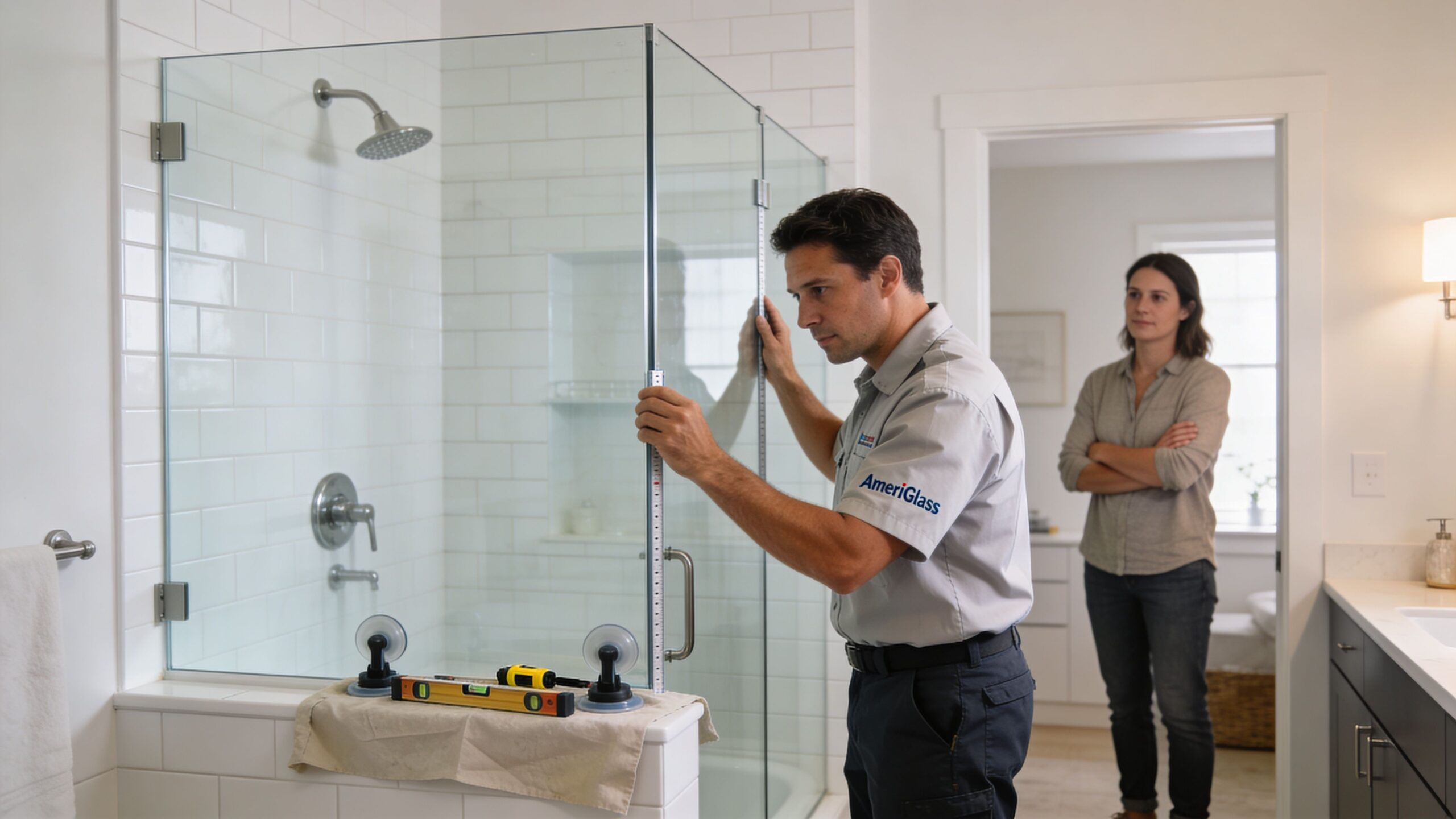
Step one is not glass
The first appointment should focus on the opening, not the sales pitch. Shower dimensions on paper rarely tell the whole truth. Tile may run slightly out of square. A wall may bow. A curb may be level enough for tile and still not be ideal for frameless glass without adjustment.
That early site visit is where practical decisions happen:
- Door swing direction
- Fixed panel placement
- Hinge mounting conditions
- Water containment strategy
- Hardware finish coordination
This is also the stage where clients usually ask the right long-term questions. How easy will it be to clean? Where will water land? Will the handle placement feel natural? Those are the questions that improve the finished enclosure.
Why measurement quality decides everything
Frameless systems don’t forgive rough measuring. The glass is fabricated to fit the opening as measured. If the opening is read inaccurately, the panel won’t magically adjust on install day.
According to the National Glass Association technical design guide release, long-term performance depends heavily on hardware specification. The guide calls out solid brass hinges, stainless steel fasteners, and waterproof vinyl profiles as essential for preventing corrosion and water leakage, especially in humid climates. That matters in Southwest Florida, where coastal moisture can expose shortcuts quickly.
If the hardware is wrong, the shower may still look fine at handoff. The problems show up later.
Fabrication and scheduling
Once measurements are confirmed, the glass is fabricated to the final specification. That includes edge finishing, hole placement for hinges and handles, and any notches or specialty cuts needed for the design. This isn’t the point to improvise. Fabrication follows the field measurements, and the installation schedule should follow fabrication readiness, not wishful timing.
Homeowners often appreciate clear milestone updates more than anything else. If the glass is in production, say so. If hardware is still being coordinated, say that too. The smoothest jobs are usually the ones with the fewest surprises.
A lot of common client questions are already answered in this frameless shower FAQ library, which can help before the install date arrives.
Here’s a quick visual look at how custom glass installation comes together in the field:
Installation day and final fit
Installation day should be controlled and methodical. Glass gets set, aligned, secured, and checked for movement, reveal consistency, and seal placement. Door action is tested. Hardware is tightened correctly. The enclosure is cleaned, and the homeowner is shown how the system operates.
The final walkthrough is where good installers separate themselves from rushed ones. The client should know how to open and close the door properly, what normal settling looks like, and how to care for the glass and hardware from day one.
One local option for that full process is AmeriGlass Industries, which provides consultation, measurement, fabrication coordination, and installation for frameless shower systems in Southwest Florida.
Protecting Your View The Secret to Low-Maintenance Glass
Frameless glass looks clean. Keeping it clean in Southwest Florida is the main issue.
This is the part most showroom conversations skip. In a coastal climate, the glass deals with frequent humidity, mineral-heavy water spotting, soap residue, and hardware exposure at the same time. Homeowners often assume frameless means low maintenance by default. It doesn’t. It means the maintenance is different, and if the glass isn’t protected, you’ll notice.
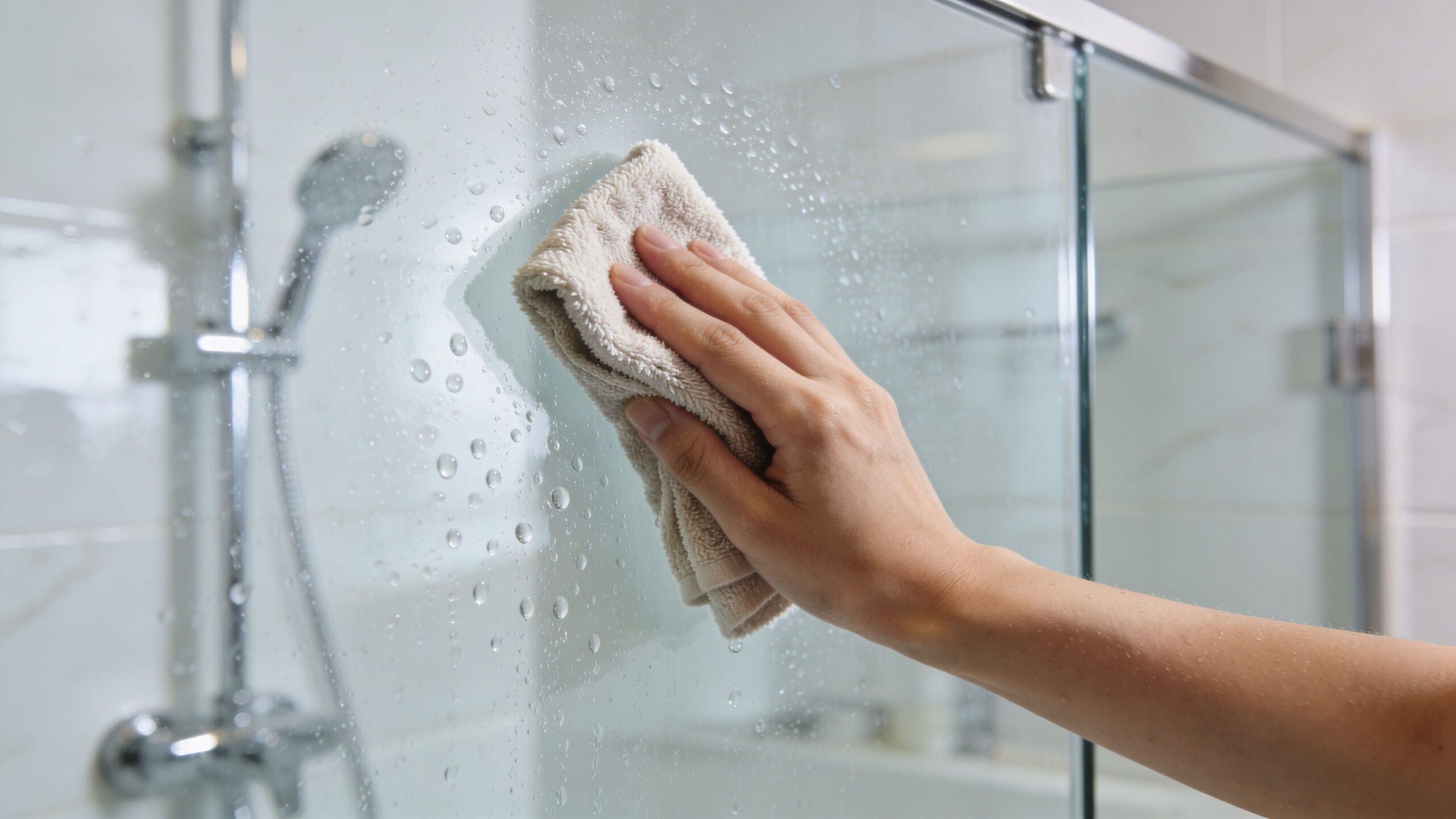
According to the Southwest Florida maintenance angle summarized in this frameless shower retail category reference, homeowners in humid, coastal climates report 20 to 30% higher cleaning frequency for frameless enclosures. The same verified data also notes that protective coatings such as Diamond-Fusion can reduce maintenance by up to 90%.
Why Diamond-Fusion matters here
Diamond-Fusion is the upgrade that many buyers should consider standard in this climate. The purpose is straightforward. It creates a protective barrier that helps water bead and release from the glass instead of sticking, drying, and leaving behind mineral deposits and soap film.
That changes the ownership experience in practical ways:
- Less daily wiping: Water doesn’t hang on the surface as aggressively.
- Lower risk of buildup: Hard water deposits have a harder time gaining traction.
- Better long-term clarity: The glass is less vulnerable to the dull, etched appearance that can develop over time.
What does and doesn’t work
A lot of homeowners try to solve the problem after installation with sprays and occasional deep cleaning. That’s better than nothing, but it’s a reactive plan. Once minerals start bonding to unprotected glass, cleaning gets harder and the surface can lose that fresh, clear look.
A better routine combines the right coating with simple maintenance habits.
- Do use a squeegee or microfiber cloth regularly.
- Do clean with products appropriate for shower glass and hardware.
- Don’t wait until the glass looks cloudy to start caring for it.
- Don’t use abrasive pads or harsh methods that can damage finishes.
If mineral spotting is already part of your routine, this guide on how to remove limescale from glass offers useful general cleaning context.
The easiest shower glass to maintain is the glass that was protected before buildup became the problem.
For ongoing care after installation, a dedicated shower door maintenance guide is worth keeping handy. In this climate, maintenance isn’t optional. It’s part of protecting the investment.
Your Checklist for Choosing a Shower Enclosure Installer
A nice-looking website doesn’t tell you whether an installer can execute a frameless shower correctly. This product category is too exact for guesswork. The right company should be able to answer technical questions clearly, explain how they measure, specify hardware appropriately, and talk candidly about maintenance in Southwest Florida.
When homeowners search frameless shower enclosures near me, they usually get a mix of custom glass specialists, remodelers, and lead-generation directories. That’s why a vetting checklist matters.
Questions worth asking before you hire anyone
Use these as buying filters, not as afterthoughts.
- Are you licensed and insured for this work? You want accountability if something goes wrong on site.
- How do you measure custom openings? Precise field measurement is essential on frameless projects.
- What glass thickness are you recommending, and why? The answer should relate to layout and panel dimensions, not preference alone.
- What hardware materials are being used? In this climate, corrosion resistance matters.
- How are you addressing water management? A frameless enclosure still needs a plan for seals, swing direction, and splash control.
- What maintenance do you recommend in Southwest Florida? If the answer ignores humidity, hard water, and coastal exposure, keep looking.
Signs the installer understands the region
Local knowledge shows up in small details. The installer asks about ventilation. They pay attention to tile conditions. They discuss corrosion-resistant components instead of speaking only about style. They mention protective coatings before you bring them up.
That’s the difference between someone who installs shower glass and someone who understands what shower glass has to survive here.
You can also learn a lot by looking at how local home-service businesses present themselves online. This overview of Local SEO for Home Services is useful because it shows why proximity-based searches can surface many options, not all of them equally qualified.
A practical shortlist
A strong installer should check these boxes:
| Checkpoint | What you want to hear |
|---|---|
| Measurement process | Custom field measuring, not rough sizing |
| Glass specification | Recommendation tied to dimensions and use |
| Hardware quality | Brass hinges, stainless fasteners, proper seals |
| Climate awareness | Clear advice on humidity, spotting, and corrosion |
| Communication | Clear scheduling and realistic expectations |
| Aftercare guidance | Cleaning and maintenance instructions that match the environment |
The decision most people remember later
Homeowners rarely regret choosing a quality enclosure. They regret choosing the wrong installer for it. The finished product is only as good as the measuring, fabrication coordination, hardware selection, and install discipline behind it.
If you’re narrowing options in Naples, Fort Myers, Bonita Springs, or the surrounding area, ask direct questions and pay attention to direct answers. That usually tells you more than a gallery ever will.
If you’re ready to compare options for your own bathroom, AmeriGlass Industries offers consultations for custom frameless shower enclosures in Southwest Florida. Bring your measurements, photos, or renovation plans, and get practical guidance on glass layout, hardware, and low-maintenance protection for your space.