

A lot of homeowners in Naples and Fort Myers start in the same place. The bathroom works, but it feels boxed in. The old framed shower has thick metal lines, the glass looks busy, or the curtain hangs into the room and steals light. In a small bathroom, that kind of visual clutter doesn't stay in the background. It becomes the room.
That's why frameless shower doors for small bathrooms get so much attention. In the right space, they can change the way the whole room feels without moving a wall. You see more tile, more light, and more of the floor plan at once. The bathroom doesn't suddenly become larger, but it often feels more open and better organized.
Homeowners who are still sorting through finishes and layouts sometimes start with broader Kitchen Renovations Perfected remodel inspiration and then narrow the plan once they understand what their room can support. When you're ready to turn ideas into a door style, panel layout, and hardware package that fits the room you have, a good next step is to design your shower door around your opening instead of trying to force a stock solution into a tight space.
Reimagining Your Small Bathroom Space
A small bathroom usually feels smaller for simple reasons. Too many lines. Too many visual stops. Too much hardware competing with the vanity, toilet, and tile. In older Southwest Florida homes, I also see bathrooms where every surface reflects humidity, wear, and hard-water spotting, so the room feels heavy before you even address layout.
Frameless glass changes that starting point. It removes the bulky border that makes the shower read like a separate block in the room. In a compact bathroom, that matters more than people expect because your eye catches every edge.
What homeowners notice first
The first reaction usually isn't about hardware or hinge type. It's about relief. The room looks cleaner. Light travels farther. Tile that used to disappear behind a frame becomes part of the design again.
That's especially helpful if your bathroom has any of these common problems:
- A shower curtain that drifts inward: It makes the bathing area feel cramped and adds visual softness where you need crisp lines.
- A framed enclosure with dark trim: The metal border breaks up the room and can make a narrow wall feel even narrower.
- An awkward vanity-to-shower relationship: When fixtures already sit close together, heavy framing exaggerates that crowding.
- Limited natural light: Clear glass lets more of the room stay visible, which helps the space feel less closed off.
In a small bath, the shower door isn't a detail. It's one of the biggest visual surfaces in the room.
Small can still look intentional
A compact bathroom doesn't need to feel like a compromise. Some of the sharpest remodels in Naples use smaller footprints well because the design stays disciplined. The enclosure is scaled correctly, the hardware isn't oversized, and the opening works with the room's traffic instead of against it.
That's the shift that matters. Stop treating the room like a problem to hide. Treat it like a space that needs better proportions, better sightlines, and a better fit.
Why Frameless Doors Excel in Tight Quarters
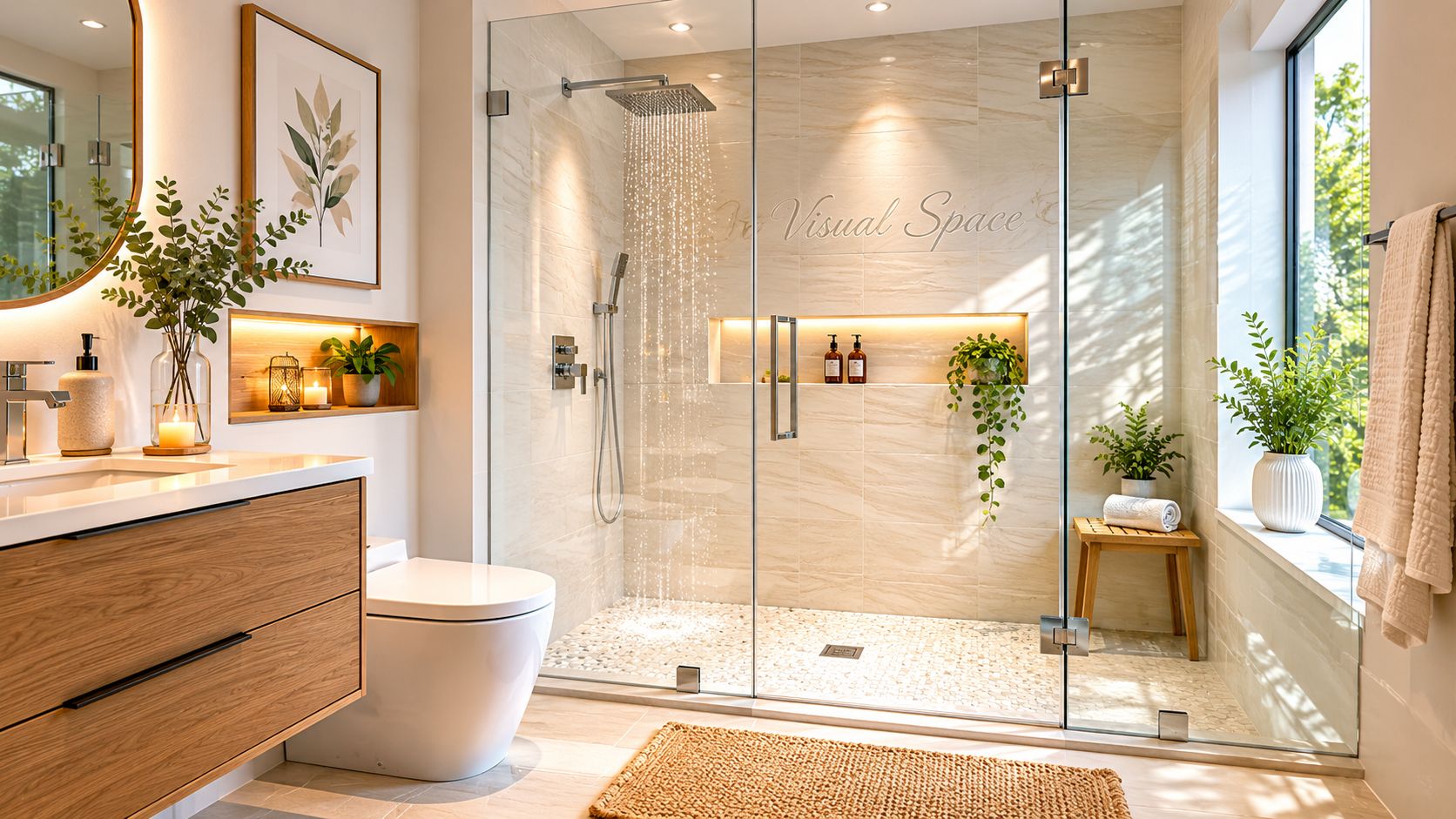
Frameless shower doors work well in compact bathrooms because they reduce visual weight. That's the core advantage. A framed enclosure creates a border your eye has to stop at. A frameless enclosure keeps the sightline moving.
Industry guidance ties the popularity of frameless doors to minimalist bathroom design and notes that they can make a small bathroom feel larger by preserving sightlines and allowing more light to pass through. The same guidance also points to the importance of custom-cut, made-to-measure installation because small bathrooms rarely fit standard enclosure dimensions cleanly, as noted by ABC Glass and Mirror's discussion of custom frameless shower installations.
Less frame means less interruption
Think of it this way. In a small room, every thick border acts like a divider. The more dividers you add, the smaller the room feels. Frameless glass doesn't erase the shower, but it lets the enclosure recede.
That creates a few practical wins:
- You keep the tile visible: The back wall remains part of the room instead of getting boxed off.
- Light moves across the bathroom: That helps both bright bathrooms and darker interior baths.
- The room reads as one space: That's one of the biggest visual upgrades in smaller remodels.
- The enclosure looks custom instead of inserted: In a finished bathroom, that difference is obvious.
It's not only about style
Some homeowners assume frameless is mostly a luxury look. It does look cleaner, but in small bathrooms it's also a functional design move. When the room is tight, visual openness isn't cosmetic. It affects how comfortable the space feels every day.
That's also why standard kits often disappoint in older homes. Walls may be slightly out of plumb. Tile buildup can tighten an opening. A curb may not be perfectly uniform. In those conditions, a stock enclosure can look close enough on paper and still feel off after installation.
For homeowners weighing panel layouts and opening widths, looking at inline door and panel configurations helps clarify how a frameless system can be fitted to an alcove or straight opening without adding unnecessary bulk.
Practical rule: If the bathroom is small, the enclosure should do two jobs at once. It should contain water and visually disappear.
Where frameless helps most
Frameless shower doors for small bathrooms tend to shine when the room already has good tile, a modest footprint, and limited tolerance for clutter. They're especially effective when the shower sits in direct view from the entry. In that setup, a heavy framed unit becomes the first thing you see. A frameless one lets the whole room present itself at once.
That's why these doors often feel like a bigger upgrade than the square footage would suggest.
Mastering Layout and Measurement Strategy
A frameless shower door can look perfect in a photo and fail in a real bathroom. The usual reason is simple. Nobody solved the swing path.
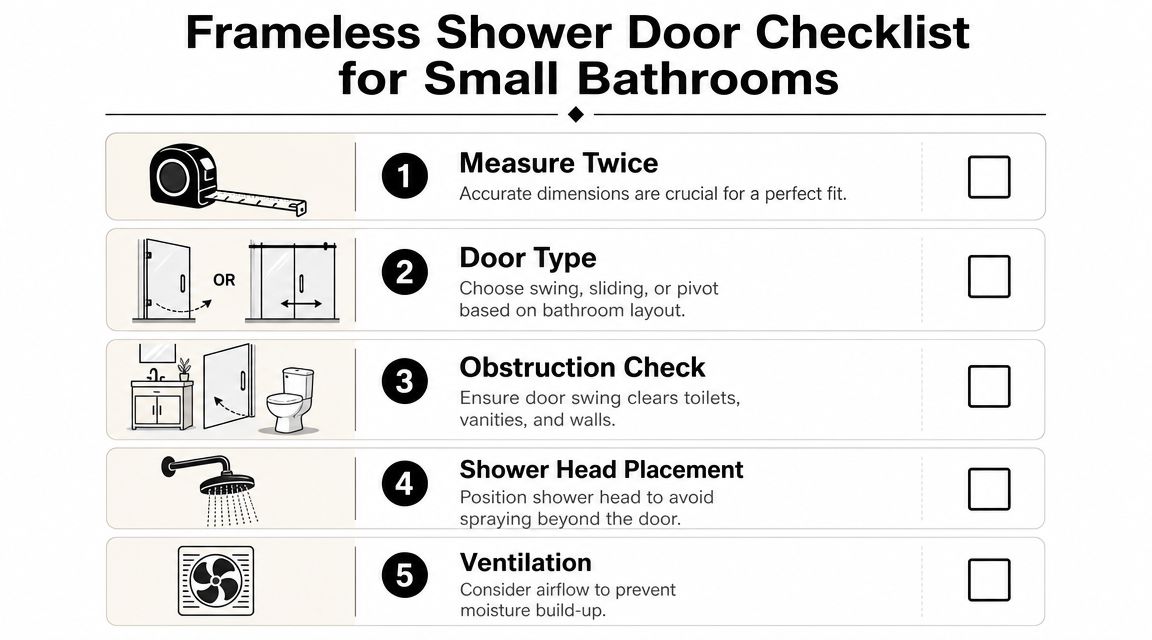
That's the part homeowners need to think through before glass is ordered. In a small bath, a few inches can decide whether the door clears the vanity, clips the toilet, or blocks the room when it opens. Neutral industry guidance notes that sliding frameless doors can work better when there isn't enough clearance for a swinging door, and it also warns that a swing door can block the toilet, vanity, or entry path if the room isn't measured carefully, as explained in Pioneer Glass's guide to frameless shower enclosure buying decisions.
Start with the room, not the door
Homeowners often choose a hinge style first because it looks elegant. That's backwards. Start with traffic flow. Ask what happens when someone exits the shower, opens a vanity drawer, or walks in while the door is open.
Use this quick self-check before you talk finishes or handle styles:
- Check the approach: Stand where you'd step out of the shower. Is there clear floor space, or does the toilet or vanity crowd that landing area?
- Map the swing: Use painter's tape on the floor to mark the arc of a hinged or pivoting door.
- Look at fixture conflict: Open nearby cabinet doors and imagine the shower door open at the same time.
- Watch the entry path: Make sure the shower door doesn't turn the doorway into a bottleneck.
- Think about daily use: A door that technically fits but feels awkward every morning isn't the right door.
When sliding makes more sense
Sliding frameless doors aren't just a backup option. In many small bathrooms, they're the smarter answer because they remove the swing radius entirely. If the shower sits close to the vanity or directly across from the toilet, that can make the difference between a layout that works and one that frustrates you every day.
The same logic applies to corner enclosures. If your room is tight and the shower belongs in a corner, a neo-angle layout can reclaim useful circulation space that a wider straight opening might consume. Homeowners comparing configurations often review neo-angle shower door options when a standard straight door would crowd the room.
A short walkthrough can help you think through those trade-offs:
Measure like the glass is permanent, because it is
Once a frameless system is fabricated, there's very little forgiveness. That's why smart measurement goes beyond width and height. The curb, wall condition, tile thickness, and exact hinge location all matter. In small bathrooms, those details matter even more because there's less room to hide a bad assumption.
If the layout is tight, the right question isn't “Can I fit a frameless door here?” It's “Which frameless door works with the way this bathroom actually moves?”
A good layout feels calm when the door is open, closed, and halfway in between. That's the standard to aim for.
Choosing Your Glass and Hardware
Once the layout is solved, the next decision is what the enclosure is made of and how it's supported. At this point, many homeowners either overspend on details they won't notice or cut corners on components they'll live with every day.
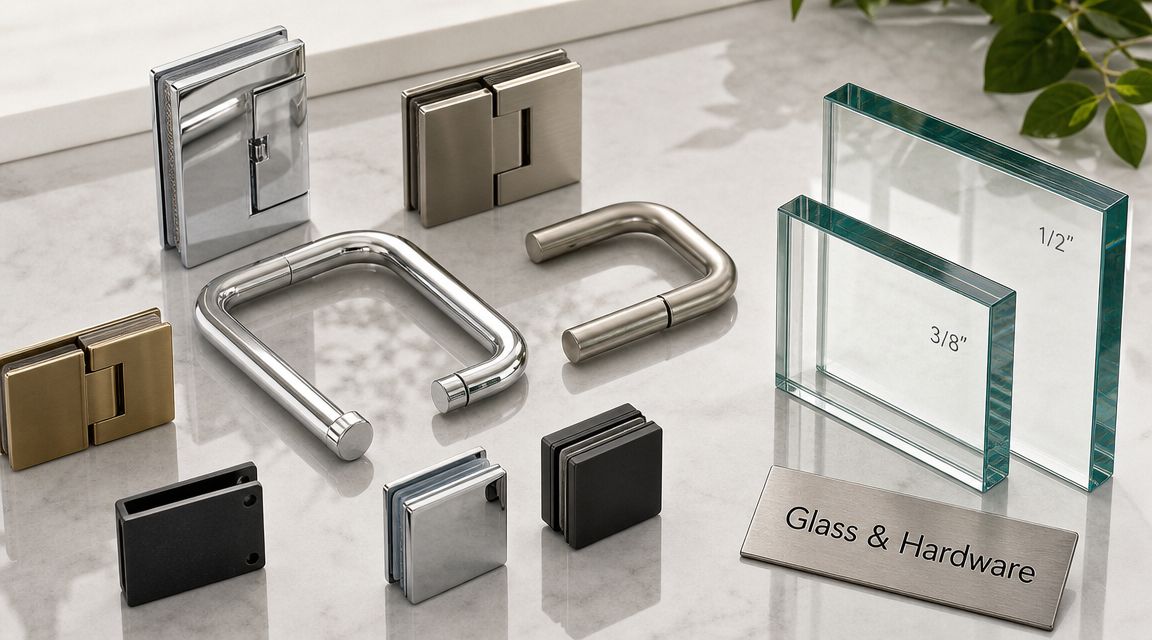
Frameless shower doors are typically built with thicker tempered glass, most commonly 3/8 inch to 1/2 inch glass because the panel carries more of its own structural load without a full metal frame, according to Lee & Cates Glass on frameless shower door construction. That thicker glass is a major reason frameless systems usually cost more and demand more precise measurement and installation.
Glass thickness and what it changes
For homeowners, thickness affects more than engineering. It changes how the door feels in use. A thicker panel usually feels steadier and more substantial. It also places more demand on hinges, anchors, and installation accuracy.
A practical way to consider the point:
| Choice | What you notice |
|---|---|
| 3/8 inch glass | A common balance of clean appearance, solid feel, and manageable weight |
| 1/2 inch glass | More visual presence, more heft, and a stronger premium feel |
That doesn't mean thicker is always the automatic choice. In a very compact bathroom, proportion matters. The cleanest result often comes from choosing a thickness and hardware package that suits the opening, not merely the heaviest option available.
Clarity matters more in small rooms
In a small bathroom, glass isn't a background material. You look through it every day at tile, grout, fixtures, and lighting. If you've invested in stone, decorative tile, or a precise color palette, glass clarity can affect how those finishes read.
Homeowners who want a more color-true view often look at ultra-clear shower glass options because they reduce the greener cast that standard glass can show, especially along exposed edges. In a tight bathroom with lots of light-colored tile, that can make the enclosure feel cleaner and less tinted.
Hardware should match the room, not dominate it
Small bathrooms rarely benefit from oversized handles or chunky hardware. Minimal hardware usually supports the frameless look better, but minimal doesn't mean careless. Hinges, clamps, handles, and seals all need to work together.
Here's what usually works best:
- Polished finishes: Good for brighter, lighter bathrooms where you want the hardware to reflect surrounding light.
- Brushed finishes: More forgiving in daily use and often easier to pair with vanity fixtures.
- Matte dark finishes: Strong visual contrast, but they stand out more. In a tiny bath, that can be either sharp or too assertive depending on the design.
Choose hardware that supports the glass. If the first thing you see is the metal, the enclosure is doing too much.
The right combination feels quiet. You notice the room first, then the craftsmanship.
Solving for Southwest Florida's Climate
Southwest Florida changes the frameless shower conversation. A generic guide may tell you clear glass looks open and modern, which is true. It won't spend enough time on what Naples and Fort Myers homeowners deal with after installation. Humidity hangs in the room. Salt air can be hard on exposed finishes near the coast. Hard water leaves spotting that shows up quickly on clear glass.
In a compact bathroom, those issues are even more visible. There's less distance between you and the glass, less room to hide drip lines, and less tolerance for hardware that falls out of alignment over time. One of the more useful industry perspectives is that the smallest bathrooms may not benefit most from the most minimalist hardware if residue, alignment issues, and cleaning burden become more obvious in daily use, as discussed by VIGO's frameless shower door product guidance.
What SWFL homeowners should prioritize
The buying criteria shift. Instead of asking only what looks best on installation day, ask what still looks good after months of humidity, repeated use, and mineral-rich water.
That usually means prioritizing:
- Easy-clean glass choices: The glass should support simple upkeep, not constant scrubbing.
- Protective coatings: A surface treatment can help water and minerals release more easily.
- Reliable hardware finishes: Coastal conditions reward finishes that hold up and clean well.
- Good ventilation habits: Even the best enclosure benefits from an exhaust fan and dry-down routine.
Protective coating vs standard glass in SWFL
| Feature | Standard Glass | Glass with Diamond-Fusion Coating |
|---|---|---|
| Water spotting visibility | Spots and residue tend to show more quickly | Easier for water and minerals to release from the surface |
| Cleaning effort | Usually needs more frequent hands-on cleaning | Typically supports easier routine maintenance |
| Appearance between cleanings | Can lose that crisp clear look faster in hard-water conditions | Often stays cleaner-looking longer with regular care |
| Best fit | Works if you're comfortable with more upkeep | Better for homeowners who want lower-maintenance clarity |
Local conditions change the best answer
In Southwest Florida, the perfect frameless enclosure isn't always the one with the least hardware. It's the one that balances clean sightlines with realistic maintenance. That's a different standard than what you see in a showroom.
For that reason, some homeowners choose coated glass and practical hardware over the most stripped-down look. That's a smart decision, especially in a tight primary bath or guest bath that gets constant use. AmeriGlass Industries offers Diamond-Fusion coated glass as one available option for homeowners who want a frameless enclosure with easier day-to-day maintenance in this climate.
In Naples and Fort Myers, low maintenance isn't a bonus feature. It's part of choosing the right shower door.
Local code and installation practices matter too. A qualified installer should account for proper anchoring, tempered glass requirements, and the actual conditions of the room instead of treating every bathroom like a dry, perfectly square box.
The Path to a Flawless Installation
A frameless shower door only looks effortless after someone has done a lot of exact work. That's the part homeowners don't always see. The finished glass looks simple. The process behind it isn't.
For small bathrooms, frameless shower doors are usually specified around 22 to 36 inches wide and 72 to 78 inches tall, and the measurement should be taken to the nearest 1/16 inch. For pivot doors, the swing must be checked against available floor clearance before fabrication, as outlined in Fab Glass and Mirror's shower door dimension guide.
What a professional process should include
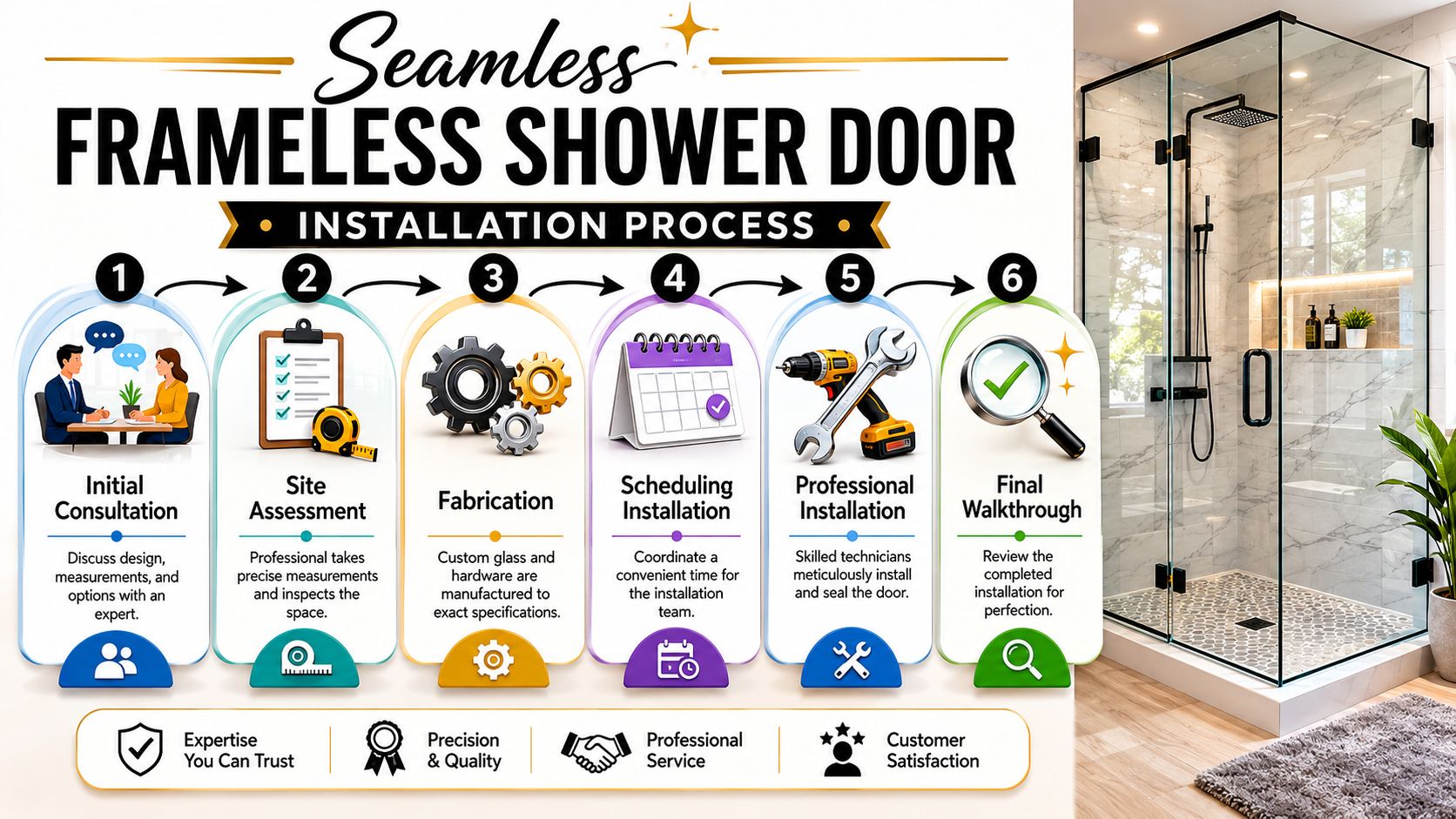
A solid installation process is methodical. It shouldn't feel rushed, vague, or improvised on site.
Here's what homeowners should expect:
Detailed consultation
The installer reviews the opening, wall condition, curb, nearby fixtures, and how you use the room.Precise field measurement
Small errors in measurement become expensive errors. The opening is measured carefully, and out-of-plumb conditions are noted before glass is ordered.Fabrication to the measured opening
Frameless glass isn't a trim-to-fit product. It's made for the exact conditions recorded in the home.Hardware planning and anchoring review
Hinge placement, handle style, and support details should match the wall structure and enclosure design.Professional setting and alignment
The team sets the panels, aligns the door, fits seals, and checks for proper movement and water control.Final walkthrough
The homeowner should see how the door operates, where to clean, and what to watch during normal use.
What separates a good install from a bad one
Bad frameless installations usually reveal themselves quickly. The gaps look uneven. The door drifts. Water escapes where the homeowner was told it wouldn't. In a small bathroom, these flaws stand out fast because the enclosure is close to everything else.
A good installation feels deliberate. The reveal lines look consistent. The door opens cleanly. The handle lands where it should. The enclosure feels integrated with the room instead of perched inside it.
For homeowners in this region, it also helps to work with an installer who understands local conditions and service areas such as frameless shower door installation in Fort Myers, Florida, where humidity, cleaning expectations, and material choices affect long-term satisfaction.
The goal isn't just to get the glass in. The goal is to leave you with a door that works quietly every day.
Questions worth asking before you hire
Use these questions when you compare installers:
- How are out-of-plumb walls handled: You want an answer that reflects real field measurement, not guesswork.
- Who performs the installation: Experienced glass technicians matter with heavy frameless panels.
- How is water containment addressed: Ask about seals, curb conditions, and practical expectations.
- What happens if hardware needs adjustment later: Service matters because houses move and heavy doors need precision.
- Are they licensed and insured: This should be standard, not optional.
A small bathroom leaves no room for sloppy work. The cleaner the design, the more obvious the craftsmanship becomes.
If your bathroom in Naples, Fort Myers, Bonita Springs, or the surrounding SWFL area feels crowded, a well-planned frameless enclosure can change the space dramatically, but only if the layout, glass, hardware, and installation are handled correctly. AmeriGlass Industries works on custom glass and shower enclosures throughout Southwest Florida, and it's a practical place to start if you want a measured, site-specific recommendation instead of a one-size-fits-all door.