

A lot of homeowners start in the same place. The bathroom works, but it doesn’t feel finished. There’s a framed shower with metal lines cutting up the room, or a curtain that makes the whole space look smaller. Towels end up on a hook too far away, on the vanity edge, or worse, on the floor after a rushed morning.
That’s usually when the idea of a frameless shower door with towel bar starts to make sense. It solves two problems at once. It opens the room visually, and it puts a daily-use item exactly where you need it.
The appeal isn’t just style. It’s how the room functions when the glass, hardware, door swing, and towel placement are planned together from the start. In a bathroom that already has limited wall space, especially one with tile patterns, niches, windows, or a floating vanity, integrating the towel bar into the door can clean up the whole layout in a way a separate rack never does.
In Southwest Florida, that combination matters even more. Humidity changes how bathrooms wear over time. Water management, hardware choice, and easy-to-clean surfaces aren’t extras. They’re part of whether the project still looks good years later.
Envision Your Ideal Bathroom
A dated shower usually makes the whole bathroom feel dated. Even when the tile is fine and the vanity is in good shape, a bulky frame or cloudy old glass can make the room feel tight, busy, and harder to clean than it should be.
Most homeowners aren’t asking for anything extravagant. They want a bathroom that feels open when they walk in. They want the light to travel across the room instead of stopping at metal edges. They want a towel within reach, without adding another bar to an already crowded wall.
That’s where a frameless shower door with towel bar stands out. The glass keeps the sightlines clean, and the hardware adds function without introducing clutter. It’s a small design move that changes how the whole room reads.
What this upgrade changes right away
A good frameless enclosure removes visual interruption. Instead of seeing the shower as a separate box, you see the tile, the depth of the room, and the rest of the finishes working together.
A towel bar built into the door helps in a practical way too:
- It frees wall space for artwork, sconces, shelves, or a cleaner tile layout.
- It keeps towels close to the shower exit, which makes the room easier to use every day.
- It reduces visual noise because the function is built into the enclosure itself.
For homeowners thinking about a larger bathroom refresh, it often helps to look at how custom glass changes the feel of a room as a whole. This guide on how a glass company can make your home feel luxurious is a useful place to start.
A well-designed shower doesn’t only look lighter. It makes the whole bathroom work with less effort.
The Smart Upgrade Your Bathroom Deserves
A framed shower door can act like a border around one of the most expensive parts of the room. It’s a little like putting a heavy picture frame over artwork that should be the focal point. A frameless enclosure does the opposite. It lets the tile, stone, fixtures, and natural light do their job.
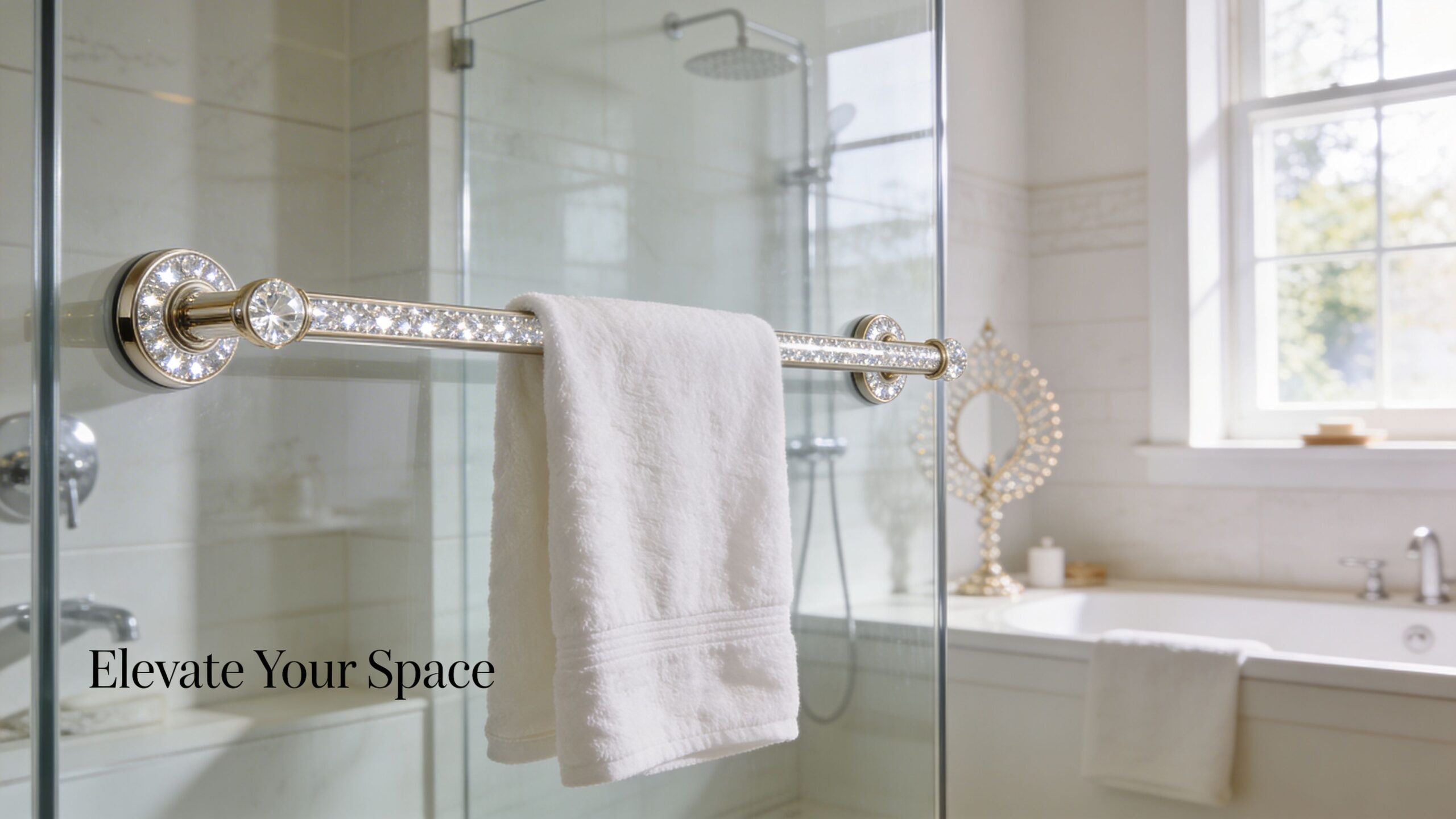
The towel bar is what turns that clean look into an everyday convenience. Instead of treating it like an add-on, think of it as part of the door system. Done right, it saves space, supports safer habits, and keeps the room looking intentional.
More openness without giving up function
One of the biggest wins is visual openness. Frameless glass allows light to move through the enclosure, which helps compact bathrooms feel less boxed in. In a primary bath, it also shows off the shower tile instead of hiding it behind frame lines and busy hardware.
The towel bar gives you function without asking for another wall location. That matters more than people expect. Once you account for mirrors, switches, windows, niches, art, and tile symmetry, wall space disappears fast.
If you’re collecting ideas before settling on a layout, design your shower door with the door style, opening direction, and hardware all considered together.
The safety benefit homeowners overlook
Wet towels migrate. In a poorly planned bathroom, they end up on the floor, over the tub edge, or draped where they don’t dry well. That creates clutter and can contribute to slip hazards.
Integrated towel bars enhance safety by preventing wet towels from accumulating on floors, reducing slip-and-fall incidents, which account for 234,000 bathroom-related injuries annually in U.S. homes according to CDC data (allwinhardware.com). The same source notes 50% less grime buildup than framed doors due to fewer crevices, which also makes routine cleaning easier.
That matters in real life. The best bathroom upgrades are the ones that improve the morning routine without asking for extra effort.
Why cleaning gets easier
Framed shower doors collect residue in joints, tracks, and narrow channels. Those are the spots where soap scum, moisture, and mildew tend to settle. Frameless systems reduce those hiding places.
That doesn’t mean no maintenance. Glass still needs care. But with fewer crevices and less visual obstruction, the enclosure is simpler to wipe down and easier to inspect.
Here’s a quick way to compare the difference:
| Feature | Framed approach | Frameless shower door with towel bar |
|---|---|---|
| Visual impact | More segmented | More open and continuous |
| Wall space use | Usually needs separate towel hardware | Towel storage integrated into door |
| Cleaning | More corners and frame lines | Fewer places for buildup to collect |
| Daily access | Towel may be farther away | Towel stays at the point of use |
A quick video can help you visualize how these elements come together in a finished enclosure.
What works and what doesn’t
Some bathrooms benefit immediately from an integrated bar. Others need a little restraint.
- Works well in compact baths: The bar eliminates the need for another wall-mounted accessory.
- Works well in primary suites: It keeps the enclosure looking sleek while adding utility.
- Doesn’t work when hardware is an afterthought: If the bar location conflicts with tile lines, door swing, or handle comfort, the result looks awkward.
- Doesn’t work with bargain installation: Frameless glass depends on precision. If the measurements are off, every detail feels off.
Practical rule: If the towel bar solves both reach and wall-space problems, it belongs on the door. If it only adds metal without improving function, rethink the hardware package.
Designing Your Signature Shower Experience
Customization is where homeowners either get a shower that feels designed for the room or one that looks close enough, but never quite right. The difference usually comes down to how the glass, hardware, and towel bar are selected together.
Start with the bar style
The towel bar changes both use and appearance. Some homeowners want the bar to read as a subtle utility. Others want it to act as a visual line that ties into the vanity hardware, mirror trim, or shower fixtures.
Designers often worry about whether “a towel bar in the glass blocks a primary design element of the shower.” The choice between a horizontal bar and a more modern “square towel bar pull or back to back pull” helps homeowners balance a sleek look with functional placement in luxury bathrooms (Houzz discussion on towel bars and frameless shower design).
That concern is valid. A large sheet of glass is visually quiet. Any hardware you add becomes more noticeable because there isn’t a frame around it to share the visual weight.
Horizontal or more minimal
A horizontal towel bar is the familiar choice. It’s practical, easy to reach, and works well when the room needs a clear place for a towel.
A more minimal hardware configuration can make better sense when:
- The tile is the star and you want less interruption across the opening.
- The glass panel is large and a heavy horizontal line would feel too dominant.
- The bathroom leans contemporary and a square pull or back-to-back pull better matches the rest of the room.
Choose the glass with the room in mind
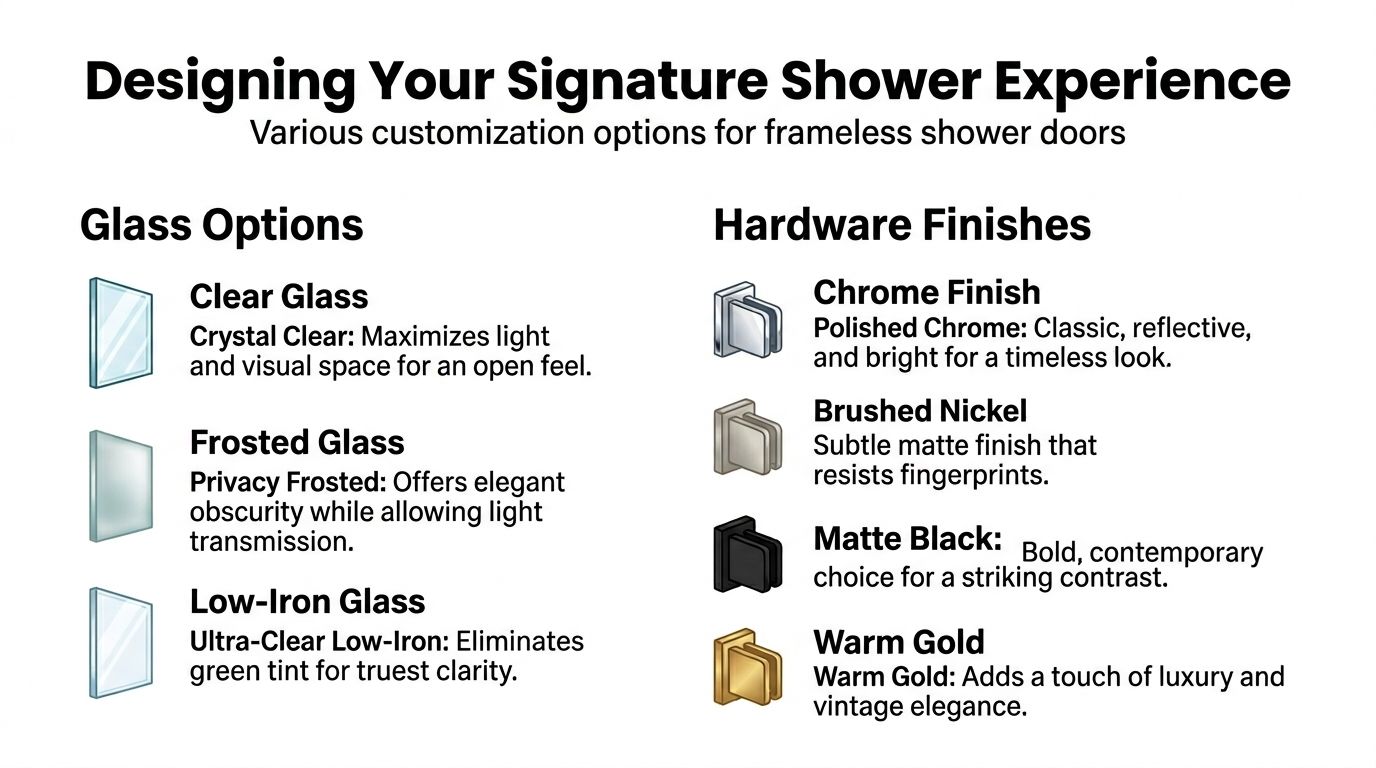
Clear glass is the default for many projects because it keeps the room open and bright. It’s often the right choice when you’ve invested in tile, slab walls, or a carefully detailed shower niche.
Low-iron glass is the upgrade homeowners notice once they compare samples side by side. It reduces the green cast that standard glass can show, especially on thicker panels and lighter materials. In bathrooms with pale stone, white tile, or warm neutrals, that truer clarity can matter.
For layouts that combine a door with fixed panels, looking at inline door panels can help you understand how the overall enclosure is composed before you choose final hardware.
Finishes should match the room, not fight it
Hardware finish is one of the easiest details to get almost right and still be disappointed later. The safest approach is to relate it to the dominant metal in the bathroom.
Here’s a practical matching guide:
| Finish | Often works best with | Watch for |
|---|---|---|
| Polished chrome | Bright faucets, clean contemporary spaces | Can feel too reflective in warmer palettes |
| Brushed nickel | Transitional baths, softer tones, mixed textures | Can look flat if paired with very glossy fixtures |
| Matte black | High-contrast modern rooms | Shows design intent fast, but can overpower small baths |
| Warm gold | Luxury and vintage-leaning palettes | Needs coordination, not random mixing |
Details homeowners should ask about
A showroom conversation gets more productive when you ask specific questions.
- Bar length and proportion: Integrated towel bars are often available in 12 to 24 inches according to the verified product guidance from Allwin Hardware, and proportion matters more than choosing the longest option.
- Handle pairing: Some setups use a towel bar outside with a different interior pull. That can improve both ergonomics and style.
- Protective coatings: In humid climates, protective treatments can help preserve clarity and reduce cleanup effort.
- Finish consistency: Hinges, clips, pulls, and bars should look like one system, not like parts sourced at different times.
The best-looking custom shower usually comes from restraint. One glass style, one hardware language, and one clear reason for every visible detail.
What works in practice
A successful frameless shower door with towel bar usually has three qualities. The bar is easy to reach from the shower exit. The finish belongs with the other fixtures. And the hardware doesn’t distract from the glass or tile.
What rarely works is selecting the towel bar last. By then, homeowners are trying to squeeze function into a design that was already set. The cleaner approach is to decide early whether the bar is meant to disappear into the design or act as one of its defining lines.
The Unseen Strength of Frameless Glass
The biggest hesitation homeowners have is straightforward. If a frameless shower door is just glass, and you add a towel bar through that glass, doesn’t that create a weak point?
Done properly, no. Done casually, it can create problems. That’s why this part of the project belongs in the hands of fabricators and installers who understand how the full system behaves under daily use.
Why the glass thickness matters
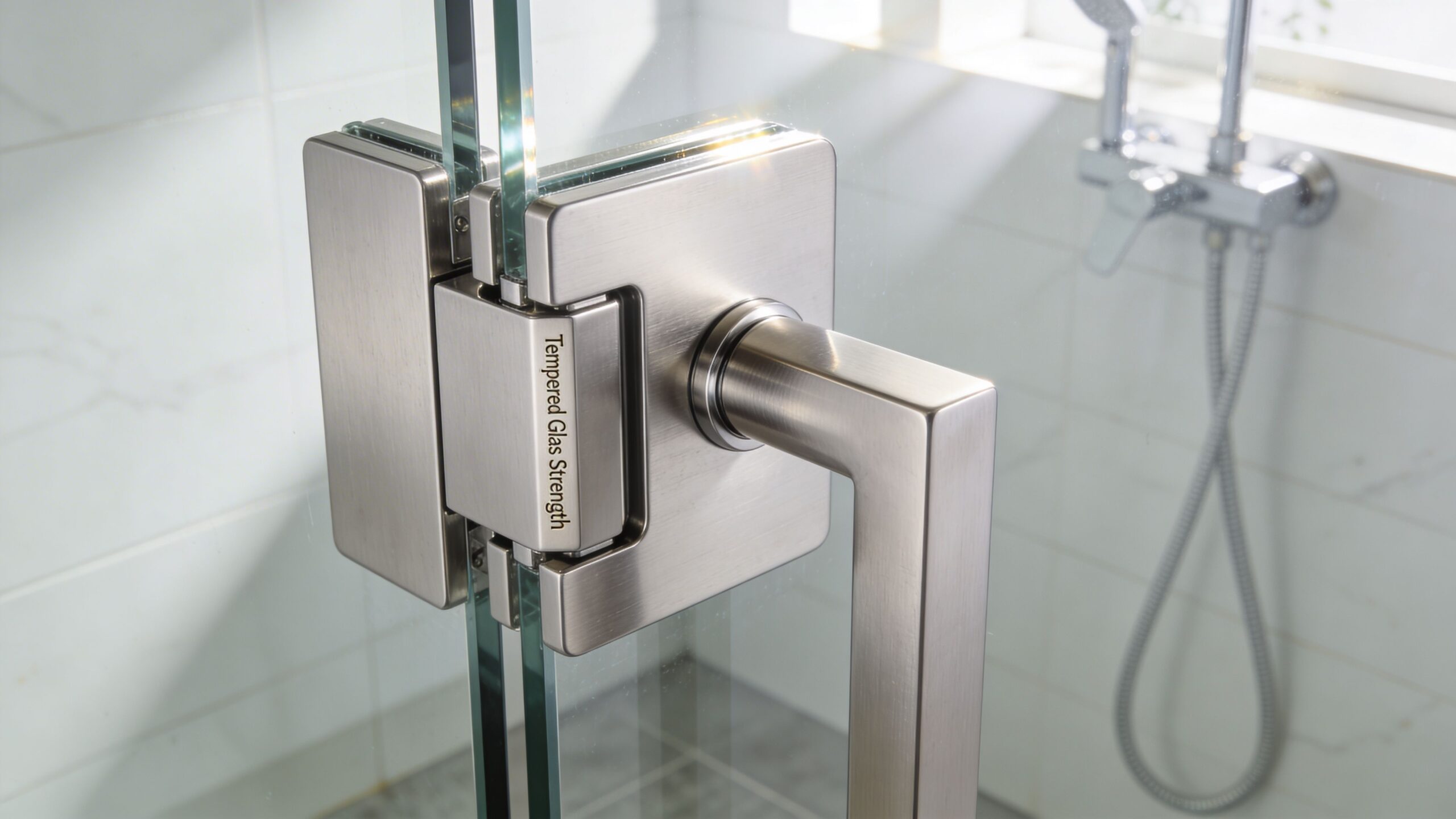
Frameless doors with towel bars typically use 3/8 inch to 1/2 inch glass to meet ANSI Z97.1 safety standards, and that added thickness helps the panel resist deflection and support hardware loads without overstressing the glass. The same product guidance notes that thicker glass reduces vibration-related fatigue on hinges and towel bars, extending hardware life by 2 to 3 times compared with thinner semi-frameless designs (Kohler Devonshire frameless shower door specifications).
That sounds technical, but the takeaway is simple. A frameless door isn’t relying on a surrounding metal frame to stay stable. The glass itself is a structural part of the enclosure.
Many installations use 3/8-inch tempered glass, and that’s common for good reason. It provides the strength needed for a frameless look while still allowing a clean, workable hardware package. In some larger or more demanding applications, 1/2-inch glass may be the better fit.
The holes are not drilled later
One of the most important details is also one homeowners rarely see. Towel bars mount through holes that are fabricated before tempering. That matters because tempered glass cannot be drilled on site without ruining the panel.
A common homeowner concern is whether a towel bar weakens the glass. It doesn’t when it’s fabricated and installed correctly, because the holes are drilled before tempering, so a properly installed bar does not create a stress raiser in the finished panel (Houzz discussion on whether towel bars weaken frameless shower glass).
That’s why true custom work starts long before installation day. Measurements have to be right. Hardware locations have to be right. There’s no improvising once the glass has been fabricated.
If an installer talks about “making it work on site” with tempered frameless glass, that’s a warning sign. The critical decisions should already be locked in.
How the whole door carries load
A towel bar doesn’t exist in isolation. It’s part of a moving glass door that also depends on hinges, anchoring, wall conditions, and panel size. When the door opens and closes, all of those forces interact.
Here’s what professionals evaluate before fabrication:
- Door dimensions: Larger panels behave differently than smaller ones.
- Hinge location: Wall-mount hinge placement affects how load transfers into the wall.
- Fixed panel support: U-channels or other support methods stabilize adjacent glass.
- Hardware compatibility: The bar, handle, hinge set, and glass thickness must match.
In many frameless systems, stationary panels are secured with U-channels or dedicated hardware, while the door itself swings from heavy-duty hinges anchored into suitable backing. If the wall isn’t plumb, or the curb has variation, those conditions need to be accounted for in the measurements instead of hidden with oversized gaps.
Why professional measurement matters in Southwest Florida
Bathrooms in Southwest Florida ask more from materials. Humidity stays high. Surfaces stay damp longer. Hardware finishes and seal performance matter more because the environment is less forgiving.
This is also where material choice becomes practical, not just aesthetic. When homeowners compare clear glass options, ultra-clear glass often enters the conversation because it improves clarity, but the discussion should include panel size, edge visibility, and hardware pairing too.
For anyone who wants a broader primer on safety glass types outside the shower category, this resource on understanding laminated and toughened glass gives useful background on how these materials differ.
What works and what fails
The strongest frameless installations are boring in the best way. The door swings smoothly. The bar feels solid. The gaps look intentional. Nothing flexes in a way that catches your attention.
Problems tend to come from one of four places:
| Issue | What causes it | What the homeowner notices |
|---|---|---|
| Poor hole placement | Incorrect measuring before fabrication | Hardware looks off or feels strained |
| Wrong glass specification | Panel too thin for the application | More movement, less confidence |
| Weak anchoring | Inadequate support behind tile or wall finish | Hinge issues over time |
| Improvised field fixes | Trying to correct fabrication errors on site | Uneven reveals, awkward operation |
Why DIY is the wrong tool for this job
A lot of home projects can tolerate some variation. Frameless shower glass can’t. There’s too little margin for error once custom tempered panels are made.
This is not just about hanging a door. It’s about coordinating:
- Exact opening dimensions
- Out-of-plumb wall conditions
- Threshold level
- Door swing and clearance
- Pre-fabricated hardware locations
- Seal and water-management details
That’s why a frameless shower door with towel bar should be treated as a precision installation, not a hardware purchase. The structural integrity is real, but only when the glass thickness, fabrication, and installation quality all line up.
Investing in Lasting Quality and Performance
Homeowners naturally ask about cost, but the better question is what drives long-term value. With frameless shower work, the price is shaped by the glass size, the selected thickness, the type of glass, the hardware finish, the enclosure design, and the labor required to measure and install it correctly.
The towel bar affects that conversation too. It’s not just a decorative accessory. It changes fabrication because the glass needs the correct pre-drilled holes in the correct location before tempering. That’s one reason custom work should be planned as a system instead of priced as separate parts.
Where quality pays you back
Cheap frameless work usually doesn’t fail in a dramatic way. It fails slowly. The door may not close cleanly. The reveals may look uneven. Water escapes in places it shouldn’t. The hardware may feel loose sooner than expected.
The water-management side is where better installation often proves its value. Frameless doors use bottom door wipes with 45° drip rails made of clear polycarbonate to redirect 95% of runoff back into the enclosure, and professional installation creates the compression seal against the threshold that helps prevent chronic leakage and subfloor damage (Mincey Marble master specifications for hinged frameless shower doors).
That’s the kind of detail homeowners don’t usually see in a quote, but they live with it every day.
Cost factors worth paying attention to
A practical estimate should reflect real project variables, such as:
- Glass selection: Standard clear and low-iron glass won’t price the same.
- Panel size and layout: Larger doors and return panels add complexity.
- Hardware package: Hinges, clips, finishes, and towel bar style all matter.
- Installation conditions: Out-of-square openings and tile constraints require more precision.
One provider in this market is AmeriGlass Industries, which also publishes maintenance guidance that helps homeowners protect clarity, seals, and finish quality after installation.
Better shower glass isn’t just about what you see on day one. It’s also about what you don’t have to repair later.
Think beyond the quote total
The right way to compare proposals is to ask what each includes. Is the glass thickness specified? Are the seals and drip details addressed? Is the towel bar part of the fabricated design, or treated like a generic add-on? Are measurements handled by the installer who will stand behind the finished fit?
A higher upfront number can still be the lower-risk decision if it avoids leakage, hardware issues, and rework.
Why Southwest Florida Chooses AmeriGlass
In Southwest Florida, bathroom glass has to do more than look clean on install day. It has to hold up in a humid environment, work with modern home design, and be measured precisely enough that the finished enclosure feels effortless to use.
That local design preference is already well established. In markets like Southwest Florida, over 60% of Naples luxury homes feature frameless enclosures according to regional builder surveys, and integrated towel bars fit that demand by keeping surfaces clean and towels accessible without adding wall clutter (Absolute Shower Doors on frameless door and panel designs with towel bars).
Why local experience matters
A national product catalog can show options. It can’t inspect your curb, verify your wall conditions, or account for the way a specific bathroom was built. Local installation experience matters because custom frameless work depends on what is there, not what the plan originally said.
In this region, a reliable glass team needs to understand:
- Humidity exposure: Finish and maintenance choices matter more.
- Luxury design expectations: The enclosure has to look custom-fitted, not standard.
- Measurement accuracy: Openings are rarely as perfect as they appear from a distance.
What homeowners should expect from their installer
A serious frameless shower project should include more than a product selection meeting. Homeowners should expect careful measurement, a discussion of hardware placement, and clear answers about glass type, door swing, and towel-bar integration.
The right installer also won’t rush past the less glamorous parts of the project. Seal placement, hinge anchoring, and fabrication accuracy are what make the elegant finished result possible.
Good frameless work feels calm. The door closes well, the hardware lines up, and nothing about the installation calls attention to itself.
For homeowners in Naples, Fort Myers, Bonita Springs, and nearby communities, the best choice is usually the company that combines custom design understanding with disciplined field measurement and professional installation practices.
Your Top Questions Answered
Will a towel bar weaken the glass
No, not when the door is designed and fabricated correctly. The mounting holes are drilled before the glass is tempered, so a properly installed towel bar does not create a stress raiser in the finished panel. That’s the technical point that answers most homeowner anxiety.
Can I hang heavy items on the bar
Use the towel bar for what it’s designed for: towels and normal bathroom use. If you want to hang something unusually heavy, ask your installer before fabrication so the hardware choice and glass specification can be discussed in context.
Can the towel bar be replaced later
Sometimes, yes, but only with compatible hardware that matches the existing hole pattern and glass thickness. This isn’t like swapping a cabinet pull. With frameless glass, compatibility matters.
What if my walls aren’t perfectly plumb
That’s common. Skilled installers measure for those conditions and account for them before the glass is fabricated. They don’t assume the tile is straight just because it looks straight.
Is this a DIY-friendly project
No. A frameless shower door with towel bar depends on precise measurement, fabrication before tempering, proper hardware selection, and accurate installation. Once the glass is made, field changes are extremely limited.
What should I ask during an estimate
Bring these questions to the appointment:
- Glass specification: What thickness is being proposed, and why?
- Hardware planning: Is the towel bar location determined before fabrication?
- Wall conditions: How will out-of-plumb walls or curb variation be handled?
- Water control: What seals and bottom wipe details are included?
Does the towel bar belong on every shower door
Not always. It works best when it solves a layout problem and improves daily use. In some designs, a smaller pull keeps the glass visually cleaner. In others, the towel bar is exactly what makes the room function.
If you’re planning a custom shower in Naples or Southwest Florida, AmeriGlass Industries can help you evaluate glass options, hardware choices, and fit conditions with a professional measurement process and a no-obligation estimate.