

You're probably standing in the middle of a bathroom remodel right now, looking at tile samples, fixture finishes, and a shower opening that still exists mostly in your head. The shower glass can feel like one more spec to approve.
It isn't.
On a frameless enclosure, the glass thickness changes how the shower looks, how the door moves, how solid it feels in your hand, and how well the whole system holds up years from now. It's one of those decisions that seems technical on paper but becomes obvious the first time you open a door that feels crisp, quiet, and planted instead of loose or underbuilt.
In Southwest Florida homes, that choice also has to respect real conditions. Remodel walls aren't always perfect. Tile installers vary. Some bathrooms have generous layouts and some are tight. The right answer isn't always “go thicker.” The right answer is the thickness that fits the panel size, hardware, wall condition, and the look you want when the room is finished.
Why Your Shower's Glass Thickness Matters More Than You Think
A homeowner can spend weeks choosing stone, plumbing trim, and lighting, then treat the shower glass as a final checkbox. That's usually where avoidable mistakes start. Frameless glass is not decorative filler. It is the structure.
When the thickness is right, the enclosure feels calm and intentional. The door closes with authority. The fixed panels stay visually straight. The hardware looks like it belongs there instead of compensating for a weak design. That's a big part of why a frameless shower instantly changes how a bathroom feels, much like the design principles behind making a home feel more luxurious with glass.
The detail you notice every day
Most homeowners don't walk into the bathroom and say, “I'm glad I chose this specific glass thickness.” What they do notice is the result.
They notice whether the door feels refined or slightly shaky. They notice whether the edges look substantial. They notice whether the enclosure disappears cleanly into the room or feels pieced together.
Thicker, properly specified glass doesn't just support the shower. It supports the feeling you wanted from the remodel in the first place.
Where bad decisions show up
The wrong thickness usually reveals itself in practical ways before it becomes a visual complaint.
- Door movement: A panel that's underspecified for the opening can feel more flexible than homeowners expect in a frameless design.
- Hardware strain: If the weight, span, and support points weren't planned as a system, hinges and clamps have to work harder than they should.
- Long-term alignment: In a remodel, even a beautiful tile job can't rescue an installation if the wall structure behind it isn't suited to the glass being hung.
That's why frameless shower door thickness deserves more attention than people give it. It affects luxury, but it also affects what works and what doesn't.
The Industry Standards 3/8-Inch vs 1/2-Inch Glass
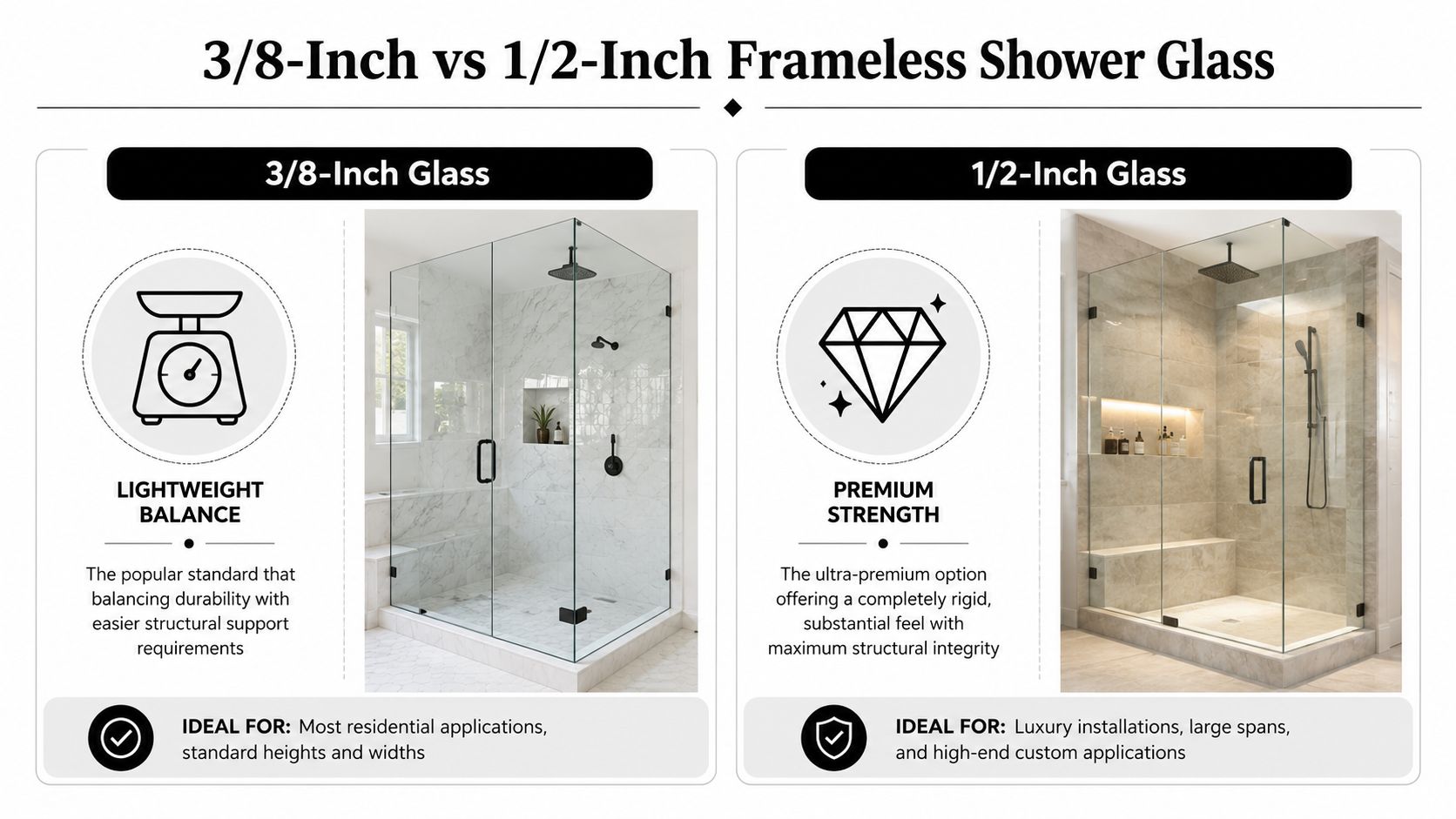
Most homeowners comparing frameless shower door thickness are really deciding between two established standards. A major industry rule of thumb is that frameless shower doors typically use either 3/8-inch or 1/2-inch glass, and Glass Doctor notes that 3/8-inch is the minimum thickness that provides the stability and soundness needed for a frameless door, while 1/2-inch glass is chosen when homeowners want even more structural soundness and a more substantial feel (Glass Doctor shower glass thickness guide).
What 3/8-inch glass feels like
3/8-inch glass is the popular standard because it gives a frameless shower the clean, sturdy look homeowners want without pushing every project into a heavier premium build. In real bathrooms, it's the choice that often hits the sweet spot.
It looks substantial from the side. It feels solid in daily use. It works well across a wide range of custom enclosures when the measurements, support, and hardware are right.
For many homeowners browsing frameless shower and glass product options, this is the thickness that delivers the modern frameless look they had in mind from the start.
What 1/2-inch glass changes
1/2-inch glass has a different presence. The exposed edge reads thicker immediately. The panel feels more architectural. The door has more mass in the hand.
The easiest comparison is a high-end car door. Both doors close. One just has that heavier, more planted feel that signals a more substantial build. That's what many people respond to when they choose 1/2-inch glass. It isn't automatically the right choice for every shower, but it often feels more premium.
Practical rule: Don't treat 1/2-inch glass as “better” in every situation. Treat it as a heavier, more demanding option that can look and feel outstanding when the layout and structure support it.
Frameless Glass Thickness At a Glance 3/8" vs. 1/2"
| Feature | 3/8-Inch Glass (10mm) | 1/2-Inch Glass (12mm) |
|---|---|---|
| Typical role | Standard frameless choice | Premium frameless choice |
| Feel | Solid and refined | Heavier and more substantial |
| Visual edge | Clean, elegant | Thicker, more architectural |
| Structural demand | Easier to accommodate in many projects | Demands more from hardware and support |
| Best fit | Many custom doors and panels | Larger, taller, or more design-forward enclosures where conditions allow |
The wrong way to compare them
Many articles reduce the decision to a quick yes-or-no question. That misses the actual point.
Choose 3/8-inch when you want an excellent frameless enclosure with a balanced build. Choose 1/2-inch when you want extra presence and your installation conditions justify it. The jump is not cosmetic only. It affects the entire system.
How Glass Thickness Impacts Weight and Installation
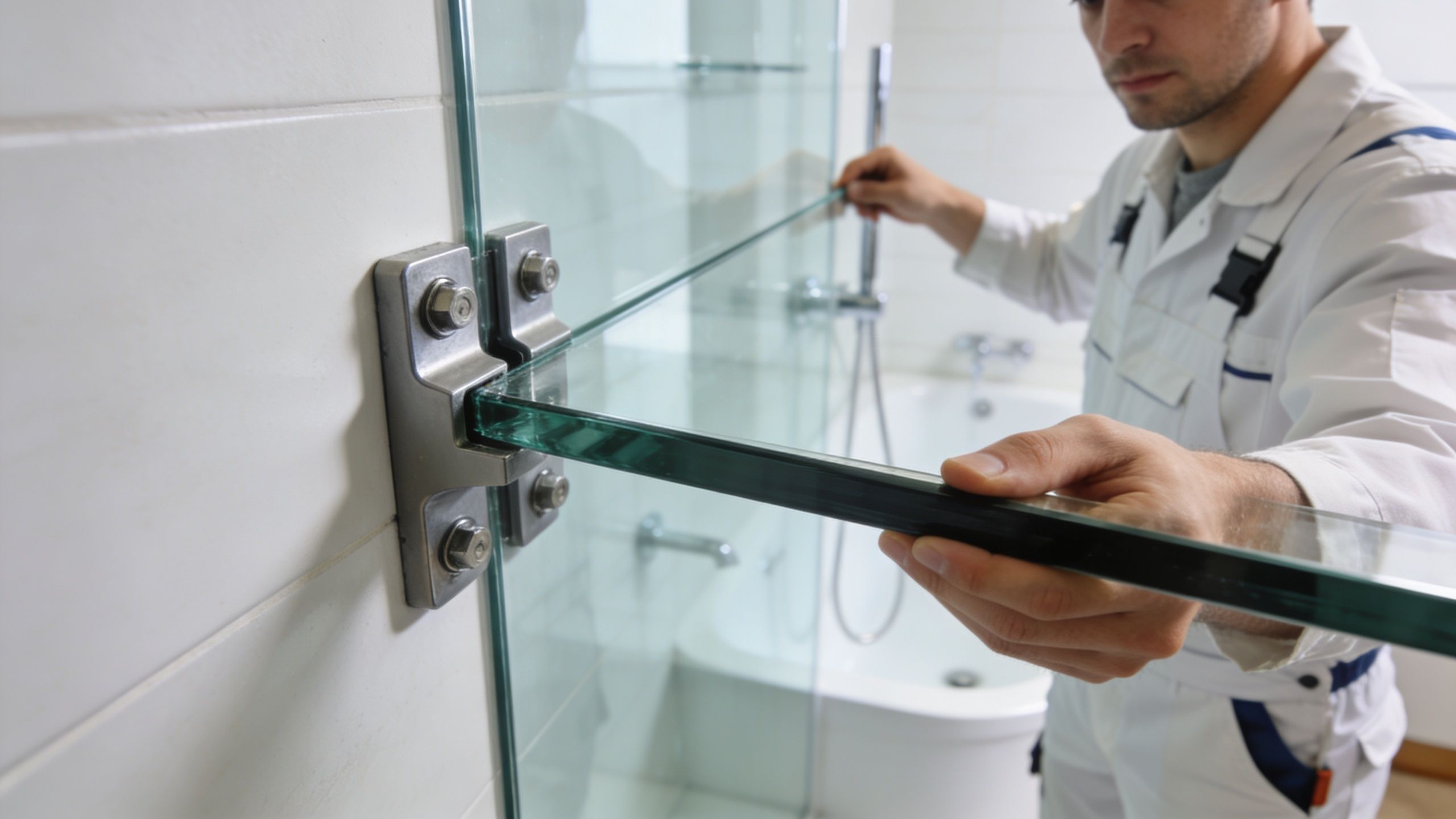
Thickness changes weight. Weight changes everything else.
That's why experienced installers don't choose frameless shower door thickness by preference alone. They look at the opening, the wall condition, the hinge side, the height of the glass, and how much of the panel will stand without help from adjacent support.
What the engineering actually says
Industry guidance says thickness is determined by total height, total width, and total square area, with concrete limits such as a maximum 30-inch width for 3/8-inch glass with an unsupported corner and 36 inches for 1/2-inch under similar conditions (Glass Magazine on safe frameless design).
That matters because many homeowners assume thicker glass is always the safer answer. Sometimes it is. Sometimes it adds load to hinges, anchors, and walls that weren't ideal to begin with.
What goes wrong in real remodels
In Naples, Fort Myers, and nearby areas, remodel work often means dealing with existing framing, patched walls, old substrate, or tile layouts that weren't designed around a heavy frameless door. That's where paper specs stop being enough.
Here's what installers watch for:
- Weak mounting conditions: Tile may look perfect while the backing behind it is inconsistent.
- Door swing stress: A wide swinging door transfers repeated force into the hinge side of the wall.
- Unsupported glass spans: The more open the design, the more critical thickness and hardware become.
- Retrofit complications: Clean design choices can become risky if the wall can't carry the load over time.
For builders and detail-minded homeowners, understanding basics like sizing concrete anchor bolts helps explain why attachment points matter so much whenever a heavy assembly is mounted to a structural surface. In shower work, that same mindset applies. The visible glass may get the attention, but long-term performance starts at the anchor and support strategy.
Installation isn't just lifting glass
A heavier panel doesn't only take more effort to move into place. It gives the installer less margin for error. Hinge placement, plumb walls, reveal gaps, and support alignment all become less forgiving as weight climbs.
That's why professional site measurement is not optional on custom frameless work. Services such as frameless shower door installation in Fort Myers are built around assessing the opening before fabrication, not trying to solve structural issues after the glass arrives.
If the wall condition is marginal, a thicker door can create a more impressive first impression and a worse long-term outcome.
Matching Your Hardware to Your Glass
Glass and hardware need to be planned together. Homeowners often choose the glass they want first, then assume the hinges, clamps, and support bars will sort themselves out later. That's backward.
The hardware is what allows the glass to behave the way you expect.
What changes when the glass gets thicker
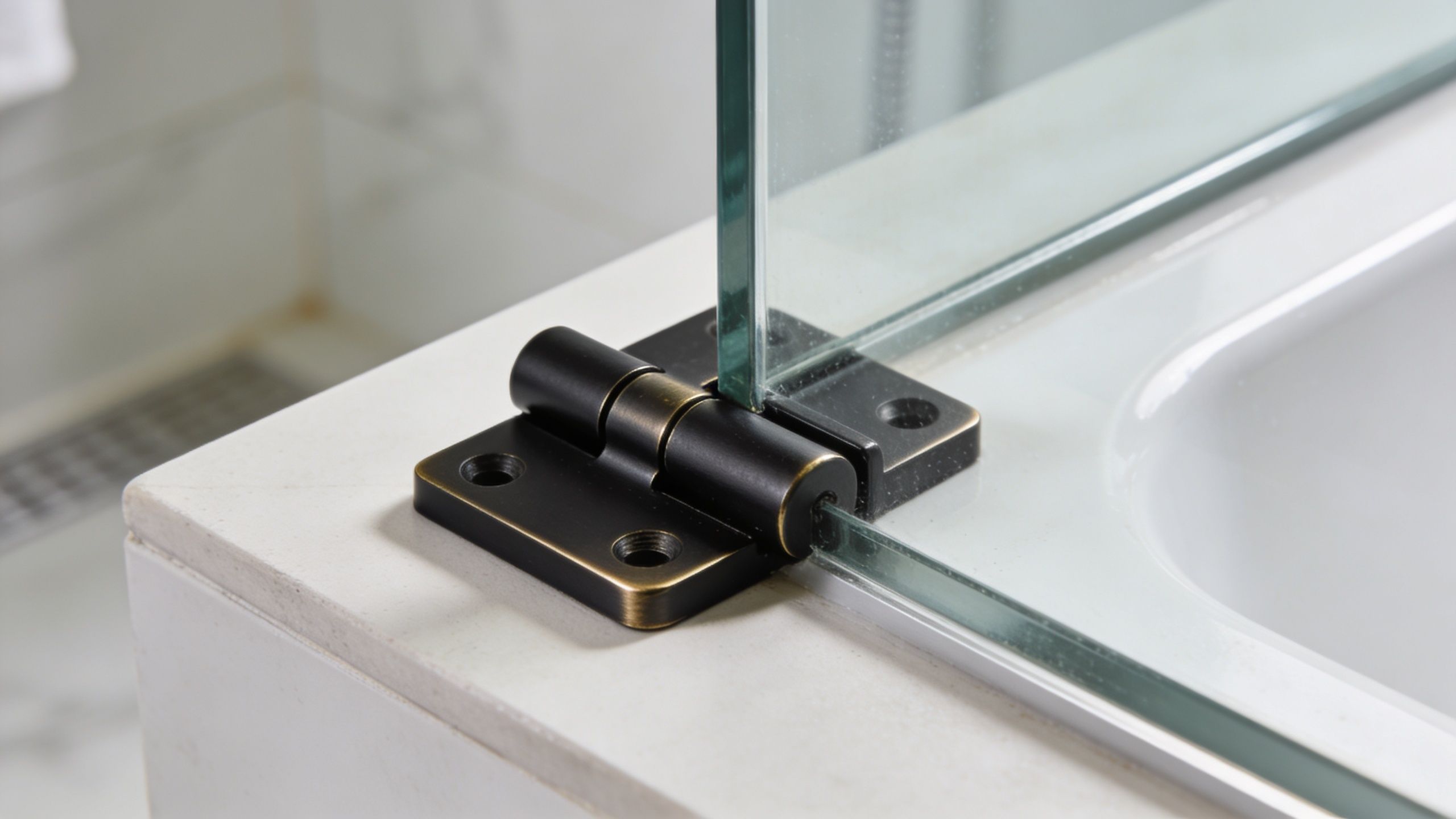
With 3/8-inch glass, you usually have broad design flexibility. Standard premium hinges, clamps, and channels can support a sleek frameless look without making the hardware feel oversized.
With 1/2-inch glass, the enclosure often needs more from every connection point. That can mean heavier-duty hinges, more substantial clamps, or an added support bar depending on the layout. None of that is bad. It just needs to be expected early so the final look still matches the design intent.
Hardware choices that affect the final look
A minimal shower can still be minimal, but only if the hardware package matches the glass honestly.
- Wall-mounted hinges: A strong choice for many door layouts, especially where the hinge side wall is dependable.
- Pivot hardware: Useful when design or swing clearance calls for a different movement pattern.
- Clamps and channels: These help stabilize fixed panels and define how visually light or grounded the enclosure feels.
- Support bars: Sometimes they preserve performance without compromising the room. Other times they interrupt the cleanest possible look. That trade-off should be deliberate.
A sliding system changes the conversation entirely. If you're considering a bypass or barn-style layout, a product style such as the Belmont slider system shows how hardware selection can shape both appearance and function without relying on a heavy swinging door.
Here's a visual look at how hardware systems come together in practice:
Don't chase an invisible-hardware fantasy
Many homeowners want “no metal look” frameless glass. That's understandable. But completely ignoring hardware reality leads to bad choices.
The cleanest shower isn't the one with the least hardware on paper. It's the one where the hardware looks intentional, stays aligned, and supports the glass without strain.
If your designer is drawing a very open enclosure with tall panels and minimal visual interruption, make sure the hardware package is part of that conversation from the start.
Safety and Code Compliance in Southwest Florida
A frameless shower should feel luxurious, but it also has to be built like a permanent architectural element. In Southwest Florida, local experience matters because homes vary so much. New construction, condo renovations, older single-family homes, and coastal properties all create different installation conditions.
The frameless shower market has standardized around a small set of thicknesses for a reason. The vast majority of frameless shower enclosures are assembled using 3/8-inch and 1/2-inch-thick glass, and the market commonly uses the metric equivalents 10 mm and 12 mm for safety and engineering specifications (pFOkUS on shower glass thickness standards).
Safety is more than the glass itself
Homeowners often ask whether code is mostly about tempered glass. Tempered safety glass is expected in reputable shower enclosures, but code-minded installation goes further than the glass type alone.
It includes:
- Accurate measurement
- Correct hardware selection
- Secure anchoring
- Respect for wall condition and substrate
- Proper door clearances and swing paths
That matters in Southwest Florida because a beautiful shower can still fail functionally if it's installed into a wall assembly that wasn't evaluated carefully.
Why local judgment matters
A national article can tell you common thicknesses. It can't inspect your tile, check your backing, or tell you whether a specific wall in your bathroom is suited for a heavier door. That requires local field judgment.
For homeowners considering frameless shower door installation in Naples, the value of a local specialist is simple. They're evaluating the actual opening, the actual support conditions, and the actual installation constraints in front of them, not an idealized version of the project.
In this region, that practical eye matters as much as the glass itself.
Making Your Final Decision With Confidence
At this point, the best frameless shower door thickness usually becomes clearer. Not because one option wins universally, but because your project starts telling you what it needs.
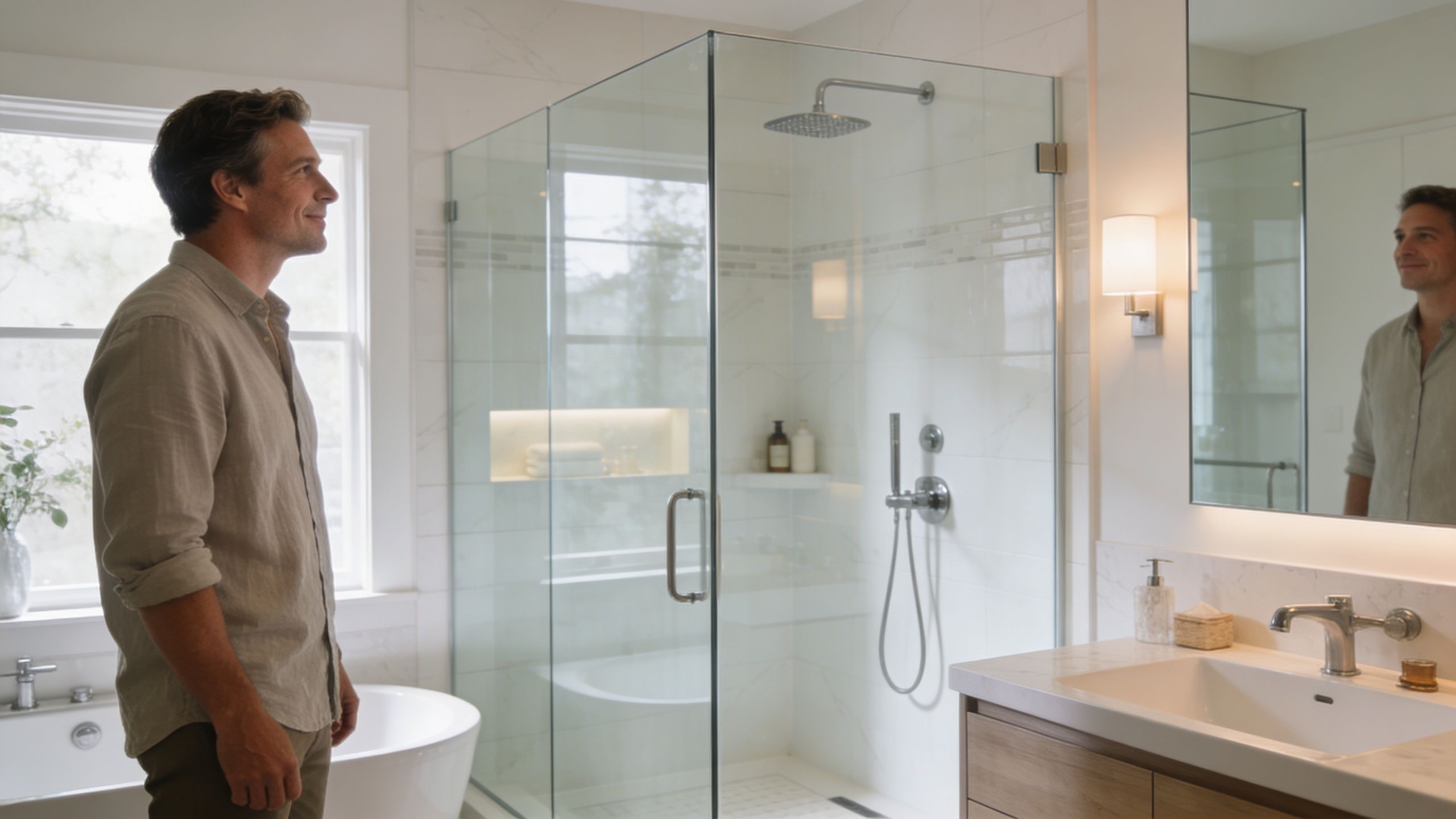
For shower enclosures, thickness selection is strongly tied to span and opening method. Thicker glass like 10mm (3/8") is a durable option for larger bathrooms or heavy-use applications because it reduces flex, while thinner 6mm to 8mm glass is lighter and better suited to compact layouts where unsupported spans are short. It's an engineering tradeoff between safety margin and installation burden, as noted by Conric's overview of frameless shower glass thickness.
Simple ways to think through it
If your enclosure is a standard swinging-door layout with reasonable panel sizes and solid wall conditions, 3/8-inch glass is often the smart answer. It gives you the frameless look, solid day-to-day feel, and broad hardware compatibility most bathrooms need.
If your shower is larger, taller, or designed to make the glass itself feel like a statement feature, 1/2-inch glass may be worth pursuing. That's especially true when you want more visual substance and the structure can support it cleanly.
A practical decision filter
Ask these questions before you commit:
- How open is the design? Large unsupported spans usually push the decision toward a heavier specification.
- What type of door are you using? Swinging doors place different demands on walls and hinges than sliders.
- How strong are the mounting conditions? In a remodel, this question matters as much as aesthetics.
- What look are you after? Some bathrooms benefit from a lighter visual touch. Others want the thicker exposed edge and heavier feel.
- Are you buying feel or solving a problem? Those are not always the same thing.
What works best by project type
- Compact shower with short spans: A lighter specification can be appropriate if the layout supports it.
- Typical custom frameless door and panel: 3/8-inch is often the balanced choice.
- Large statement enclosure: 1/2-inch becomes more attractive when the design, support, and hardware all align.
- Tight access remodel: Sometimes a more moderate thickness leads to a safer, cleaner installation.
One practical option for homeowners who want a measured recommendation instead of a guess is AmeriGlass Industries, which provides custom shower enclosure measurement and installation in Southwest Florida based on the actual opening and support conditions rather than a one-size-fits-all thickness rule.
Your Questions Answered and Your Next Step
A few questions come up near the end of almost every shower consultation.
Common questions homeowners ask
Is thicker glass harder to clean?
Not in any meaningful way. Maintenance has more to do with water quality, cleaning habits, and whether you add a protective coating than with the difference between standard frameless thicknesses.
Does thicker glass automatically mean safer?
Not always. A well-designed, properly supported enclosure is the safer result. Thickness is one factor in that equation, not the whole answer.
Can I choose thickness based only on the look I want?
You can start there, but the final decision has to respect opening size, support conditions, hardware, and installation geometry.
Do coatings or glass clarity options depend on thickness?
Those choices are usually separate from the thickness decision. They should be discussed alongside maintenance goals and the style of the bathroom.
The smartest next step
The best frameless shower door thickness is a project-specific answer. It depends on what the glass is being asked to do, what the walls can support, and how refined you want the finished shower to feel every day.
If you're remodeling in Naples, Fort Myers, Bonita Springs, or nearby Southwest Florida communities, don't settle for a generic “3/8 versus 1/2” debate. Get the opening measured. Have the wall conditions evaluated. Make the thickness choice after someone looks at the actual installation, not just the photo on your phone.
If you want a practical recommendation for your shower, AmeriGlass Industries can help you compare layout, hardware, and glass thickness based on your actual bathroom. A consultation gives you a measured plan, not a guess, so you can choose a frameless enclosure that feels safe, clean, and appropriately luxurious for your home.
Not sure which thickness you need? Feel 3/8″ and 1/2″ glass side by side at our Bonita Springs showroom. AmeriGlass Industries installs frameless shower doors across Naples, Fort Myers, Bonita Springs and Cape Coral. Call (239) 426-6884.