

You've spent good money on a frameless shower because you wanted clean lines, open sightlines, and that high-end look that makes the whole bathroom feel finished. Then the door swings open and gets a little too close to the tile, the fixed panel, or the edge of a vanity. That's usually the moment homeowners realize the enclosure isn't just glass and hinges.
A frameless shower works because a handful of small hardware parts control a very heavy moving panel with precision. The frameless shower door stop is one of the parts that does the quiet work. If it's missing, poorly chosen, or installed in the wrong place, the rest of the system takes the hit. Hinges see more stress, glass edges are less protected, and water control gets worse.
In Southwest Florida, where people invest in bright, open, luxury bathrooms, this matters more than most homeowners expect. A frameless enclosure should look minimal, but it shouldn't act casual. Every detail has to be deliberate. That's part of what makes a glass shower feel refined and not improvised, and it's one reason custom glass adds to the sense of luxury in a home, as shown in this look at how glass can make your home feel luxurious.
The Unsung Hero of Your Modern Bathroom
A new frameless shower usually gets admired for the obvious things. Clear glass. Minimal hardware. Sharp tile work behind it. Nobody stands there and says, “Nice door stop.”
But on real jobs, that small part often decides whether the door feels controlled or vulnerable.
I've seen beautiful showers where the layout left very little room for error. The door cleared the wall by just enough. The handle passed close to stone. The fixed panel sat exactly where it needed to for the design to work. In that kind of installation, a stop isn't a finishing touch. It's the part that keeps a premium enclosure from acting like a problem waiting to happen.
A frameless shower can look effortless while still depending on precise hardware at every contact point.
That matters because frameless glass doesn't have a full metal frame to absorb slop, hide bad alignment, or limit movement. If the door opens too far, the consequences show up somewhere else. Tile chips. Glass edges take contact. Hinges get asked to do a job they weren't meant to do by themselves.
Why homeowners usually notice it late
Individuals typically don't think about the stop until something feels off:
- The door swings farther than expected and everyone in the house starts handling it carefully.
- The close feels vague instead of landing in one clean, repeatable position.
- Water starts escaping because the closing plane isn't being controlled properly.
A high-end enclosure should feel settled every time you use it. The stop helps create that feeling. Without it, the shower may still function for a while, but it won't be protecting your investment the way it should.
What this little part is really protecting
The stop protects more than the door edge. It protects the enclosure geometry. It helps preserve hinge alignment. It helps keep impact away from finished surfaces that cost far more to repair than the hardware ever did.
That's why I never treat a frameless shower door stop as a cheap accessory. In a true frameless system, it's one of the parts doing engineering work in plain sight.
What a Frameless Shower Door Stop Actually Does
A frameless shower enclosure uses discreet hardware instead of a full perimeter frame. In industry use, “frameless” means the operating panel has no full-length metal attachments on the top, sides, or bottom, and the system relies on hinges, clamps, seals, and related hardware for alignment and function. That approach became practical because tempered glass in common shower-door thicknesses can stand without a perimeter frame. Glass Magazine notes that 3/8-inch glass is commonly used up to 84 inches in height, while 1/2-inch glass can reach 120 inches in height when supported on two vertical edges and the base or on two horizontal edges in its discussion of frameless systems at Glass Magazine.
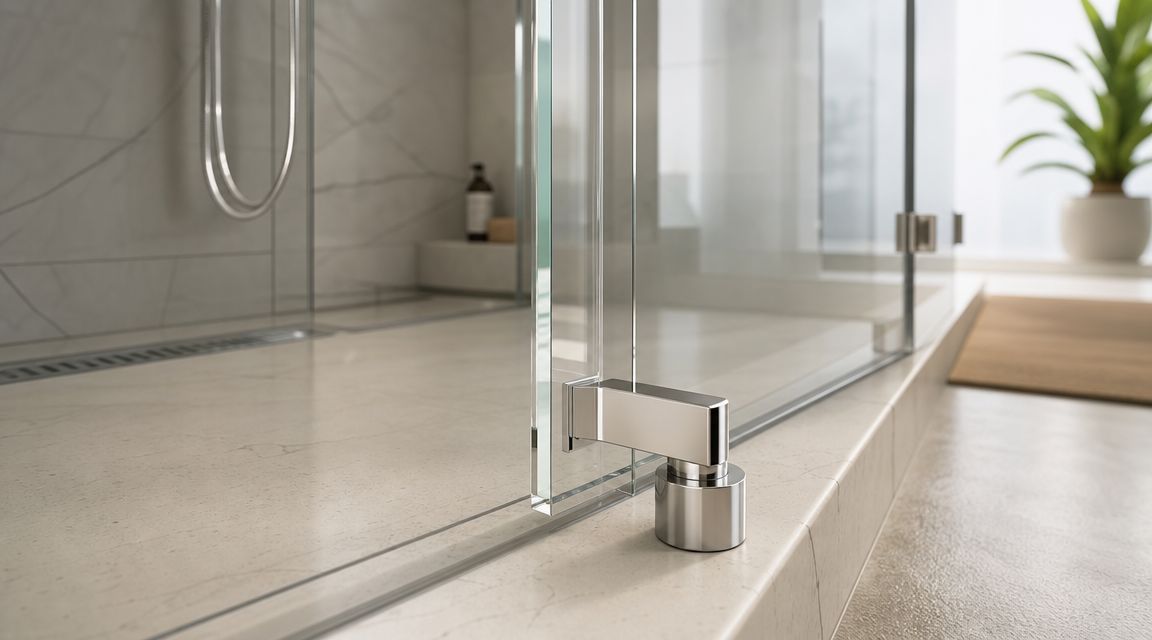
That's why the stop matters. In a framed enclosure, the frame does a lot of controlling. In a frameless enclosure, the stop helps define where the moving panel ends its travel and where it closes.
It limits the swing before something else takes the impact
Consider it a latch point on a precision gate. It doesn't just stop movement. It tells the moving part where its proper endpoint is.
A frameless shower relies on discreet hardware for alignment. The stop becomes the physical limit that prevents the door from swinging too far, protecting tile or glass from impact. It also plays a role in water management because the lip of the stop often faces outside the shower so the door closes against it, while a drip edge faces inside to help keep water contained, as described in the earlier cited Glass Magazine guidance.
It also helps the shower close like a system
The stop works with sweeps and seals. If the door closes against the stop in the correct plane, the bottom sweep and edge seals can do their job more consistently. If that closing point is off, you can get rubbing, bounce-back, or a gap that doesn't look serious until water finds it.
That's one reason fixed panels and related components matter too. If you're comparing enclosure layouts, details like fixed splash guards often affect where the stop belongs and how the door should terminate.
Practical rule: If the stop isn't controlling the door before the hardware reaches its own limit, the hardware is doing too much work.
A good stop isn't a bumper you add at the end. It's part of the enclosure's operating logic.
How to Choose the Right Shower Door Stop
The right stop depends on where the door needs to stop, what it might hit, how the hinges are set up, and how visible you want the hardware to be. Homeowners often shop by finish first. Installers don't. Function comes first, then appearance.
Even very minimal frameless doors depend on small stop-and-seal components rather than a full frame. A frameless FAQ from a long-running glass specialist describes the simplest frameless shower door as a single glass panel with hinges, a handle, and a bottom sweep, which shows how much the system depends on compact hardware rather than perimeter framing, as noted by Maine Shower Door.
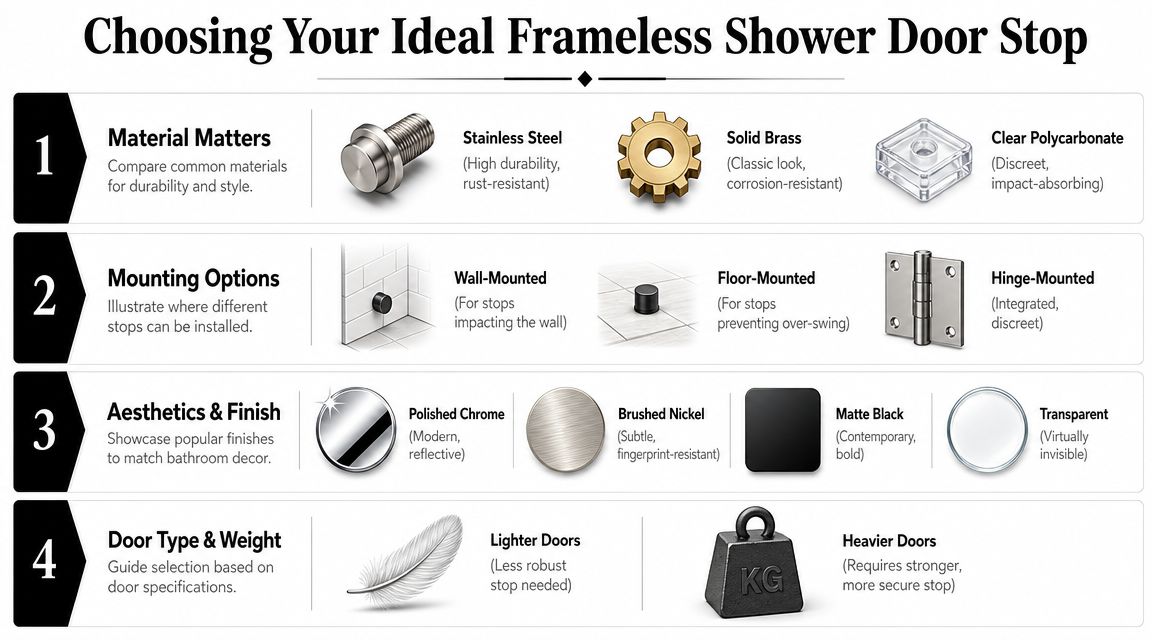
Start with where the stop will live
Some doors need to stop against a wall. Others need to stop against a fixed glass panel. Some layouts are better served by a hinge-integrated solution because there's no clean place to mount a separate stop.
Here's a practical comparison:
| Type | Best For | Material Options | Pro | Con |
|---|---|---|---|---|
| Wall-mounted | Doors that need to stop against a tiled wall or jamb area | Brass, stainless steel, polycarbonate | Strong, direct stopping point | Requires exact placement and suitable mounting surface |
| Glass-to-glass | Doors closing against a fixed panel | Acrylic, polycarbonate, some metal-compatible designs | Clean look, works well in panel-to-door layouts | Wrong fit or position can create poor contact |
| Floor-mounted | Layouts where swing must be limited before the wall or fixture | Brass, stainless steel | Effective for over-swing control | Can interrupt a clean curb line |
| Hinge-mounted | Tight layouts where integrated control makes more sense | Hinge-family-specific hardware | Discreet and coordinated with hinge geometry | Less forgiving if selected late |
Match the stop to the hinge family
A lot of mistakes often arise concerning the stop. A stop shouldn't be treated like a random add-on from a parts bin.
Commercial-grade stops for 1/4-inch to 3/8-inch glass are commonly specified to match hinge families and may use a nylon-tipped set screw to clamp to the glass without metal-to-glass point contact, according to the product guidance at DK Hardware. That's an important clue. Stop choice needs to track with the hardware geometry, not just the finish color.
Material affects both performance and appearance
- Stainless steel works well where corrosion resistance and durability matter most.
- Solid brass is a favorite when the rest of the enclosure hardware uses matching decorative finishes.
- Clear polycarbonate or acrylic keeps the look lighter and can soften contact in the right application.
The best choice depends on how visible the stop will be and how the door delivers force into it. If the panel is heavy and the traffic is constant, I lean toward more heavy-duty hardware. If the goal is visual restraint and the geometry is simple, a clear stop can work very well.
If you're still sorting out enclosure style, swing direction, and hardware combinations, a shower planning tool like design your shower door helps narrow the right stop before the glass order locks things in.
The wrong stop can look fine on day one and still be wrong for the enclosure.
Proper Placement and Installation Guide
Placement is where a good part either performs well or becomes useless. I've seen quality hardware fail because it was mounted in the wrong spot or turned the wrong direction. The stop itself wasn't the problem. The geometry was.
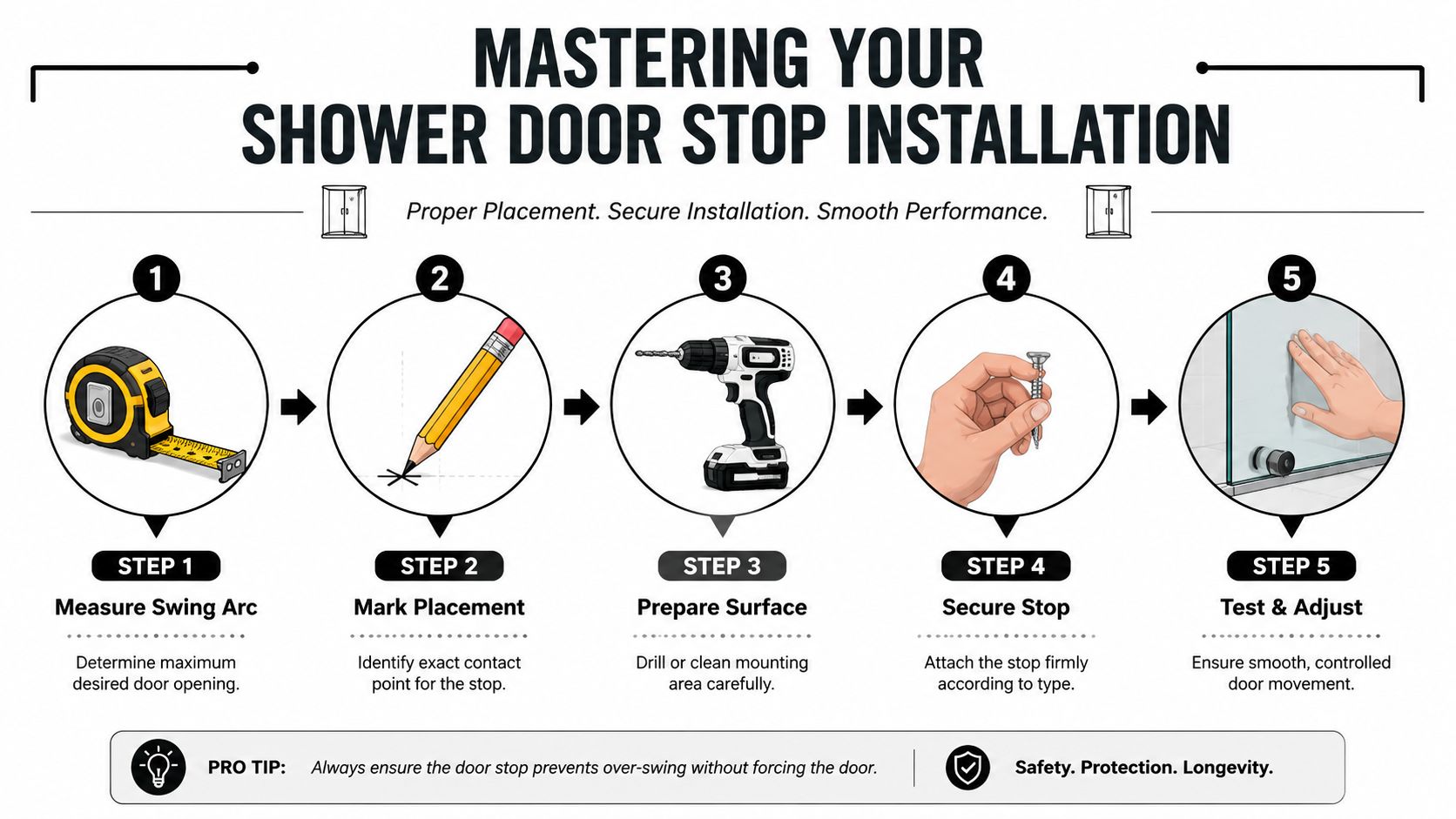
Installation guidance for frameless systems shows that the stop's lip should face the outside of the shower so the door closes against it, and installers position it by measuring from the curb or floor to the top of the door and marking the location where it intersects the door path precisely. That orientation serves both as a mechanical limiter and part of the water-management strategy, as shown in this installation video guidance.
Get the swing arc right before you drill
Before mounting anything, open the door slowly and decide exactly where it should stop. Not approximately. Exactly.
Look at all the conflict points:
- Tile and stone edges that could chip on impact
- Adjacent fixed glass that can't take repeated contact
- Handle clearance near walls, vanities, or trim
- Bottom sweep travel so the sweep doesn't bind or roll awkwardly
If you're still planning the enclosure from the ground up, details like curb shape and threshold design affect all of this. A remodeling guide on walk in shower base options is useful because base layout often determines how much room you have for sweep clearance and stop placement.
Orientation is where DIY installs often go wrong
For wall-to-glass and glass-to-glass setups, the lip faces the outside. That sounds simple, but it's one of the most common errors because people think of the stop only as a blocker, not as part of the close.
If you flip that orientation, the door may not land where the enclosure was designed to seal. The stop can also miss the intended contact path, which leaves the hinge absorbing travel it shouldn't.
If the stop is too high, the door can bypass it. If it's too low, the close can feel forced and the seal may not sit correctly.
A practical installation sequence
- Dry-fit the movement. Open and close the door several times and watch the contact path, not just the edge.
- Mark from the curb or floor to the top of the door. This keeps the stop aligned with the operating panel where it will meet.
- Prepare the mounting surface correctly. Tile, stone, and glass all demand a different level of care.
- Mount and test slowly. Never slam a freshly installed stop to “see if it holds.”
- Check the close with the sweep in mind. Mechanical stopping and water control have to work together.
For homeowners who want a broader view of enclosure fit, alignment, and hardware setup, this overview of frameless shower door installation in Fort Myers Florida is a helpful reference.
Troubleshooting Common Door Stop Problems
Most stop problems come down to one of three causes. Wrong type, wrong placement, or a good part installed into a bad condition. When the stop fails, the symptoms show up somewhere else first.
Industry hardware pages describe door stops as preventing over-swing, but they often don't explain sizing or load path. They also leave out a key reality. The right stop depends on wall material, door weight, and sweep clearance, and it's often chosen after the glass is ordered, which limits your options. That practical gap shows up clearly in the product category information from C.R. Laurence.
Common symptoms and the real cause
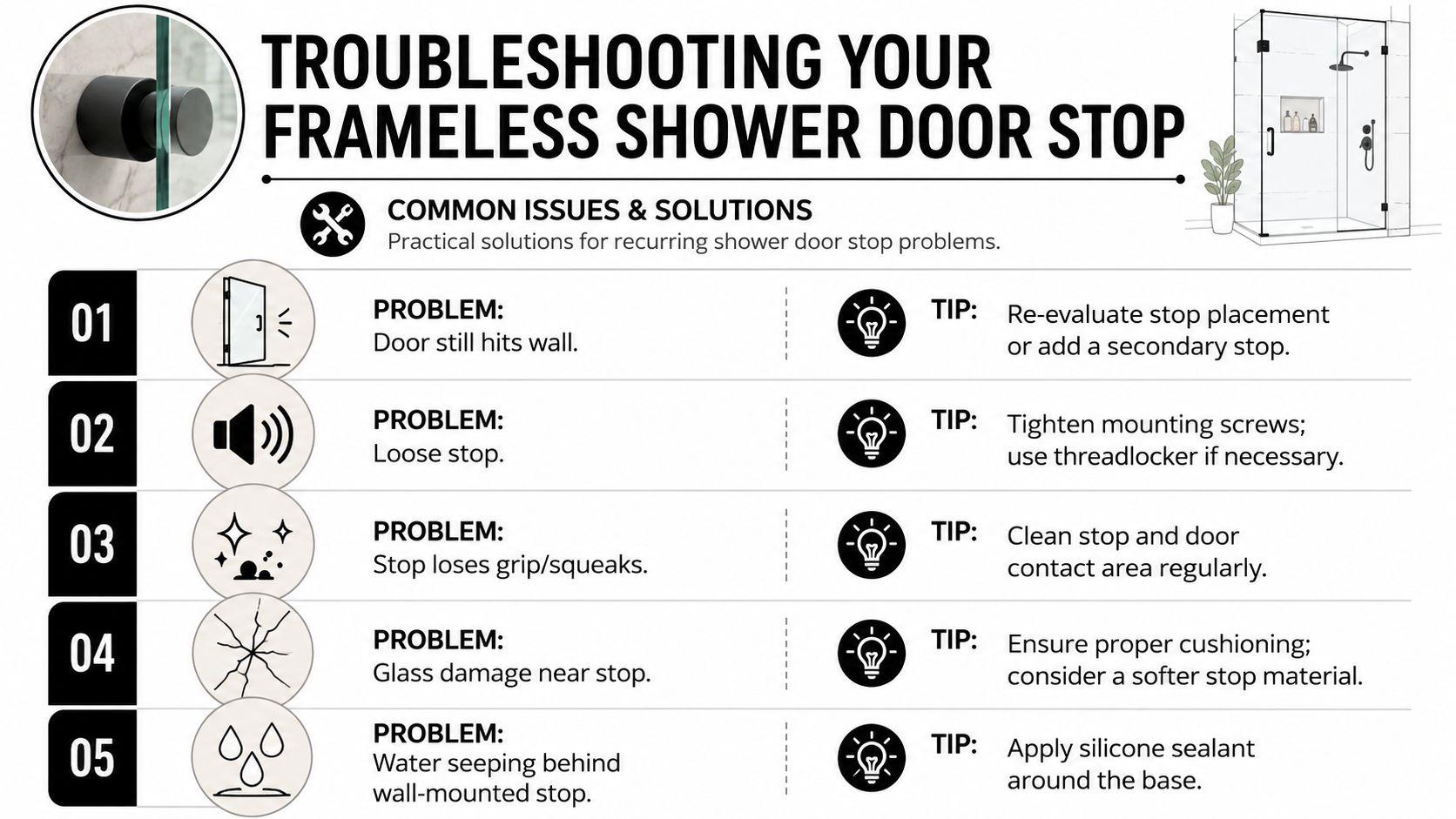
- The door still hits the wall. Usually the stop is mounted too high, too low, or too far off the actual swing path.
- The stop loosens over time. That often points to poor mounting, weak substrate, or a stop that's taking more force than it was selected for.
- The close feels noisy or abrupt. The contact material may be too hard for the application, or the stop is meeting the door at the wrong point.
- Water shows up outside the enclosure. Sometimes the stop location is interfering with proper closure rather than helping it.
What works and what doesn't
What works is correcting the geometry first. Don't start by tightening everything and hoping the system settles down. Watch the door move. See where the panel wants to land. Then verify that the stop is controlling that motion.
What doesn't work is adding random bumpers after the fact while the hinge side remains overstressed. That may reduce noise, but it doesn't fix the load path.
A failed stop is rarely an isolated hardware issue. It usually signals that the enclosure is no longer stopping the door where the system was designed to stop it.
If you see edge chipping, hinge sag, or repeated misalignment, stop using force. Heavy tempered glass should move predictably. If it doesn't, the shower needs a proper adjustment before the problem spreads to more expensive parts.
DIY Installation vs Calling a Professional
A simple adhesive bumper is one thing. A properly placed frameless shower door stop in a premium enclosure is something else.
DIY can work when the application is forgiving, the stop is light-duty, and there's no drilling into finished tile or stone. The risk climbs fast once you're dealing with a heavy glass door, tight clearances, decorative wall surfaces, or a stop that has to align with hinge geometry and the closing plane at the same time.
Where DIY goes sideways
Homeowners usually get in trouble in three places:
- They choose the stop too late after the glass and swing path are already locked in.
- They mount for appearance instead of the actual point of contact.
- They underestimate substrate issues and crack tile, miss backing, or create a weak mount.
That's why bathroom planning matters long before the glass goes in. If you're sequencing a full remodel, practical resources like Voyager Plumbing's reno steps can help homeowners understand how early trade coordination affects later fixture performance.
When professional installation makes sense
Call a pro if the door swings near glass, stone, or expensive finishes. Call a pro if the enclosure has a fixed panel, an unusual curb, or limited clearance. Call a pro if the door already feels slightly out of line.
Professional installation isn't about making a simple part look complicated. It's about protecting a custom enclosure from avoidable stress. A correctly installed stop preserves alignment, limits over-travel, and helps the shower close the way it was designed to close. That's a small service cost compared with replacing damaged tile, reworking hardware, or dealing with broken glass.
Frequently Asked Questions
| Question | Answer |
|---|---|
| Does every frameless shower door need a door stop? | Not every layout uses the same kind of stop, but every frameless door needs controlled travel. In many enclosures, a dedicated stop is the cleanest way to provide it. |
| Can a frameless shower door stop reduce leaks? | Yes, if it helps the door close in the correct plane with the sweep and seals working as intended. A stop won't fix every leak, but placement affects water control. |
| Is a clear acrylic stop worse than metal? | Not automatically. Clear materials can work very well in the right glass-to-glass application. The question is whether the stop matches the door weight, mounting condition, and contact pattern. |
| What if my door has started closing differently over time? | That usually means the enclosure needs inspection. The stop may be out of position, the hardware may have shifted, or the door may no longer be landing where it should. |
| Can I add a stop after the shower is already installed? | Often yes, but your options depend on wall material, panel layout, hinge type, and available clearance. It's easier to get right when planned early. |
| Should the stop be matched to the finish of the hinges and handle? | Visually, yes if the stop is visible. Functionally, compatibility matters more than finish. The stop has to work with the enclosure geometry first. |
| Where can I get answers for my specific shower setup? | A detailed FAQ page like frameless shower door FAQs is a good starting point, but custom enclosures usually need layout-specific advice. |
If you're in Naples, Fort Myers, or anywhere in Southwest Florida and want your frameless shower to look sharp, close properly, and stay protected for the long haul, talk with AmeriGlass Industries. Their team handles precision measurement, hardware selection, and professional installation so the small parts, including the door stop, do the job they're supposed to do.
Door swinging too far? AmeriGlass Industries fits stops, hinges and seals through our shower door repair service across Naples, Fort Myers, Bonita Springs and Cape Coral. Call (239) 426-6884.