

You notice it when the bathroom is otherwise perfect. The tile looks sharp. The glass is clean. The frameless enclosure gives the room that open, high-end look homeowners in Naples usually want. Then the door drifts slightly open, or you have to nudge it twice before it catches.
That small annoyance usually comes back to one part. The frameless shower door latch.
A latch doesn't get the attention that glass or tile gets, but it affects the part you feel every single day. It decides whether the door closes with confidence, whether the edge stays aligned, and whether the enclosure still feels precise after months of humidity, cleaning, and use.
The Unsung Hero of Your Frameless Shower
A good frameless shower should feel quiet and settled. You pull the door closed, it meets the strike point cleanly, and it stays there without bounce or rattle. When that doesn't happen, homeowners often assume the problem is the hinge, the sweep, or the glass itself. In many cases, the latch is where the experience succeeds or fails.
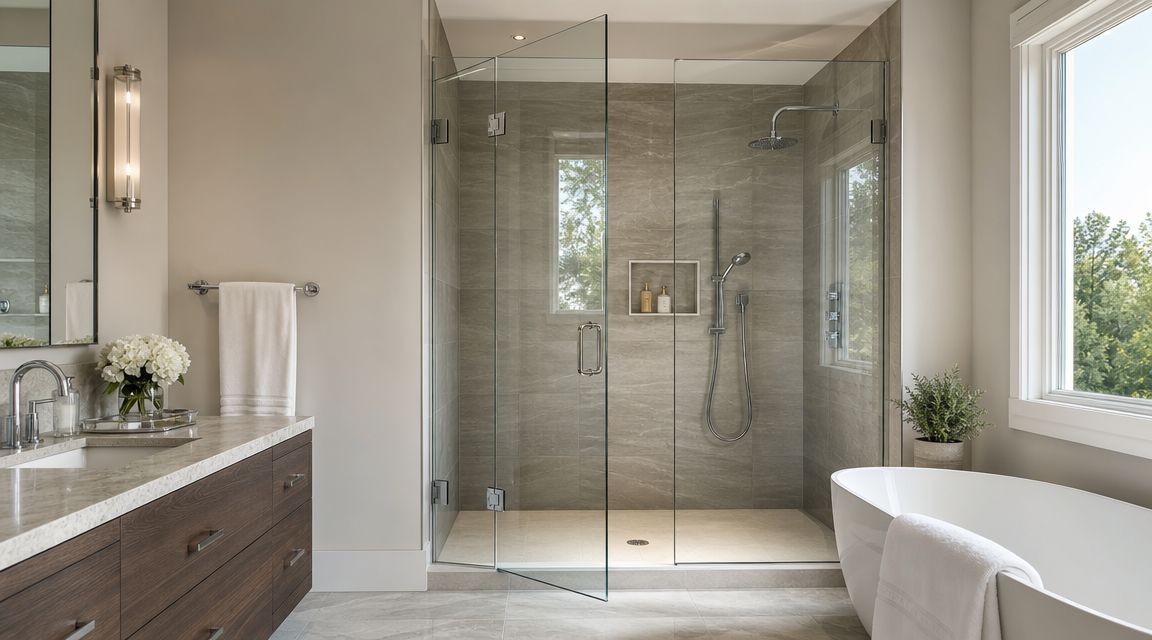
Modern frameless systems became popular as shower design moved away from bulky framed assemblies and toward thick, durable glass with minimal visible metal. That shift changed the job of the hardware. A buyer guide on frameless enclosures notes that the category evolved around secure function with very little visual interruption, especially as headerless-looking systems gained popularity for cleaner sightlines in contemporary bathrooms (frameless shower buyer guidance).
That design goal sounds simple. It isn't. The less visible structure you have, the more every hinge, clip, and latch has to work precisely.
Why the latch matters more than homeowners expect
The latch is the closing point that keeps a heavy glass panel in the right relationship to the fixed panel or wall. It also helps the enclosure feel finished. A poorly matched latch makes a luxury shower feel cheap fast.
In real homes around Southwest Florida, that shows up in familiar ways:
- The door looks closed but isn't seated: Water control gets worse, and the closure never feels solid.
- The door rebounds after contact: The latch or catch isn't receiving the door where it should.
- The hardware feels light or noisy: Even when the glass is high quality, weak closure changes the whole impression.
A frameless shower doesn't have extra frame material to hide bad alignment. The latch has to do its job cleanly and quietly.
That's why homeowners who are thinking about upgrades often focus on glass clarity or finish color first, then later realize the door operation is what they notice every morning. If you're trying to create a more refined bath overall, details like closure feel matter just as much as the visual impact discussed in luxury glass upgrades for the home.
Understanding Latch Types and Mechanisms
Not every frameless shower door latch works the same way, and the right choice isn't just about appearance. It's about how the door feels in motion, how forgiving the hardware is, and what kind of maintenance you're willing to live with.
I usually explain it like the clasp on a quality watch. You want it to look clean, but you also want a closure that feels deliberate. Shower hardware works the same way.
The main latch families
Most homeowners will run into three broad categories.
- Magnetic latches: These use magnetic pull at the closing edge. They tend to feel smooth and quiet when aligned well.
- Mechanical catches: These rely on physical engagement. One common example is a stainless-steel catch with a spring-loaded nylon tip.
- Specialty or integrated closing systems: These may involve auto-close behavior tied into hinge design rather than a separate catch experience.
A commonly sold mechanical option is a stainless-steel catch with a spring-loaded nylon tip, often around 1/2 in. x 1-5/16 in., and that nylon tip matters because it creates a compressible bearing surface that reduces metal-on-glass impact at closure (Prime-Line shower door catch details). In practical terms, that means the latch can absorb a little variation better than bare hard contact would.
What the closing feel tells you
Homeowners usually describe a latch by feel before they describe it by type.
| Frameless Shower Latch Comparison | Closing Feel | Visual Profile | Best For |
|---|---|---|---|
| Magnetic latch | Soft pull, quieter close | Low-profile edge detail | Daily-use showers where a lighter closing feel is preferred |
| Mechanical catch | More defined click or seat | Small visible hardware point | Doors that need a firmer, positive hold |
| Auto-close or specialty system | Guided close as the door nears shut | Usually minimal if integrated well | Homeowners focused on ease of use and a premium operating feel |
A magnetic setup often feels cleaner in use. The trade-off is that it depends heavily on alignment and clean edge conditions. A mechanical catch gives you a more obvious moment of engagement. Some people prefer that because it reassures them the door is securely shut.
What works in the field
The right answer depends on the enclosure, not just the catalog.
- For a minimalist look: Magnetic closure often fits the design intent.
- For a more positive seat: A mechanical catch can be the better choice.
- For buyers comparing aesthetics and operation together: It helps to review hardware during the design phase, not after fabrication. AmeriGlass offers that kind of planning in its custom shower door design process.
Practical rule: If a latch only looks good on a sample board but feels fussy in daily use, it's the wrong latch.
The mistake I see most often is choosing purely by finish and ignoring closure behavior. That's how homeowners end up with a beautiful enclosure that never feels quite right.
Choosing the Right Material and Finish
In Naples, the latch material matters for a reason that has nothing to do with trends. Bathrooms stay humid. Coastal air adds another layer. Hardware that looks fine on day one can age very differently depending on what it's made from and how it's finished.
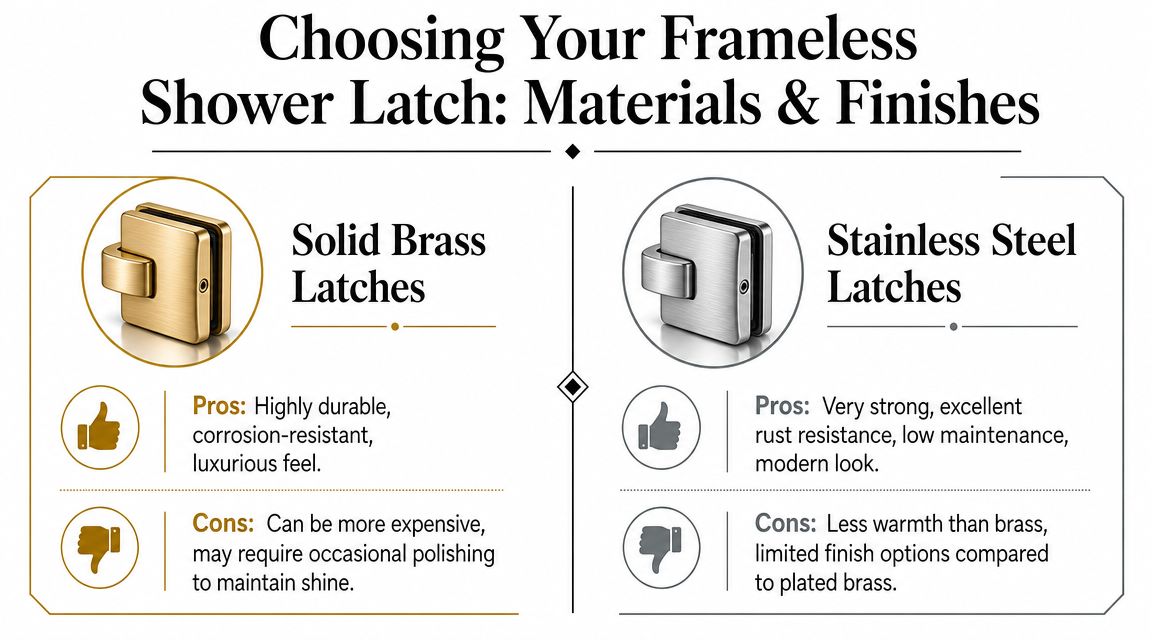
Brass vs stainless steel
For most frameless shower door latch applications, the conversation usually lands on solid brass versus stainless steel.
Brass has weight and a more traditional richness. It pairs well with warmer bathroom palettes and can make the enclosure feel more furniture-like. Stainless steel leans cleaner and more architectural. It fits modern bathrooms well and is often the straightforward choice for homeowners who want durability with less fuss.
The better option depends on the room and the maintenance habits of the household. If a homeowner wants warm metallic character, brass makes sense. If the priority is a crisp, practical hardware package, stainless is often easier to live with.
Finish choice is part of maintenance planning
Finish isn't only visual. It changes what you'll notice over time.
- Polished chrome: Bright and sharp. It coordinates easily with many bathroom fixtures.
- Brushed nickel: Softer and more forgiving visually.
- Matte black: Strong contrast in modern bathrooms, but it needs thoughtful coordination with the rest of the room.
- Oil-rubbed bronze: Better for warmer, more classic spaces.
If you're exploring privacy and style at the same time, this guide on how to elevate your bathroom with frosted doors is useful because it shows how hardware and glass treatment need to work together rather than as separate decisions.
Matching the finish to the glass
Clear glass and ultra-clear glass don't read the same next to hardware. Lower-iron glass tends to make finish choice more noticeable because the enclosure has less color cast. That's worth considering if you're comparing polished metals against darker finishes or trying to keep the room bright and restrained. You can see how that aesthetic shift plays out in ultra-clear glass shower applications.
A latch should match the room, but it also has to age gracefully. In Southwest Florida, I'd rather see a finish chosen for long-term livability than short-term drama.
Ensuring a Perfect Fit with Proper Measurement
If the latch is the part you feel, measurement is the part that decides whether it will work. Most latch problems start long before the first shower. They start when someone assumes frameless glass is forgiving.
It isn't.
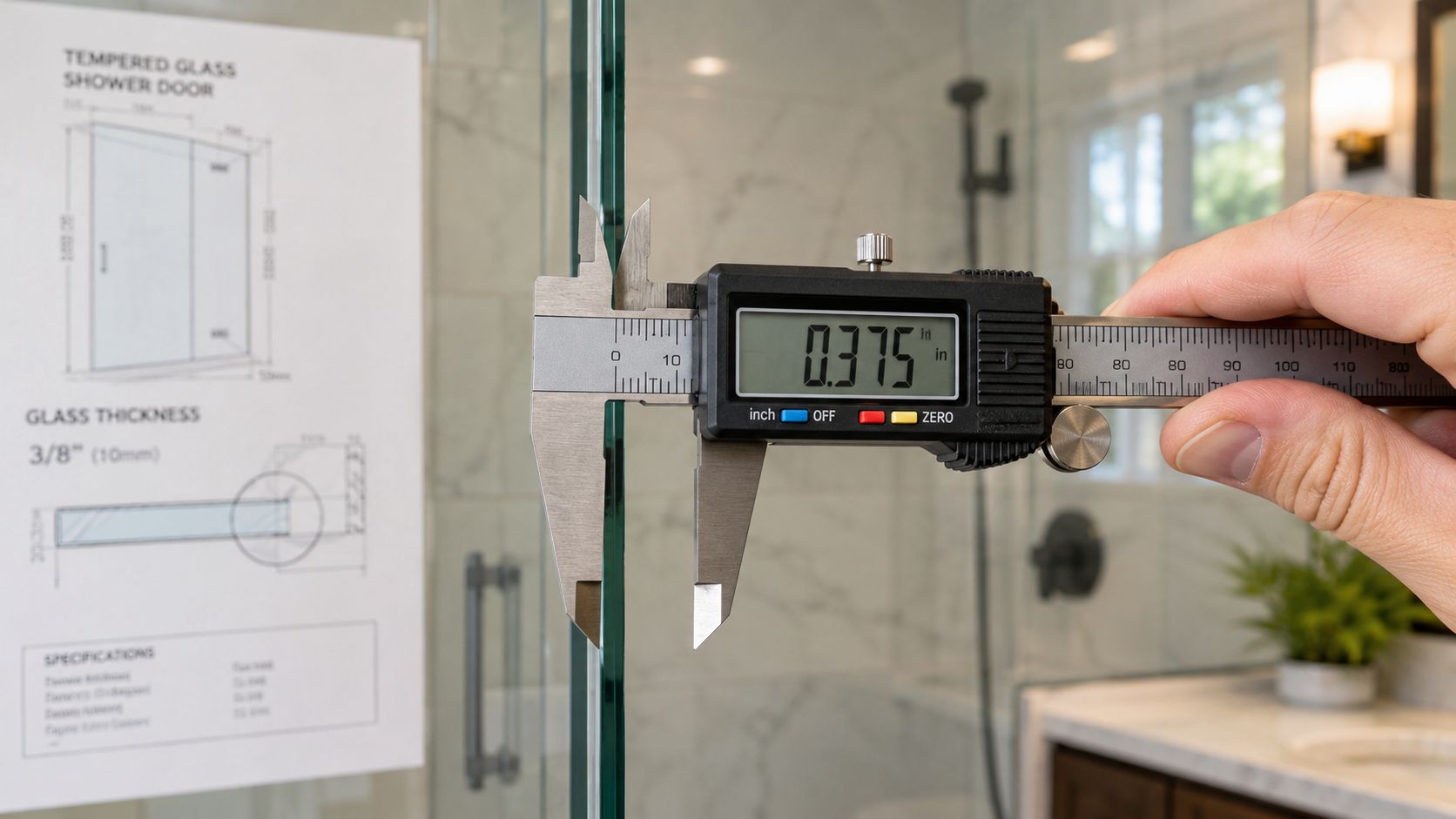
Manufacturer specifications for frameless hinged systems commonly call for 3/8 in. to 1/2 in. glass, and they warn against exceeding door size limits set for the hinge package because hinge torque affects the closing position and whether the latch engages consistently (frameless hinged shower door specifications). That's the core of what installers call tolerance stack-up. The glass, hinge placement, wall condition, and swing path all combine at the latch edge.
What measurement really controls
A proper measure doesn't just answer “how wide is the opening?”
It answers questions like these:
- Glass thickness compatibility: The latch and hinge package must match the glass specification.
- Door weight behavior: A heavier door changes how the hinge set carries the panel over time.
- Wall plumbness: If the wall is out of plumb, the latch edge won't arrive at the strike point the way the drawing suggests.
- Swing geometry: In-swing, out-swing, and bi-swing behavior all affect where and how the latch engages.
A homeowner may only see a slight gap. An installer sees whether that gap means the door is centered correctly, whether the sweep will seat, and whether the catch will receive pressure evenly.
Why small errors show up as latch problems
Frameless hardware has very little room to hide mistakes. If the wall leans, the curb isn't level, or the hinges aren't tuned correctly, the latch becomes the first obvious symptom.
If the door only catches when you lift it slightly by the handle, the latch usually isn't the original problem. The enclosure geometry is.
That's also why online DIY videos can be misleading. They make the process look like a straightforward assembly job when it's really a fitting job. This overview is worth watching because it helps homeowners see how much setup detail goes into a clean result.
What a professional is checking on site
During field measurement, a good installer is looking beyond the opening size.
- Plumb and level conditions: Not just at one point, but across the enclosure.
- Hinge mounting realities: Tile build-up, backing, and hardware clearances all matter.
- Latch landing point: The strike side has to receive the door with the right angle and compression.
- Long-term adjustment margin: The install should still allow fine-tuning later if needed.
That precision is why one shower closes with a clean, confident feel and another never seems to line up the same way twice.
Troubleshooting Common Shower Door Latch Issues
Most homeowners don't start researching a frameless shower door latch because they're shopping. They start because something changed. The door used to close properly. Now it rubs, bounces, clicks too hard, or won't stay shut.
That change over time is normal enough that it deserves more attention than it gets. Installation guidance for neo-angle frameless doors shows how exact these systems are, with examples such as a 7/16-inch bottom gap and a 1/8-inch top gap, which means even small changes can alter latch engagement (neo-angle installation guidance).
Door won't latch cleanly
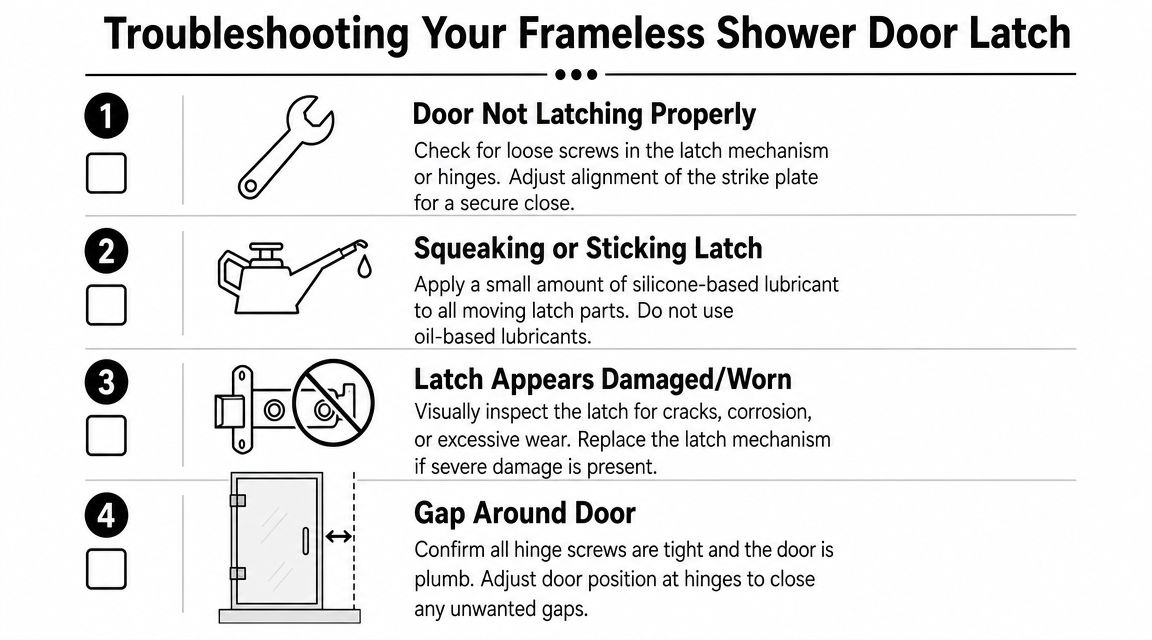
If the door meets the strike area but doesn't seat, start with alignment.
Check whether the door edge arrives evenly from top to bottom. If it's closer at one end than the other, the issue may be hinge drift, loose fasteners, or subtle settling in the opening. In coastal bathrooms, repeated humidity exposure can make wear show up faster.
Try these checks first:
- Look at the reveal: Stand back and compare the gap along the latch side.
- Test for sag: Open the door slightly and see whether it drops or shifts at the handle side.
- Inspect the hardware: Loose screws in hinges or strike hardware can change engagement.
The latch feels stiff, noisy, or rough
A mechanical catch can get noisy if debris builds up or if parts start wearing unevenly. A magnetic closure can also feel rough when the edges no longer meet squarely.
Use a basic maintenance approach:
- Clean the contact area: Soap residue and mineral film can interfere with smooth closure.
- Use the right lubricant: Silicone-based lubricant is the safer choice for moving latch parts.
- Avoid forcing the door: If you have to push harder than usual, stop and diagnose. Forcing it transfers stress to glass and hinges.
Hardware should guide the door into place. It shouldn't require a shove.
The gap changed after months or years
This is the issue I see most in real homes. The latch itself may still be serviceable, but the enclosure no longer lands where it did originally.
Common causes include:
- Hinge wear
- House settling
- Silicone compression or movement
- Out-of-plumb conditions becoming more noticeable over time
At that point, replacing the latch alone may not solve the problem. The better fix is often adjustment first, then replacement only if the hardware is worn or damaged. Homeowners who want a simple maintenance baseline should keep up with frameless shower door maintenance habits, especially in humid bathrooms where small issues build slowly.
When to call for service instead of adjusting it yourself
Some symptoms are not DIY territory:
- The door edge contacts glass or tile
- The hinge side looks stressed or shifted
- The latch only works when the door is lifted
- You see chips, cracks, or deformation near hardware cutouts
Those aren't cosmetic annoyances. They're warning signs that the panel is no longer moving the way it should.
Why Professional Installation Matters for Your Latch
Homeowners usually judge a shower by what they can see. Installers judge it by how it moves. That's where professional installation makes the biggest difference.
A frameless shower door latch can only perform as well as the enclosure around it. If the wall is slightly off, if the hinge set isn't matched correctly, or if the strike point is set without enough precision, the door may still close on day one. The problems show up later. The closure feels weak. The edge alignment changes. Water control gets worse.
The catalog doesn't answer real-life performance questions
Product listings often highlight features such as auto-closing behavior, but they rarely compare long-term maintenance or daily usability against standard magnetic or mechanical latches. That leaves buyers with a gap that usually gets filled by installer experience rather than brochure language (auto-closing frameless door product listing).
That matters because the right latch on paper may be the wrong latch for a heavily used primary bath, a guest suite, or a property that sees constant humidity.
What professional installation changes
A professional install improves the result in ways homeowners feel immediately.
- Better closure feel: The door reaches the latch at the intended angle.
- Less hardware stress: Hinges and latch components don't have to compensate for bad geometry.
- Cleaner visual lines: Gaps look intentional and consistent.
- More predictable maintenance: Future adjustments are simpler when the original fit was correct.
The goal isn't just to get the door on the wall. The goal is to make the door close the same way next month.
For homeowners in this region, that local experience matters. Southwest Florida bathrooms deal with constant moisture, frequent use, and construction conditions that aren't always perfectly square. If you're planning a new enclosure or replacing an older one, frameless shower door installation in Fort Myers and nearby Southwest Florida areas is one way to review how a properly measured and fitted system is handled from the start.
Frequently Asked Questions About Shower Latches
Can a frameless shower door latch be replaced without replacing the whole door
Often, yes. If the glass is sound and the cutouts, edge condition, and overall alignment are still good, a latch can sometimes be replaced on its own. The key issue is compatibility. The replacement hardware has to match the glass thickness, mounting style, and door geometry already in place.
If the latch problem is really caused by hinge sag or enclosure movement, replacing the latch alone won't fix much.
Are all magnetic latches interchangeable
No. Even when two products look similar, they may differ in profile, polarity orientation, mounting detail, and how they meet the opposing edge. Frameless systems are less forgiving than homeowners expect, so “close enough” usually isn't good enough.
Bring photos and exact hardware details when asking about replacement parts.
Why does my shower door latch work sometimes and not others
That usually points to alignment drift rather than a completely failed latch. Temperature, humidity, residue buildup, and slight movement in the door can all affect whether the closure engages smoothly on a given day.
If the problem comes and goes, check the gap and the door's resting position before assuming the latch mechanism is bad.
Is a softer close always better
Not necessarily. Some homeowners like the lighter feel of magnetic closure. Others prefer the more definite seating of a mechanical catch. The better choice depends on who uses the shower, how often it's used, and whether the priority is minimal feel, firm engagement, or ease of operation.
A guest bath can tolerate a different hardware feel than a primary suite used every day.
How should latch hardware be cleaned
Use a soft cloth and non-abrasive cleaner suitable for the finish. Keep soap film and mineral residue off the contact points. For moving mechanical parts, use only products appropriate for shower hardware and avoid anything that leaves heavy residue.
Harsh chemicals and abrasive pads can damage the finish long before the latch wears out naturally.
What's the biggest mistake homeowners make with latches
They treat the latch like an accessory instead of part of the operating system of the shower. The handle gets attention. The finish gets attention. The latch gets chosen last.
That order should be reversed. The shower should close properly first, then look good doing it.
If your shower door doesn't close the way it should, or you're planning a new enclosure and want the hardware specified correctly from the start, AmeriGlass Industries can help you review latch style, enclosure fit, and installation details for a frameless system that suits your bathroom and daily use in Southwest Florida.