
Frameless glass railing cost usually lands between $250 and over $800 per linear foot installed, with broader national benchmarks running from $150 to $600 per linear foot and some higher-spec installed projects planning closer to $400 to $850+ per linear foot depending on glass, hardware, engineering, and labor. If you're pricing a luxury railing in Naples, Fort Myers, or Bonita Springs, the final number depends less on a generic national average and more on the details that matter on your exact site.
Most homeowners I talk to are in the same spot. They step onto a balcony, lanai, pool deck, or stair landing and realize the railing is doing two jobs poorly. It blocks the view, and it cheapens a space that otherwise feels custom. On the Gulf, on a golf course, or around a sharp modern pool, bulky posts and rails don't just look dated. They interrupt the reason you invested in the property in the first place.
Frameless glass fixes that. But it isn't a commodity purchase, and Southwest Florida isn't a forgiving market for shortcuts. Salt air, exposed edges, demanding inspections, and tricky retrofits all affect what you should expect to pay and what should be included in the quote.
The Real Cost of an Unobstructed View
A homeowner in Naples might love everything about a condo except the balcony guard. The view is there, but the railing chops it into sections. A Bonita Springs homeowner may have a pool terrace with beautiful stonework, yet black pickets still dominate the sightline. In both cases, frameless glass is usually the cleanest answer because it removes the visual barrier without giving up safety.
The first question is always price. A solid planning benchmark for frameless glass railing cost is about $150 to $600 per linear foot installed, with a narrower frameless-specific range often cited at $250 to $400 per linear foot according to HomeGuide's glass railing cost guide. For a 20-foot run, that puts a practical budget at roughly $3,000 to $12,000 installed from the same guide.
That sounds like a huge spread because it is. Straight runs on simple structures price differently from stairs, raised balconies, and high-finish exterior work. Premium projects also push upward fast when homeowners want cleaner glass, more refined hardware, or a mounting system that hides more of the structure.
Why the range is so wide
Frameless railing isn't just glass. You're paying for a system. The panel spec, the anchoring method, the condition of the structure below, and the installer's accuracy all show up in the final number.
A low quote can look attractive until you learn it doesn't include engineering, structural prep, or the hardware grade needed near the coast.
In Southwest Florida, the visual goal is simple. Keep the sightline open. The technical side is where cost gets real. A railing on a sheltered interior stair has different demands than a balcony facing wind, moisture, and airborne salt.
For homeowners evaluating broader property upgrades, this guide for Jacksonville real estate investors offers a useful reminder that outdoor design choices affect both appearance and long-term value. The same logic applies to glass railings. The best results come when the railing is treated as part of the architecture, not an afterthought.
If you're deciding whether glass belongs in a higher-end home at all, this look at how glass can make a home feel more luxurious is worth a read. In the field, that's exactly why homeowners choose frameless. They aren't buying lineal footage. They're buying openness.
What Is Included in Your Frameless Railing Quote
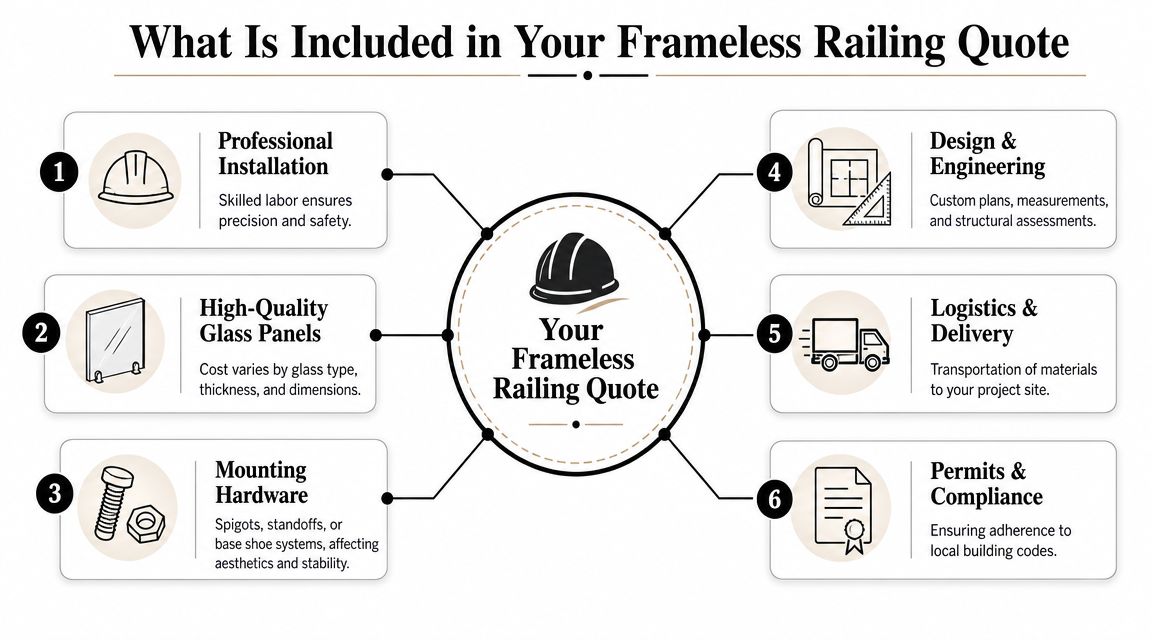
A professional quote should read like a detailed scope of work, not a one-line number. With frameless railing, the phrase "per linear foot" can hide a lot. If the proposal doesn't break out the system, you're trusting assumptions that may not hold once fabrication starts.
A defensible installed planning range for frameless glass railings is about $400 to $850+ per linear foot, made up of glass panels at $80 to $300+ per foot, stainless-steel hardware and structural engineering at $100 to $250+ per foot, and professional installation at $100 to $300+ per foot according to this frameless stainless steel glass railing cost breakdown.
The glass itself
This is the part homeowners focus on first, but it's only one block of the price. Panel thickness, edge finish, clarity, dimensions, and whether the panel is standard or custom all matter. In luxury work, cleaner-looking glass often costs more because expectations are higher and tolerances are tighter.
Some projects also call for laminated safety configurations or more refined visual specs. That doesn't just affect fabrication. It can change handling, lead time, and installation method.
The hardware system
Many low quotes fail to properly account for the specialized nature of frameless systems. Frameless systems rely on engineered attachment points rather than visible posts and rails doing the work for them. Base shoes, spigots, and standoffs don't just hold the glass. They control the visual style, the structural behavior, and the corrosion resistance of the whole installation.
A quote should tell you what hardware family is being used and where it's mounted. It should also make clear whether engineering is included or treated as an extra.
Labor and the work behind the number
Good frameless work is measurement-driven. The installer has to account for slab condition, tile build-up, waterproofing, edge alignment, and finished sightlines. Small errors show immediately because the system is so clean and exposed.
Practical rule: If a quote is vague about installation scope, assume the final invoice won't stay vague for long.
A complete quote should usually account for:
- Field measuring: Precise site dimensions before fabrication.
- Fabrication coordination: Ordering the correct panel sizes and cut details.
- Delivery and handling: Glass is heavy, delicate, and not a casual freight item.
- Installation labor: Setting, aligning, anchoring, and finishing the system safely.
- Permits and compliance: Local review where required.
- Engineering review: Especially important on raised or exposed conditions.
What often gets missed
The biggest omissions are usually below the glass, not in it. If the supporting deck, slab edge, or balcony structure needs reinforcement, that can become a separate line item. The same source notes that structural retrofit may add $500 to $5,000 before the glass is even installed.
That's why the cheapest quote on day one often becomes the most expensive quote by the end of the job.
Design Choices and Site Conditions That Change the Price
A straight balcony run is the easy version of frameless railing. Once the design turns, climbs, or wraps around architecture, cost changes because the fabrication and installation become less forgiving.
In product specifications, the market has moved toward ½-inch tempered low-iron glass with common heights of 36 or 42 inches, which points toward more custom, higher-spec configurations rather than commodity pricing, as shown on Trex glass railing product pages. That trend lines up with what homeowners in luxury coastal markets often want. They don't want "glass railing." They want nearly invisible railing.
Glass clarity and panel sizing
Low-iron glass matters when the railing sits against water, sky, or pale stone. Standard glass can show a greener edge and more color shift. Some clients don't care. Others notice it immediately, especially on white or light-neutral homes.
Custom panel sizing also changes cost. When the installer can use efficient panel layouts, the project is simpler. When the design calls for odd widths, long spans, or highly coordinated sightlines at corners, fabrication gets more specific and waste gets harder to avoid.
For readers comparing visual quality, this overview of ultra-clear glass options helps explain why one frameless system can look much crisper than another even before hardware enters the equation.
Mounting style and geometry
The mounting system drives both appearance and labor. A recessed base can create a floating-glass effect, but it usually asks more of the substrate and the waterproofing details. Surface-mounted hardware may be easier to install, but it changes the look and can expose more metal.
Stairs are where quotes separate quickly. Angled glass, changing elevations, and transitions at landings create more measuring risk and more fabrication complexity. Curved work raises that further because the geometry leaves less room for adjustment in the field.
Consider the difference this way:
| Condition | Why it changes cost |
|---|---|
| Straight run | Easier layout, fewer custom complications |
| Stair section | Angles, transitions, and tighter tolerances |
| Corner conditions | More detail work to preserve clean sightlines |
| Recessed mounting | More prep and substrate coordination |
| Custom-sized panels | More fabrication specificity, less flexibility |
On a frameless project, the parts you don't notice are usually the parts that cost the most to get right.
Why Railing Costs in Naples and Fort Myers Are Unique
Generic online calculators miss what happens once frameless glass meets coastal Florida. A railing that might perform acceptably inland can age badly near the Gulf if the metal spec, anchoring details, and structural review weren't chosen for the environment.
Salt air changes the hardware decision
In Southwest Florida, corrosion isn't a side issue. It is the issue. If the quote doesn't clearly identify the stainless grade and finish quality, you don't yet know what you're buying. Hardware sits at the edge of the building envelope, often exposed to moisture, cleaning chemicals, and airborne salt. On paper, two systems can look similar. On site, one stays sharp and the other starts looking tired far too early.
That matters even more on luxury homes, condominiums, and pool decks where the railing is always in view. Cheap hardware doesn't stay hidden. It becomes the thing your eye goes to.
Wind, code review, and exposed edges
Naples and Fort Myers projects also face stronger scrutiny because many railings sit on raised balconies, lanais, stair openings, and waterfront exposures. The more exposed the location, the more important engineering and proper anchorage become. That's one reason local quotes can differ so much from a national article that assumes a simple interior installation.
When homeowners ask why one installer sounds cautious and another sounds casual, the answer is usually experience. A local specialist knows when a beautiful detail on paper becomes a code or performance problem in the field.
For a look at the kind of precision and site awareness that local glass work requires, this page on frameless shower door installation in Naples, Florida is relevant even though it's a different product category. The principle is the same. In coastal work, precision isn't a luxury. It's protection.
A coastal frameless railing should be priced around the environment it lives in, not around a generic catalog image.
Comparing Framed and Frameless Railing Investments
Many homeowners aren't deciding between "railing" and "no railing." They're deciding between a framed glass system and a frameless one. That's a fair comparison because framed options can cost less upfront and still deliver transparency.
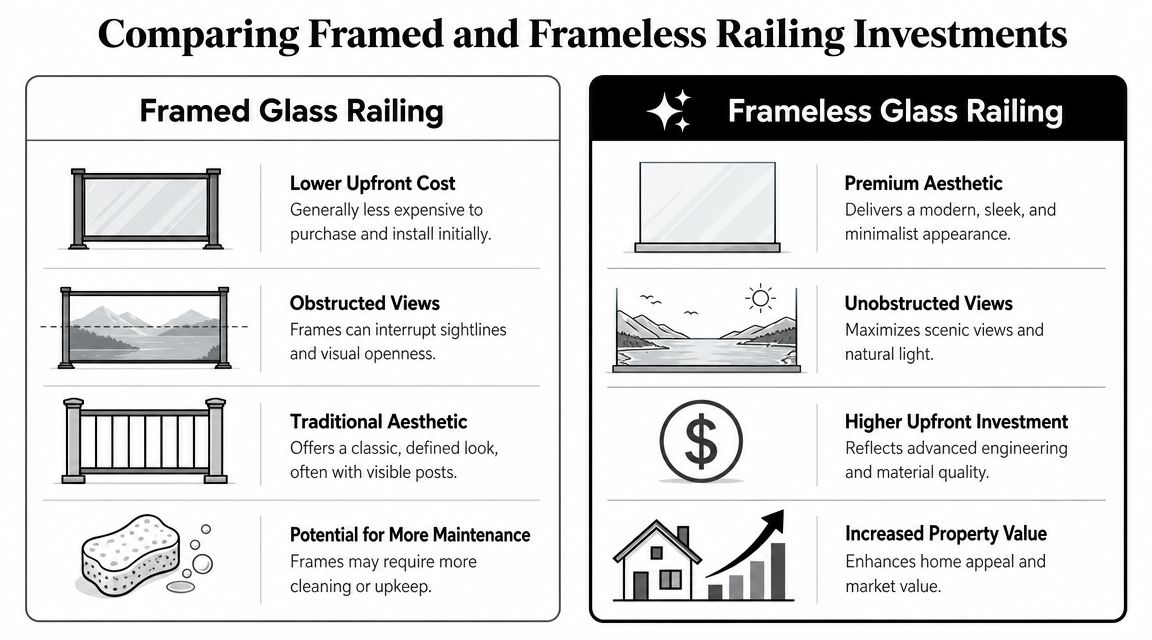
Installed pricing often places turnkey frameless glass railings around $250 to $600 per linear foot for interior projects, while framed systems are commonly cited at about $150 to $300 per linear foot, putting frameless at roughly a 50 to 100 percent premium according to this framed versus glass railing cost comparison.
What the premium actually buys
Frameless systems cost more because they rely on thicker glass, premium hardware, and skilled installation rather than a simpler post-and-rail structure. That's the technical explanation. The homeowner version is easier to understand. You're paying for the absence of visual clutter.
A framed system can still look good. In some projects it makes perfect sense. But if the goal is a clean edge against the Gulf, a pool, or a stair void, the frame becomes the thing you keep seeing.
Side-by-side decision points
- Upfront spend: Framed usually wins on initial budget.
- View quality: Frameless keeps sightlines cleaner.
- Visual weight: Framed systems read more traditional. Frameless reads architectural.
- Cleaning and upkeep: Frameless has fewer visual interruptions where grime and oxidation draw attention.
- Luxury positioning: Frameless tends to align better with modern custom homes and high-end remodels.
A lot of design decisions in a home work the same way. You can see a similar pattern in other custom glass upgrades, including mirrors and specialty glass styles, where the cleaner look usually comes from better detailing rather than more visible material.
The right question isn't only "Which one costs less?" It's "Which one fits the house I'm trying to create?"
Putting It All Together Sample Project Costs
The easiest way to understand frameless glass railing cost is to look at how real project types behave. Not exact bids. Realistic configurations.
A straight balcony in Naples
Take a clean balcony edge on a high-rise where the homeowner wants the railing to disappear into the view. This kind of project usually leans toward a premium exterior spec because the setting is exposed and every detail is visible from inside the unit as well as outside.
A straight run like this is usually more efficient to fabricate and install than a stair. But if the owner wants higher-clarity glass, refined edge finishing, and hardware selected for coastal durability, the project will sit higher in the market than a basic interior run. If the existing structure also needs review or preparation before anchoring, that pushes the total further.
An interior U-shaped stair in Bonita Springs
Now switch to a custom home stair with turns, landings, and a strong design brief. Interior work avoids some exterior exposure issues, but the geometry often makes it more demanding from a layout and fabrication standpoint. Stair sections have to look effortless while landing in exactly the right place.
Homeowners often underestimate the value of a careful installer. The challenge isn't just getting glass on site. It's aligning angled panels, transitions, and hardware so the whole assembly reads as one continuous architectural feature.
A useful way to budget these examples is by using the planning ranges already covered earlier, then adjusting based on complexity, clarity, mounting style, and structural conditions. That's how professionals think about these projects before final field dimensions and engineering lock everything down.
How to Get an Accurate Quote and Avoid Surprises
Most quote problems start before the installer ever visits the property. The homeowner asks for a number, the contractor gives a rough one, and both sides fill in the blanks differently. Frameless glass doesn't reward that approach.
Start with better information.
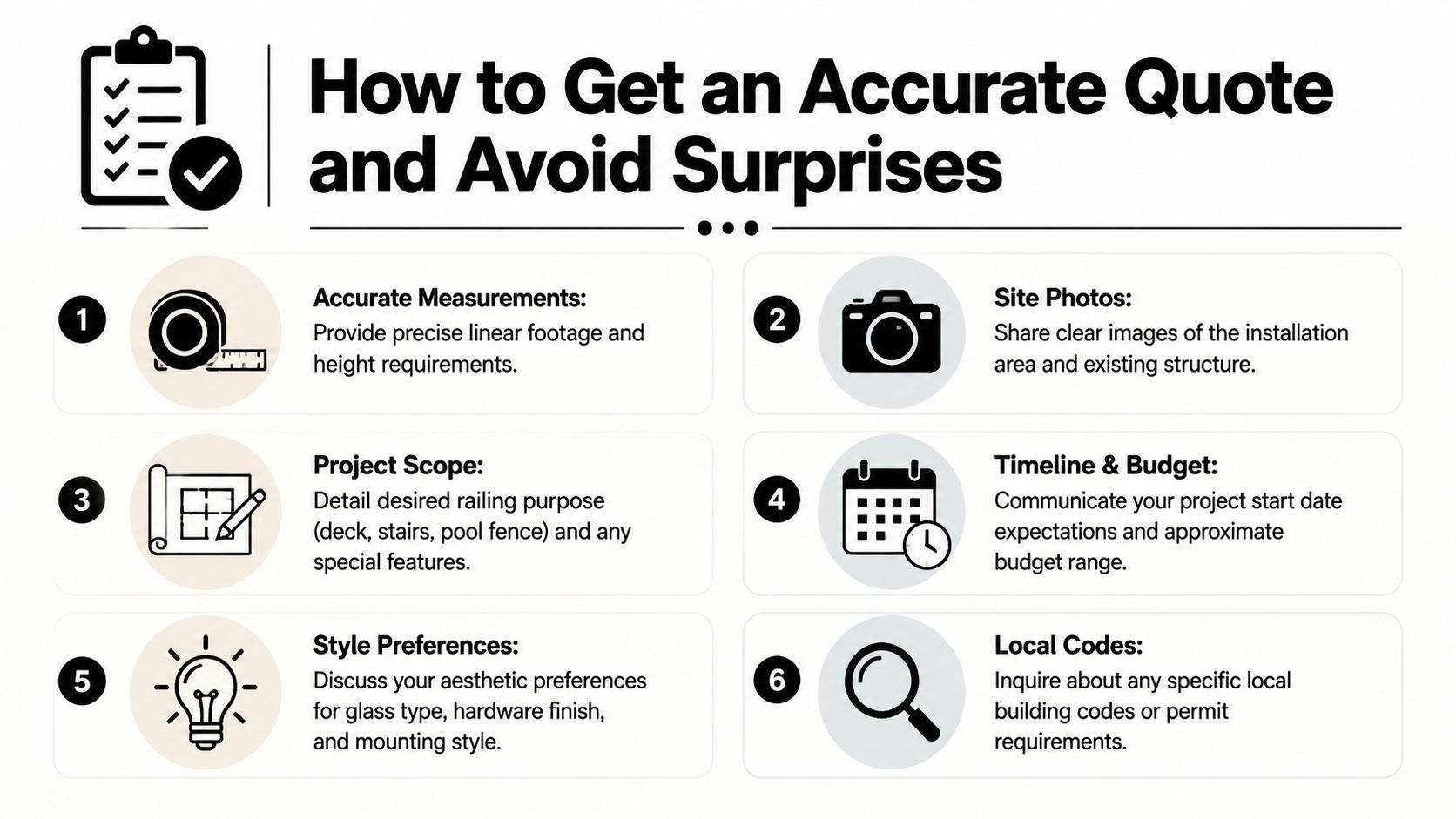
What to prepare before you ask
Bring enough detail so the quote reflects your project, not somebody else's.
- Approximate measurements: Linear footage and whether the run is straight, angled, or stair-related.
- Clear photos: Show the full area, the edge condition, and anything below or behind the mounting point.
- A style reference: Base shoe, spigots, standoffs, top cap, no top cap, standard clarity, or low-iron look.
- Your setting: Interior stair, pool deck, balcony, lanai, or high-rise edge.
- Your timeline: Not because speed changes quality, but because lead times affect planning.
For homeowners comparing custom project pricing in other trades, Netco Design's 2026 price guide is a useful example of how detailed scopes prevent confusion. Different industry, same lesson. The more custom the work, the less useful a one-size-fits-all number becomes.
Questions that expose a serious installer
Ask direct questions. Good contractors won't mind.
- What glass spec are you quoting? You want clarity on the actual panel configuration, not just "tempered glass."
- What hardware system is included? The mounting style and metal quality affect both look and longevity.
- Is engineering included in your price? If not, find out when it becomes an extra.
- Are permits or code compliance items excluded? They shouldn't appear as a surprise later.
- Have you accounted for structural preparation if needed? That's where many budgets get hit.
- Who performs the field measurement and installation? Precision matters more than sales polish.
This video gives a helpful visual sense of how professional installation thinking works in practice.
Red flags in a low quote
If the proposal lists a great price but avoids material specifics, that isn't transparency. It's exposure.
Watch for these problems:
- Missing hardware detail: No mention of the exact system or finish.
- No engineering language: A bad sign on projects at height or exposed projects.
- No permit discussion: That usually means the hard conversations were skipped.
- One-line pricing: Clean-looking proposal, unclear scope.
- No site qualification: If the installer hasn't asked about structure, access, or substrate, the number is premature.
When you're ready to move from rough budgeting to a real project number, request a detailed estimate through this glass project quote page. A serious quote should leave fewer assumptions on the table, not more.
If you're planning a frameless railing in Naples, Fort Myers, Bonita Springs, or anywhere in Southwest Florida, AmeriGlass Industries can help you price it correctly from the start. Their team handles custom glass and precision installation with the level of detail coastal projects demand, so you get a railing that looks refined, performs properly, and doesn't surprise you halfway through the job.