

A lot of homeowners in Naples start in the same place. They've picked the tile, the vanity, the lighting, and now they want the shower or interior opening to feel open, clean, and high-end. Frameless glass usually becomes the obvious choice because it removes visual clutter and makes the room feel larger without changing the footprint.
That part is easy to picture. What's harder to see is the part that determines whether that door still operates properly years from now in a humid Florida home. The finish you notice first matters, but the frameless glass door hardware is what decides whether the glass stays aligned, whether the door closes cleanly, and whether the installation remains safe.
Your Vision for a Frameless Future
Southwest Florida remodels often start with a simple goal. You want the room to feel brighter, cleaner, and more expensive without adding square footage. A frameless glass door does that well, whether it's a shower enclosure, a wine room, or a glass partition opening into a living area.

What usually gets overlooked is that the glass only performs as well as the hardware attached to it. Homeowners tend to compare finishes first. Contractors sometimes focus on layout and opening size first. In practice, the smarter question is whether the hardware system fits the glass, the wall structure, and the environment it has to live in.
That matters because demand for this category keeps growing. The global glass hardware market was valued at $4.8 billion in 2025 and is projected to reach $8.1 billion by 2034, with a 6.1% CAGR, driven by modern architectural demand in residential and commercial spaces, according to Dataintelo's glass hardware market report. That kind of growth tells you something important. Hardware isn't an afterthought in glass work anymore. It's a core part of the system.
What homeowners usually notice first
These features are immediately apparent:
- Minimal lines: Less metal around the glass means the tile, stone, and lighting stay visible.
- More light flow: Clear openings help smaller bathrooms and tighter interiors feel less boxed in.
- A cleaner design language: Frameless systems pair well with contemporary, coastal, and transitional homes.
Those benefits are real. They're also the reason style-focused articles dominate search results.
What actually determines long-term performance
The main decision points are less glamorous:
- Material quality: In Naples, humidity and salt air punish cheap finishes and lower-grade metal.
- Hardware engineering: Hinges, pivots, clamps, and headers have to match the glass and carry the load correctly.
- Fit to the opening: Walls, tile buildup, curb conditions, and out-of-plumb surfaces all affect what hardware will work.
A frameless door can look perfect on installation day and still be the wrong system for the opening.
If you're planning a remodel and aiming for that upscale, open feel, it helps to start with projects that show how glass changes the room visually. This look is part of what makes luxury glass design feel so dramatic in a home. But before you choose a handle shape or a matte black finish, make sure the structure underneath the look is right.
Why Hardware Is the Unsung Hero of Frameless Design
A framed door spreads stress through a metal perimeter. A frameless door doesn't have that backup. The load goes straight into the hardware and the points where that hardware meets the glass and the structure around it.
That's why hardware is the skeleton of the system. If the skeleton is weak, misaligned, or poorly matched, the clean frameless look starts failing in ways you can feel long before you can always see them. The door drags. The margins shift. The close changes. The handle starts to feel different in your hand.
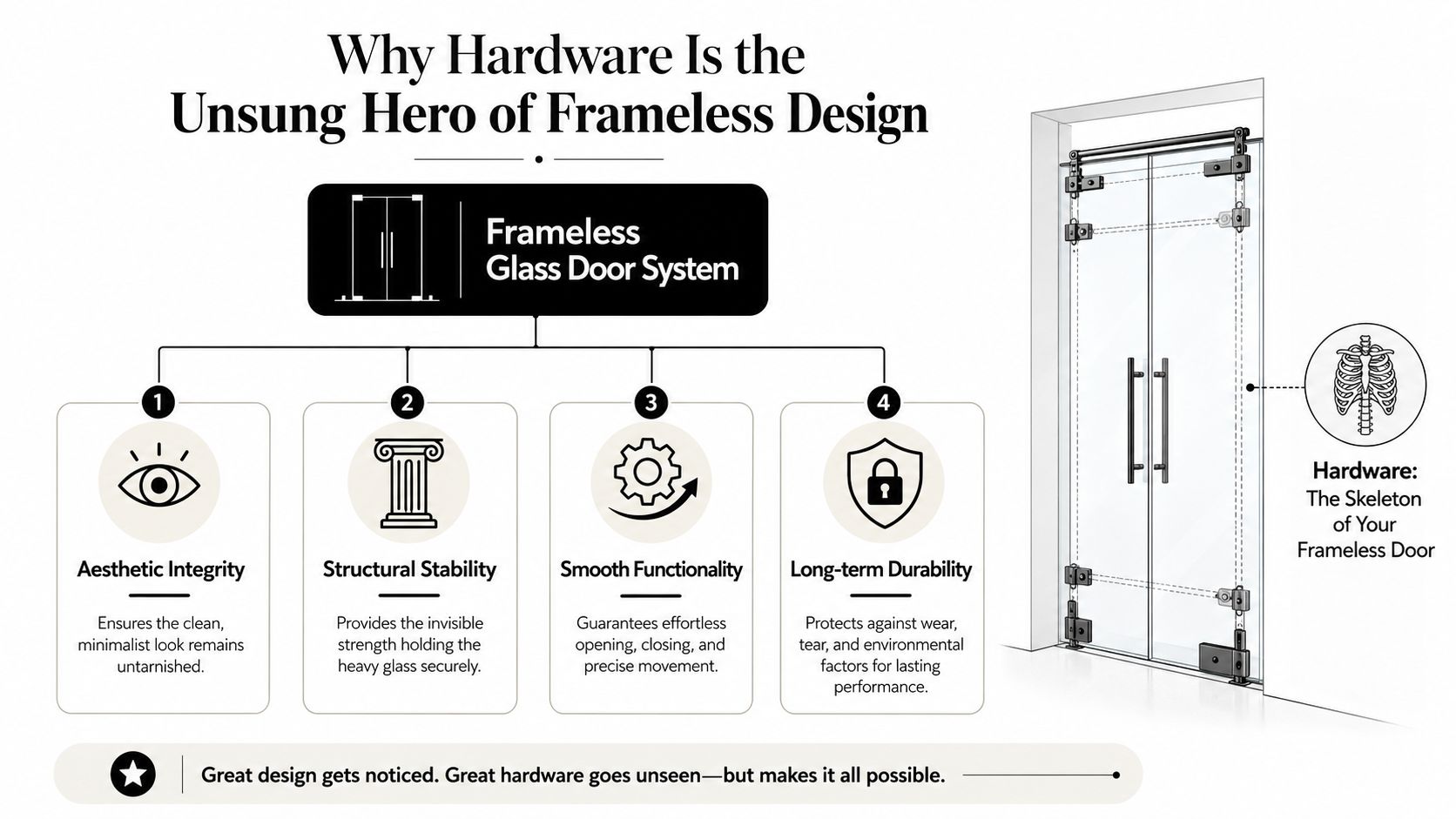
In frameless shower applications, hardware serves as the primary structural component, bearing 100% of the load without a traditional frame to distribute weight. That's why the hardware needs to be made from high-grade, rust-resistant materials such as stainless steel or brass, as explained in Allwin Hardware's engineering overview of frameless glass hardware.
Why the load path matters
When installers talk about load, they're talking about where the weight goes and how it transfers. On a frameless door, the glass doesn't forgive shortcuts. Every hinge, clamp, pivot, or patch fitting has a job, and each one has to do that job without concentrating stress in the wrong place.
A few practical examples:
- Wall-mounted hinges transfer force into the wall structure.
- Glass-to-glass hinges depend on both panels being fabricated and aligned correctly.
- Pivot hardware changes how the door swings and where the load is carried.
- Patch fittings and connectors manage stress at small contact points, which means precision matters.
Why Florida changes the conversation
In Naples and along the Gulf Coast, hardware selection has to account for more than appearance. Moisture is constant. Air conditioning cycles create temperature changes. Homes near the coast deal with salt exposure that can shorten the life of poor-quality metal and compromised finishes.
That's why I push people away from “what looks most invisible” as the first question. The better question is what hardware will still be stable and corrosion-resistant after daily use in a wet room or a humid interior.
Practical rule: In frameless work, every decorative piece is also doing structural work.
Cheap hardware often looks acceptable in a box or even in a showroom sample. Problems show up later. The hinge action gets rough. Fastener points discolor. Alignment drifts because the system wasn't designed for the actual door weight and the actual conditions of the opening.
What quality hardware actually does
Good frameless glass door hardware has four jobs:
- Carry the glass safely without overstressing the wall, panel, or fittings.
- Control movement so the door opens and closes predictably.
- Resist corrosion in wet or humid environments.
- Protect the design intent by staying quiet visually while doing heavy structural work.
That combination is what separates a frameless system that ages well from one that starts asking for service calls.
A Visual Dictionary of Hardware Components
Most quotes list hardware by part name, not by what that part does. That can make a proposal look more technical than it really is. Once you understand the component families, it gets easier to compare systems and spot where corners may be getting cut.
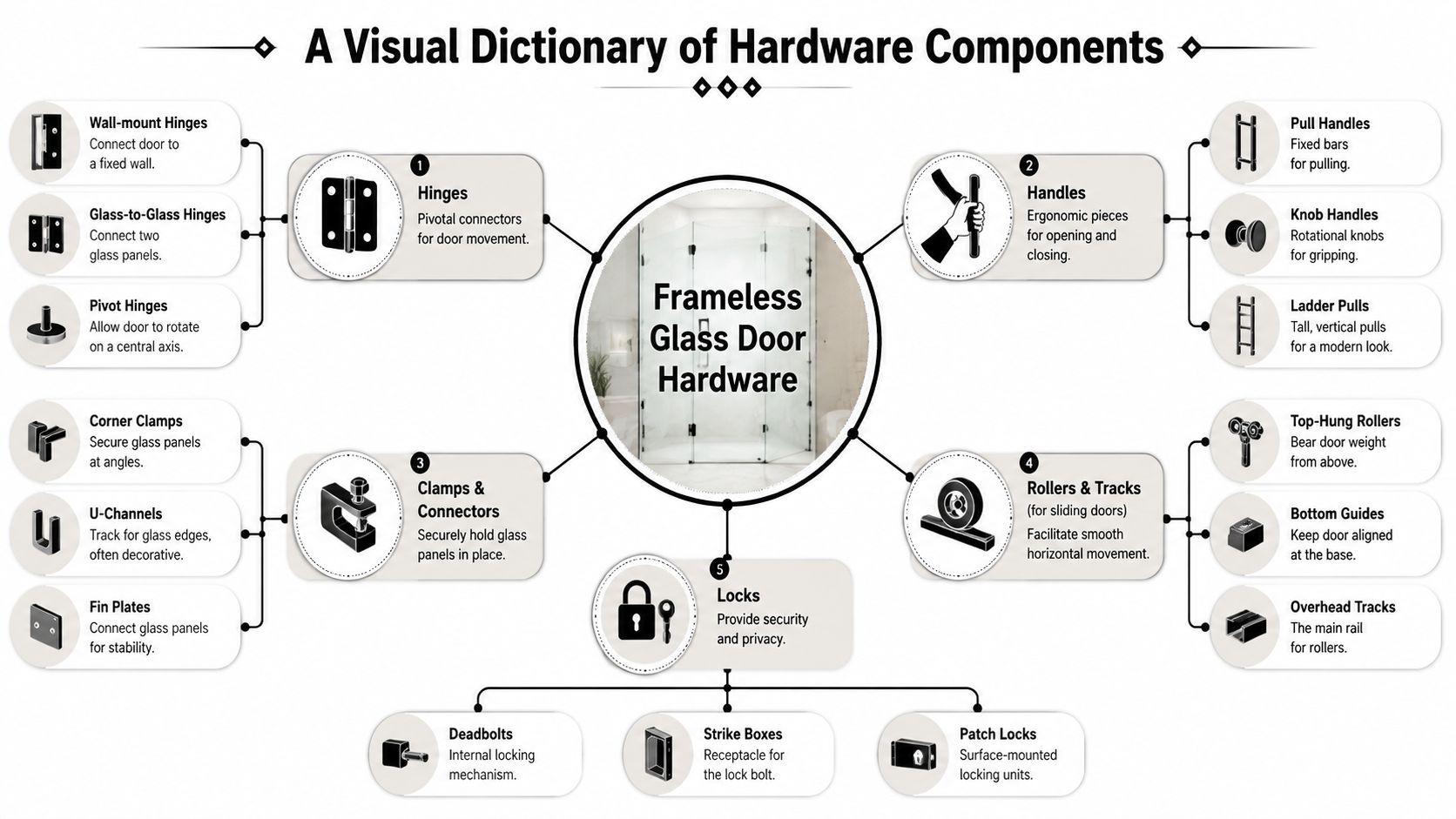
A typical frameless glass door technical stack includes a top header, bottom rail, hinges, bulb seals, pull handles, and overhead or recessed door closers, with hardware selected to carry the load while keeping the look minimal. That also shifts the design challenge to point-load management at hinges and patch fittings, as noted in this technical reference on frameless glass doors.
Movement hardware
These are the parts that make the door move the way it should.
Hinges
Hinges are the most familiar component, but not all hinges do the same job.
- Wall-mount hinges attach the door directly to a wall or fixed structural surface.
- Glass-to-glass hinges connect a moving door to a fixed adjacent panel.
- Pivot hinges rotate the door around a pivot point rather than a traditional side hinge line.
Wall-mount hinges are common in shower openings where there's solid backing behind tile. Glass-to-glass hinges are useful when layout drives the design toward a fixed panel plus a swinging door.
Sliding hardware
Sliding systems trade swing clearance for track and roller complexity. In these systems, the critical parts are the overhead track, rollers, stoppers, and bottom guide. If the track isn't level and the rollers aren't matched properly, the movement feels rough no matter how attractive the glass looks.
A good product gallery helps homeowners connect these names to real systems. If you want to compare categories visually, AmeriGlass keeps examples of glass products and applications that show how different hardware styles appear in finished installations.
A short video also helps clarify the terminology before you read a quote or meet with an installer:
Structural hardware
These pieces hold the system together and keep the glass stable.
Clamps and connectors
Clamps secure fixed panels to walls, curbs, floors, or other glass panels. Connectors and patch fittings do similar work in more specialized configurations. These parts don't draw attention when the job is done right, but they control stability.
You'll often see:
- Corner clamps where panels meet at an angle
- U-channels where a cleaner edge restraint is preferred
- Fin plates or specialized connectors on custom layouts
- Patch fittings in commercial or heavier-duty assemblies
Headers and support members
A header is a structural member at the top of the system. Some designs need one. Some don't. A true frameless look doesn't always mean zero support. It means the support is used carefully and only where needed.
The intersection of design and engineering often presents a challenge. Homeowners often want the least visible metal possible. Sometimes that works. Other times a discreet header or stabilizing element is the safest choice.
The cleanest-looking installation is the one where the hardware disappears visually, not structurally.
Functional hardware
These are the pieces you touch or notice during daily use.
Handles and pulls
Handles should fit the door size and the room style, but they also affect ease of operation and comfort. Taller pulls often feel better on larger doors. Small knobs can work, but they don't suit every panel size or every user.
Seals and sweeps
Bulb seals, edge seals, and bottom sweeps manage gaps, alignment, and water control. They're small parts, but they matter. A well-hung door with poor sealing still feels like a compromised installation.
Closers and locks
In some frameless door systems, especially beyond showers, overhead or recessed closers control return and closure. Locks may be included where privacy or access control matters. These components need exact fit-up because they rely on proper hole placement and consistent margins.
If you understand these component families, you can read a quote with a much sharper eye. You'll know which pieces are visible style choices and which ones are carrying the engineering burden.
How to Choose the Right Hardware for Your Project
Choosing frameless glass door hardware starts with one question. What is the hardware being asked to support? If that answer isn't clear, every other choice becomes guesswork.
Glass thickness is a big part of that decision. A common specification range for frameless glass doors is 1/2 inch to 3/4 inch for larger applications, while some lighter interior systems use 1/4 inch (6 mm) tempered safety glass. That thickness changes hardware compatibility, hole and notch dimensions, and the tolerances needed for closers and patches, according to this ScienceDirect reference on frameless glass door specifications.
Start with the glass, not the finish
A lot of selection mistakes happen because the process gets reversed. Someone picks matte black hinges, a popular pull, and a minimal clamp style before confirming what glass thickness the system uses and what the substrate can support.
That's backwards.
Thicker glass is stiffer and changes the hardware package. It also changes fabrication details. Once tempered glass is cut and processed for a specific hinge or handle pattern, you don't have much room for improvisation.
Use this order instead:
- Confirm the glass thickness
- Match hardware compatibility to that thickness
- Verify the opening and support conditions
- Choose the finish last
Material choice matters more in Florida
In Southwest Florida, the base metal deserves more attention than the finish color. Homeowners usually ask about black, nickel, chrome, bronze, or brushed options. Those are valid design decisions, but the hidden issue is how well the underlying hardware resists corrosion and wear in a wet, humid setting.
Stainless steel and brass are both used in frameless systems. The right choice depends on the application, the environment, and the product line being specified. The key is making sure you're getting a high-grade, corrosion-resistant component rather than a finish-first part that looks good on day one and ages poorly.
Hardware Material and Finish Comparison
| Material/Finish | Base Material | Corrosion Resistance | Best For | Common Finishes |
|---|---|---|---|---|
| Stainless steel hardware | Stainless steel | High | Bathrooms, pool-adjacent spaces, humid interiors | Brushed stainless, polished stainless, black-coated options |
| Brass hardware | Brass | High when properly finished | High-end residential showers, detailed finish matching | Chrome, brushed nickel, bronze, matte black, polished brass |
| Matte black finish | Varies by product | Depends on base material and coating quality | Modern and transitional interiors | Matte black |
| Brushed nickel finish | Varies by product | Depends on base material and finish process | Softer, more forgiving residential design | Brushed nickel, satin nickel |
| Polished chrome finish | Varies by product | Depends on base material and finish process | Bright, clean bathrooms and commercial-style interiors | Chrome, polished chrome |
Match the hardware style to the real use case
Not every door needs the most minimal hardware package. In fact, some openings perform better with a little more visible structure.
Consider the trade-offs:
- Minimal hinge-and-clamp layouts look light and elegant, but they demand excellent substrate conditions and precise fabrication.
- Pivot systems can solve some layout issues, but they change door behavior and need exact planning.
- Sliding systems save swing space, though they introduce track and roller considerations.
- Headers or stabilizing elements may interrupt the “all-glass” look slightly, but they can improve long-term stability.
What works and what doesn't
What works well in real projects:
- Matching hardware to the actual glass spec
- Choosing corrosion-resistant materials for Florida conditions
- Keeping finish expectations realistic in wet environments
- Using hardware families designed to work together
What doesn't work:
- Mixing incompatible components
- Choosing based only on showroom appearance
- Ignoring fabrication requirements
- Trying to force a no-header look where the opening really needs support
Hardware should fit the opening first, the glass second, and the design language third. If you reverse that order, the job usually tells on itself later.
Installation and Structural Safety Essentials
The best hardware in the world can't save a bad substrate. That's the part DIY articles usually skip. A frameless door doesn't start with hinges. It starts inside the wall.
Wall-mount hinges require a wall that is straight even if it is out of plumb, a wood stud or similarly strong substrate behind the hinge location, and hardware selected within the manufacturer's weight and door-width limits. Those are primary safety constraints for retrofit and new installations, as explained in Glass Magazine's discussion of code, structure, and fitment for frameless systems.
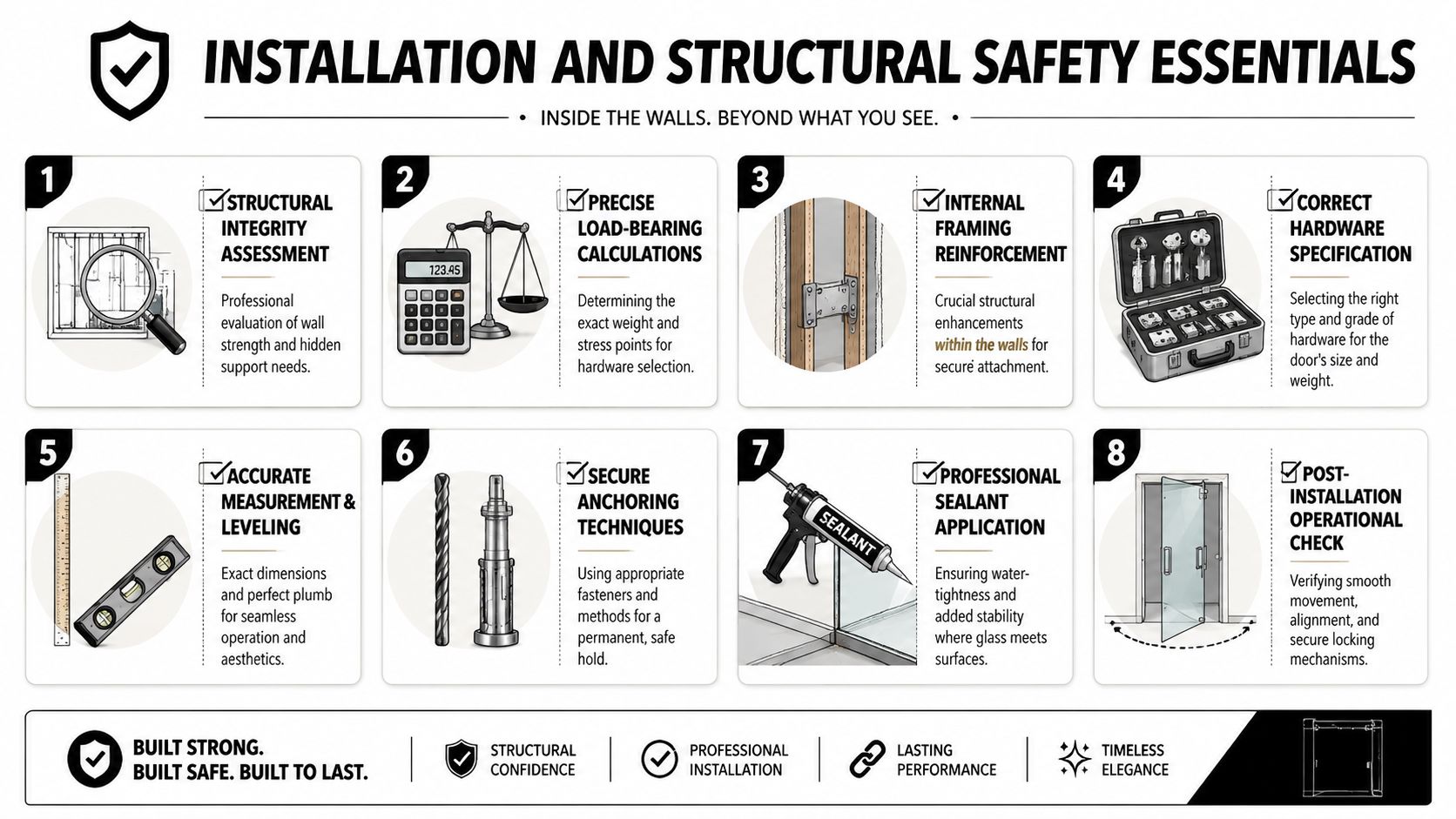
What professionals check before glass is ordered
Good installation starts long before the truck arrives with the glass.
A competent installer verifies:
- Backing at hinge locations: Tile and drywall are not structural attachment points by themselves.
- Wall condition: Straightness matters. A wall can be out of plumb and still workable if the line is consistent.
- Opening geometry: Curbs, returns, and adjacent walls affect clearances and seal lines.
- Hardware limits: Every hinge and mounting pattern has width and weight boundaries.
That's why field measurement is so critical. In custom glass work, a small layout mistake doesn't stay small. It becomes a fabrication issue, then an installation issue, then a service issue.
Why custom shapes raise the stakes
Neo-angle layouts, unusual returns, and non-standard openings can look excellent when they're measured and engineered correctly. They can also become expensive problem jobs when the geometry isn't resolved before fabrication.
In those layouts, installers have to think about more than just door swing. They need to avoid hardware clashes, account for wall conditions, and make sure clamp or hinge locations land where support exists.
For homeowners in this area considering a custom enclosure, it helps to review how frameless shower door installation in Fort Myers is typically handled, because the same structural concerns apply throughout Southwest Florida.
A frameless door isn't a universal swap-in upgrade. The opening has to earn it.
Why professional installation is worth it
Professional installers bring three things that matter here:
- Accurate measurement so fabrication matches the actual opening
- Structural judgment about where and how the hardware can anchor safely
- Adjustment experience during final set, sealing, and alignment
The difference shows up in operation. A properly installed frameless door feels controlled. It doesn't wobble, rack, scrape, or fight the user. That smoothness is not cosmetic. It's evidence that the load path, fit, and anchoring were handled correctly.
Long-Term Care and Advanced Protective Coatings
Once the door is installed, the goal changes. Now you're trying to preserve clarity, finish quality, and smooth operation without damaging the materials during cleaning.
That starts with simple habits. Use soft cloths, non-abrasive cleaning methods, and avoid harsh chemicals that can attack finishes or leave residue at seals. The wrong cleaner causes a lot of unnecessary wear, especially on darker finishes that show buildup faster.
Daily care that actually helps
These habits make the biggest difference:
- Wipe moisture down regularly: Less standing water means fewer mineral deposits on glass and hardware.
- Clean gently: Soft microfiber and finish-safe products are better than abrasive pads or strong chemicals.
- Check moving parts: If a hinge, pull, or slider feels different, address it early rather than waiting for misalignment.
- Replace worn seals when needed: Small vinyl components affect water control more than people expect.
A lot of homeowners ask for one product that solves the maintenance issue. There isn't a magic cleaner, but protective coatings can reduce the amount of work the surface asks of you.
Where protective coatings fit in
Advanced coatings help by making the glass less likely to hold onto mineral residue and everyday grime. In Florida, that matters because humidity, hard water spotting, and frequent shower use can make even a beautiful new enclosure look tired sooner than expected.
If you want a useful outside reference on what coatings do and how they fit into routine care, this 2026 glass care guide gives a practical overview without turning the topic into chemistry class.
For local owners, it also helps to review a basic shower door maintenance guide so cleaning habits match the type of glass and hardware installed.
What not to do
The most common maintenance mistakes are predictable:
- Using abrasive powders or pads
- Letting residue build around hinges and seals
- Assuming all finishes tolerate the same cleaners
- Ignoring small changes in movement or alignment
Good frameless glass door hardware doesn't need constant attention. It does need consistent, sensible care. A few minutes of routine maintenance protects both the finish and the function.
Your Final Checklist for Hiring a Glass Professional
By the time you're getting bids, the design decisions probably feel mostly settled. However, the project's ultimate success or failure hinges on the implementation. The installer you hire will determine whether the hardware package is matched properly, measured accurately, and anchored safely.
A homeowner or contractor doesn't need to know every technical detail. You do need to ask better questions.
Questions worth asking before you sign
Bring these into the conversation:
- How do you verify structural support at hinge locations? You want a direct answer about studs, blocking, or equivalent backing.
- Who takes final field measurements? The person measuring should understand fabrication and installation, not just sales.
- What hardware lines or material grades do you use? Ask about corrosion resistance and compatibility with the glass being specified.
- How do you handle out-of-plumb walls or uneven surfaces? Real openings are rarely perfect.
- What happens if the layout is non-standard? Custom angles and awkward openings require more than a template approach.
- What does your post-install adjustment process include? Final alignment is part of the job, not a favor.
Answers that should make you cautious
Some responses signal trouble right away.
| Warning sign | Why it matters |
|---|---|
| “Any frameless system will work there.” | Openings vary. Structure and geometry decide what's feasible. |
| “We'll figure out the hardware after the glass is ordered.” | Hardware and fabrication have to be coordinated early. |
| “The tile will hold it.” | Tile is finish material, not structural backing. |
| “All finishes perform about the same.” | In Florida conditions, material quality and finish system matter. |
The simple standard
A qualified glass professional should be comfortable discussing support, measurement, hardware limits, adjustment, and maintenance. If those answers feel vague, rushed, or overly focused on appearance, keep looking.
If you want a straightforward starting point, a solid list of common glass project FAQs can help you compare installer answers against the questions that matter most in custom work.
The right hire won't just sell you a frameless look. They'll explain what the opening can support, what hardware fits that condition, and what trade-offs come with each option.
If you're planning a frameless glass project in Naples, Fort Myers, or nearby Southwest Florida communities, AmeriGlass Industries can provide a professional estimate, field measurement, and guidance on hardware options that fit the glass, the structure, and the environment.