
Your bottles started on a kitchen counter, then moved into a wine fridge, then into whatever cool corner of the house still had space. That works for a while. Then the collection grows, labels disappear behind each other, odd bottle sizes don't fit, and the “storage solution” starts looking more like overflow.
That's usually the moment homeowners in Naples and across Southwest Florida start looking at custom wine storage cabinets. Not because they suddenly want a showpiece, though many do. It's because they want order, preservation, and a cabinet that fits the home instead of fighting it.
In high-end homes, the best custom wine storage cabinets do two jobs at once. They protect the wine and they enhance the room. The mistake is treating one of those jobs as optional. A cabinet that looks spectacular but runs warm is expensive furniture. A cabinet that preserves wine but makes half the bottles hard to reach becomes frustrating fast. Good design solves both.
Is a Custom Wine Cabinet Right for Your Collection
A custom build makes sense when your collection has outgrown generic storage and your buying habits are stable enough to design around. If you're stacking cases in a pantry, tucking bottles into a bar cabinet, and losing track of what you own, you're already paying for the lack of a system. The question isn't whether custom is attractive. It's whether your collection needs something more intentional.
There's also a broader market signal behind that shift. The global wine cabinet market is projected to grow from USD 2.06 billion in 2024 to USD 4.26 billion by 2035, with a projected 6.8% CAGR from 2025 to 2035, according to Market Research Future's wine cabinet market forecast. That doesn't mean every homeowner needs a bespoke enclosure. It does mean purpose-built wine storage is moving well beyond a niche indulgence in premium homes.
Start with how you actually drink
The first filter is simple. Are you storing wine to age it, or to drink it soon?
If most of your bottles turn over quickly, a highly engineered custom cabinet may be more than you need. If you're collecting bottles you plan to hold, especially in Florida's heat and humidity, preservation starts to matter a lot more. That distinction affects every decision that follows, from cooling to glass to where the cabinet should sit in the home.
A good outside resource for sorting out the basics is this wine storage guide, which lays out the preservation side in plain terms. It's useful before you start comparing finishes and hardware.
Practical rule: Don't design around the fantasy version of your collection. Design around the bottles you already buy, how long you keep them, and how often you want to see them.
A custom cabinet is worth it when off the shelf keeps failing
Custom wine storage cabinets tend to be the right move in a few common situations:
- Your space is awkward: Under stairs, beside a dining room passage, inside a converted closet, or built into millwork where standard units leave wasted gaps.
- Your collection is mixed: Standard bottles, Champagne, larger formats, and a few display bottles all need different handling.
- The room matters visually: In formal living areas, generic cooling units and mismatched cabinetry can drag down the architecture.
- You want access, not just capacity: A packed cabinet isn't efficient if daily bottles are buried behind special bottles.
For many homeowners, the strongest return isn't resale math. It's daily usability and better integration with the home. A well-designed enclosure can also make an interior feel more refined, especially when glass is used well. If you're exploring how architectural glass changes that feel, this look at how a glass company can make your home feel luxurious is a useful reference point.
The wrong reasons to go custom
Custom isn't automatically better. It's the wrong choice when the project is driven only by appearance, when the wine won't stay in the house long enough to justify the engineering, or when nobody has thought through inventory growth. I've seen homeowners build around today's bottle count and run out of room almost immediately.
The better approach is to ask three blunt questions:
- What am I storing now?
- What do I expect this collection to become?
- Do I need display, preservation, or both?
If you can answer those clearly, a custom cabinet stops being a luxury impulse and starts becoming a well-aimed investment.
Choosing Your Cabinet Style Materials and Finishes
Style drives the first impression. Materials decide whether that first impression still looks good years later. In custom wine storage cabinets, those two things have to work together.
Some homeowners want the cabinet to disappear into the architecture. Others want it to command the room. Both approaches can work. The wrong move is choosing a style that ignores how the cabinet will be used, cleaned, cooled, and viewed from across the room.
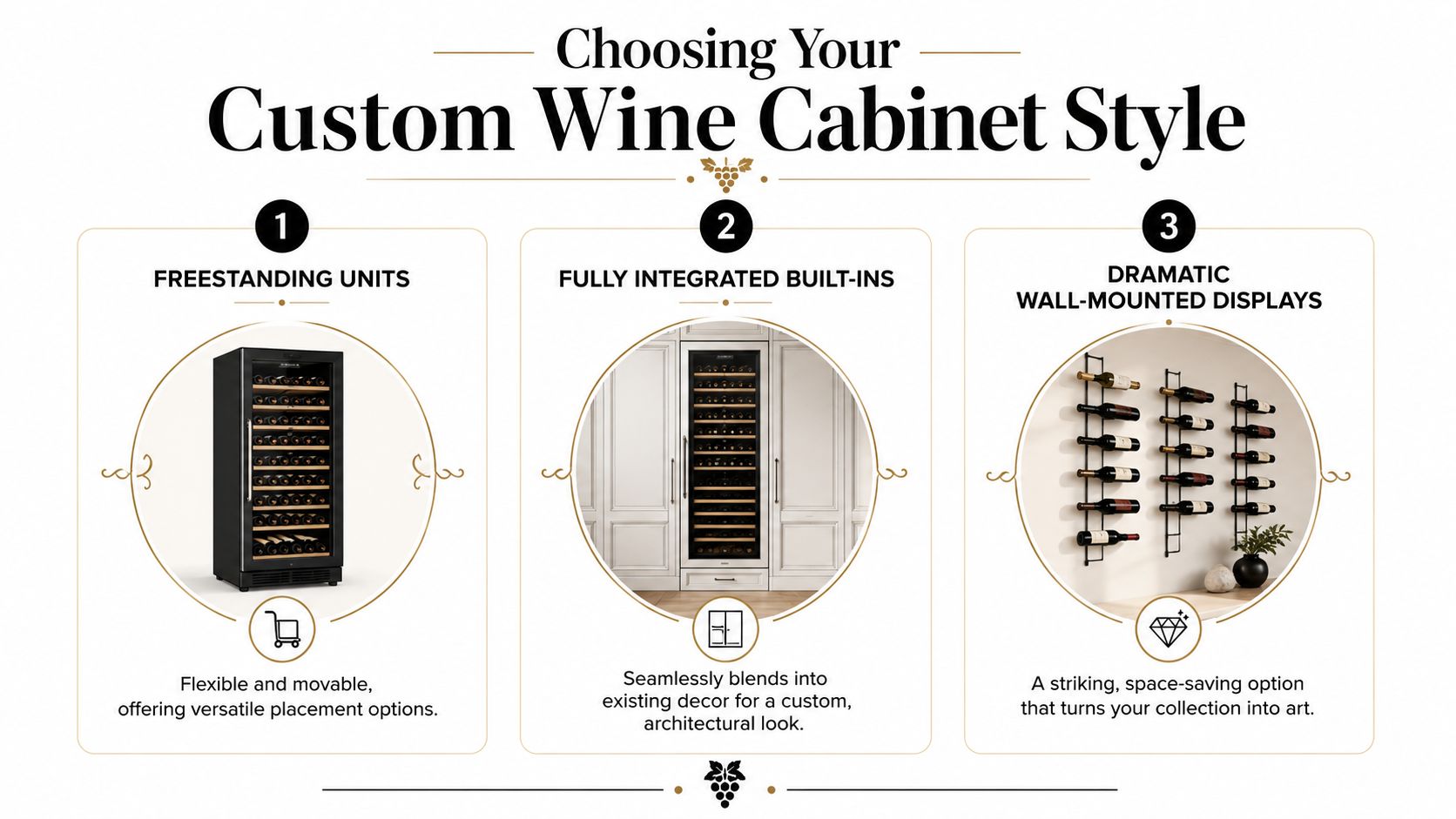
Three cabinet styles that shape the whole project
A freestanding unit works when flexibility matters most. It's easier to place and can be a smart answer for a homeowner who isn't ready to commit to construction. The trade-off is visual integration. It usually looks like an appliance, not architecture.
A fully integrated built-in is the strongest option when you want the cabinet to feel native to the house. It can align with surrounding millwork, balance adjacent shelving, and make a converted niche or closet look intentional rather than adapted.
A wall-mounted display leans hardest into presentation. It's dramatic, space-conscious, and excellent for feature walls, but it needs disciplined layout planning. A display-first concept can sacrifice storage efficiency quickly if every bottle is treated like a hero bottle.
Material Comparison for Custom Wine Cabinets
| Material | Pros | Cons | Best For |
|---|---|---|---|
| Wood | Warm, classic, works well with traditional and transitional interiors | Can feel visually heavy, needs finish choices that suit the room | Libraries, dining rooms, legacy-style interiors |
| Metal racking | Clean lines, strong bottle visibility, works with many bottle orientations | Can feel too commercial if not balanced with other finishes | Contemporary homes and mixed-use display walls |
| Glass | Open sightlines, premium feel, makes smaller spaces feel larger | Shows fingerprints, requires precise installation and good lighting strategy | Modern homes, showcase enclosures, feature installations |
For homeowners leaning modern, frameless glass usually creates the cleanest result. It lets the collection read as part of the room rather than behind a heavy visual border. Low-iron options can sharpen clarity even further, which is why many designers and homeowners compare ultra-clear glass when they want the labels and bottle colors to stay visually crisp.
Good material selection isn't about chasing the most expensive finish. It's about choosing a combination that still looks deliberate when the cabinet is full, lit, and in daily use.
Finishes that hold up
Hardware and finish selections should follow the room, not compete with it. Matte black works well in contemporary homes and pairs naturally with steel racking. Brushed nickel tends to bridge traditional and modern spaces more gently. Warmer metal tones can work in softer interiors, but only if the rest of the room already supports them.
A few finish rules save a lot of regret:
- Match the adjacent architecture: Cabinetry, door hardware, and nearby fixtures should feel related, not identical.
- Expect maintenance: Glass-heavy designs look sharp, but they reveal smudges faster than wood-faced millwork.
- Use contrast carefully: Dark racking against light walls can make bottles read cleanly. Too much contrast can make a small enclosure look busy.
- Think about nighttime appearance: The cabinet should look composed when the room lights are low, not like a brightly lit appliance niche.
The best custom wine storage cabinets don't rely on one material. They layer them. Glass for openness, metal for bottle presentation, wood for warmth, and hardware that ties the enclosure back to the house.
Perfecting the Sizing and Layout for Your Space
A wine cabinet can be beautiful and still be badly planned. That usually shows up in one of three ways. Bottles are hard to reach, labels are impossible to read, or the layout only works for one bottle shape.
The hardest projects are often the most rewarding. Under a staircase, beside a hallway, or inside a converted closet, the geometry is irregular but the opportunity is strong. Industry guidance around under-stair installations highlights the importance of angled mounting and high-reveal display rows to keep labels readable and bottles accessible, as discussed in this piece on building an understairs wine cellar.
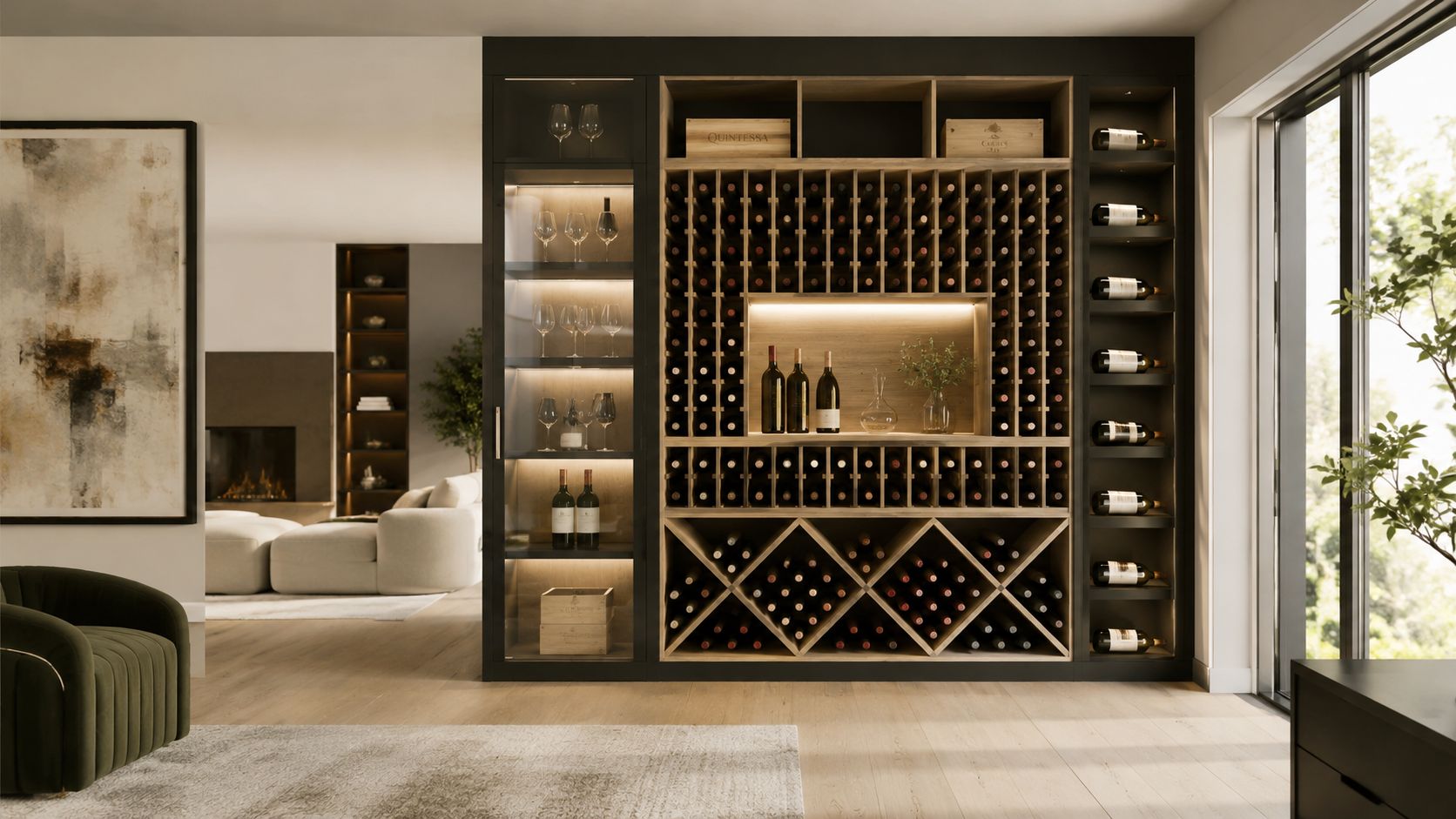
Plan around access before capacity
Homeowners often start by asking, “How many bottles can we fit?” The better question is, “How will we get to the right bottle without disturbing the rest?”
That changes the layout immediately. Daily drinkers should sit in the easiest zones. Long-term bottles can occupy denser storage. Special formats need dedicated locations so they don't disrupt every adjacent row.
A practical layout usually includes a mix of these zones:
- Front-facing display rows: Best for a smaller selection of bottles you want to see and grab quickly.
- Horizontal bulk storage: More efficient for larger parts of the collection.
- Oversized bottle sections: Important if your buying habits include Champagne, Burgundy, or larger formats.
- Service space: Small but critical. You need room to clean, inspect labels, and move bottles without scraping glass or trim.
Under stairs and closets need discipline
Under-stair projects tempt people into over-designing. Every angle looks like a chance to add another feature. In practice, too many display gestures can make the cabinet harder to use.
A converted closet has the opposite risk. Because the room is enclosed and rectangular, homeowners assume it's easy. It can be, but only if the depth, door swing, shelf spacing, and cooling path are coordinated early. Otherwise, a closet wine room ends up cramped and awkward.
Design note: The most functional niche layouts use the hard-to-reach corners for slower-moving inventory and reserve the most comfortable reach zones for frequent-use bottles.
If you're comparing rack types and enclosure components, reviewing available wine enclosure products and configurations helps you visualize what can be adapted to a tight footprint.
Build in flexibility from day one
Collections don't stay static. Tastes change. Bottle mix changes. Entertaining patterns change. The layout should absorb that without forcing a full rebuild.
That means avoiding a cabinet made entirely of one rack style unless your collection is unusually uniform. It also means treating highly decorative display rows with caution. They look great in renderings, but too many of them can reduce practical storage and make rotation harder.
A balanced cabinet usually does three things well:
- It gives you easy visual inventory.
- It stores a meaningful portion of the collection densely and safely.
- It leaves enough adaptability for the collection to evolve.
That's what separates a cabinet you admire from one you enjoy using.
The Heart of Preservation Climate and Humidity Control
Preservation is where many luxury projects either justify themselves or fall apart. If the enclosure can't maintain the right environment, the cabinetry, glass, and lighting are secondary.
In Southwest Florida, that issue gets sharper. Homes fight heat, moisture, and seasonal swings almost year-round. A wine cabinet here doesn't just need to look refined. It needs to be designed like a controlled environment.
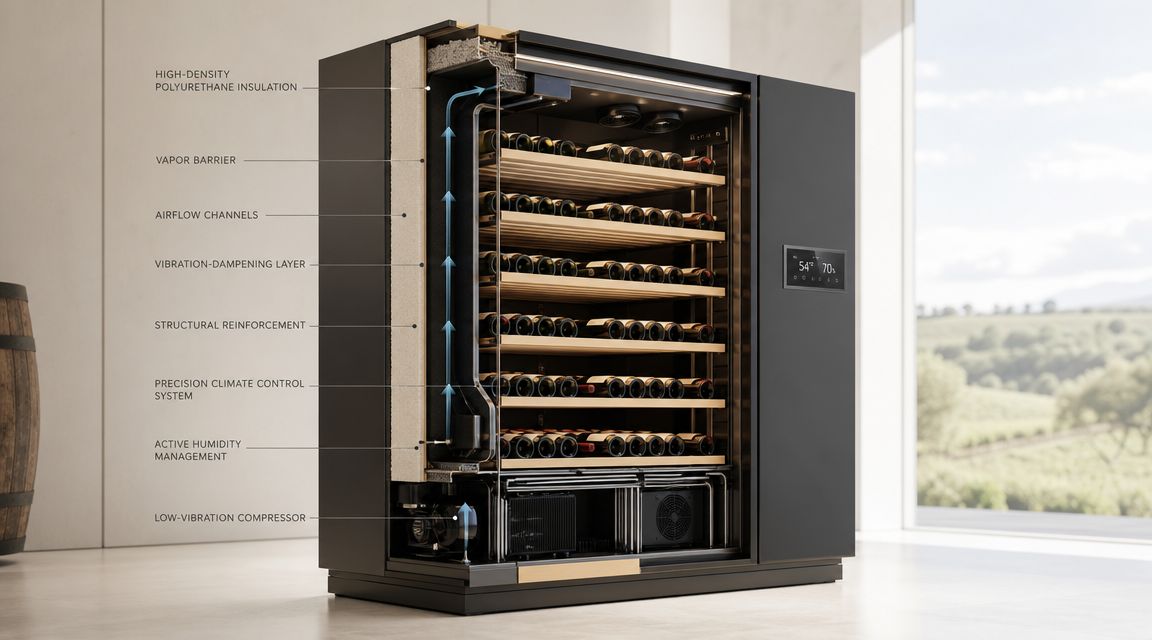
Cooling is a system, not a box you add later
One of the most common mistakes is finalizing millwork first and asking cooling questions afterward. That reverses the project logic. Cooling strategy should shape the enclosure, not squeeze into whatever space remains.
For proper operation, rear-exhaust wine cabinets require at least 6 inches of clearance between the wall and the cabinet, according to Vinotemp's storage solution guidance. That same guidance notes that poor ventilation makes the condenser work harder, which reduces performance and can shorten the system's lifespan.
Single-zone targets are also specific. That source identifies 55 to 64°F (13 to 18°C) for storage and 46 to 54°F (8 to 12°C) for serving in single-zone cabinet applications. Those numbers matter because they define whether you're building for preservation, service, or a compromise between the two.
The enclosure has to support the machine
Cooling equipment can't overcome a poorly built envelope. If warm, damp air keeps finding its way in, the system will run harder than it should and the cabinet won't behave the way the owner expects.
Independent cellar design guidance recommends a 6-mil poly vapor barrier, R-19 minimum wall insulation, and R-30 ceiling insulation, with floor insulation also recommended when the cellar isn't in a basement. The same guide advises using dual-paned insulated glass for doors or sidelights because the higher R-value improves thermal performance, as outlined in this wine cellar design guide.
That guidance matters even more in a humid coastal market. If your home already struggles with indoor moisture, broad home-level moisture control helps the wine space too. This overview of HVAC solutions for home humidity is worth reading before the build starts, especially if the cabinet will sit near an exterior wall or in a room that already feels damp.
Here's a visual primer on the preservation side before final equipment selections are made.
What fails in the field
The failures are usually boring. That's why they're so expensive.
- Skipped clearance: The cabinet gets pushed too close to a wall and airflow suffers.
- Partial sealing: One missed seam in the vapor barrier lets humid air keep entering the enclosure.
- Wrong glass choice: Standard decorative glass may look fine but perform poorly compared with insulated assemblies.
- Display-first thinking: Large glass areas and dramatic lighting are added without fully accounting for cooling load.
If you're reviewing examples of purpose-built wine enclosures, pay attention to the hidden details as much as the visible ones. The best projects don't advertise the insulation, sealing, and ventilation work. They perform.
If the cabinet is meant to preserve wine, climate control is not an upgrade. It's the project.
Illuminating Your Collection With Lighting and Security
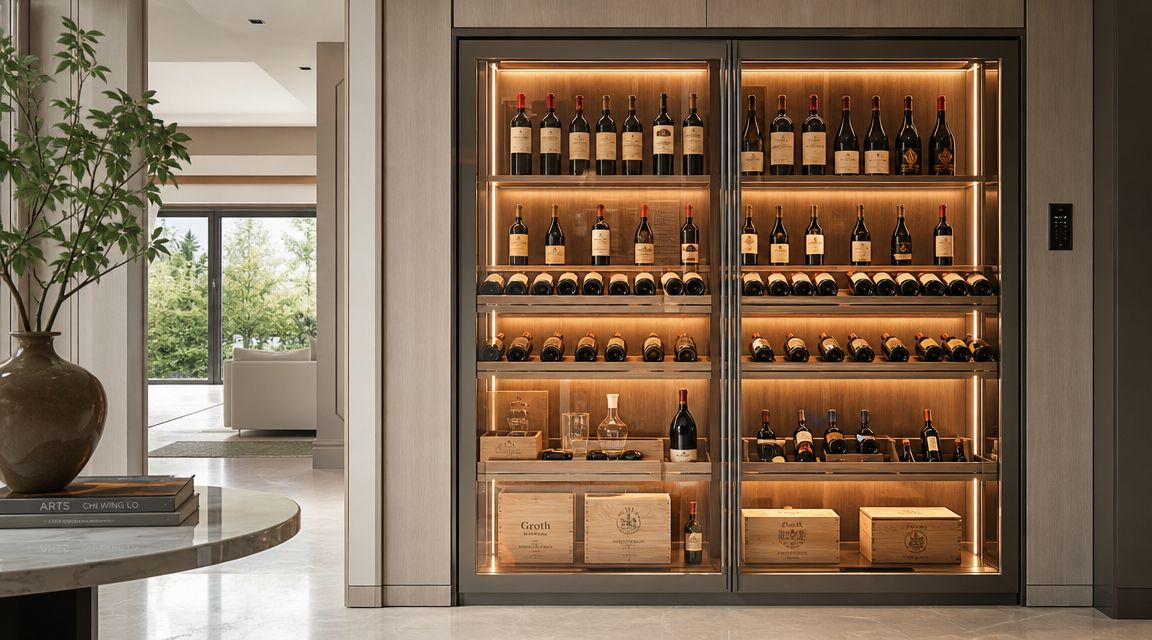
Lighting changes the cabinet from storage to presence. It also changes how every material reads. Wood looks richer, metal looks sharper, and labels become part of the room instead of disappearing into shadow.
The wrong lighting scheme can undo a lot of careful design. Harsh light creates glare on glass. Poor placement makes a full cabinet look cluttered. Over-lighting can make the enclosure feel more like retail display than residential architecture.
Where lighting should go
For most custom wine storage cabinets, LED lighting is the practical choice because it keeps the visual effect clean without introducing the kind of heat you don't want near wine. A key design decision isn't whether to light the cabinet. It's where the light should originate.
Three placements work especially well:
- Vertical side lighting: Good for making bottle rows legible without blasting light directly at the viewer.
- Top wash lighting: Soft and effective when you want the collection to glow rather than sparkle.
- Accent lighting for feature rows: Best used sparingly for a small display section, not every shelf.
A good rule is to light the bottles, not the glass. If the first thing you notice is reflection, the lighting needs to be reworked.
Security that fits the setting
Not every homeowner needs a high-security setup. But if the collection includes rare or sentimental bottles, some level of protection makes sense. In a dedicated wine room, that might mean controlled access. In a cabinet integrated into a public area of the home, it often means discreet locking hardware and thoughtful placement.
Use security that feels native to the cabinet. Oversized visible devices can cheapen a refined enclosure quickly.
Security can also be passive. A cabinet placed where children or guests can't casually handle bottles may need less hardware intervention than a statement installation off the main entertaining area.
For design-forward spaces, specialty glass details can help the cabinet feel more intentional and integrated with the rest of the interior. Reviewing mirror and specialty glass styles can spark ideas about tone, reflectivity, and how adjacent glass features might complement the wine display.
The cabinet should look good when closed and when in use
That sounds obvious, but it gets missed. Many cabinets photograph well with every light on and every bottle perfectly staged. Real life is different. You want a setup that looks calm during the day, elegant at night, and usable when someone opens the door to pull a bottle before dinner.
That's the standard worth holding.
Budgeting Timelines and Working With Professionals
This is the part homeowners usually want simplified, but a custom wine project goes better when the numbers and process are discussed plainly.
Professionally installed custom wine storage can range from USD 35,000 to USD 60,000 or more, based on VintageView's wine cellar budget guide. That same guidance notes that an active wine cellar often starts around USD 15,000, and more elaborate projects can move into the six-figure range. For a midsized cellar of about 500 bottles with one wall of glass, the published examples showed USD 35,000 for frameless glass and USD 46,000 for framed glass, with major components including USD 12,000 for racking, USD 13,000 for cooling, and USD 5,000 to USD 16,000 for glass depending on framing.
Where the budget goes
Those figures tell homeowners something important. The cost isn't just cabinetry.
A serious wine cabinet or enclosure is usually a combination of:
- Racking and bottle presentation: This shapes both capacity and the daily experience of using the cabinet.
- Cooling equipment: A major cost center because preservation depends on it.
- Glass and enclosure work: Especially important in projects where visual openness is part of the design brief.
- Finish carpentry and installation coordination: The part that makes the whole system feel built in rather than assembled.
That's why budget conversations need to include performance expectations, not just appearance. If a homeowner wants a display-heavy glass enclosure in a humid environment, the enclosure details and cooling demands will influence cost materially.
Timelines move with decisions
There isn't one universal schedule for custom wine storage cabinets because every project depends on site conditions, trade coordination, fabrication complexity, and how quickly selections are approved. A converted closet can move very differently from a staircase build tied into new millwork and flooring work.
What matters more than promising a fixed timeline is sequencing the project correctly. Measurements should follow stable site conditions. Glass should follow confirmed openings. Cooling and ventilation requirements should be locked before trim details are finalized.
A smooth project usually comes from a clear chain of responsibility.
What to ask before hiring
The best professionals don't just show attractive photos. They show how the project will work.
Ask questions like these:
- How are cooling and ventilation being accommodated?
- What assumptions are built into the bottle layout?
- How will the glass and surrounding finishes handle daily use and cleaning?
- Who is coordinating the cabinet maker, glass installer, and cooling contractor?
- What happens if field measurements change after adjacent trades finish?
A clean quote should separate the visible design features from the performance components. If those elements are blended together too loosely, it gets hard to understand what you're actually buying.
When those answers are solid, the project becomes much less stressful. You're not just commissioning a beautiful feature. You're building a cabinet that preserves the collection, suits the house, and still works long after the install crew has left.
If you're planning a custom wine enclosure in Naples or anywhere in Southwest Florida, AmeriGlass Industries can help you execute the glass side with the precision these projects demand. From frameless enclosures to ultra-clear glass and professional field measurement, their team brings the kind of detail-focused installation that helps a wine cabinet look refined and perform the way it should.