

A lot of people start thinking about a mirror when a room feels unfinished. The hallway is dim even at noon. The bathroom is clean but flat. A fitness room has good equipment and bad light. The first instinct is usually to shop by shape and size.
That's only part of the decision.
A custom mirror can brighten a room, stretch sightlines, clean up awkward transitions, and make millwork, tile, and stone look more intentional. But the effect people want from a mirror depends just as much on how it's measured, specified, and installed as it does on the glass itself. A mirror that's slightly out of level, mounted on a damp wall, or underspecified for its size won't age well, no matter how good it looked on day one.
Transform Your Space with Custom Mirrors
A well-placed mirror changes how a room behaves. In a narrow foyer, it can catch light from an adjacent room and push it deeper into the space. In a primary bath, it can make a long vanity feel balanced instead of heavy. In a dining room or entry, it stops reading like décor and starts acting like part of the architecture.
That's why custom work matters. A stock mirror fills wall space. A properly designed custom mirror aligns with grout lines, light fixtures, cabinetry reveals, and outlet locations. It looks built in because it was planned that way.
Homeowners notice this most in spaces that feel almost right. The vanity is beautiful, but the mirror leaves odd margins. The sconces are centered, but the reflection feels dark because the glass is too small. The wall looks straight until a large panel goes up and suddenly every bow and dip shows. Good custom mirror installation solves those issues before glass ever reaches the site.
The demand for that level of work is substantial. The U.S. custom mirror market generated approximately USD 400 million in 2024 and is projected to grow at a 7.4% CAGR, reflecting strong demand for professionally installed glass mirror sheets over acrylic alternatives, according to mirror sheets market data from GM Insights.
For homeowners refining a high-end interior, mirrors often do the same kind of visual work as stone, lighting, and custom glass. If you're considering upgrades that make a home feel more polished as a whole, this look at how glass can make a home feel luxurious is a useful companion.
A custom mirror should make the room feel finished, not merely more reflective.
Choosing Your Mirror Type and Mounting Method
Mirror selection works best when you treat it like finish selection. The glass color, edge treatment, and mounting style all change the final look. What works in a powder room often won't be the right choice for a gym wall, a lobby, or a full vanity run.
Start with the glass itself
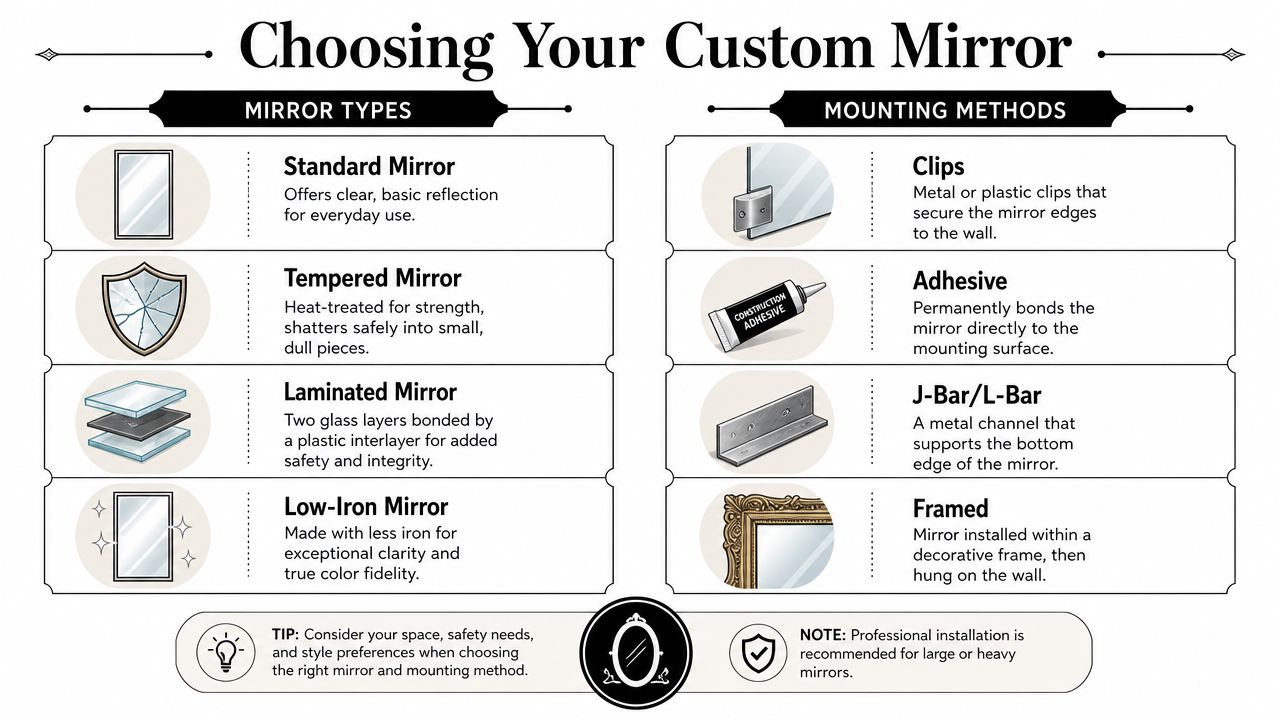
Some projects call for standard mirror glass because it delivers a familiar, balanced reflection and works with most interiors. Others benefit from low-iron glass, where reduced green cast creates a cleaner, truer reflection. That difference becomes more visible next to white stone, pale tile, and lighter paint palettes.
There are also stylistic choices that shape the room in a different way:
- Bronze or gray mirror finishes soften the reflection and can work well in moodier spaces.
- Antique mirror treatments add texture and age, but they're decorative rather than crisp.
- Tempered or laminated configurations may be appropriate where safety requirements or traffic conditions demand a different level of protection.
For style ideas and finish direction, this overview of mirror and specialty glass styles can help narrow the visual side of the decision.
Match the mounting method to the mirror
Mounting isn't just about appearance. It determines support, serviceability, edge exposure, and long-term performance.
| Mounting method | Best use | What to watch |
|---|---|---|
| Adhesive | Clean, minimal installations with no visible hardware | Wall condition matters. So does proper adhesive selection and cure environment. |
| Clips | Simple installations where visible hardware is acceptable | Clip pressure has to be controlled to avoid edge stress. |
| J-bar or L-bar | Larger mirrors that benefit from continuous bottom support | Works best when integrated neatly with the room's trim and layout. |
| Framed installation | Decorative mirrors or spaces that need a stronger visual border | The frame changes both the weight and the hanging method. |
| Standoffs | Floating, contemporary designs | Better for specific design statements than for every bathroom application. |
What works and what doesn't
A common mistake is choosing hardware for the look alone. A slim, nearly invisible clip system can look clean, but if the wall is uneven or the panel is large, a more supportive setup may be the better call. On the other hand, overbuilding a small decorative mirror with heavy commercial hardware makes the finished room feel clumsy.
Practical rule: The larger the mirror, the less forgiving the wall and hardware become.
The right combination depends on size, substrate, environment, and sightlines. A large vanity mirror over tile has different demands than a framed mirror over painted drywall. A studio or retail wall often needs a support strategy that prioritizes panel stability and safer edge handling. A seasoned installer chooses the method that protects the glass first and flatters the room second.
The Blueprint for Perfection Measurement and Templating
Most mirror problems start long before installation day. They start when someone assumes the wall is square, the vanity is level, the tile was set consistently, or the sconce rough-ins are centered exactly where the plans say they are.
Real buildings don't cooperate that neatly.
Tape measures don't tell the whole story
A tape measure can give width and height. It can't fully reveal a wall that bellies in the center, tile that drifts out of plane, or an outlet box that sits just far enough off to ruin a cutout. In older homes especially, corners wander and finished surfaces hide small inconsistencies that become obvious once reflective glass goes up.
That's why professionals treat measurement as a fabrication process, not an estimate. Digital laser measuring helps capture exact spans and check alignment across the wall plane. On more demanding installations, a physical template is still the safest route. It confirms not just dimensions, but shape.
Where templating earns its keep
Templates matter most when the mirror has to interact tightly with other elements. Typical examples include:
- Outlet and switch cutouts that need clean spacing and proper alignment
- Sconce penetrations where symmetry is visible from across the room
- Arched or angled niches that can't be trusted to be perfectly uniform
- Backsplashes and stone tops that look straight but vary slightly over distance
A mirror cut from rough field measurements may still fit. It just won't fit well. You'll see the compromise in uneven reveals, oversized sealant lines, or hardware that has to hide a bad assumption.
The same design discipline used in custom enclosures applies here. If you've ever seen how accurate glass planning affects fit and finish in other applications, this look at designing a shower door shows why precise templating changes the final result.
Large mirrors magnify small errors. A wall can be off by a little and still look fine until reflective glass makes the flaw obvious.
Precision protects more than the appearance
Accurate measurement also protects lead time, budget, and safety. A miscut panel isn't just inconvenient. It can delay trades, force field adjustments, and create pressure to install glass that should have been remade. That's where shortcuts show up.
A clean custom mirror installation begins with data you can trust. When the dimensions are right, the edge work lands where it should, hardware lines up, and the mirror sits in the room like it belongs there.
A Look Inside the Professional Installation Process
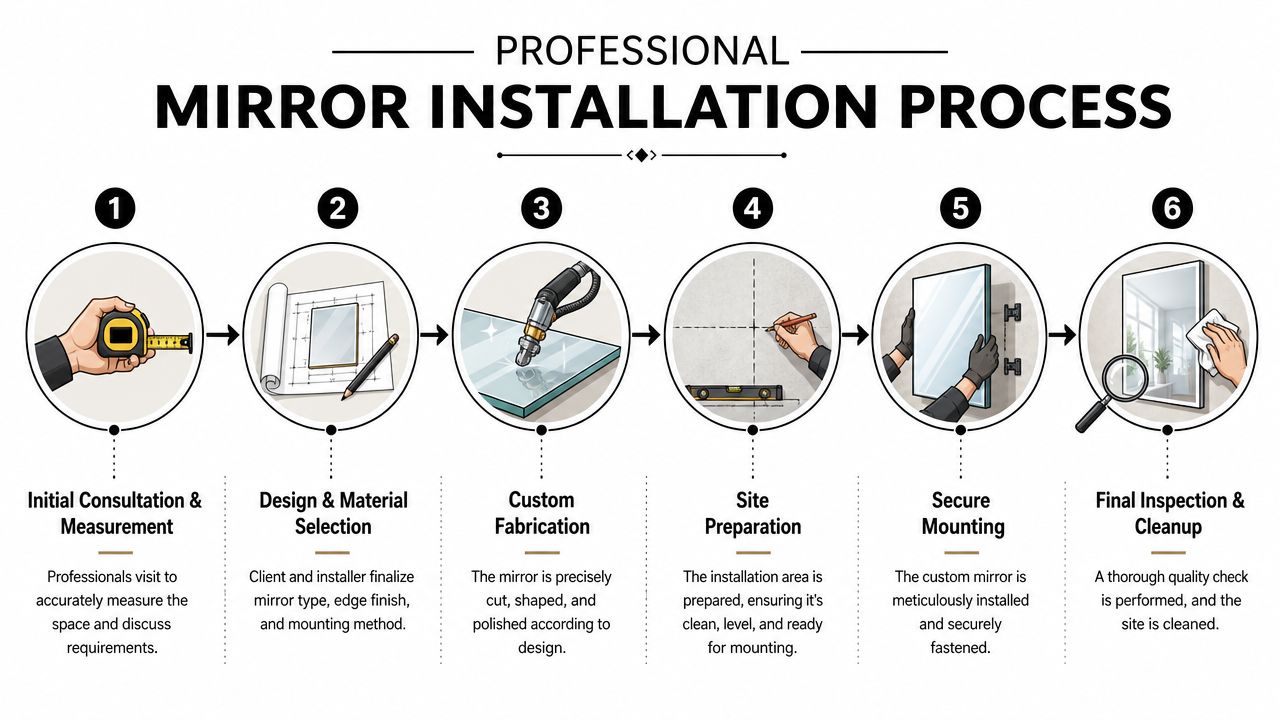
Installation day should look calm. That's usually the result of careful prep, not luck. By the time the glass arrives, the important decisions should already be made. What remains is execution.
A clear visual summary helps before getting into the field details.
Site prep and substrate checks
Professionals start by protecting adjacent finishes. Floors get covered. Counters, fixtures, and nearby trim are shielded. In occupied homes, that matters as much for cleanliness as it does for safety.
Then the wall gets checked again. Not casually. The installer verifies the mounting surface, confirms critical dimensions, and looks at the substrate the way a glass installer should. In bathrooms and humid interiors, that includes moisture awareness. The wall may look ready and still be the wrong surface to bond against if moisture has been trapped behind tile, paint, or drywall.
Hardware goes into structure, not hope
Large mirrors need support that transfers weight properly. According to custom glass mirror installation guidance from TriView Shower Door, professional installers fasten mounting hardware such as J-channels and cleats directly to wall studs because drywall alone doesn't have the shear strength to support heavy glass panels over time. The same guidance notes that protective pads are placed between clips and the mirror to prevent edge stress.
That's the kind of detail DIY installs often miss. The mirror may go up and stay up for a while, but if the load path is wrong, the wall assembly eventually tells the truth.
Here's a local example of how disciplined glass installation looks in another demanding setting: frameless shower door installation in Fort Myers. The same attention to plumb, level, anchoring, and finish protection carries directly into mirror work.
Placement, alignment, and final checks
Getting the panel onto the wall is only one step. The crew still has to confirm reveal lines, level, edge pressure, hardware contact, and the uniformity of the finished sightline. If clips are used, they must secure the mirror without being overtightened. If channels are used, the panel has to sit fully and evenly.
After the mirror is set, installers inspect the reflection for signs of twist or uneven seating. They also check surrounding surfaces for contact issues and clean the panel properly so the client sees the finish, not the fingerprints of the install.
A short installation video can help visualize that sequence in motion.
What a homeowner should notice
A professional custom mirror installation usually feels uneventful. That's a good sign. You should see a team that works deliberately, protects the room, handles the glass with control, and leaves the wall looking finished rather than patched around.
You shouldn't see rushed drilling, improvised shims, hardware moved repeatedly to “make it work,” or pressure applied at the edges to force alignment.
Understanding Safety Standards and Material Integrity
Pretty mirrors still have to obey physics. Consequently, professional judgment separates decorative thinking from real installation practice. Size, thickness, rigidity, support, and edge protection all work together.
Why thickness isn't optional on large panels
For mirrors wider than 800mm or taller than 1000mm, industry guidance calls for 6mm glass thickness. That specification matters because 6mm glass increases structural rigidity by approximately eight times compared with 3mm glass, reducing flex and lowering the risk of stress fractures or adhesive failure over time, according to Built by Glass custom mirror guidance.
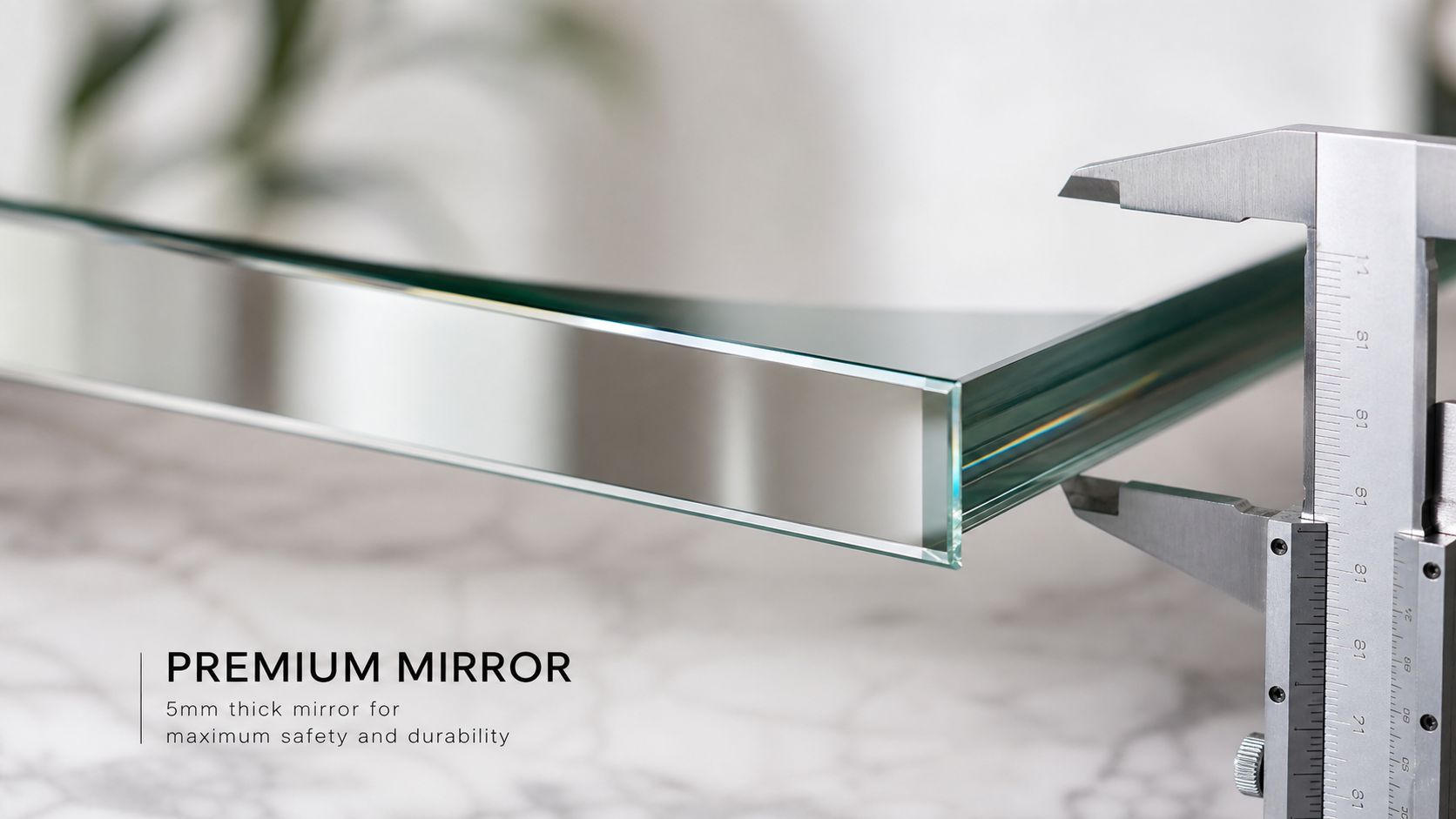
That's not a technicality. Thin glass on a large wall panel can flex enough to distort the reflected image, create uneven stress, and fight against the mounting system. Homeowners sometimes read that as “the mirror looks a little wavy.” Installers read it as underbuilt.
Safety decisions depend on the space
Not every room carries the same risk profile. A mirror over a residential vanity doesn't face the same daily use as one in a gym, dance studio, retail corridor, or commercial restroom. Traffic patterns, impact risk, edge exposure, and maintenance conditions all shape the final specification.
A few material choices often come up in that discussion:
- Standard mirrored glass works well in many residential applications when the panel size and mounting method are appropriate.
- Tempered mirror options may be preferred where stronger impact behavior or code-driven safety considerations apply.
- Laminated assemblies or safety backing can add another layer of protection by helping hold glass together if breakage occurs.
For projects where clarity is the design priority, especially beside white stone and pale finishes, ultra-clear glass is worth considering. It doesn't replace proper safety specification, but it does change the visual quality of the final installation.
Thin mirror glass can look acceptable in the crate and still become the weak point once it's mounted at full size.
Material integrity includes the edge and the wall
A safe mirror isn't only about thickness. Edge quality matters. So does the condition of the wall behind it. A polished, properly supported panel on a compromised substrate is still a compromised installation.
This is why professionals look at the whole assembly. Glass type, size, backing, support method, clip pressure, and substrate condition all have to agree with one another. When they do, the mirror stays flat, secure, and visually clean. When one part is wrong, the failure usually starts there.
Costs Timelines and Protecting Your Investment
People often ask for a price before the project is defined. That's understandable, but mirrors don't price like off-the-shelf décor. Cost follows specification.
What changes the price
The final number usually moves based on a few practical variables:
- Overall size of the mirror
- Glass type and visual quality
- Edge finishing, especially when edges remain exposed
- Cutouts for outlets, sconces, or other penetrations
- Mounting method and substrate conditions
- Access and handling complexity on site
A simple rectangle on a clean wall is one kind of job. A large panel over tile with multiple cutouts, tight tolerances, and finish-sensitive surroundings is another.
What affects the timeline
Custom mirror work usually follows a sequence: consultation, field measurement, fabrication, then installation. The more complex the shape and detailing, the more important accurate templating becomes. Fabrication schedules also depend on the finish selected and whether the panel needs specialty processing.
The material side of the industry remains substantial and stable. The global market for float glass used in mirrors reached USD 4.85 billion in 2024 and is growing at a 4.9% CAGR, reflecting a durable supply chain that supports professional mirror fabrication and installation, according to Grand View Research mirror float glass data.
That doesn't mean every project moves instantly. It means serious mirror work sits on a mature materials base, not a novelty product category.
Cheap installation is often expensive later
The long-term value of a custom mirror installation comes from avoiding the kinds of failures that force replacement or wall repair. A mirror that was measured correctly, supported properly, and installed on a suitable substrate typically costs less over its life than one that needed shortcuts to hit a lower entry price.
Maintenance choices matter too. In rooms exposed to water spots, residue, and frequent cleaning, protective surface treatments can reduce upkeep and help preserve clarity. Many homeowners look at that as an optional upgrade. In the right environment, it's really a way to protect the finish they already paid for.
Good mirror work pays you back in fewer callbacks, less maintenance frustration, and a cleaner-looking room year after year.
Hiring a Trusted Installer A Checklist and FAQs
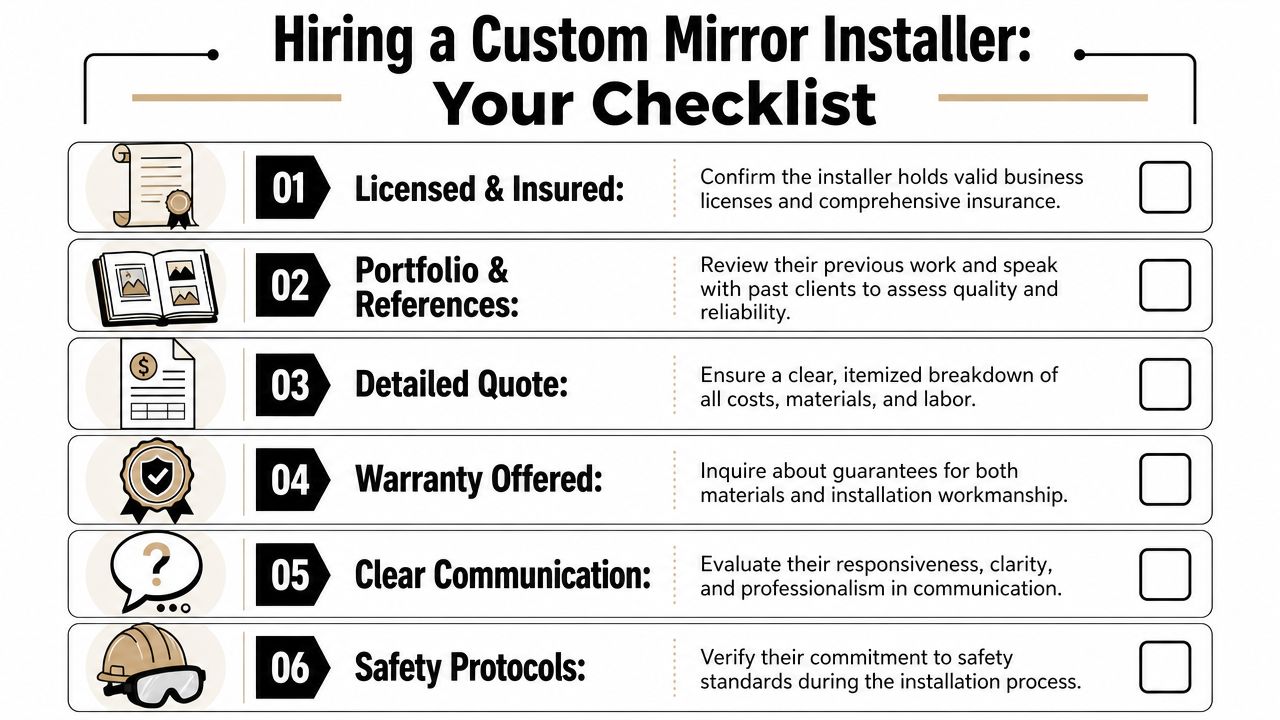
Choosing the installer is often more important than choosing the mirror style. Most failures don't happen because reflective glass is a bad product. They happen because the wall wasn't ready, the panel wasn't specified correctly, or the support system didn't match the job.
The short hiring checklist
- Ask how they evaluate the wall: In humid areas, this matters a lot. Installation guidance discussing moisture-related mirror failures notes that 68% of mirror failures in bathrooms stem from moisture-induced adhesive degradation, and recommends moisture meter readings below 15% before adhesive application.
- Review project photos that resemble yours: A vanity wall, a full-height gym mirror, and a decorative entry mirror are not the same assignment.
- Look for written scope details: The estimate should identify glass type, edge finish, cutouts, mounting method, and who is responsible for wall readiness.
- Confirm insurance and installation responsibility: If tile, stone, or finished millwork is nearby, you want a contractor who works carefully around completed surfaces.
- Pay attention to communication: The way a company answers technical questions before the job usually predicts how it will handle issues during the job.
If your project touches multiple trades, it helps to work from the same standard of due diligence across the house. For plumbing-related planning, this guide for Wellington plumbing needs is a good example of the kind of practical contractor vetting homeowners should do.
Quick FAQs
Can mirrors be installed over tile?
Yes, but drilling and support details matter. The installer should account for the tile condition, thickness, and what's behind it.
Is a handyman good enough for a mirror job?
Sometimes for a small, simple decorative mirror. Not for large custom panels where wall condition, glass thickness, and structural anchoring decide safety.
What's the biggest red flag in an estimate?
Vague language. If the proposal doesn't explain materials and mounting, you're being asked to trust a method that hasn't been defined.
If you want a custom mirror installation handled with precise measurement, clean design, and professional site execution, AmeriGlass Industries serves Southwest Florida with expertly installed mirrors, frameless shower doors, and specialty glass solutions for homes and commercial spaces.