
A simple custom mirror project can start around $250, but most homeowners pay $200 to $2,500 for a custom-cut mirror, and total project cost rises with size, fabrication details, and professional installation. If you're pricing a bathroom vanity, entryway statement mirror, gym wall, or commercial feature, the number that matters most isn't just the glass price. It's the full installed project.
That's usually the point where people get frustrated. They find one price for the mirror, another for labor, and then discover the final number changes again once edgework, cutouts, wall conditions, delivery, and mounting are part of the conversation. A custom mirror isn't a shelf item. It's a measured, fabricated, transported, and installed glass project.
From the shop side, the biggest mistake I see is treating a custom mirror like a decor purchase instead of a fitted building component. The mirror may be the visible product, but the actual cost is the combination of material, fabrication, and installation quality. When you look at it that way, the quote makes a lot more sense and the finished result usually does too.
Understanding Your Custom Mirror Investment
A lot of custom mirror projects start the same way. There's an empty wall that needs scale, a dated vanity that needs a cleaner look, or a room that would feel brighter and larger with the right reflection. Standard sizes don't line up with the space, and that's when custom becomes the practical choice.
A 2026 industry guide puts the average custom mirror installation cost at about $250, with simpler jobs ranging from $80 to $1,000 and larger or more specialized projects reaching $3,000+. The same guide notes that custom mirrors can cost 30% to 100% more than stock sizes because they're made for non-standard spaces, according to Glass & Auto's custom mirror installation cost guide.
Why the project total matters more than the mirror price
If you only compare raw mirror prices, you'll miss the part that often determines whether the job looks sharp or becomes a headache. A custom mirror has to fit the wall, clear nearby fixtures, sit level, and stay secure over time. That means the useful number is the installed cost, not just the panel cost.
That difference matters most in spaces where precision shows. Bathroom vanities expose uneven outlet spacing. Entry mirrors need exact centering. Gym walls and commercial installs punish sloppy alignment because every seam and reflection becomes visible.
Practical rule: Ask for the full installed scope early. That should include measuring, fabrication, edge finishing, delivery, and mounting.
Where homeowners usually oversimplify the budget
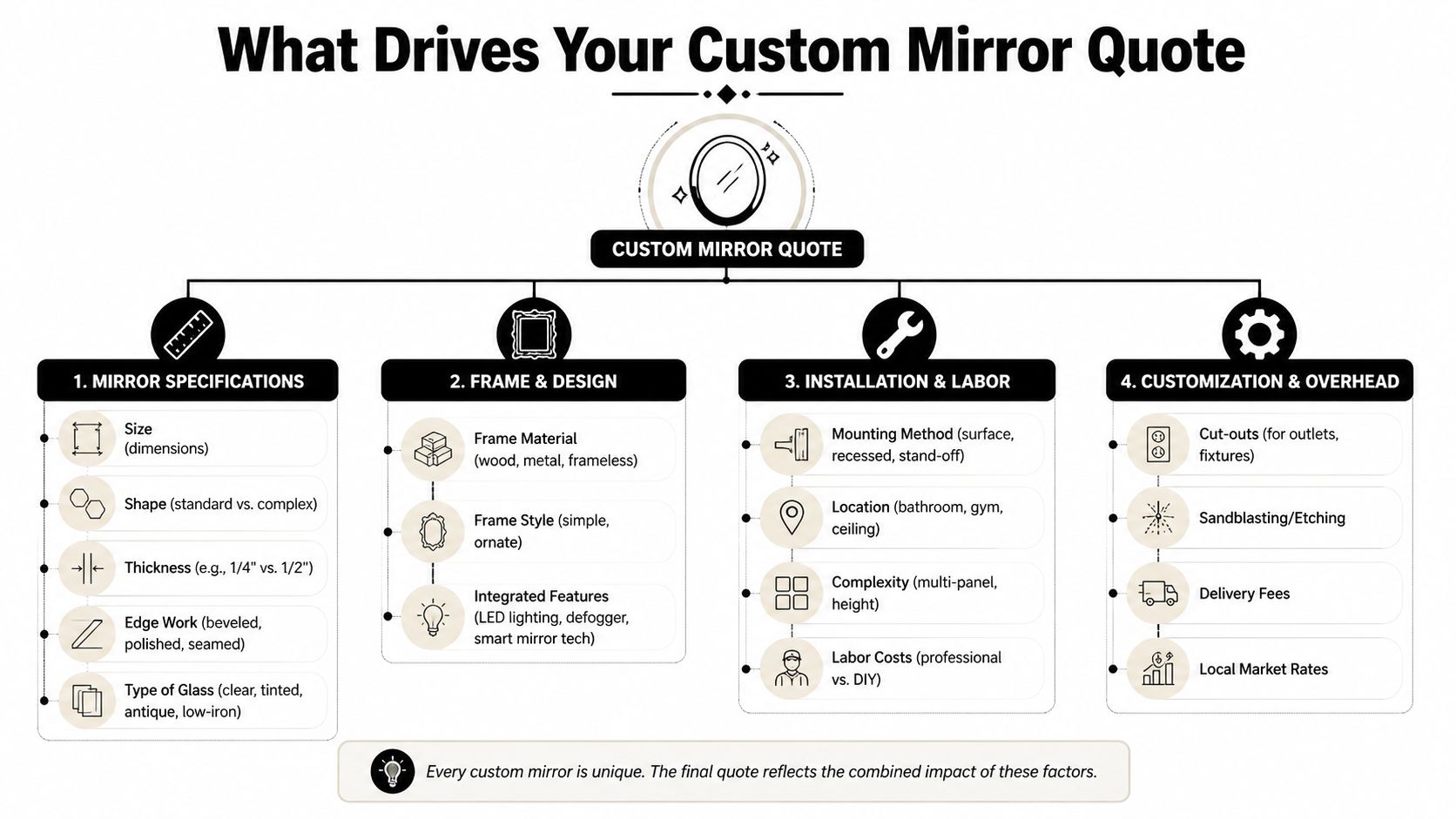
People often assume size is the whole story. Size matters, but it's only one variable. Shape, thickness, edge detail, wall surface, mounting method, and access to the install area can all change the quote.
A simpler rectangular mirror with straightforward installation is one kind of job. A large custom-shaped mirror with decorative edges and site-specific fitting is another. They're both mirrors, but they aren't priced the same way because they don't require the same labor or fabrication effort.
If you're using a mirror to enhance an entry, bath, or living space, it helps to look at examples of how glass changes a room's feel. AmeriGlass has a useful visual reference in this article on how glass can make your home feel luxurious.
What Really Drives Your Custom Mirror Quote
Think of custom mirror pricing like building a car. There's a base configuration, but every upgrade changes the final number. In glass work, the quote moves based on what has to be fabricated, handled, protected, and installed, not just on how big the mirror looks once it's on the wall.
A broader 2026 pricing guide estimates the average custom-cut mirror at $500, with most homeowners paying $200 to $2,500. That same guide places materials at $10 to $50 per square foot, labor at $50 to $120 per hour, and notes that small jobs may carry $75 to $200 minimum service fees, based on Angi's custom-cut mirror cost guide.
Glass size, thickness, and shape
The fastest way to move a quote upward is to increase panel size and complexity at the same time. Bigger mirrors use more material, but they also become harder to transport, maneuver, and mount without damage. Thickness can rise with application needs, especially when a large span or a more substantial visual profile is part of the design.
Shape affects cost because fabrication changes. A standard rectangle is efficient. Once you move into arches, circles, notches, or custom templates, the work no longer follows a simple production path.
Edgework and visible finish details
Edges matter more than many buyers expect. If the mirror is frameless or the edge is exposed, the finish becomes part of the design. A clean polished edge gives a different look than a decorative bevel, and both require more finishing than a basic edge hidden inside a frame.
This is one of the easiest places to control custom mirror cost without making the finished piece feel cheap. If the edge won't be seen, paying for more decorative finishing often doesn't add practical value.
A mirror can be modest in size and still become a premium project if the fabrication details are fussy enough.
Cutouts, coatings, and integrated features
The quote also changes when the mirror has to work around the room instead of hanging on it. Outlet cutouts, sconce openings, unusual wall conditions, and integrated lighting all increase the need for precise measuring and fabrication.
If you're considering illuminated vanity mirrors, Golden Lighting's LED mirror guide is a helpful design reference for understanding how lighting changes both appearance and planning requirements.
Other upgrades can make sense too, but only when they serve the room. Protective coatings, specialty glass looks, and design-driven finishes are worth discussing when maintenance, clarity, or aesthetics are priorities. For a broader look at available options, AmeriGlass outlines several mirror and specialty glass styles.
What tends to save money and what usually doesn't
A few choices typically help keep the project efficient:
- Standard shapes: Rectangles and simple circles are easier to fabricate than one-off templates.
- Visible upgrades only where needed: Spend on bevels or decorative edges only where the edge is exposed.
- Clean scope: Fewer cutouts and fewer site surprises usually mean a cleaner quote.
What usually doesn't save money is trying to push a stock mirror into a non-standard opening. When a mirror almost fits, someone still has to solve the gap, the alignment, or the awkward reveal. That often costs more in the long run than ordering the right piece the first time.
Why Professional Installation Is a Critical Cost Factor
Labor is where many custom mirror budgets become real. Buyers often focus on glass selection first, then realize the difficult part is getting a finished mirror onto the wall safely, level, and properly supported. That's especially true with oversized panels, multiple pieces, unusual thicknesses, and installs in bathrooms, gyms, or commercial spaces.
For custom mirror projects in major U.S. markets, installation labor is often priced at $13.86 to $20 per square foot for standard jobs, but rises to $20 to $50 per square foot when the mirror needs custom sizing, unusual thickness, or specialized edge styles, according to Swivl's mirror installation cost guide. The key point is simple. Complexity changes labor faster than anticipated.
Why the same mirror can have two very different labor numbers
A straightforward install has predictable handling, simple wall prep, and easy alignment. A demanding install might require more than one technician, specialty mounting hardware, extra protection during handling, and slower positioning to avoid chipping or stress on the glass.
Wall conditions also affect labor. Tile, uneven surfaces, tight corners, outlet placement, and high mounting positions all slow the job down because accuracy matters. Once a large mirror is on adhesive or set into position, there isn't much room for correction.
Trade reality: The larger the mirror, the less forgiving the installation becomes.
Kitchen and bath projects offer a useful comparison here. Homeowners often budget carefully for a countertop slab, then discover the install work, cutouts, and fit details are what shape the final project cost. If you've gone through that process before, this overview of South Jersey granite countertop pricing gives a familiar example of how fabrication and installation drive total cost in finish materials.
DIY vs Professional Mirror Installation
| Factor | DIY Installation Risks | Professional Installation Benefits |
|---|---|---|
| Measurement | Inaccurate dimensions can leave gaps, bad reveals, or unusable glass | On-site measuring improves fit and accounts for real wall conditions |
| Handling | Breakage risk rises fast with larger or thicker mirrors | Technicians use proper lifting, carrying, and positioning methods |
| Wall attachment | Wrong adhesive or mounting method can fail over time | Installers match hardware and mounting approach to the wall and mirror |
| Alignment | Crooked placement is obvious in reflected lines and seams | Clean leveling and consistent spacing produce a finished look |
| Safety | Risk of injury during lifting or sudden glass failure | Insured crews reduce personal and property risk |
| Accountability | If something goes wrong, the homeowner owns the problem | A professional install gives you a clear point of responsibility |
What professional service actually buys you
Professional installation isn't just labor. It's risk control. It's knowing the mirror was measured with the actual wall in mind, fabricated for the right application, and mounted by someone who understands how glass behaves during transport and placement.
It also gives you a place to ask questions before the order is cut. If you need help sorting out edge options, mounting methods, or room-specific concerns, a practical starting point is a contractor FAQ page like the one AmeriGlass keeps here: glass and mirror installation FAQs.
Sample Custom Mirror Projects and Estimates
The clearest way to understand custom mirror cost is to look at common project types. Not exact quotes, because no serious glass specialist should promise a final number without measuring the site, but realistic examples of how costs build.
One independent 2025 guide puts many custom-cut mirrors in the $200 to $500 range, with professional installation adding roughly $150 to $450 more. It also notes that installation can cost as much as the mirror itself, which is why buyers who ask for mirror-only pricing often underestimate the full project, as explained in NY Glazing's custom-cut mirror cost article.
Master bathroom vanity mirror
A typical vanity project looks simple from the outside. Then the details show up. The mirror may need to land precisely between sconces, clear a backsplash, and align with cabinetry. If outlets, light boxes, or asymmetrical walls are involved, the fabrication gets more exact.
This kind of job often stays controlled when the design is a clean rectangle with polished edges and straightforward mounting. It becomes more expensive when the owner wants decorative edgework or when the wall is out of square and the fit has to be tuned carefully.
Home gym mirrored wall
A gym wall isn't just a bigger bathroom mirror. It's a handling and alignment project. Large spans magnify every seam, every height change, and every wall irregularity. The material choice matters, but installation discipline matters more because reflected lines reveal mistakes instantly.
That's why a gym mirror wall usually lands well above a single vanity mirror. The labor is heavier, access can be more complicated, and structural mounting decisions become part of the conversation.
If the reflection needs to read as one clean surface, the install quality carries as much weight as the glass itself.
Boutique or commercial decorative mirrors
Retail and hospitality spaces often want mirrors that do more than reflect. They frame merchandise, shape lighting, and reinforce the room's identity. That usually means custom forms, repeated pieces, branded layouts, or mirrors integrated with millwork and surrounding finishes.
These jobs can look smaller than a gym wall and still cost more to execute because the tolerance for visual inconsistency is low. A small template error repeated across multiple mirrors becomes a design problem, not just a glass problem.
If you want to compare custom applications beyond mirrors alone, AmeriGlass shows a range of related glass products and project types. That's useful when a space may need a coordinated approach rather than a single standalone mirror.
Smart Ways to Manage Your Custom Mirror Budget
Budget control in mirror work isn't about stripping everything down. It's about choosing where customization improves the finished result and where it adds cost.
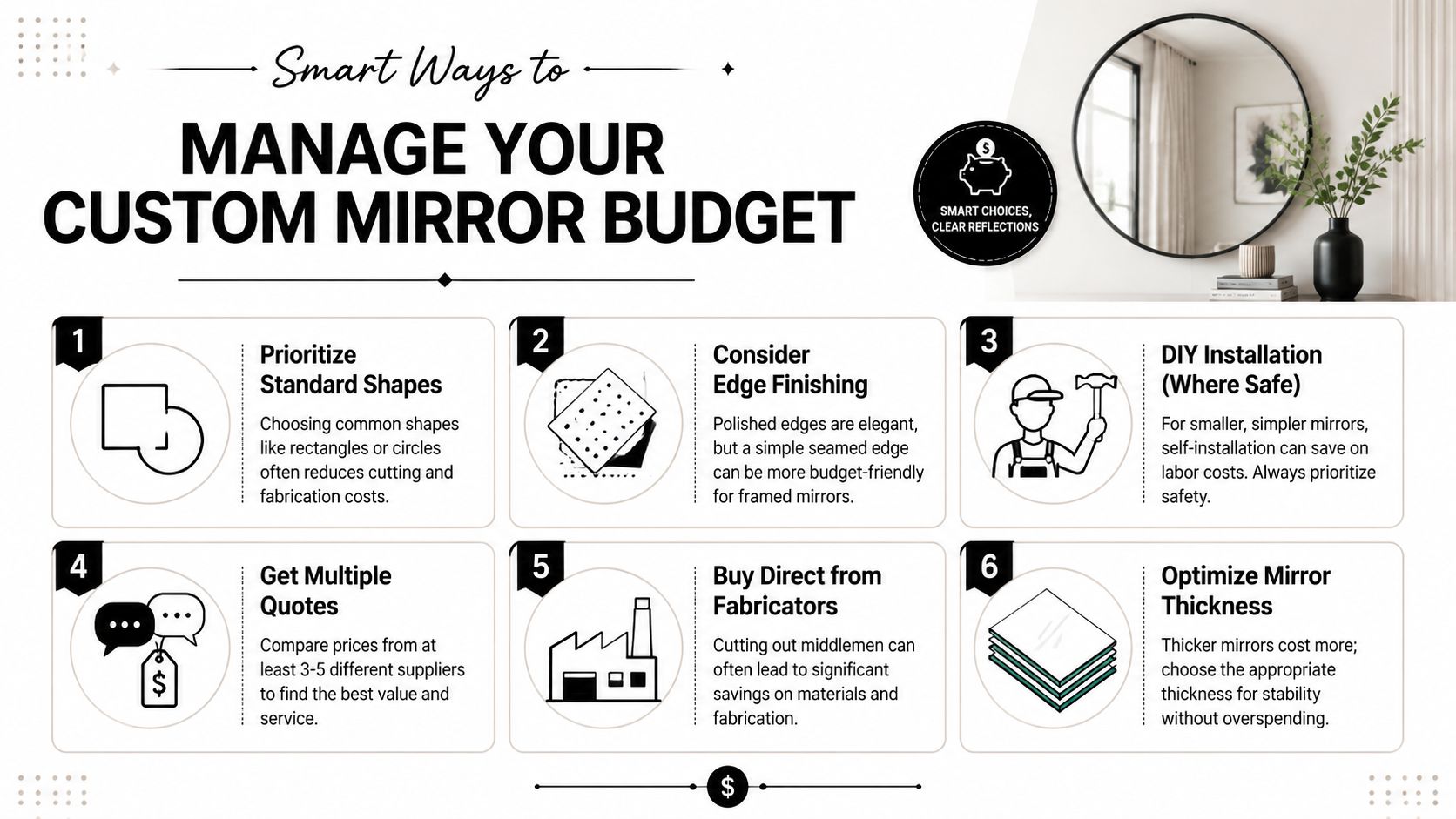
Choices that usually keep value high
- Start with the wall, not the idea: A mirror that suits the actual space is easier to price accurately than a concept pulled from a photo with no dimensions.
- Keep the shape simple where possible: Rectangles and other standard forms usually give you the cleanest value.
- Match the edge finish to visibility: If the edge will sit inside a frame or against trim, a decorative finish may not be worth paying for.
- Avoid unnecessary cutouts: Every opening adds fabrication complexity and raises the chance of delays if field dimensions change.
Where spending more often makes sense
There are places where it's smarter not to squeeze. Large mirrors, high-use bathrooms, gym walls, and commercial feature installs usually benefit from proper measuring and installation from the start. That's where mistakes cost more to fix than they would have cost to prevent.
It also helps to budget the room as a whole, not just the mirror. A broader planning tool like Northpoint Construction's cost calculator can be useful when the mirror is one piece of a larger renovation and you're trying to understand where finish choices fit into the bigger project.
The simplest way to avoid expensive mistakes
Get professional measurements before glass is cut. That one decision prevents a surprising number of problems. Walls aren't always square, tile layouts shift usable dimensions, and fixture locations can differ slightly from plan drawings.
One practical option is to work with a local fabricator-installer that handles both field measurement and the final install. AmeriGlass Industries offers custom mirror services as part of that type of measured-to-fit process.
Partnering with AmeriGlass for a Perfect Result
Custom mirror cost is never just the panel. It's the finished project. That includes the right glass for the application, clean fabrication, accurate field measurement, careful transport, and installation that looks intentional from every angle.
That's why experienced buyers ask different questions. They want to know how the mirror will be measured, how edge details will be handled, what mounting method fits the wall, and who is responsible if site conditions change. Those questions usually lead to better results than chasing the lowest mirror-only price.
For homeowners, builders, and designers in Southwest Florida, AmeriGlass approaches mirror work as a fitted glass project rather than a simple product sale. The practical value is clear. You get site-specific measuring, guidance on finish trade-offs, and licensed, insured installation that accounts for safety and appearance. If you want to start with the actual project number instead of a rough guess, request a custom quote from AmeriGlass.
If you're planning a vanity mirror, mirrored wall, entry feature, or commercial installation, AmeriGlass Industries can help you price the full project clearly, from measurement through installation, so you know what you're paying for and why.
Want an exact price for your space? AmeriGlass Industries cuts and installs custom mirrors across Naples, Fort Myers, Bonita Springs and Cape Coral. See our custom mirrors in Naples or call (239) 426-6884 for a free in-home estimate.