You're probably looking at a space that needs two things at once. More privacy, and more light.
That's the usual starting point in Southwest Florida. A Naples homeowner wants to soften a master bath without closing it in. A Fort Myers business owner wants conference room privacy without turning the office into a row of drywall boxes. In both cases, clear glass feels too exposed, but opaque materials kill the openness that made the room appealing in the first place.
Custom etched glass panels solve that tension better than most materials. They filter sightlines, hold daylight, and add a finished architectural look that reads as intentional rather than improvised. The best projects don't feel decorative for decoration's sake. They feel calm, precise, and built for the room.
Transforming Light and Space with Custom Etched Glass
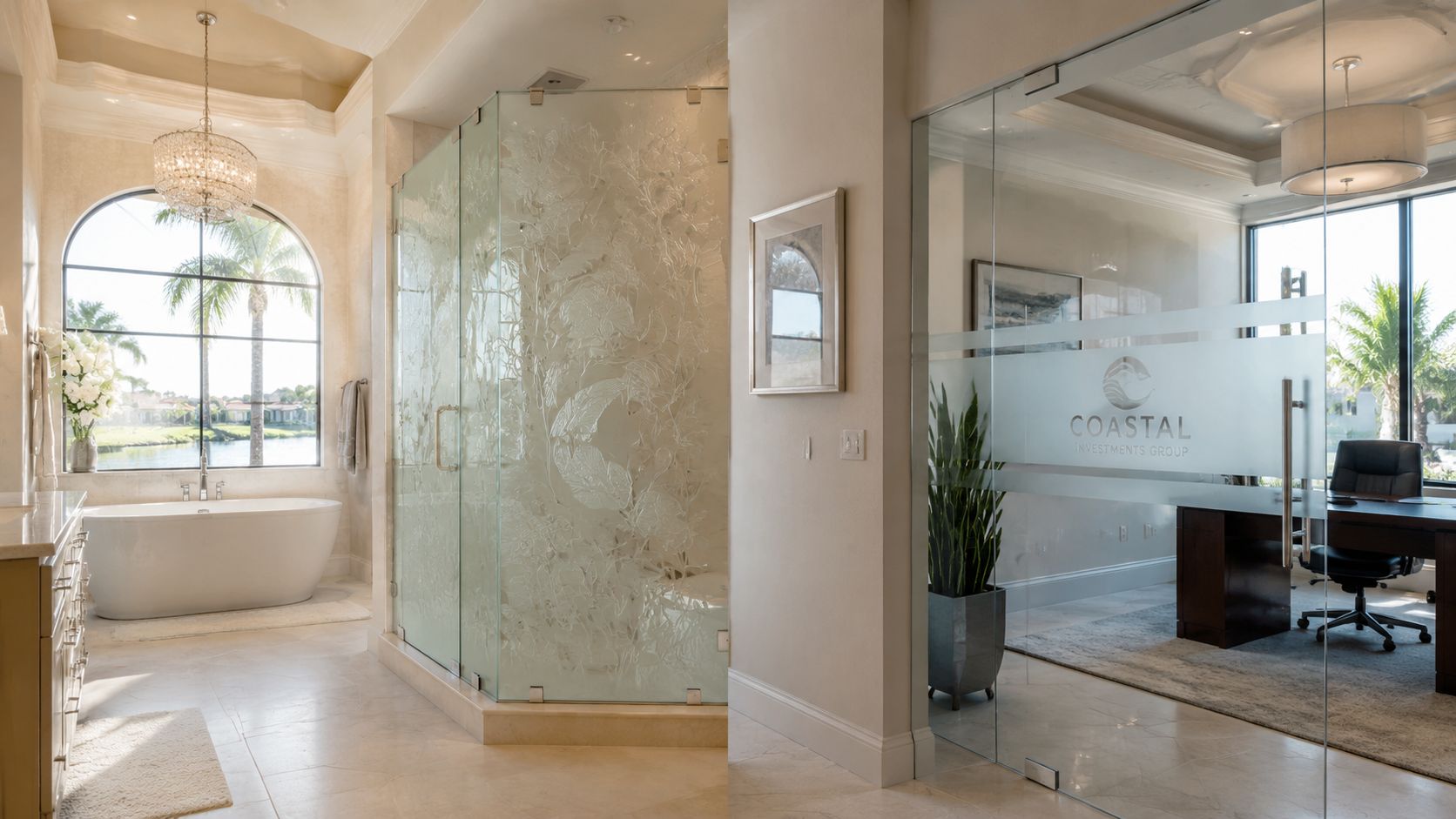
A well-designed etched panel changes how a room feels before anyone notices the pattern itself. In a bathroom, it can turn a plain shower enclosure into a softer focal point. In an office, it can separate work zones without making the space feel smaller. That's the strength of etched glass. It shapes visibility while still letting light travel.
Why it still feels timeless
Etched glass may look modern in a coastal home or a contemporary office, but the craft has deep roots. Decorative glass traditions go back to ancient Rome, and engraved glass artifacts trace back even earlier. The modern era accelerated in the 18th century, and the float-glass process introduced in the 1950s changed architectural glass permanently. Today, the float-glass method accounts for about 90% of flat plate glass production worldwide, which is a major reason large, uniform etched panels are possible for doors, partitions, and shower enclosures now, as noted in this engraved glass history reference.
That blend of old-world craft and modern fabrication is what gives etched glass its appeal. It isn't trendy. It's adaptable.
Where clients usually start
Most clients don't begin by asking for “art glass.” They start with a problem.
- Bathroom privacy: They want the room to feel open, but they don't want clear sightlines through a shower enclosure or water closet door.
- Office separation: They need a visual boundary, often with branding, without losing daylight across the floor plate.
- Entry statements: They want a front entry or sidelights to feel personalized, not builder-basic.
- Luxury details: They're refining a wine room, partition, or decorative insert and want glass that does more than fill an opening.
Custom etched glass works best when privacy and openness matter equally.
Design-minded homeowners often look beyond the glass trade for daylight ideas. If overhead light is part of the bigger remodel conversation, this resource on skylight options for Melbourne homeowners is useful because it shows how glazing choices influence brightness, mood, and room character. The same principle applies to etched panels. You're not just selecting a surface. You're controlling how light behaves in the room.
For homeowners chasing that polished, hotel-like feel, the broader design effect is similar to what's described in this look at how a glass company can make your home feel luxurious. The difference is that etched glass adds privacy to that sense of refinement.
Choosing Your Etching Method Sandblasting and Acid Etching
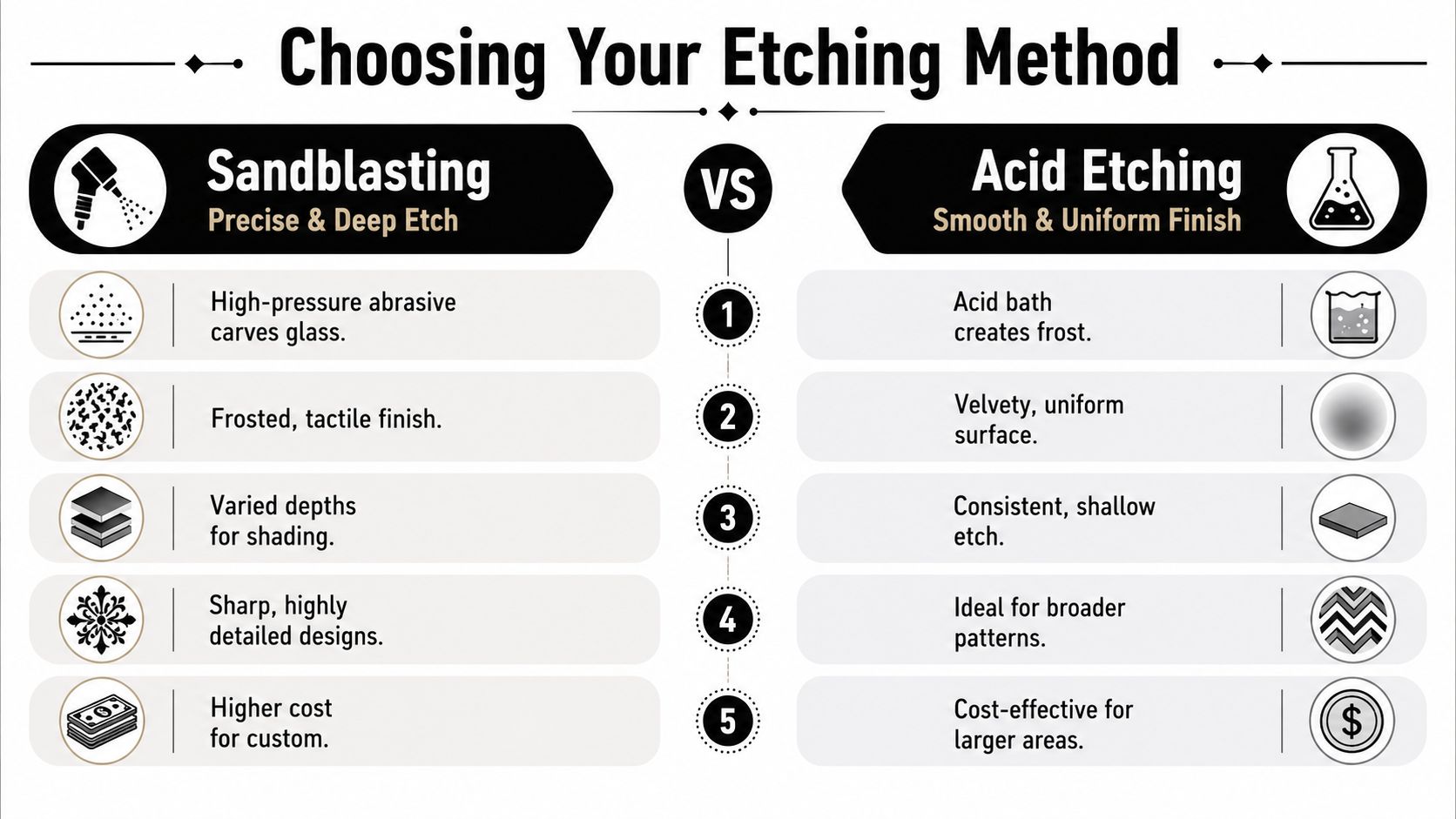
Not all etched glass is made the same way, and that difference determines whether projects are specified correctly or go sideways. The two core methods are sandblasting and acid etching. Both create a frosted effect. They do not create the same surface, the same visual depth, or the same maintenance profile.
How the finishes differ
Think of sandblasting as controlled carving. Abrasive media strikes the glass surface and cuts it mechanically. That makes it a strong choice when you want sharper definition, layered depth, or a more sculpted look.
Acid etching creates a more uniform satin finish. It's smoother to the touch and usually better suited to broad privacy fields or a softer, more even frost across a panel.
A quick comparison helps:
| Method | Best for | Surface character | Design strength |
|---|---|---|---|
| Sandblasting | Logos, deep carving, shading, detailed motifs | More textured | Strong on custom artwork and dimensional effects |
| Acid etching | Full-panel privacy, clean modern looks, uniform frosting | Smoother, more velvety | Strong on consistency and understated elegance |
What performs well in daily use
From a performance standpoint, etched glass is made by permanent abrasion or acid treatment, which produces the frosted look while reducing specular reflection and increasing privacy. Product guidance also notes that etched surfaces are fingerprint resistant, scratch resistant, and easy to clean, and the glass can be tempered, laminated, back-painted, or insulated for different applications. One manufacturer also notes a 6 mm laminated, double-sided etched panel that passed a 10,000-cycle abrasion test, which is a useful durability benchmark for higher-use settings, according to this acid etched glass product data sheet.
This is important for practical use. A decorative office partition sees hands, bags, chairs, and routine cleaning. A shower enclosure sees moisture, soap residue, and repeated wiping. The finish can't just look good on install day.
Practical rule: If the design itself is the star, sandblasting often wins. If the panel's job is calm, even privacy with easier day-to-day upkeep, acid etching usually makes more sense.
Matching method to the room
The wrong method usually shows up in one of three ways:
- Too much texture in a wet area: Heavily textured surfaces can ask more of the cleaning routine.
- Too little character in a focal application: A plain satin finish may feel flat where the client expected visual depth.
- Detail mismatch: Very fine artwork needs a process that can preserve edges cleanly.
If you're comparing decorative surfaces more broadly, these mirror and specialty glass styles are worth reviewing because they show how finish choice changes the overall tone of a room. The lesson carries over to etched panels. Technique isn't a shop detail. It determines the finished experience.
From Simple Privacy to Intricate Artistry
Some custom etched glass panels are almost invisible as design features. Others are the feature. Both approaches can work beautifully, but the strongest results come from understanding how pattern, clear space, and glass type interact.
The simplest use is often the smartest
A full frosted panel is the straightforward choice when the goal is privacy. It works well for bathroom enclosures, office fronts, and entry sidelights where the client wants a clean architectural surface with softened visibility.
Then there are smarter variations:
- Horizontal bands: Good for office partitions where seated privacy matters but upper openness still feels welcome.
- Gradient fades: Useful when you want more coverage at eye level and more openness near the top.
- Border and field combinations: A clear center with etched perimeter, or the reverse, can make a panel feel more custom without becoming busy.
These designs rely on positive and negative space. The etched area diffuses. The clear area frames, reveals, or lightens the composition.
What larger panels make possible
Architectural product data shows that custom etched panels are commonly fabricated from monolithic sheets ranging from 3 mm to 19 mm and can be made in sizes up to 126 x 236 inches. The same data notes that low-iron glass is a meaningful upgrade because it reduces the green tint that can show through standard glass, especially across broad etched fields in more refined interiors, according to this classic full etch product reference.
That technical range opens up design possibilities clients often don't realize are available.
- A room divider can be one uninterrupted statement instead of several smaller lites.
- A wine enclosure can carry a repeating motif across multiple panels.
- A logo or monogram can be scaled so it feels integrated into architecture, not pasted onto it.
If you're weighing etched glass against film, this outside guide with essential window film advice for UK homeowners is a useful comparison point because it highlights a question many buyers should ask early. Do you want a removable privacy layer, or do you want privacy built into the glass itself?
Etched glass tends to win when permanence, finish quality, and a tailored look matter more than short-term flexibility.
For specialty spaces, scale and clarity matter even more. That's why projects like custom wine enclosures often benefit from careful glass selection. A poorly chosen substrate can muddy the final look. A clean low-iron panel lets the etched design read the way it was intended.
Where to Use Etched Glass in Your SWFL Property
Southwest Florida properties ask a lot from glass. It needs to feel light, stand up to daily use, and suit interiors that often lean coastal, contemporary, or transitional. Etched glass works because it can be subtle in one room and expressive in the next.
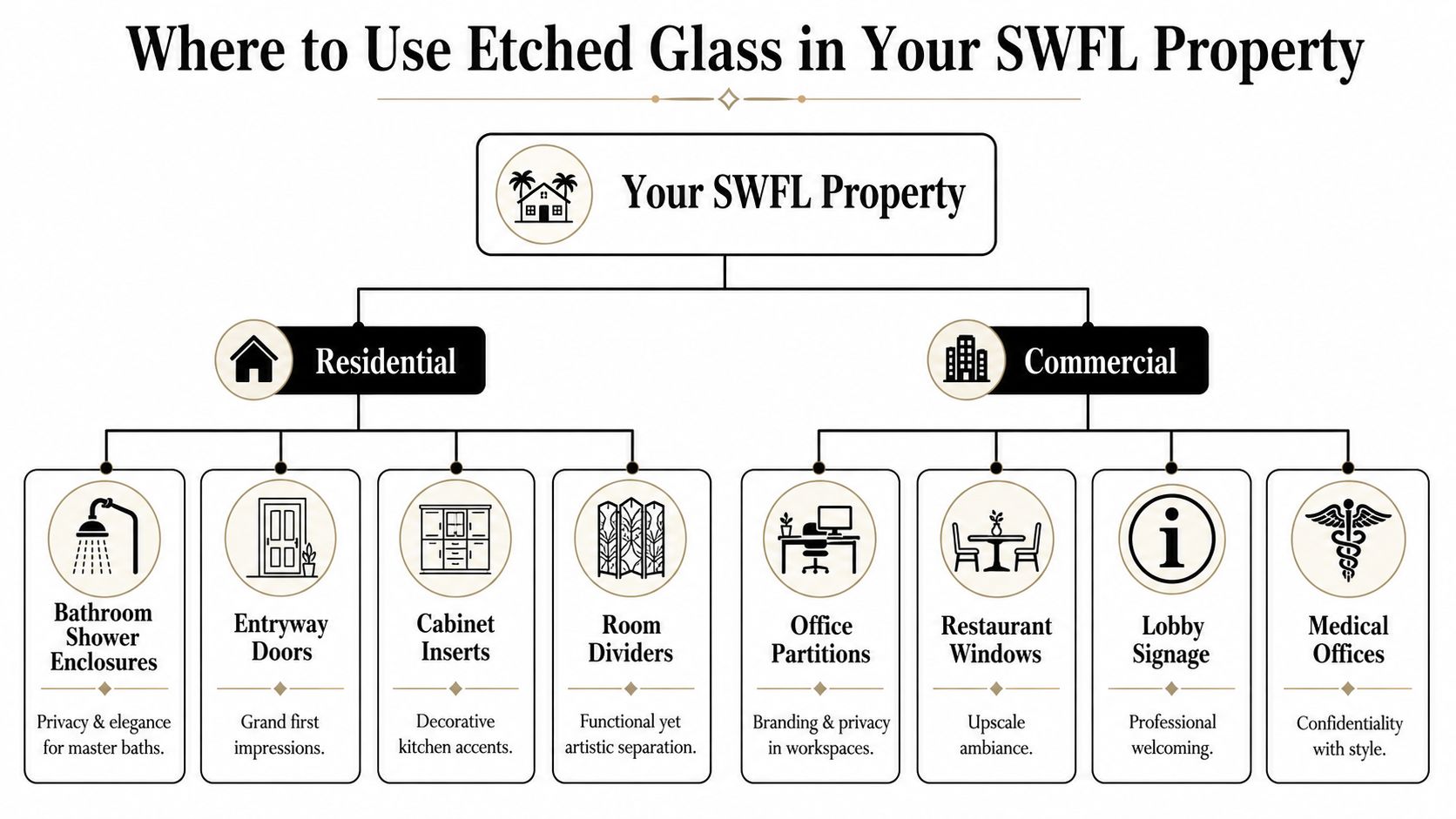
Residential uses that make sense
In homes, I'd narrow the strongest applications to spaces where sightlines matter.
Shower enclosures are the obvious example. A fully clear enclosure looks crisp, but it doesn't hide much. A frosted band or a full etched field can give the room a spa quality while still keeping natural light moving through the bath. If the enclosure is part of a primary suite, that privacy can make the whole layout feel more considered.
Entry doors and sidelights are another smart place for etching. You keep daylight in the foyer without putting the interior on display.
Room dividers and cabinet inserts suit open-plan homes that need gentle separation. In these cases, etched glass works better than solid partitions because the room still feels connected.
Commercial spaces where it earns its keep
In commercial work, etched glass tends to perform best where privacy and image overlap.
- Office partitions: Good for conference rooms, private offices, and reception zones.
- Lobby signage: Logos and names etched into glass feel cleaner than applied vinyl in the right setting.
- Medical offices: Frosted zones can support confidentiality without making the suite feel closed off.
- Restaurants and hospitality spaces: Etched panels can soften views and shape a more upscale atmosphere.
The demand behind these uses isn't hypothetical. Cognitive Market Research projects the global etched-glass market to grow at a 5.90% CAGR from 2023 to 2030, and the same market research notes the acid-etched segment at USD 59,775 million in 2024, with a projection of USD 91,458 million by 2032. It also reports that Asia Pacific held more than 35% of global revenue in 2022, all of which supports the idea that etched glass is a broad architectural category rather than a niche decorative add-on, as outlined in this etched-glass market report.
A local application that keeps coming up
In Naples and Fort Myers, one of the most reliable uses is the frameless shower. That's because the architecture already favors openness. Heavy visual barriers fight the room. Glass preserves the layout, and etching gives it control.
If that's the project you're considering, looking at examples of frameless shower door installation in Naples Florida can help you judge proportions, hardware placement, and how much coverage looks balanced in a finished bath.
Understanding the Costs of Custom Etched Glass
The cost of custom etched glass panels isn't driven by one thing. It's the combination of glass choice, fabrication requirements, design complexity, and installation conditions. Anyone who gives you a flat answer before discussing those variables is guessing.
What changes the price most
Start with the glass itself. Larger panels cost more to fabricate, transport, and install than smaller inserts. Thicker glass adds stiffness and presence, but it also changes handling and hardware requirements.
Then there's the substrate choice. Standard clear glass may be perfectly acceptable for some applications. Low-iron glass usually becomes more attractive when the etched area is broad and the client wants a cleaner, less green cast.
The design also matters, and not evenly.
- Simple full frost: Usually the most straightforward path.
- Bands and geometric layouts: Moderate complexity depending on alignment and masking.
- Logos, layered artwork, and carved effects: More labor-intensive, especially when edge quality and depth shifts matter.
Fabrication choices that affect budget
Safety requirements can add another layer. If the panel needs to be tempered or laminated for the application, that influences both production sequence and final cost. Installation access matters too. A large etched partition on an upper floor isn't priced like a small cabinet lite carried in through a side door.
The most expensive design isn't always the best one. The best value usually comes from putting the detail where people see it most and simplifying everything else.
That's why early decisions make such a difference. If the panel is decorative but secondary, a simpler etch on the right glass may outperform an elaborate concept on the wrong substrate. If the panel is the visual anchor of the room, cutting corners on clarity or execution usually shows.
A detailed estimate should account for all of this. If you're ready to price a real project instead of a rough guess, request a custom glass quote based on the actual opening, glass type, and intended use. That's the only way to compare options accurately.
From Consultation to Flawless Installation
The success of an etched-glass project usually comes down to process. Good design can still fail if measurements are loose, if the wrong finish is selected for the room, or if the installer treats a custom panel like commodity glass.
A clean process protects the result.
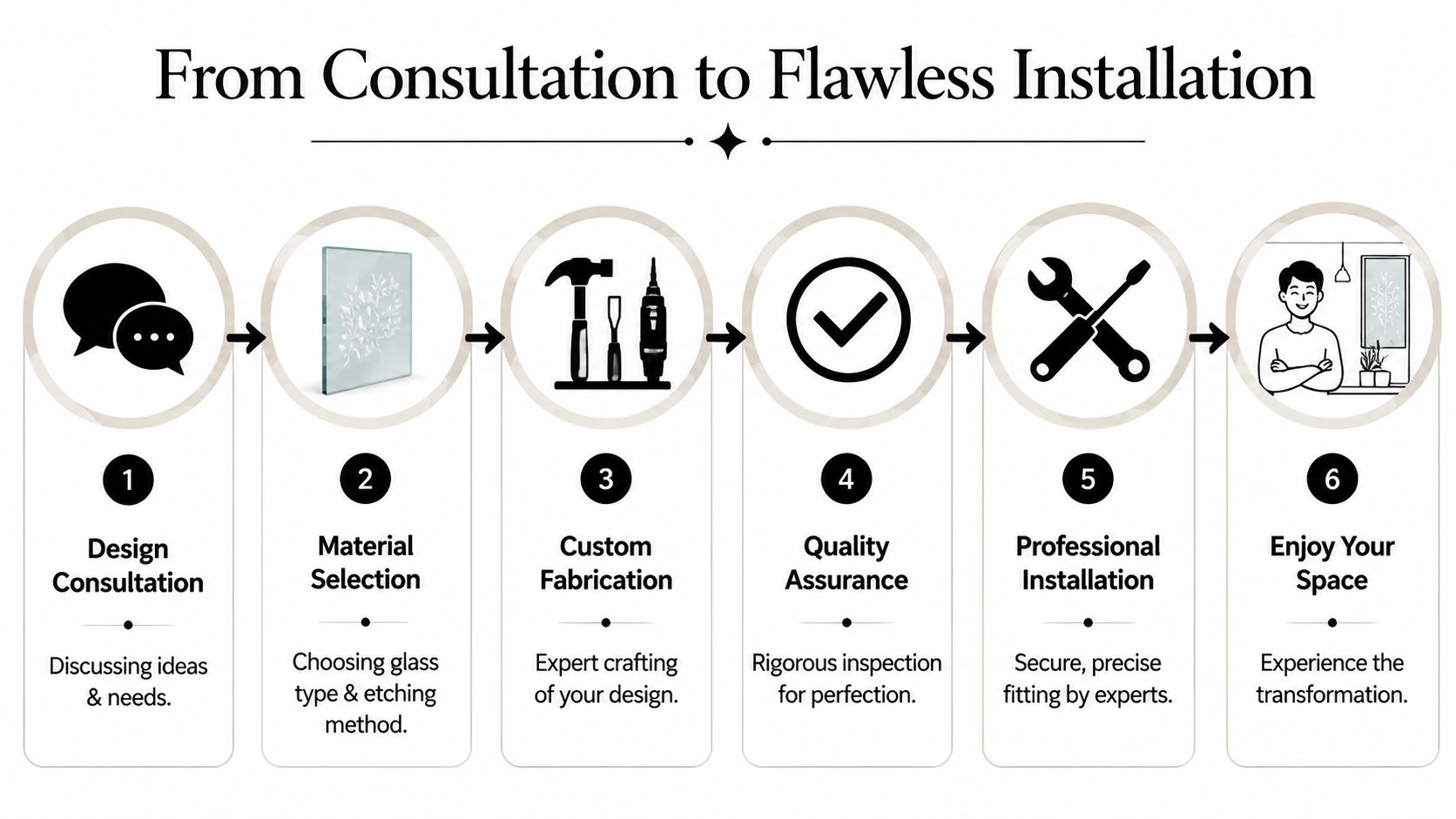
The sequence that keeps projects on track
Most successful jobs follow a straightforward path.
Design consultation
The first conversation should pin down privacy needs, design direction, and where the etched surface will live. A shower interior is a different environment than a conference room front.Material selection
Material selection involves resolving glass type, thickness, safety requirements, and etching method. If low-iron, laminated, or tempered glass is needed, that should be settled before fabrication starts.Precise field measurement
Openings in real homes and commercial interiors are rarely as perfect as drawings suggest. Accurate field dimensions matter, especially with frameless work.
After the design and measurement phase, seeing a fabrication process in motion helps many clients understand the level of control involved.
The part many articles skip
Long-term maintenance matters just as much as the initial look. That's especially true in Southwest Florida, where humidity, hard water exposure, and frequent cleaning all shape the life of the finish.
The overlooked questions are practical ones:
- Will the etched surface be inside the wet zone?
- Is the finish shallow and satin, or more heavily carved?
- Will a protective coating make cleaning easier for this location?
- Is the panel installed where hands and oils will touch it constantly?
One reference on etched glass maintenance makes the point well. Etch depth, panel location, and protective coatings are critical factors in keeping the glass presentable over time without creating unnecessary upkeep, according to this etched glass maintenance discussion.
In a shower, beauty without a cleaning plan is a short-lived victory.
What careful installation looks like
Installation should be quiet, precise, and boring in the best possible way. Hardware aligns cleanly. Reveals are consistent. The etched face is oriented correctly for the intended use and maintenance plan.
For wet areas, many homeowners also ask about surface protection such as Diamond-Fusion. That kind of coating can be a smart choice when the goal is easier cleaning and better resistance to spotting on working glass surfaces. It doesn't replace proper design decisions, but it can support them.
Choosing Your Expert Glass Fabricator in Naples and Fort Myers
Custom etched glass panels only look effortless when the fabricator and installer know exactly what they're doing. The panel can be beautifully designed and still disappoint if it's measured poorly, specified casually, or installed by a crew that doesn't understand how decorative glass behaves in the field.
What to look for locally
A strong fabricator should bring more than a catalog.
- Local project experience: You want someone who understands the kinds of homes, offices, and moisture-heavy environments common in Naples, Bonita Springs, and Fort Myers.
- Code awareness: Safety glazing requirements, tempered applications, and proper hardware selection aren't optional details.
- Measurement discipline: Frameless and custom work depend on exact field conditions.
- Installation standards: Licensed and insured technicians matter because custom glass isn't forgiving.
It also helps to review how a company presents itself in local markets. This guide for home service businesses is aimed at marketing, but it highlights a practical point for homeowners too. Reputable local companies build visible proof over time through service area relevance, reviews, and consistent project presence. That's useful context when you're deciding who should handle a custom glass feature in your home or commercial property.
The final decision is rarely about glass alone
Clients often compare quotes as if the material is the whole story. It isn't. The outcome depends on design judgment, fabrication quality, field accuracy, and respect for the jobsite.
That's what separates a panel that still looks right years later from one that always feels slightly off.
If you're considering a shower enclosure, office partition, entry panel, or another etched-glass feature in Southwest Florida, AmeriGlass Industries can help you turn the idea into a precise, durable installation. Their team serves Naples, Fort Myers, and surrounding areas with expert measuring, custom fabrication guidance, and professional installation for residential and commercial projects. Reach out for a consultation and a free estimate specific to your space.