You open a bid package on a Tuesday afternoon and realize the glazing scope is still loose. One proposal includes engineering. Another assumes by-others waterproofing. A third has a low number and almost no detail on anchorage, field measurements, or permit support. That is how a commercial job gets into trouble before a single frame hits the site.
Commercial window installation companies are not selling a finish item. They are taking responsibility for part of the building envelope, and in Southwest Florida that responsibility carries real exposure. Miss the perimeter conditions, attachment, sequencing, approvals, or submittal requirements and you are not dealing with a minor punch item. You are dealing with leaks, failed inspections, change order fights, tenant complaints, warranty disputes, and schedule damage that spreads to other trades.
That risk gets worse in a market crowded with sales-driven bidders. Plenty of firms can talk about glass packages, sightlines, and product options. Far fewer can show that they know how to coordinate opening prep, tie into adjacent wall assemblies, manage field tolerances, and keep a code-heavy project moving through review and inspection without avoidable delays.
Start with the installer. Then evaluate the system.
If you are hiring commercial window installation companies in Naples, Fort Myers, Bonita Springs, or nearby, treat the installation process as the main buying decision. Product matters, but execution decides whether the assembly performs, passes, and holds up five years from now.
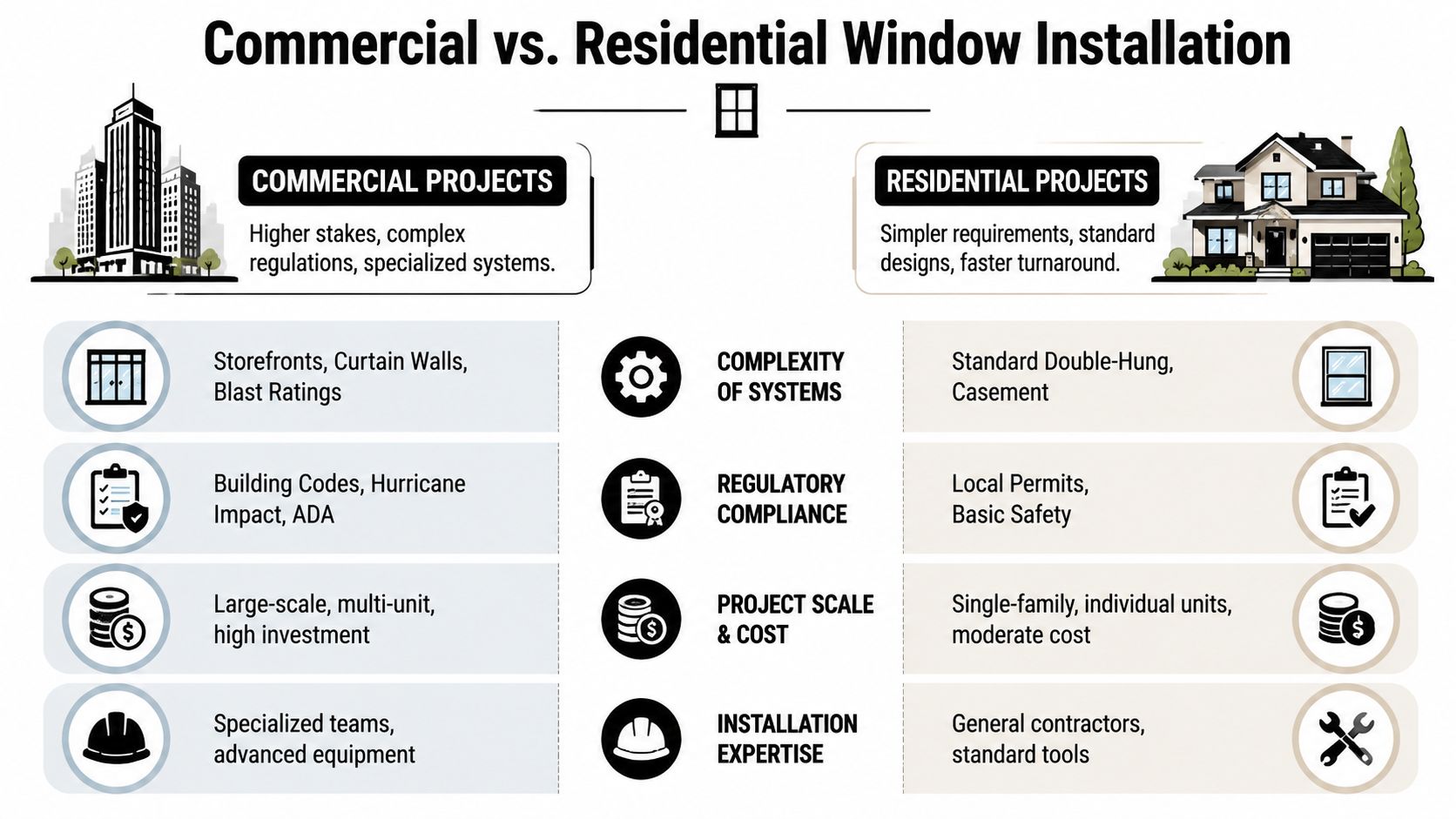
Why Commercial Window Installation Is Not a Residential Project
Hiring a residential window crew for a commercial project is like asking a handyman who builds backyard sheds to pour the foundation for a warehouse. Both involve concrete in some form. That doesn't make them comparable.
Residential installers usually work with standardized openings, familiar framing conditions, and simpler approval paths. Commercial crews deal with engineered systems, larger openings, tenant occupancy, coordination with structure and waterproofing, and inspection sequences that can stall a whole job if one detail is missed.
The wall assembly matters as much as the glass
Commercial window installation is a building-envelope integration task, not a product swap. Pacific Northwest National Laboratory's Building America Solution Center explains that installers must tie the window into the wall's water, air, vapor, and thermal control layers, and it notes field verification with ASTM E1105 water-leakage testing for installed exterior windows, skylights, doors, and curtain walls in appropriate conditions, as covered in the BASC guide on window performance grades and installation details.
That means the perimeter is the project.
If the flashing sequence is wrong, if the sealant path is broken, if the substrate is out of spec, or if the anchors don't match the approved condition, water finds a way in. Air bypass follows. Then the blame game starts. The manufacturer points at the installer. The installer points at the wall. The owner points at you.
Practical rule: In commercial work, a good product installed badly is still a bad assembly.
Commercial liability is heavier
On a house, a bad install might affect one family. On a commercial job, one mistake can affect tenants, customers, staff, inspections, and your turnover date. That changes everything about how you evaluate subs.
Look at the differences:
- System complexity: Commercial scopes can include storefronts, curtain wall, impact glazing, replacement glass, doors, sidelites, and interior partitions that all need to coordinate.
- Access and equipment: A commercial crew may need lifts, swing-stage coordination, slab edge protection, staging plans, and after-hours work windows.
- Documentation: Shop drawings, product approvals, engineered anchorage details, submittals, RFIs, field dimensions, and closeout documents aren't side tasks. They're part of the job.
- Failure consequences: One leak at a retail frontage is annoying. Repeated leakage across an occupied building becomes an operating problem and a legal problem.
The wrong subcontractor creates invisible defects
The most dangerous installer isn't the one with the highest price. It's the one who sounds confident, promises speed, and treats every opening like it's the same.
Commercial window installation companies should talk comfortably about substrates, tolerances, sequencing, water management, mockups, and inspection readiness. If they mostly talk about brands, discounts, and “getting it done,” keep looking.
Decoding Commercial Window Systems and Services
Bad scopes create bad bids. On a commercial job, the phrase "replace windows" is vague enough to hide design errors, missed materials, bad sequencing, and change orders that should have been avoided before pricing ever started.
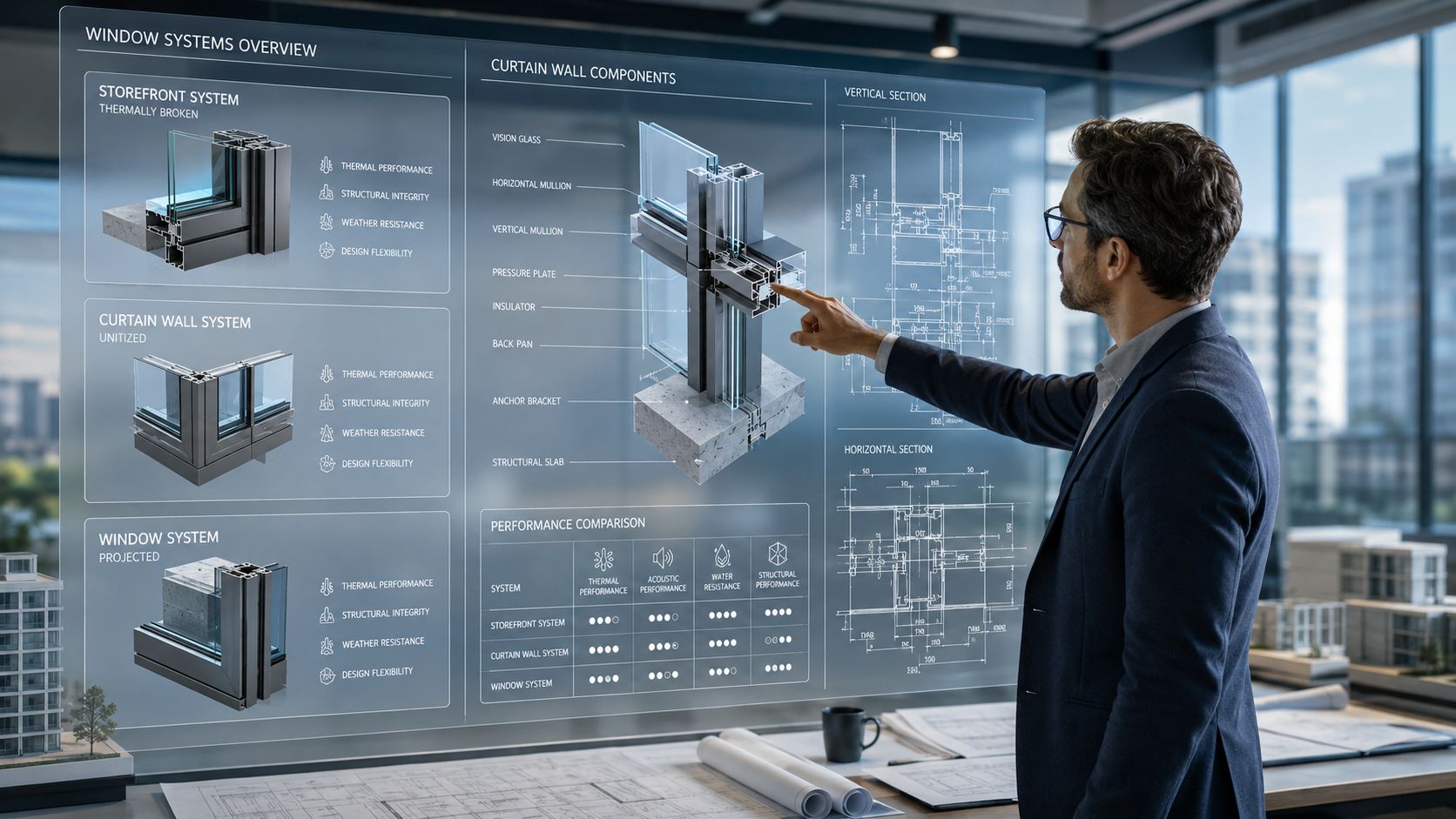
Commercial glazing is a system purchase, not a commodity purchase. The frame, glass, anchors, sealants, waterproofing, substrate, and approved installation details have to work together under wind load, water exposure, and inspection pressure. In Southwest Florida, that matters more because code approval and field execution are tied tightly together. A sub that prices from a plan note without drilling into those details is setting the job up for trouble.
Know what you're actually buying
Demand for commercial glazing remains strong, as noted earlier. That makes clear scoping more important, not less. If you do not define the system correctly, you will get bids that look comparable on paper and perform very differently in the field.
Here is what owners and GCs need to separate early.
Storefront systems
Storefront is common at ground-floor retail, office entries, restaurants, and tenant improvements. It is built for lower-rise conditions and frequent use around doors and public entries.
The installation risk is usually at the perimeter. Sloppy field dimensions, bad anchorage into questionable substrates, poor sill treatment, and weak sealant work cause the callbacks. If the proposal only names the frame series and glass type, it is incomplete.
Curtain wall systems
Curtain wall belongs in a different bucket. It handles larger spans, more structural movement, and more demanding engineering coordination across the facade.
Treating curtain wall like oversized storefront is a costly mistake. The labor plan, shop drawing process, embed or anchor coordination, staging, and waterproofing strategy are different. Hire a subcontractor that can explain those differences in plain language.
Impact glazing
In Southwest Florida, impact glazing is part of the compliance path, not a nice upgrade. Approval depends on the tested assembly and the approved installation method, including fastener type, spacing, edge distances, substrate conditions, and attachment geometry.
If one part changes in the field, the assembly can fall out of compliance. That is why experienced installers ask harder questions up front.
Replacement glazing and retrofit scopes
Retrofit work looks simple until the crew starts opening walls. Existing frames may be out of square. Anchors may be buried. Sealants may be failing in more than one plane. Occupied buildings add access limits, dust control requirements, and tighter work windows.
These jobs need better investigation, not looser assumptions.
Services that belong in the written scope
A serious commercial glass subcontractor sells process, not just products. If the proposal skips the steps that control water, fit, approvals, and closeout, you are not looking at the full job.
Require the proposal to state who handles:
- Field verification: Final measurements before fabrication, with responsibility clearly assigned.
- Shop drawings and submittals: Project-specific drawings, product approvals, and coordination details that match the actual openings.
- Selective demolition and disposal: Removal of existing glass, framing, sealants, trims, and protection of adjacent finishes.
- Perimeter conditions: Backer rod, sealants, flashings, sill treatment, and transitions to adjacent waterproofing.
- Hardware and door coordination: Closers, panic hardware, thresholds, and interface with access control if doors are included.
- Inspection support and closeout: Required documents, correction work, and turnover package expectations.
- Specialty glass selection: If the design calls for decorative, low-iron, patterned, or other custom assemblies, review the available glass product options for commercial and custom applications before the bid set goes out.
One more point. Risk transfer matters on glazing scopes because water intrusion, broken glass, and occupied-site damage claims get expensive fast. If you need a refresher on coverage basics, this guide to protecting your contracting business is a useful starting point.
The right proposal names the system clearly, defines perimeter work, and states who owns each deliverable. That is how you separate a real commercial installer from a bidder who is guessing.
Your Non-Negotiable Contractor Vetting Checklist
There are a lot of glazing contractors out there. That alone should make you more selective, not less. The U.S. window installation industry included 25,194 businesses in 2025 and employed 41,236 people that year, according to IBISWorld's U.S. window installation industry data. In plain terms, this is a crowded trade. Quality varies a lot.
So stop asking only for a price. Start by deciding who's disqualified before bidding even begins.
Paperwork first, personality second
A smooth salesperson can get you into a bad contract faster than a rough one. I'd rather hire the subcontractor with boring paperwork and disciplined systems than the one with a great pitch deck.
Use this screen before you compare proposals:
- License fit: Verify the company is properly licensed for the scope they're taking on. Don't assume a residential-focused license profile translates cleanly to your commercial conditions.
- Insurance proof: Get current certificates and review them. Don't just collect them. Check named insureds, dates, and whether the limits look appropriate for an occupied commercial project.
- Workers' compensation status: If the sub is bringing field crews, this matters. A cheap proposal gets expensive fast when there's an incident onsite.
- Scope match: Ask for recent work that resembles your job. A company that installs glass regularly isn't automatically qualified for your system, your code exposure, or your building type.
For a practical outside reference on what insurance gaps can hurt contractors, this guide to protecting your contracting business is worth reviewing before you finalize vendor requirements.
Ask for evidence, not reassurance
You want proof of process. Not promises.
What a qualified sub should provide without drama
- Project-specific submittal habits: They should be able to explain how they handle shop drawings, approvals, and revisions.
- Safety documentation: If they can't show a real safety culture, assume they don't have one.
- Field supervision plan: Who runs the crew onsite matters more than who sells the job.
- Schedule logic: They should understand sequencing with waterproofing, framing, finishes, and inspections.
“We do this all the time” is not a credential. It's a sentence.
Disqualifiers that should end the conversation
Some red flags don't deserve a second meeting.
| Red flag | What it usually means |
|---|---|
| Vague inclusions | They're leaving room to charge later |
| No discussion of substrate conditions | They assume the opening will magically work |
| No plan for occupied-space protection | They haven't thought through operations |
| Generic warranty language | You'll fight over responsibility later |
If you're serious about reducing risk, build a bid list from the top down. Fewer bidders. Better bidders. Cleaner procurement.
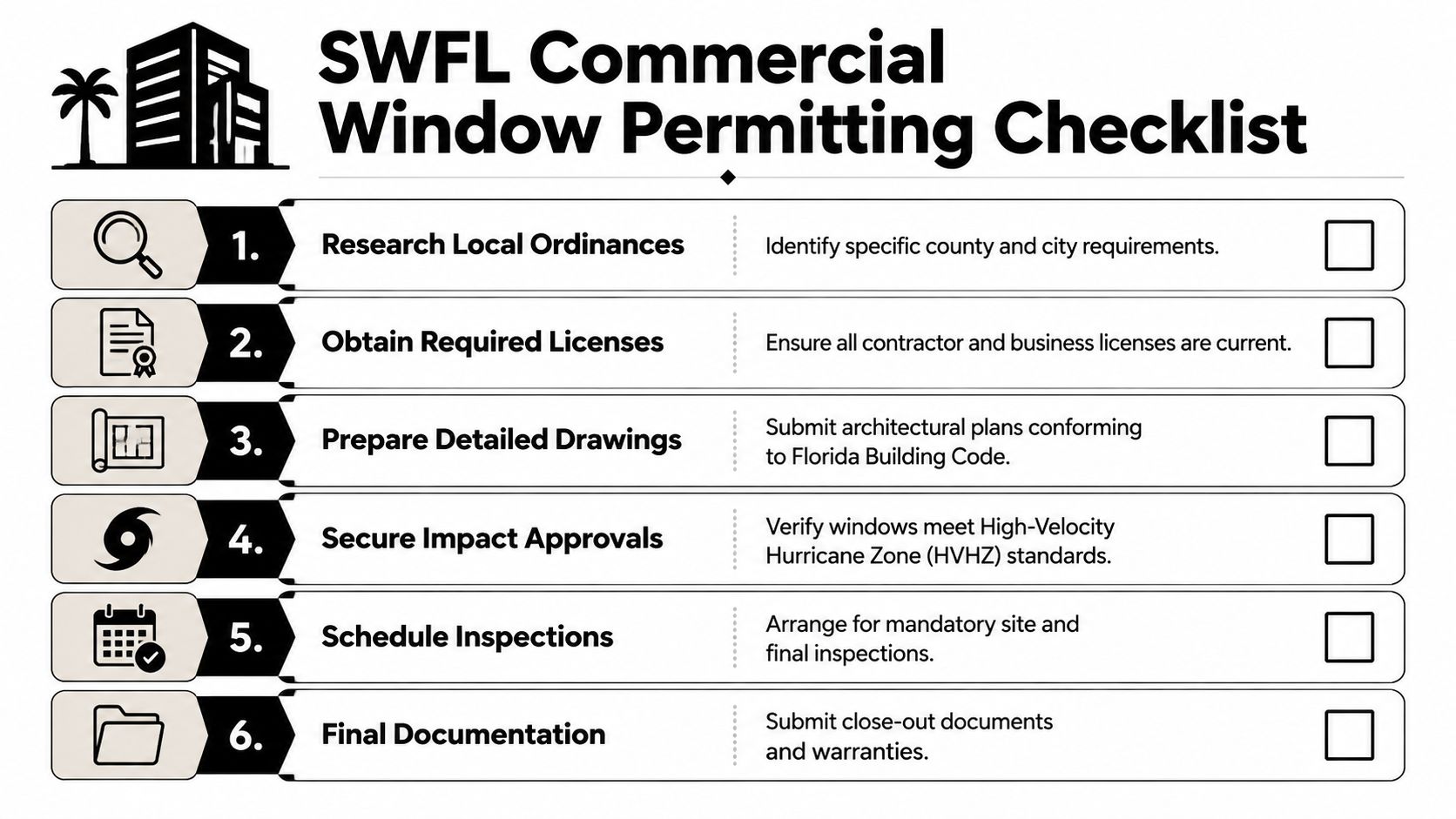
Navigating Southwest Florida's Permitting and Code Maze
Southwest Florida doesn't forgive sloppy glazing work. That's true even before storm season enters the conversation.
In this region, the product submittal is only part of the compliance story. The installation method matters just as much. Industry guidance for Florida impact systems stresses that quality depends on the installation method, not just the product label, and that the assembly must be installed to manufacturer and code requirements to achieve intended performance and preserve warranty validity, as noted in this Florida commercial impact systems overview.
Product approval is not the whole answer
A lot of owners hear “impact-rated” and think the problem is solved. It isn't.
In Southwest Florida, you need alignment between the approved product, the opening condition, the structural support, the fastener pattern, and the actual field installation. If one part changes, the whole approval path can shift with it.
That's why you need a subcontractor who can talk through practical questions like these:
- What substrate are we fastening into? Masonry, concrete, steel, or framed backup changes the install.
- What are the actual field dimensions? Drawings don't set frames. People do.
- Is this new construction or retrofit? Existing openings bring hidden conditions.
- Who owns engineering coordination? If that's fuzzy, expect delay.
For owners and builders trying to sort through process questions before bidding, AmeriGlass Industries keeps a commercial glass FAQ resource that's useful for clarifying scope, installation concerns, and project expectations.
Permitting failures usually start with assumptions
A permit set can look complete and still break down in the field. That happens when teams assume a standard detail applies everywhere.
Common trouble points include:
Mismatched approvals
The submitted product doesn't match the opening condition or design intent.Anchorage confusion
The drawing shows one condition. The field gives you another.Inspection timing errors
Work gets covered before the right inspection occurs.
This short overview helps frame the local compliance mindset before crews mobilize.
What I'd insist on in this region
If you're building or renovating in Naples, Fort Myers, or Bonita Springs, require these conversations early:
- Approved installation details: Not just product sheets.
- Field verification before fabrication: No guessing from old drawings.
- Responsibility map: Who handles engineering questions, permits, inspections, and closeout.
- Mockup logic when conditions are unusual: Strange interfaces deserve testing before full rollout.
In Southwest Florida, code compliance lives at the perimeter. That's where strong projects stay strong, and weak ones start leaking.
Unpacking the Real Drivers of Cost and Timelines
If you're evaluating bids only by glass type and frame finish, you're missing the primary cost drivers.
The hardest commercial jobs aren't always the biggest ones. They're often retrofits in occupied buildings where access is limited, tenant disruption is a live issue, and every phase has to be sequenced around operations. Industry coverage of commercial retrofit work in hurricane-prone markets points out that budget and schedule pressure often comes from after-hours work, permitting, tenant disruption, and reuse of existing openings, not just material pricing, as discussed in this commercial storefront impact window overview.
Cheap bids usually omit the painful parts
When one proposal comes in well below the others, don't get excited yet. Start asking what's missing.
The usual omissions look like this:
- Site protection: Dust barriers, floor protection, public safety separation, and debris handling.
- Phased mobilization: Occupied spaces rarely allow a straight-line install.
- After-hours labor: If tenants or customers stay open, someone pays for off-hours execution.
- Coordination time: Submittals, approvals, remeasure, and inspections all consume time even when no glass is being installed.
A fast way to surface missing scope is to request a formal commercial project quote review with installation assumptions spelled out before award. If a vendor resists clarifying assumptions, they're protecting margin, not your schedule.
The timeline lives and dies in preconstruction
Fabrication lead time matters, but field readiness matters more than is often acknowledged. If openings aren't verified, approvals aren't aligned, and adjacent trades aren't sequenced, the glass package turns into a parked truck and a stack of excuses.
Where schedules usually slip
| Schedule issue | Why it causes delay |
|---|---|
| Late field measurements | Fabrication can't proceed cleanly |
| Incomplete submittals | Review cycles drag out |
| Existing condition surprises | Crews stop while solutions are priced |
| Missed inspection sequence | Installed work gets held up or reopened |
Occupied buildings change the math
A vacant shell gives you flexibility. An occupied office, retail center, medical space, or mixed-use property does not. Noise limits, access windows, life safety routes, weather exposure during change-out, and public-facing protection all shape the install plan.
The lowest number on bid day can become the highest cost by closeout if the subcontractor didn't price real operating conditions.
That's why I'd rather hire a glass sub with a disciplined sequence and a realistic proposal than one that wins on paper and starts writing change orders once the first opening is exposed.
Questions That Guarantee an Apples-to-Apples Bid
Most glazing proposals are too vague because the buyer let them be vague. If your RFP is soft, your bid comparison will be worthless.
You need questions that force each bidder to show their process, assumptions, and exclusions. That's how you separate competent commercial window installation companies from companies that just know how to fill out a quote form.
Put these questions in writing
Use the table below in your RFP or bid leveling sheet.
| Category | Question to Ask |
|---|---|
| Field verification | What is your process for final field measurement before fabrication, and who signs off on dimensions? |
| Substrate review | How do you verify existing opening conditions, tolerances, and structural support before installation? |
| Waterproofing | Describe your perimeter waterproofing scope, including flashing, sealants, and tie-in responsibility at adjacent assemblies. |
| Anchorage | What determines your anchor selection and fastening pattern for this project's opening conditions? |
| Shop drawings | Will you provide project-specific shop drawings showing dimensions, attachment, and system interfaces? |
| Permitting | What permit support, submittal documentation, and inspection coordination are included in your base scope? |
| Occupied-space logistics | If the building is occupied, how will you stage work, control debris, protect tenants, and handle after-hours access? |
| Schedule | Provide a sample schedule that includes submittals, approvals, fabrication, installation, punch, and final inspection. |
| Exclusions | List all exclusions clearly, especially demolition, repairs to adjacent finishes, engineering, and temporary protection. |
| Warranty | Describe labor and material warranty coverage, and list the conditions that could void it. |
If your project includes high-clarity design features, premium interior partitions, or visual specifications where low-iron glass matters, include that requirement upfront. Don't leave bidders guessing. Reference the desired finish or material directly, such as ultra-clear glass options where relevant to the design package.
Listen for how they answer, not just what they answer
A good bidder gives crisp answers. A weak bidder gives pretty answers.
Strong responses usually sound like this
- They identify assumptions without being asked.
- They separate base scope from alternates.
- They explain sequence and responsibility clearly.
- They flag unknowns at existing conditions instead of burying them.
Weak responses usually sound like this
- “We'll handle it.”
- “Standard install included.”
- “Subject to field conditions.”
- “Warranty per manufacturer.”
That language tells you almost nothing.
If a bidder can't explain their install method in a few clear paragraphs, don't trust them to execute it under pressure.
Use the bid interview to test accountability
When you meet finalists, ask one blunt question: “If there's a leak at the perimeter after turnover, walk me through how you determine whether it's your responsibility.”
You'll learn a lot from the pause before the answer.
The AmeriGlass Difference Precision Under Pressure
At this point, the pattern should be obvious. Commercial glazing risk doesn't start with the glass. It starts with measurement, coordination, installation discipline, and how the subcontractor behaves when the field conditions aren't perfect.
That's where a process-driven shop stands apart from a sales-driven one.
What matters in a real commercial partner
For Southwest Florida work, I'd favor a subcontractor that shows strength in four areas:
- Measurement discipline: Clean field dimensions reduce fabrication mistakes and rework.
- Project coordination: Commercial glass needs organized communication with the GC, design team, and adjacent trades.
- Installation control: Crews need to respect occupied spaces, sequencing, and finish protection.
- Local accountability: You want a company that will answer the phone after substantial completion.
AmeriGlass Industries is one local option that supports commercial glass work in Southwest Florida, including offices, retail, and industrial settings, and you can review its background and service profile on the company's about us page. That matters because local commercial jobs reward firms that can coordinate precisely and execute cleanly under schedule pressure.
Precision is not a luxury on these jobs
A mismeasure in custom glass work doesn't stay small. It ripples into fabrication, installation sequencing, inspection timing, and owner confidence. The same goes for loose communication. If the sub can't track revisions, confirm dimensions, and manage field changes, the GC ends up carrying the load.
That's why I put so much weight on process. Not branding. Not brochure language. Process.
The right hiring mindset
If you're choosing among commercial window installation companies, use this filter:
| Priority | What to prefer |
|---|---|
| Reliability | Clear scope and documented assumptions |
| Technical competence | Detailed answers about perimeter conditions and installation method |
| Schedule confidence | Real sequencing, not optimistic promises |
| Long-term value | Fewer call-backs, cleaner closeout, stronger warranty position |
A strong glass subcontractor protects more than the facade. They protect your schedule, your owner relationship, and your margin.
Hire the company that treats the opening like an engineered interface, not a hole waiting for glass.
If you're planning a commercial glass or window project in Southwest Florida and want a subcontractor that takes field measurement, coordination, and installation discipline seriously, contact AmeriGlass Industries to review your scope and discuss the right approach before bid gaps turn into jobsite problems.