
You're probably dealing with one of two situations right now. Your front entrance looks dated, sticks in humid weather, leaks during hard rain, or no longer matches the quality of the business inside. Or you're building out a new commercial space in Naples, Fort Myers, Bonita Springs, or nearby, and you've realized the “glass door” line item is a lot more technical than it looked on the plans.
That's normal.
In Southwest Florida, a commercial entrance has to do several jobs at once. It has to welcome customers, meet code, survive weather, handle daily traffic, and keep operating smoothly after months of heat, salt air, and wind-driven rain. A generic approach rarely works well here. A door that looks clean on paper can become a headache if the frame isn't set right, the hardware finish isn't suited to the environment, or the opening wasn't evaluated with local conditions in mind.
Commercial glass door installation is one of those trades where small mistakes show up fast. The latch starts missing. The sweep drags. Water gets under the threshold. The closer gets adjusted again and again because the problem was never the closer. It was alignment, anchoring, or the wrong system for the location.
Your Business Entrance Is Your First Impression
A business owner in Naples usually starts with appearance. They want an entrance that feels modern, open, and professional. That makes sense. On 5th Avenue, in a medical office park, or in a retail center off Tamiami Trail, the entrance sets expectations before anyone speaks to your staff.
But the first impression isn't only visual. It's physical.
Customers feel it when the door opens smoothly, when the handle is at the right height, when the threshold doesn't trip them, and when the entry doesn't rattle in bad weather. Tenants notice when the closer behaves the same way in the afternoon heat as it did during the morning walkthrough. Property managers notice when they stop getting service calls about leaks and sticking hardware.
What owners usually underestimate
Most buyers don't realize how much performance is tied to the full entrance assembly rather than the glass alone. In coastal Florida, the weak point is often not the panel itself. It's the frame condition, the anchoring, the seal at the threshold, or the hardware choice for a salt-heavy environment.
A good-looking entrance that's poorly installed becomes expensive in a hurry. You pay for the original installation, then for adjustments, then for patch repairs, and then for the tenant frustration that follows.
Practical rule: A commercial entrance should be treated like part of the building envelope, not a decorative accessory.
There's also a contractor selection issue. The U.S. Door Installation & Repair Services industry reached 6,432 businesses in 2024 and generated about $7.7 billion in revenue, according to IBISWorld's industry profile. That scale tells you two things. First, there's a large market for this work. Second, there's a major difference between a company that installs doors and a company that understands specification, replacement, coordination, and long-term service in commercial settings.
Why this matters more in Naples and Fort Myers
Southwest Florida pushes every entrance harder. Salt air attacks finishes. Summer storms expose weak waterproofing. Hurricane concerns change how owners think about glazing, framing, and hardware. High-end retail and professional offices also have less tolerance for sloppy sightlines, visible shims, or mismatched finishes.
That's why a commercial glass door installation should be approached as a business decision, not just a construction task. The entrance affects curb appeal, accessibility, maintenance, and day-to-day operation. When it's done right, people barely notice it. That's the standard you want.
Choosing the Right Commercial Glass Door Type
The right door system depends on traffic, exposure, aesthetics, and how the business functions. A boutique on 3rd Street South doesn't need the same entrance strategy as a grocery store, urgent care clinic, or industrial office in Fort Myers.
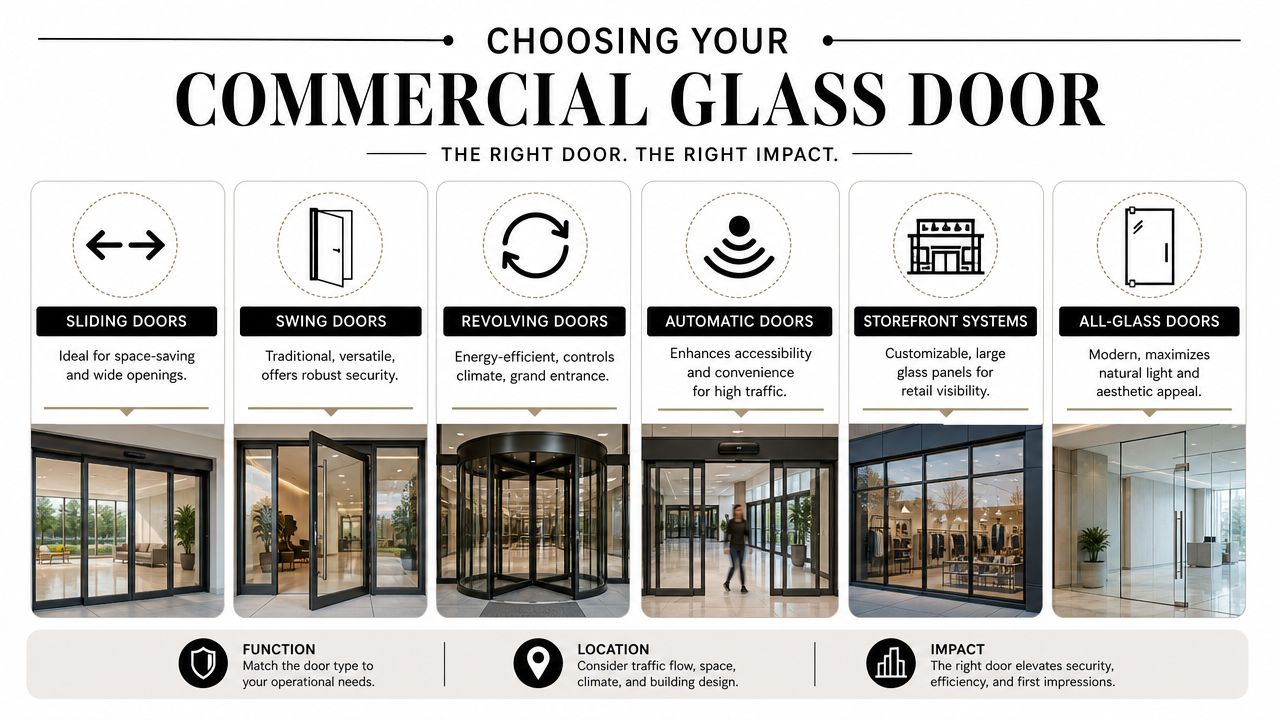
Aluminum storefront doors
This is the workhorse system for many commercial properties in Southwest Florida. Aluminum storefront doors fit retail centers, office buildings, restaurants, and service businesses because they balance visibility, structure, and serviceability.
They also give you flexibility. You can pair them with sidelites, transoms, different hardware packages, and a broad range of glazing choices. If the business wants a cleaner, brighter presentation, materials like ultra-clear glass options can change the look noticeably without changing the overall storefront concept.
Where they work well
- Retail storefronts: Good sightlines into the space and familiar operation for customers.
- Professional offices: Clean lines without feeling too industrial.
- Multi-tenant buildings: Easier to coordinate with standard storefront framing and replacement parts.
Trade-offs in Southwest Florida
- Salt exposure: Hardware and finish selection matter. The wrong finish can age poorly near the coast.
- Water management: Threshold and perimeter sealing can't be an afterthought.
- Wind exposure: The opening needs to match the project's code and location requirements, not just the designer's preference.
Frameless and all-glass doors
Frameless systems look sharp. They're common in upscale offices, interior entries, salons, and boutique environments where the goal is a minimal, modern appearance. In Naples, they fit the architectural style many owners want.
But exterior frameless applications require more scrutiny than people expect.
The cleaner the system looks, the less room there is to hide installation issues. If the floor is out, the wall is off, or the hardware layout wasn't coordinated early, the final result can look slightly wrong even before operational issues show up. On exterior conditions, you also have to think carefully about weather exposure, maintenance, and hardware durability.
A frameless door can look elegant in a showroom and still be the wrong choice for a wind-exposed entrance five blocks from the Gulf.
Automatic sliding doors
Hospitals, grocery stores, public buildings, and high-traffic commercial properties often need automatic entrances for accessibility, convenience, and traffic flow. These systems are excellent where carts, mobility devices, or frequent in-and-out movement are part of daily operations.
They're also more demanding.
Automatic doors introduce additional coordination with power, sensors, activation devices, and safety adjustments. In coastal Southwest Florida, you also need to think about weatherproofing, hardware protection, and service access. Owners should go in understanding that automatic systems can solve major operational problems, but they require a more disciplined installation and maintenance approach.
A practical comparison
| Door type | Best fit | Main advantage | Main caution in SW Florida |
|---|---|---|---|
| Aluminum storefront | Retail, offices, mixed-use | Balanced durability and appearance | Needs careful sealing and finish selection |
| Frameless / all-glass | Boutiques, interior offices, upscale entries | Minimal, modern look | Less forgiving of site errors and exposure |
| Automatic sliding | Healthcare, grocery, high-traffic public use | Accessibility and traffic handling | More coordination, more components to maintain |
What usually works and what doesn't
What works is matching the system to the business. High-traffic properties do well with durable framed systems and serviceable hardware. Design-forward interiors can justify frameless glass where exposure is controlled. Automatic entrances make sense when accessibility and traffic flow drive the decision.
What doesn't work is choosing by appearance alone.
A lot of entrance problems start with a simple mistake. The owner picks the door they've seen somewhere else, without asking whether that system makes sense for local wind exposure, salt air, service demands, and the kind of people using it all day. The best commercial glass door installation starts with that honest matching process.
The Commercial Installation Project from Start to Finish
A Naples retail owner approves a new entrance on Monday and expects crews to swap it out before the weekend rush. Then the field measure shows the slab is out of level, the existing jambs are twisted, and the landlord requires revised drawings before fabrication. That is a normal commercial glass project in Southwest Florida. The install itself may be short. Getting to a clean, code-ready handover takes planning.
Owners usually relax once they understand the sequence and the points where jobs slow down. In Naples and Fort Myers, delays often come from permit review, impact-rating requirements, occupied-business scheduling, and corrections to existing openings that looked acceptable until the old frame came out.
Here is the process that holds up in the field.
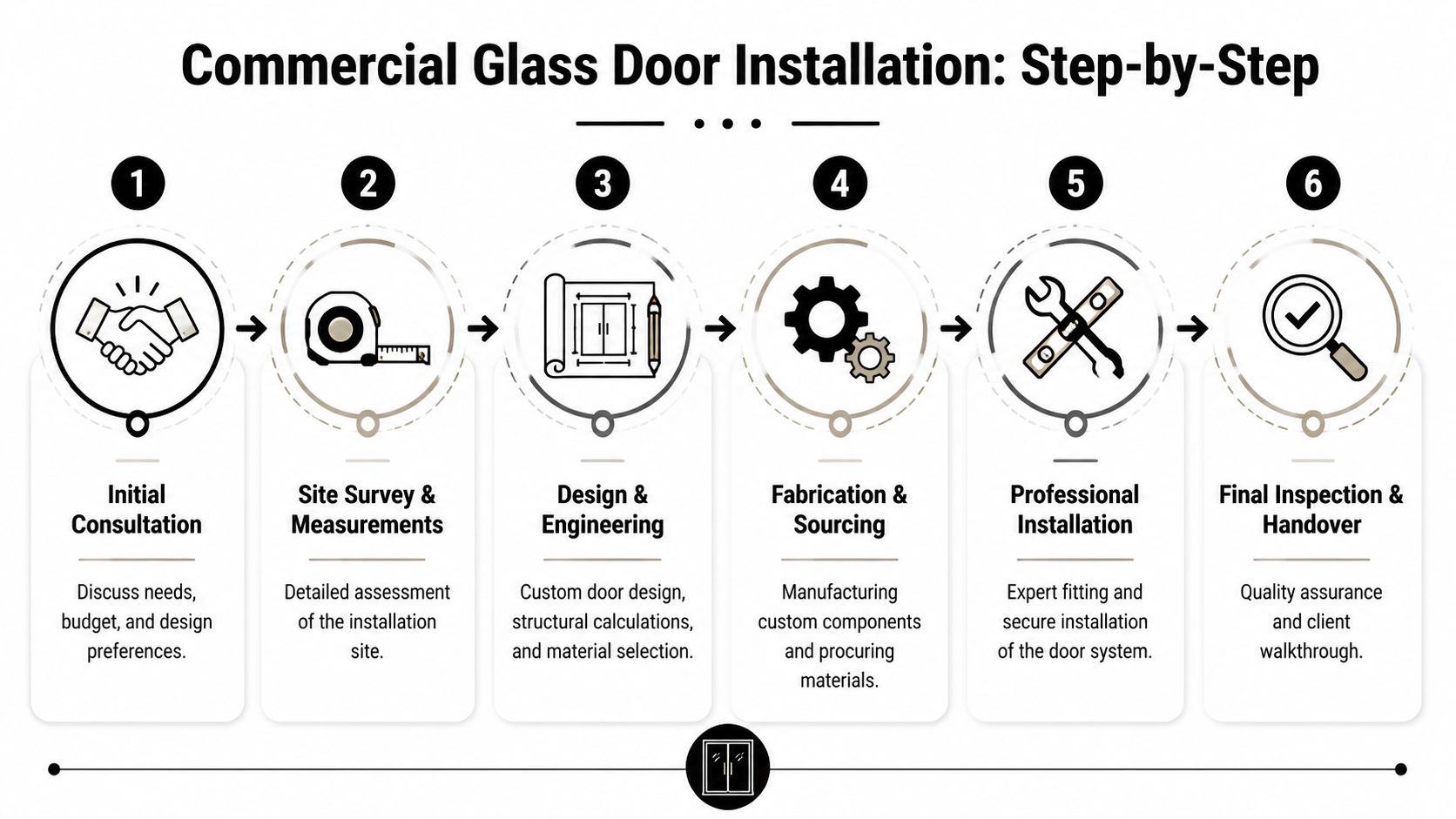
Site survey and field measurement
The site survey decides whether the rest of the job runs cleanly or turns into a patch-and-adjust exercise. A proper field measure checks opening width and height, floor slope, wall condition, anchor substrate, threshold area, swing clearance, and how close the entrance sits to salt exposure or wind-driven rain.
Replacement work is where experience shows. Older commercial spaces in Collier and Lee County often hide movement, corrosion, and bad previous repairs behind trim and sealant. Once the old system comes out, those problems become the installer's problem unless they were identified early.
In coastal work, finish selection and fastening details matter more than generic guides admit. Hardware near the beach can corrode fast if the wrong material is specified. Frames also need realistic sealing details because afternoon storms in summer will test every joint.
For owners comparing precision standards across glass trades, the same care used in frameless shower door installation in Naples, Florida applies here. Commercial entrances just add higher traffic, life-safety hardware, and stricter approval requirements.
Drawings, approvals, and coordination
After field dimensions are confirmed, the job moves into shop drawings, product approvals, permit paperwork, and scheduling. On many Southwest Florida projects, this phase takes longer than the physical installation. That is not inefficiency. It is what keeps crews from arriving with the wrong frame size, the wrong glass make-up, or hardware that conflicts with the use group.
Local coordination affects the schedule in practical ways. Property managers may limit work hours. Landlords may require their own review. If the opening needs impact-resistant glass or approved mullion details, those approvals must line up before fabrication starts.
A quick visual overview helps owners see where those handoffs happen.
Installation day and why alignment is everything
From the sidewalk, installation can look like a simple remove-and-replace job. It rarely is.
Technical storefront installation guidance published through Sweets shows that the frame must be set plumb and square, with a uniform reveal around the door, as shown in this storefront installation reference. Small errors in frame geometry lead to drag, latch trouble, uneven weather contact, and premature wear on closers and pivots. Good crews correct the opening first, then set the system. They do not try to hide a bad opening with hardware adjustment.
That point matters even more in Southwest Florida because wind pressure and moisture expose weak installation work quickly. A door that is slightly out on day one can become a service call after the first heavy storm cycle.
Final adjustment and handover
The last phase is testing, tuning, and documenting what was installed. The door should be cycled repeatedly under real conditions. Crews should verify sweep contact, closer control, latch engagement, lock function, panic hardware operation where required, and threshold performance during normal traffic.
ADA details also get checked here, especially on active commercial entries where a few small misses can create real access problems. Clear width, opening force, maneuvering clearance, threshold profile, and hardware height should all match the approved use of the space. In older buildings, that sometimes means making corrections around the door, not just to the door itself.
Occupied businesses also need a practical handover plan:
- Operating schedule: Staff need to know exactly when the entrance will be unavailable and when normal access resumes.
- Security transition: Locksets, alarm contacts, temporary closure, and key control should be resolved before the crew leaves.
- Service expectations: The owner should know which minor settling adjustments are normal and which issues need a return visit.
Downtime planning that respects the business
A fast install window does not always produce the best project outcome. Retail stores, medical offices, and multi-tenant properties often benefit from phased work, off-hours installation, or temporary entry planning that keeps business operations stable while the new system goes in.
In season, timing matters. A poorly timed entrance replacement can create customer confusion, delivery problems, and security gaps in a single day. Good project management keeps the glass work under control so the business can keep operating.
Budgeting Your Commercial Glass Door Project
A commercial door quote makes more sense when you stop looking for one magic number and start looking at the components that drive it. The system type, the opening condition, the hardware package, the glass specification, and the labor intensity all affect the final price.
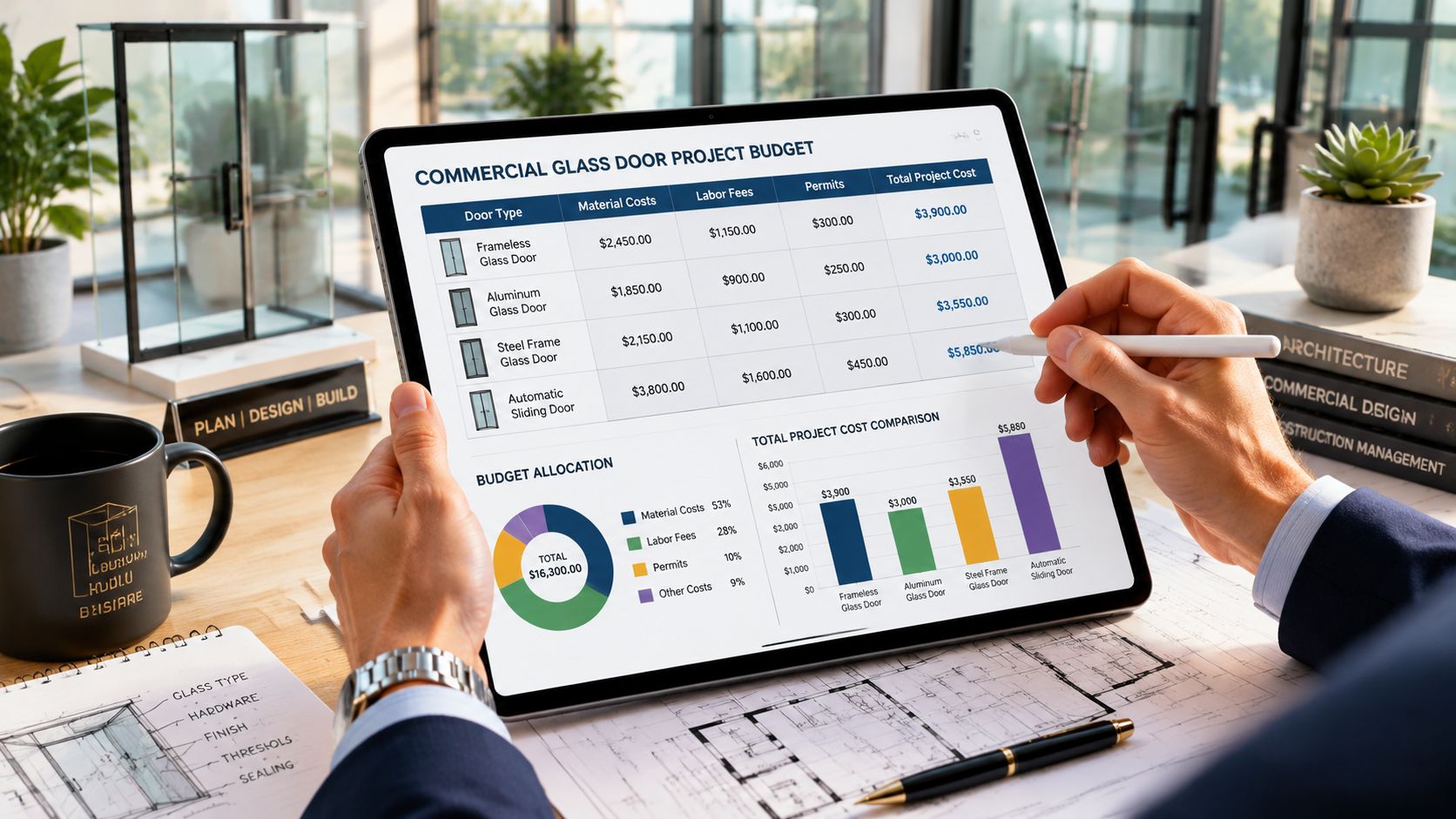
A cost guide for Texas and Oklahoma places a typical aluminum and glass storefront door at $1,200 to over $4,000 installed, a fire-rated steel door at $1,200 to $3,500, and an automatic sliding door at $3,000 to $8,000+ installed, with labor commonly accounting for 30% to 40% of the total project cost, according to this commercial door installation cost guide. Those figures are useful as a budgeting reference because they show where commercial storefront work sits relative to other code-sensitive door systems.
What you're actually paying for
A well-built quote usually reflects five cost buckets:
- Door and frame package: The base storefront door, frame members, glazing setup, and standard hardware.
- Glass specification: Clear, tinted, insulated, impact-related, or other project-driven glass choices.
- Hardware upgrades: Panic devices, closers, locks, access control prep, custom handles, and finish upgrades.
- Field condition work: Demo, opening correction, substrate repair, threshold prep, and waterproofing details.
- Installation labor: Skilled fitting, adjustment, anchoring, sealing, and final tuning.
The labor share is where many owners get surprised. They assume cost is mostly in the glass. On many projects, labor is a major value driver because precision installation determines whether the entrance works properly for years or becomes a maintenance issue.
Why low bids often age badly
The cheapest quote often excludes the hard part. It may assume the opening is perfect, gloss over waterproofing, simplify hardware, or omit the time required to make an entrance operate correctly in a lived-in building.
That doesn't mean the highest quote is automatically better. It means you should read for scope, not just price.
Budget check: If a proposal says little about alignment correction, sealing, hardware adjustments, or turnover details, ask what has been assumed away.
A better way to compare proposals
Use this checklist when you review pricing:
| Quote item | Why it matters |
|---|---|
| Scope of demolition | Prevents surprise change orders |
| Glass and hardware specification | Confirms what materials you're really buying |
| Threshold and sealant detail | Affects leaks, drafts, and long-term performance |
| Adjustment and final tuning | Separates installation from simple placement |
| Exclusions and assumptions | Reveals what may become added cost later |
If you want early pricing before final scope is locked, a structured request through a commercial glass project quote form helps narrow assumptions and avoid apples-to-oranges comparisons. That doesn't replace a field survey, but it does make the first budgeting conversation more useful.
Navigating SW Florida Building Codes and ADA Rules
In Southwest Florida, code compliance has to be built into the project from the beginning. It can't be patched in at the end with a different handle, a threshold tweak, or a rushed hardware substitution after inspection comments arrive.
That's because a commercial entrance is an assembly. The glass matters. The frame matters. The anchoring matters. The threshold matters. The hardware matters. If one of those pieces is wrong, the entrance may still look finished and still fail the test of compliance and safe operation.
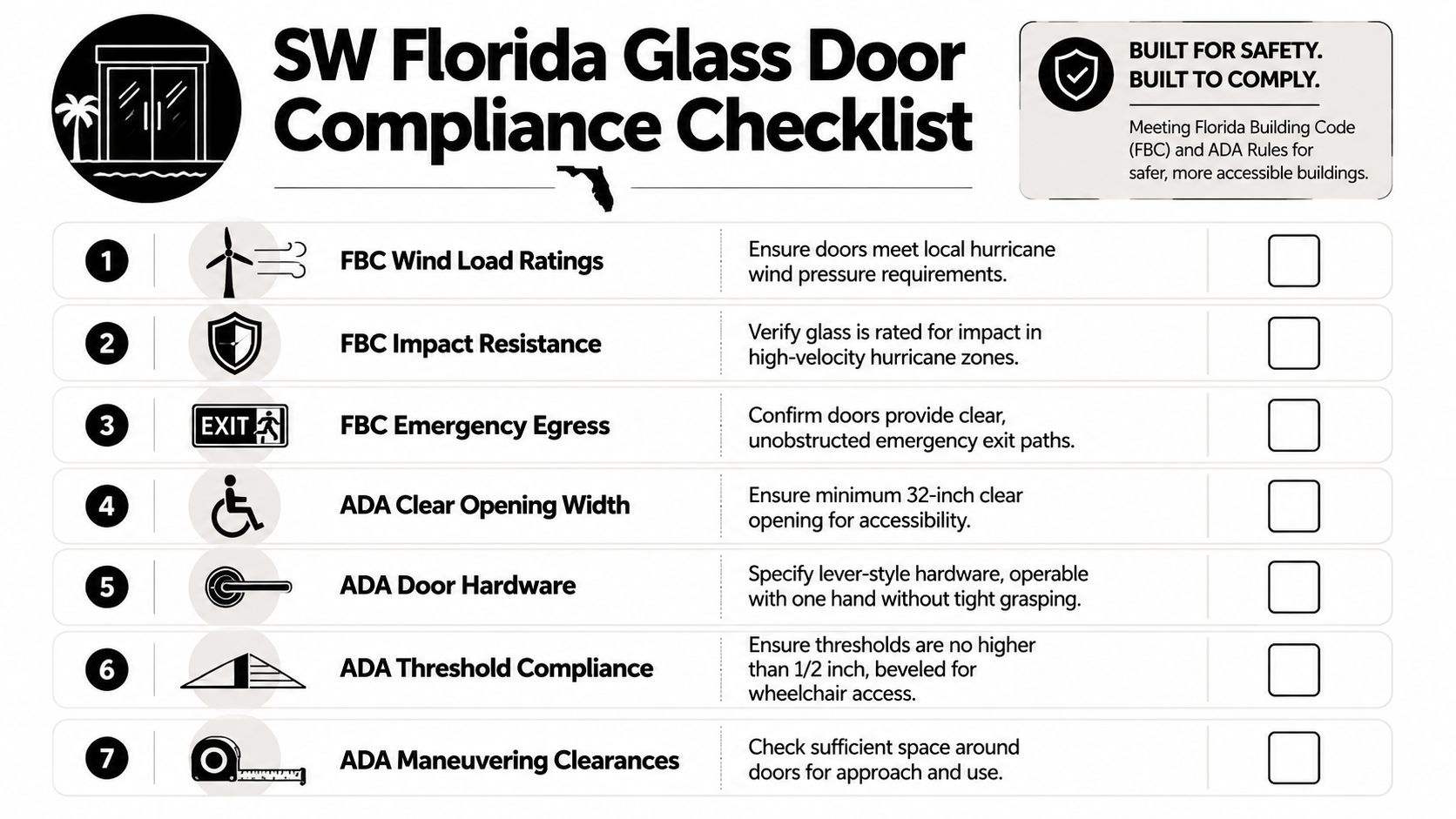
The assembly has to work as one system
Installation guidance for commercial storefront doors makes a point many owners miss. True code-compliant installation goes beyond the glass. The entire entrance assembly must be plumb, square, properly anchored, and caulked, with attention to threshold sealing and hardware adjustment, as noted in this commercial glass door installation guidance.
That matters in this region because weather exposes weak details quickly. Wind-driven rain tests threshold sealing. Humidity exposes poor adjustment. Heavy seasonal use exposes hardware that was installed but not properly tuned.
A code-compliant opening is not just an opening that passes inspection on paper. It's one that performs the way the approved assembly is supposed to perform in service.
Florida-specific pressure on product selection
Southwest Florida owners already know weather is part of every exterior decision. For commercial entrances, that means the door package needs to be evaluated in the context of local wind and impact requirements, especially on exposed sites and buildings where envelope performance is under closer review.
Local knowledge matters more than catalog language. The right question isn't “Can you install a glass door?” The right question is “Can you install the right rated assembly for this exact opening, with hardware and anchoring that support it?”
That distinction saves projects.
ADA mistakes that still happen too often
Accessibility issues are rarely dramatic. They're usually small field misses that create real problems for users and real exposure for owners.
Common trouble spots include:
- Clear opening width: The opening has to provide the required accessible passage.
- Threshold profile: If the threshold is too high or shaped poorly, wheelchairs and walkers feel it immediately.
- Hardware choice: Lever-style hardware and operability matter more than decorative preference.
- Maneuvering clearance: The area around the door has to support approach and use, not just look acceptable on a plan.
- Closer and latch adjustment: A compliant opening still has to be practical for people to operate.
Owners often ask whether the “glass package” includes ADA-related hardware and clearance review. It should. If it doesn't, the scope is incomplete.
Why local enforcement experience matters
A contractor can be competent and still be the wrong fit if they don't know how local commercial work is reviewed, scheduled, and inspected. Naples and Fort Myers projects often involve landlord standards, municipal review, tenant improvement coordination, and finish expectations that don't appear in generic online guides.
That's why experienced commercial glass teams build compliance into measurement, product selection, and installation sequencing. They don't wait until the end and hope the entrance qualifies. In Southwest Florida, that approach wastes time and invites callbacks.
How to Select a Qualified Glass Door Installer in Naples
Choosing an installer gets easier when you stop listening to marketing language and start looking for proof of process. A polished website doesn't tell you who will measure the opening, who will coordinate the permit path, or who will come back when the closer starts acting differently after a week of operation.
The best vetting questions are usually boring. That's a good sign.
What to ask before you sign
Start with the fundamentals.
- Licensing and insurance: Ask for current proof, not a verbal yes.
- Commercial project history: Look for work that resembles your building type, not just attractive glass photos.
- Local experience: Naples, Fort Myers, Bonita Springs, and nearby municipalities all have their own practical review realities.
- Scope ownership: Find out who handles measurement, ordering, installation, adjustments, and punch-list follow-up.
- Warranty clarity: Get written detail on materials, labor, and what conditions are excluded.
A surprisingly useful way to sharpen your questions comes from another trade. This list of questions for choosing a concrete company works because it focuses on accountability, scope, and process, which apply just as much to commercial glass as they do to site work.
What a strong installer should be able to explain clearly
You should hear straightforward answers to practical questions like these:
- Who takes final field measurements?
- How do you handle out-of-square openings?
- What's your plan if the existing threshold or substrate is compromised?
- How do you schedule work to reduce business interruption?
- What hardware and finish options make sense near the coast?
- Who coordinates the final operational adjustment?
If the answers stay vague, the project probably will too.
Portfolio quality matters more than portfolio size
Don't just ask for examples. Ask for local examples with similar use conditions. A medical office entry, a beachfront retail storefront, and an interior office glass system may all look good in photos, but they involve different performance demands.
You also want signs of disciplined execution:
| What to look for | Why it matters |
|---|---|
| Clean sightlines and consistent gaps | Suggests accurate measurement and frame setup |
| Appropriate hardware for the setting | Shows real specification judgment |
| Local commercial examples | Proves familiarity with regional conditions |
| Finished threshold and perimeter detail | Indicates attention to water and long-term service |
For owners who want to understand a company's background before reaching out, an about the company overview can help identify whether the team works in Southwest Florida conditions or only markets to them.
The right fit is usually obvious
Good installers don't rush the hard questions. They ask about traffic, operating hours, property management requirements, and finish expectations. They talk about the opening, not just the glass. They're careful with assumptions.
That's the company you want managing a commercial glass door installation in Naples. Not the one that promises the fastest answer. The one that gives the most complete one.
FAQs for Naples Commercial Glass Projects
How does salt air affect a commercial glass entrance
In Naples and Fort Myers, salt air usually attacks the metal before it affects the glass. Closers, pivots, lock bodies, fasteners, threshold anchors, and exposed finish surfaces all need the right specification for coastal exposure.
That choice has long-term consequences. A polished finish that looks sharp on day one can pit, stain, or seize up faster than owners expect if it is not suited to the site. For buildings near the Gulf, I treat maintenance planning as part of the installation scope, not an afterthought.
How should we schedule installation during hurricane season
Schedule exterior entrance work with extra float in the calendar. Summer and early fall jobs in Southwest Florida can shift because of storm tracks, wind-driven rain, delivery delays, and inspection reschedules.
For a straightforward storefront replacement, field work is often short. The key variable is everything around it: permit timing, existing frame conditions, access to the space, and how much temporary protection the opening needs at the end of each workday. If the business cannot shut down during normal hours, phased work or after-hours installation usually keeps risk and disruption lower.
Can you match our building's style
Usually, yes, but the final look has to stay inside the limits of the required system. In this market, that often means balancing design preferences with impact-rated components, closer strength, corrosion resistance, and the door's opening force under ADA requirements.
That is where good specification work shows. Clear glass, bronze finishes, narrow rails, and specialty pulls can all work well, but only if they fit the traffic level, exposure, and code demands of the opening.
What should we expect from the installation day itself
Expect a controlled jobsite, not a quick swap.
A good crew protects adjacent finishes, verifies dimensions again before setting the system, checks attachment points, adjusts hardware more than once, and tests the door through a full operating cycle before sign-off. If the rough opening is out of plumb, the slab is uneven, or old anchor locations have failed, the installer should stop and correct the condition instead of forcing the new door into a bad opening. That decision can add time, but it prevents leaks, binding, and premature hardware wear.
What kind of warranty questions should we ask
Ask what the material warranty covers, what the labor warranty covers, who handles service calls, and what maintenance stays with the owner. In coastal applications, also ask how corrosion-related wear is treated and whether routine cleaning, lubrication, and adjustment are required to keep coverage in place.
For owners who want to prepare before contacting vendors, this commercial glass FAQ resource is a useful place to start.
If you're planning a storefront replacement, tenant buildout, or new commercial glass project in Naples or Southwest Florida, AmeriGlass Industries is one local option for measured, professionally installed glass work for offices, retail spaces, and related commercial applications. Reach out to discuss the opening, the site conditions, and the schedule before you commit to the wrong system.