

A lot of storefront problems start with a good-looking rendering and a weak hardware decision.
The glass is clean. The frame lines are sharp. The signage is right. Then the first installed handle feels loose, shows every fingerprint, fights the closer, or collides with adjacent hardware. That's when the entrance stops feeling premium and starts feeling unfinished. For a general contractor, that usually means punch-list friction, rework risk, and an owner who notices the problem every time they walk in.
On a retail storefront, the handle is the first thing people touch. It has to look right, but that's not the hard part. The hard part is choosing a handle that fits the glass fabrication, meets accessibility requirements, survives heavy use, and still looks respectable after months of opening, pulling, pushing, cleaning, and weather exposure.
More Than Just an Entry Point
A beautiful glass storefront can lose its impact fast when the handle rattles in the stiles, the finish dulls early, or the grip feels awkward. Owners notice it. Customers notice it. Staff definitely notice it because they use that door all day.
That's why commercial glass door handles shouldn't be treated like decorative add-ons. They're part of the operating system of the entrance. They affect first impressions, daily function, maintenance workload, and whether the opening still feels intentional a year after turnover.
Glass hardware also carries a long design history. Sources on door-handle history note that a patent for a “Glass Door Knob” was issued on November 4, 1826, and by the 1920s glass knobs were widely recognized as a premium decorative hardware category, which helps explain why glass still reads as upscale in entry design today, according to this history of door handles and glass hardware.
Why that still matters on modern storefronts
Retail owners often want the all-glass look because it signals openness and polish. But the handle is what turns that visual idea into a physical experience. A slim pull can feel elegant. A heavy ladder pull can feel formal and substantial. A poor choice can make an expensive entrance feel cheap.
For architects working on tenant build-outs, it also helps to look beyond the storefront itself. Teams considering interior partition systems often review office glass wall door options to coordinate the language of handles, pulls, and glass detailing across public and private spaces. That consistency matters more than many specs admit.
A storefront handle is one of the few building components the customer judges by touch, not just sight.
When the hardware feels planted, smooth, and correctly proportioned, the whole entrance reads as higher quality. When it doesn't, no amount of nice glass makes up for it.
Pulls Levers and Patch Fittings Explained
Most specification mistakes happen because the team starts with appearance instead of function. Start with the door's use, swing, locking needs, and surrounding constraints. Then narrow the handle family.
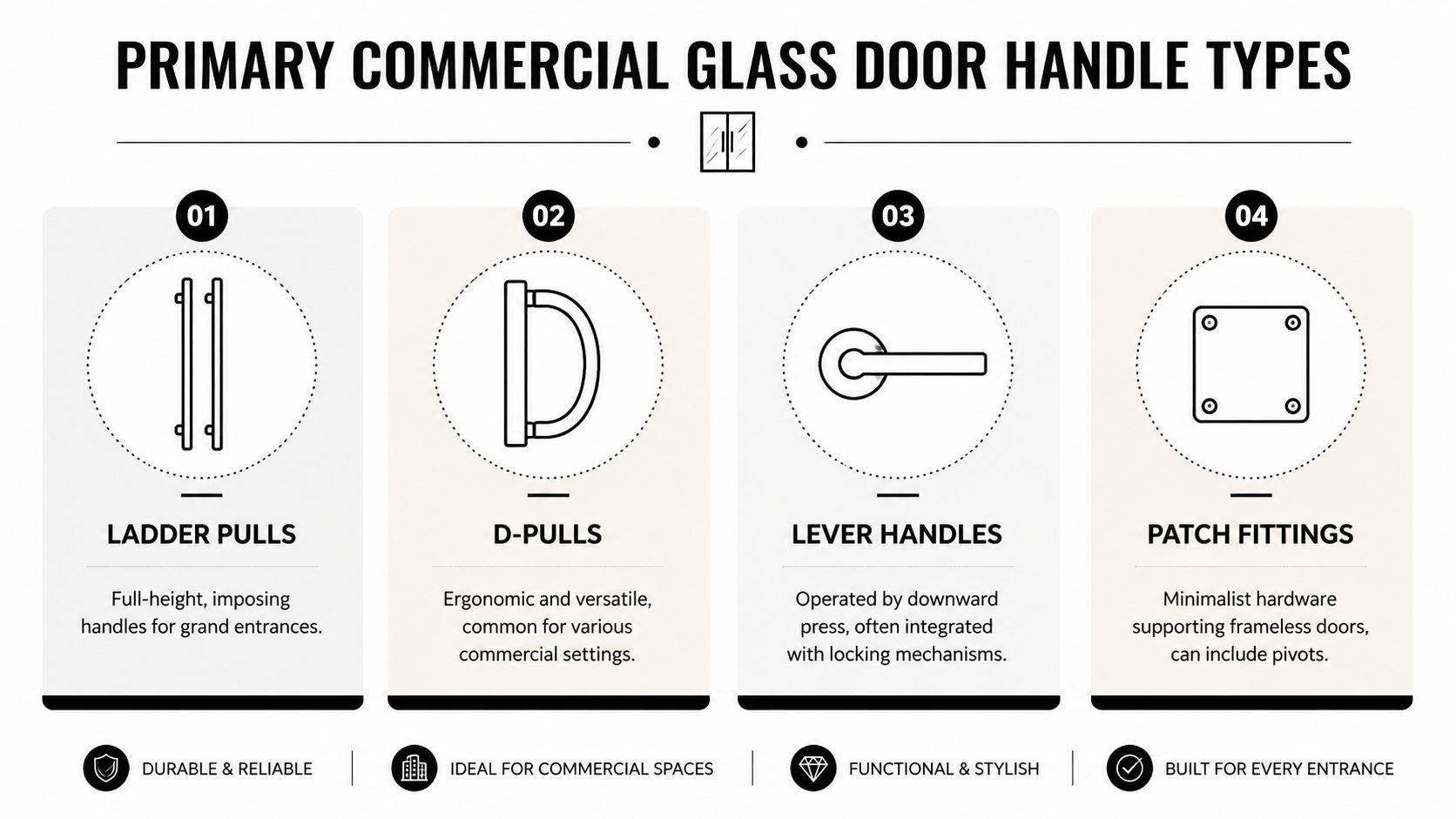
Ladder pulls
A ladder pull is the tall vertical handle common on retail and hospitality entries. It gives multiple grip points and visually anchors a large glass door. On a prominent storefront, it works like a firm handshake. It tells the user where to engage the door and gives the elevation some presence.
These are often the right starting point when the entrance is meant to feel substantial. They also work well on heavier doors where users may approach from different heights and hand positions.
What works:
- Grand entrances: Full-height or tall pulls suit flagship retail, restaurants, and hospitality entries.
- High visual impact: They read clearly through the glass from outside.
- Flexible grip zone: Users aren't forced to grab one exact spot.
What doesn't:
- Tight clearance conditions: A tall projection can interfere with nearby walls, closer arms, or adjacent mullions.
- Poorly coordinated hole patterns: If the glass was drilled for a different pull, substitutions get expensive fast.
D-pulls
A D-pull is the practical workhorse. It's compact, familiar, and easy to coordinate with many commercial styles. Back-to-back mounted D-pulls are common because they give a clean symmetrical look and reliable operation without overcomplicating the opening.
Commercial storefront pulls are often standardized by center-to-center mounting dimensions rather than overall length, and common sizes cluster around 9 in., 10 in., and 12 in. CTC, with larger architectural pulls also offered at 10 in., 12 in., and 18 in. CTC and overall lengths from 24 in. to 48 in. for taller entrances, as shown in commercial door pull sizing references.
Lever handles
A lever handle belongs in the conversation whenever the opening includes a latch, lockset, or a use case where operability matters more than visual drama. In offices, clinics, and controlled-access entries, the lever is often the more intelligent choice because it supports easy use and integrates naturally with locking hardware.
Think of a lever as a helpful gesture rather than a statement piece. It's there to make operation easy and predictable.
Patch fittings with integrated handling
On frameless glass systems, patch fittings can carry the visual language of the opening. Some setups use minimal pulls or compact integrated hardware so the glass remains dominant and the metal recedes. This can look excellent in contemporary interiors and boutique storefronts, but only if the rest of the system is coordinated carefully.
A minimalist patch-fitted door is unforgiving. If the pivot, lock, edge clearance, and pull geometry aren't in sync, the opening feels fussy instead of refined.
For teams comparing available hardware families and assemblies, a broader review of commercial glass products and systems helps frame the handle decision inside the full door package rather than as a separate accessory.
Practical rule: Choose the handle family for how the door operates first. Choose the finish second.
Choosing Materials for Durability and Style
Shape gets attention. Material choice determines whether that handle still looks and feels right after real use.
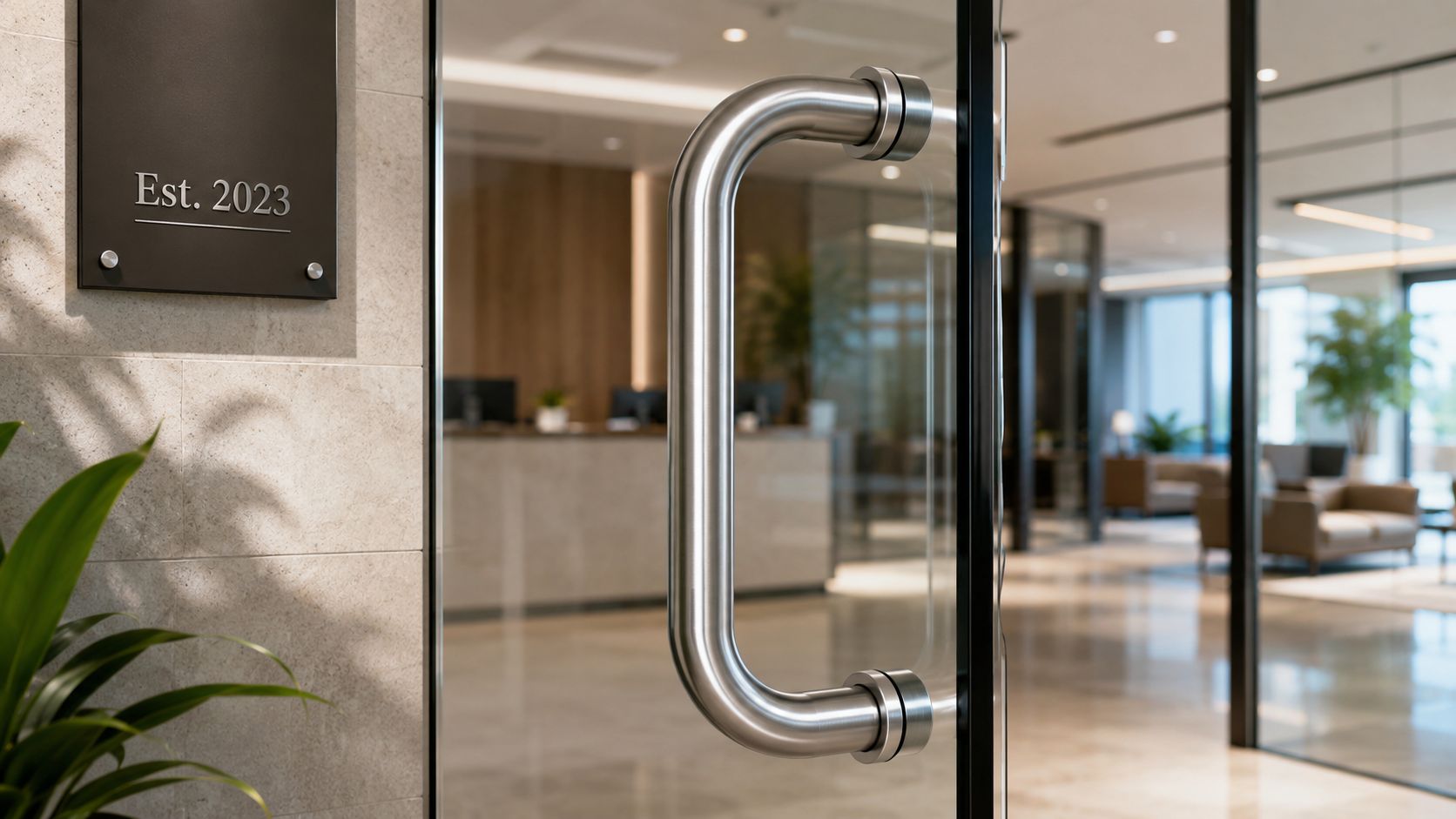
Commercial buyers often focus on finish boards and ignore the attachment details, alloy selection, and wear pattern. That's backwards. Product guidance in the commercial hardware market shows that handle failure is often driven by loosening fasteners and finish wear from heavy use, not the handle body itself, which is why storefront handle listings and guidance put so much emphasis on mounting method, material, and long-term upkeep.
Stainless steel first
For most storefront work, stainless steel is the baseline. It's durable, visually neutral, and fits modern retail architecture without trying too hard. Brushed stainless is especially forgiving because it hides handling marks better than mirror-polished finishes.
In Southwest Florida, that matters even more. Coastal exposure punishes decorative hardware. Salt, humidity, and frequent cleaning reveal weak finishes quickly. If the glass package is meant to stay crisp and color-neutral, specifiers often pair the entrance hardware with low-iron glazing or other high-clarity assemblies such as ultra-clear glass applications so the hardware doesn't fight the overall visual intent.
Brass and aluminum have their place
Brass can be excellent when the design calls for warmth and the owner accepts that appearance maintenance is part of the package. It can enhance a boutique entry, lounge, or hospitality setting where the hardware is meant to be noticed.
Aluminum can be appropriate in lighter-duty applications or where weight and cost sensitivity matter, but it doesn't project the same permanence as a well-specified stainless or brass pull. On a premium storefront, that difference is visible.
A simple material comparison helps during submittals:
| Material | Best fit | Watch for |
|---|---|---|
| Stainless steel | Retail, office, hospitality, coastal work | Fingerprints depend on finish |
| Brass | Boutique, luxury, design-forward entries | Appearance changes and upkeep expectations |
| Aluminum | Lighter-duty or budget-sensitive openings | Less substantial feel |
The finish matters as much as the base material. Matte and textured finishes can look strong on day one, but they need scrutiny. Some hide smudges well. Some show edge wear fast, especially at frequent hand-contact points and around set-screw areas.
A useful installation overview is below. It's worth reviewing because many long-term appearance issues start at fastening and alignment, not at the catalog page.
What saves money later
The lowest-priced handle isn't usually the least expensive option over the life of the opening. Hardware that needs repeated tightening, shows wear unevenly, or cleans poorly costs time. On owner-occupied retail space, that becomes a constant annoyance.
Specify for:
- Stable mounting systems: Through-bolts and correctly matched hardware packs usually age better than casual field improvisation.
- Low-visibility wear: Brushed and satin finishes tend to age more gracefully than highly reflective ones.
- Maintenance reality: Ask what the janitorial team will use on the handle every week.
If the hardware has to survive high-touch use, coastal air, and frequent cleaning, a stronger material-and-finish package is usually the cheaper decision.
Navigating ADA and Fire Code Requirements
Compliance isn't a paperwork exercise. It changes which hardware you can reasonably use.
On many commercial openings, decorative pulls are fine only if the full opening still works for the people who need to use it. The practical rule is simple. If the entrance includes latching, locking, or controlled access, the operable hardware must be easy to use without awkward hand motion. That's one reason lever hardware appears so often in compliant commercial work.
What architects and GCs should check early
A lot of field problems come from assuming the door vendor, hardware supplier, and installer are all checking the same code items. They often aren't. Put the critical requirements into the spec and the shop drawing review.
Use this checklist during coordination:
- Handle type: Lever hardware is usually the safer path when the opening requires active operation rather than simple pull access.
- Mounting location: The handle has to be placed where users can reach and use it comfortably.
- Closer behavior: A compliant handle still fails the user if the door fights them.
- Lock operation: Thumb-turns, latches, and access-control trims need the same scrutiny as the main handle.
For teams evaluating powered access on certain entries, this overview of ADA compliant door opener solutions is a useful companion resource because it addresses activation and usability issues that often get separated from the glass-door conversation.
Fire-rated openings need discipline
If the glass door assembly is fire-rated, treat the hardware package as a system. Don't assume a handle that works on a non-rated frameless entry is acceptable on a rated opening. Confirm compatibility among the glass, frame condition, closer, lock, and listed hardware set.
If the opening is rated, the handle decision stops being a style decision and becomes a system decision.
That's where many substitutions go wrong. Someone swaps a pull profile late in the project because it looks similar. But similar isn't the standard. Listed compatibility, correct mounting, and proper operation are what matter.
Common mistakes that create rework
Here's what tends to cause trouble on commercial glass entries:
- Decorative-only thinking: A pull may look elegant and still be the wrong answer for a door with locking or accessibility demands.
- Ignoring the full opening: The closer, lock, and handle have to work together.
- Late-stage substitutions: Hardware changes after glass fabrication can trigger major schedule pain.
The best way to avoid all three is to review code intent at the same time you review hardware geometry. If the entrance needs to be accessible, safe, and durable, those requirements should shape the hardware selection from the beginning.
Specifying for a Flawless Installation
This is the part that saves the job.
Most commercial glass door handle problems aren't design failures. They're specification failures. Someone ordered the right-looking pull with the wrong center-to-center dimension, the wrong hardware pack, or the wrong glass-thickness compatibility. On a tempered glass door, that mistake doesn't get solved with a drill in the field.
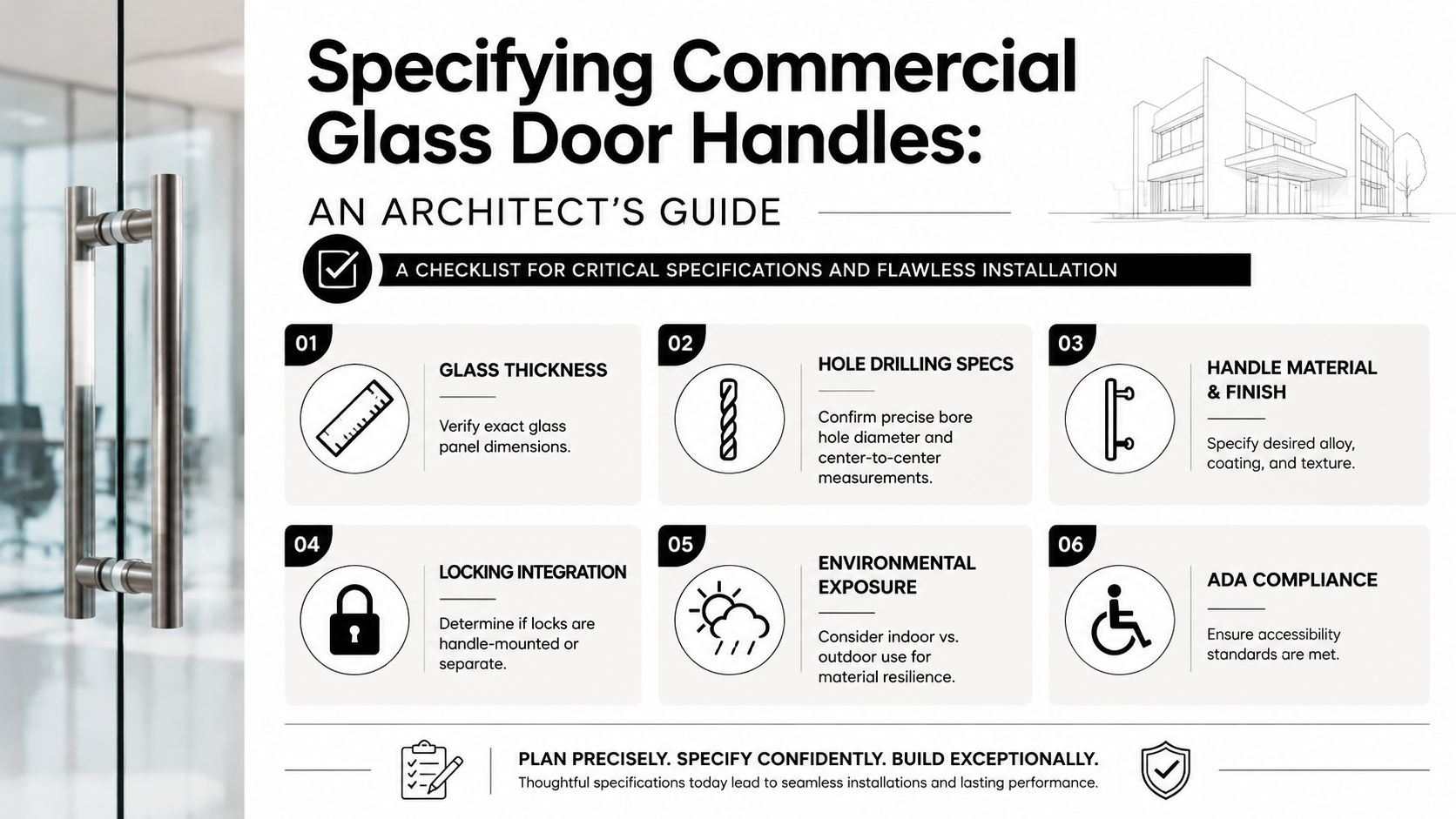
Commercial pull handles are commonly specified for glass thicknesses from 3/8 in. to 3/4 in. which is about 10 mm to 19 mm, and their center-to-center mounting dimensions are standardized. Selecting the wrong thickness compatibility or CTC can force a re-order because tempered glass cannot be re-drilled on site, as shown in commercial pull-handle specifications for glass doors.
The measurements that matter most
GCs sometimes get handed an overall handle length and assume that's enough. It isn't. The key field measurement is the hole-to-hole center-to-center dimension. That's what determines whether the new handle matches the fabricated glass.
Also verify:
- Exact glass thickness: Don't estimate from memory or from a generic door schedule.
- Single-sided or back-to-back mounting: Same profile, different hardware package.
- Hole diameter and hardware type: Through-bolt, standoff, offset, or other mounting condition.
- Handing and side orientation: Especially where locks, closers, or adjacent framing affect clearance.
Sample specification language that avoids confusion
Short, plain spec language beats decorative language every time. A useful handle note looks more like this:
Furnish commercial glass door pull set, stainless steel finish, back-to-back mounting, compatible with specified tempered glass thickness, matching existing center-to-center bore spacing, with manufacturer-approved grommets, bushings, and fastening hardware for the door configuration shown.
That tells the supplier what matters. If the project has unusual geometry, add it directly:
- Offset condition required to clear adjacent closer arm
- Narrow stile or mullion clearance to be maintained
- Coordinate with lock and patch hardware before fabrication
If the design team is reviewing custom glass details in other parts of the project, even a consumer-facing configurator like glass hardware and design selection workflows can be a useful reminder of how many variables have to be locked down before fabrication begins.
A pre-order checklist for the field
Before releasing hardware, confirm these items in writing:
- Glass thickness verified from approved drawing
- CTC dimension verified from field measurement or fabrication drawing
- Mounting type confirmed
- Finish and material approved by owner
- Clearance around closer, lock, mullion, and adjacent wall checked
- Accessibility requirements reviewed with the complete opening
Don't order from a photo, a memory, or an assumed standard. Order from the glass fabrication and actual field conditions.
That one discipline prevents a remarkable amount of avoidable trouble.
Matching Your Handle to Your Business Type
The right handle on a retail storefront in Naples isn't always the right handle for a medical office in Fort Myers or a restaurant near the water in Bonita Springs. Function changes by occupancy, traffic pattern, environment, and brand posture.

Boutique retail
A luxury boutique usually wants a handle that feels intentional, slim, and clean. A refined ladder pull or carefully proportioned D-pull often suits that environment because it supports the architecture without overwhelming the merchandise. Finish choice matters here because the owner will care about visual consistency every day.
For design teams that appreciate how hardware participates in the full architectural story, a project like this design-led Arnetoli renovation is a useful reminder that details carry the atmosphere, not just the enclosure.
Office and medical entries
An office entrance often needs a different answer. If the opening is controlled, latched, or heavily used by staff and visitors, lever hardware or a coordinated pull-and-lock arrangement usually beats a purely decorative approach. In medical and professional settings, easy operation and straightforward upkeep typically matter more than visual drama.
Hospitality and waterfront work
Restaurants and hospitality spaces need hardware that can absorb frequent use while still looking deliberate. Near the coast, corrosion resistance and finish aging deserve more attention than trend-driven color selection.
This is also where geometry becomes decisive. The right handle is often not the most decorative one, but the one that solves a physical constraint. Manufacturer and installer guidance shows that choosing an offset pull to avoid interference with a closer arm or a narrow mullion is a common retrofit scenario, and the wrong geometry can force re-drilling or create accessibility issues, as discussed in this installation-focused video on glass door handle fit and orientation.
A few quick pairings help:
| Business type | Usually works well | Usually causes trouble |
|---|---|---|
| Boutique retail | Slim ladder pull or refined D-pull | Oversized hardware that dominates the glass |
| Office or clinic | Lever or coordinated pull with compliant operation | Decorative pull with poor usability |
| Waterfront restaurant | Corrosion-conscious pull with strong mounting | Finish-first choices without exposure planning |
For design-heavy interiors, related specialty glass work such as custom wine enclosure systems can also influence handle language and metal finishes elsewhere in the project. The point isn't to match everything exactly. It's to make the hardware feel like it belongs to the same design family.
Your Local Experts in Commercial Glass Hardware
In Southwest Florida, commercial glass hardware has to do more than look sharp on opening day. It has to stand up to coastal conditions, inspection requirements, daily wear, and the realities of tenant improvement schedules. That takes more than a catalog order.
It takes accurate site measurement, careful review of glass thickness and hole patterns, coordination with code and accessibility requirements, and installation crews who understand that glass hardware tolerances aren't forgiving. One wrong assumption on CTC spacing, mounting type, or clearance can turn a simple handle package into a delay.
That's why local experience matters. A team that knows the region's commercial work, environmental exposure, and installation sequencing can prevent the avoidable errors that cost time and money. If you want to understand the background of the company behind that work, review AmeriGlass Industries and its Southwest Florida glass expertise.
If you're planning a retail storefront, office entry, or other commercial glass project in Naples, Fort Myers, Bonita Springs, or the surrounding area, AmeriGlass Industries can help you specify the right hardware, verify the field conditions, and install an entrance that performs as well as it looks.