

It usually happens at the sink. You switch on the vanity light, look in the mirror, and your face is still half in shadow. The room is bright, but the reflection is not useful. That gap is what separates a bathroom that merely looks finished from one that works well every morning and still feels calm at night.
Good mirror lighting has two jobs. It needs to light your face evenly for shaving, makeup, and skin care, and it needs to support the room's overall mood without making the vanity wall feel harsh or overbuilt. Fixture style matters, but performance comes first.
Start with the specs. For flattering, accurate color, choose a light source with a CRI in the 90 to 95 range. For most bathroom mirrors, 2700K to 3000K feels warm and refined in the evening, while 3500K to 4000K is more practical for daytime grooming. In Southwest Florida, I also tell homeowners to pay attention to moisture protection and finish durability. A pretty fixture can fail early if it is installed near a damp vanity wall or if its metal parts are not suited to humid, salt-heavy air. In many homes, that means checking IP ratings, confirming where the fixture sits relative to wet zones, and planning wiring before tile, mirror fabrication, and millwork are locked in.
The nine options below are not just style ideas. They are a decision framework. Each one has a different balance of glare control, shadow reduction, serviceability, wall clutter, and installation cost. If you are pairing lighting with a custom mirror, it also helps to coordinate mirror size, edge detail, and mounting depth early with a custom bathroom mirror fabricator so the lighting and glass look intentional together.
1. LED Strip Lighting Behind Mirror Frame
Backlit mirrors work best when you want the vanity wall to feel clean, architectural, and quiet. Instead of seeing a fixture first, you see a glow. That's why this style fits so well in frameless mirror installations and modern primary baths.
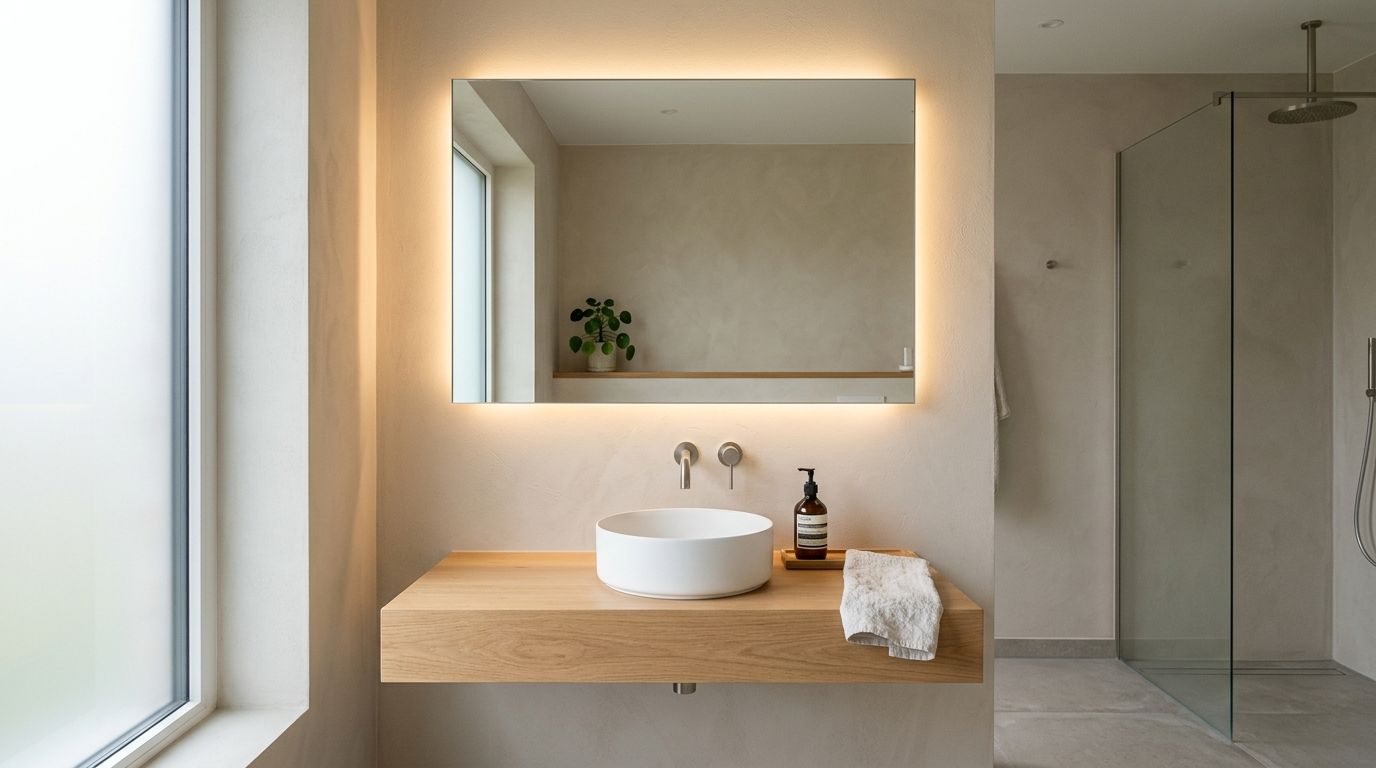
In Naples and Fort Myers homes, I see this approach used most often when the homeowner wants a spa look without adding decorative sconces or metal hardware to the wall. The mirror appears to float, and the light softens the entire vanity zone. It's excellent for atmosphere, but on its own it may not always give the strongest face-level task light.
What makes it work
The installation matters more than the strip itself. LED strips should sit in aluminum channels so the light stays even and the heat is managed properly. Wiring should be planned before the mirror goes up, because trying to retrofit visible cabling around a custom mirror almost always cheapens the result.
In humid bathrooms, I'd choose a sealed strip suitable for moisture exposure and pair it with a dimmer. That lets you run a cooler, brighter setting in the morning and a warmer feel at night.
Practical rule: Backlighting is strongest when you want mood plus clean design. If precision grooming is your priority, pair it with another light source.
Custom fabrication also matters here. The mirror has to be sized with lighting depth, mounting clearance, and wall flatness in mind. That's where working with a specialist in custom glass and mirror installations pays off.
If you want to see the floating effect in motion, this quick video shows the look clearly.
2. Sconce Lighting on Either Side of Mirror
You step up to the vanity, turn on the light, and your face is evenly lit instead of shadowed under the eyes and chin. That is what side sconces do better than almost any other bathroom mirror lighting option.
I specify this layout when the priority is grooming, makeup, shaving, and a more flattering reflection at the mirror. Light arrives from both sides of the face, so it reads cleaner and more natural than a single fixture above the mirror. In Southwest Florida homes, it also fits a wide range of styles, from polished brass in Old Naples remodels to pared-back opal glass in newer coastal contemporary baths.
Placement decides whether this looks custom or careless
Mounting height and spacing matter more than the fixture finish. In practice, side sconces usually perform best when the center of the fixture lands around eye level and the light source sits close enough to the mirror to reach the face directly without creating hot spots. Exact placement should be adjusted for the user's height, mirror width, and whether the fixture throws light up, down, or in all directions.
For a high-end result, I look at four specifications before I approve a fixture:
- CRI: Choose 90+ CRI so skin tones, makeup, and tile colors read accurately.
- Color temperature: Stay near 2700K to 3000K for a warm, flattering residential look. Go closer to 3000K if the bathroom gets little daylight and needs to feel crisp in the morning.
- Diffusion: Frosted or opal glass controls glare far better than exposed bulbs reflected in the mirror.
- Wet-location suitability: In humid baths, use a fixture with a bathroom-appropriate rating, and check the manufacturer's IP guidance if the sconce sits near a shower or tub zone.
That last point matters more in Southwest Florida than many homeowners expect. Salt air, constant humidity, and aggressive HVAC cycles can age the wrong finish quickly. Decorative sconces made only for dry rooms often show corrosion, haze, or premature driver failure in bathrooms that run hot and damp.
Scale matters too. A narrow powder room mirror can be overwhelmed by oversized lantern-style sconces, while a double vanity often needs taller fixtures with enough output to hold their own across a wider wall.
If you are choosing the mirror and sconces together, review custom mirror options for bathrooms before locking in fixture size and rough-in locations. Mirror width, edge detail, and whether the glass is framed or frameless all affect the spacing that looks balanced.
A simple rule I use on site: if the sconces make the mirror feel pinched, crowded, or glaringly bright at the edges, the composition is off. Done well, side sconces make a vanity look finished, intentional, and far more expensive than it is.
3. Overhead Vanity Light Bar or Pendant Cluster
You walk up to the mirror at 6:30 a.m., flip on the vanity light, and the top of your face is bright while your eyes and jaw fall into shadow. That usually points to one problem. The overhead fixture was chosen for looks first and light distribution second.
An above-mirror bar or a small pendant cluster can work very well, especially over a wide single mirror or a long double vanity where side-mounted fixtures would crowd the wall. In Southwest Florida homes, I see this approach often in primary baths with tall ceilings, floating cabinetry, and large mirror spans. The right fixture gives the wall a strong focal line. The wrong one creates glare, harsh forehead light, and reflections you notice every day.
Proportion matters, but placement matters more. A good rule is to keep the fixture visually subordinate to the mirror and vanity, not wider than either one. For most projects, linear bars are the safer choice because they spread light more evenly across the sink zone. Pendant clusters are more particular. They need ceiling height, careful spacing, and a mirror layout that can handle a stronger decorative statement without feeling busy.
The technical side is straightforward if you know what to check:
- Color temperature: 2700K to 3000K keeps the bathroom flattering and residential. In bright coastal homes with strong daylight, 3000K usually reads cleaner without looking cold.
- CRI: Choose 90+ CRI so skin tone, makeup, and shaving detail read accurately.
- Diffusion: Frosted lenses or etched glass soften reflected glare far better than exposed lamps.
- Moisture protection: For humid bathrooms, use a fixture rated for bathroom use. If it sits close to a shower or tub zone, verify the manufacturer's damp or wet location guidance and IP rating.
- Driver quality: In Southwest Florida, heat, humidity, and salt air expose weak LED drivers and cheap plated finishes quickly.
I specify overhead bars when the goal is strong task lighting with a clean architectural look. I reserve pendant clusters for larger bathrooms where the decorative payoff justifies the extra coordination. They can look excellent over a centered mirror, but they are less forgiving if the electrical box is off, the drops are uneven, or the pendants hang low enough to show in the mirror sightline.
Three mistakes show up repeatedly on job sites:
- Mounted too high: Light skims the forehead and leaves shadows under the eyes, nose, and chin.
- Too much sparkle, not enough shielding: Clear glass and exposed bulbs bounce glare straight back off the mirror.
- No layered support: A single overhead source rarely gives the same facial coverage as a well-planned combination of overhead and ambient light.
If you are pairing an overhead fixture with a custom mirror, review mirror and specialty glass styles for bathroom layouts before finalizing rough-in height and width. Mirror shape, frame depth, and edge detail all affect how the fixture reflects and whether the composition feels balanced.
For homeowners who want one direct answer, here it is. Choose a linear fixture first unless the bathroom has the ceiling height, mirror scale, and design budget to support pendants properly. It is the more dependable path to a polished result.
4. Integrated LED Lighting Within Mirror Surface
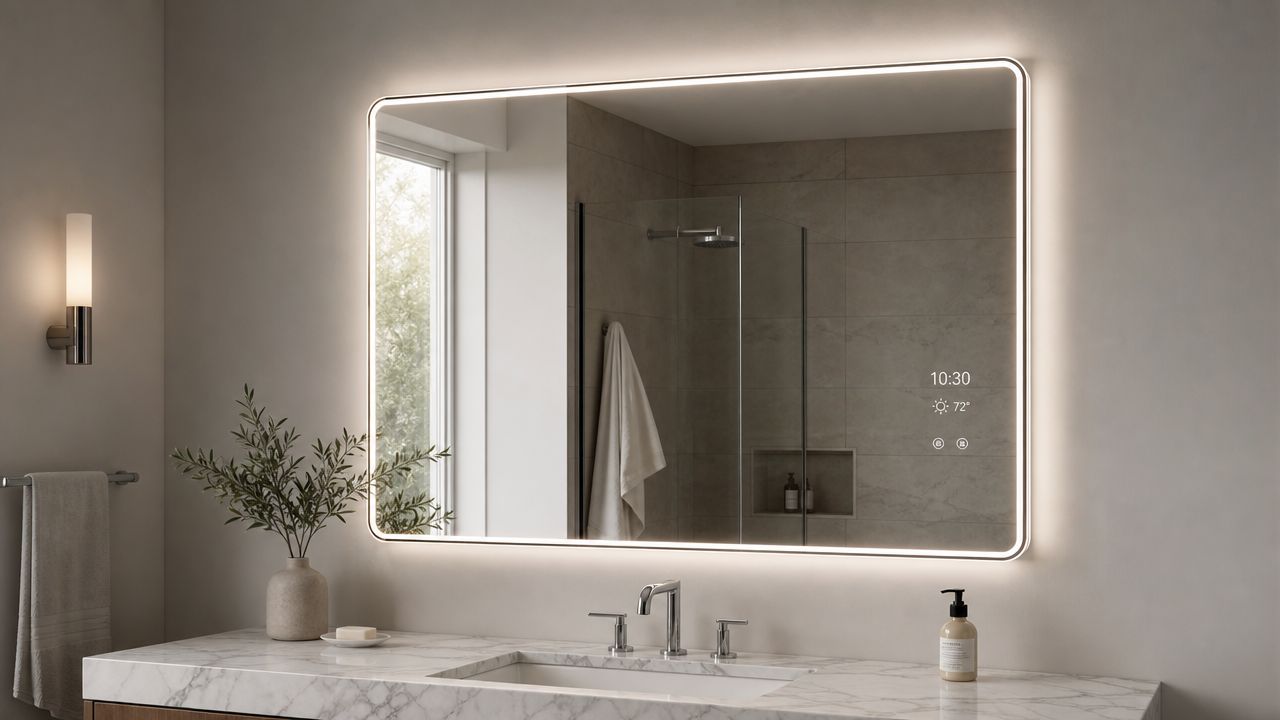
Integrated LED mirrors are for homeowners who want the mirror itself to do the work. No separate fixture. No visual layering to coordinate. Just a clean mirror face with light built in.
That's why they've become a natural fit in luxury condos, contemporary custom homes, and bathrooms where wall space is limited. Many also include defogging and touch controls, which can be useful in busy primary bathrooms.
Why the category keeps growing
The market is moving this direction. The global LED mirrors market is valued at about USD 2.8 billion in 2024 and is projected to reach around USD 5.2 billion by 2033, with a 7.2% CAGR according to Data Horizzon Research. That tells you homeowners and commercial buyers aren't treating integrated lighting as a novelty anymore.
Still, smart mirrors have trade-offs. If the electronics fail, repair is more specialized than changing a bulb in a sconce. And if the integrated light quality is mediocre, you can't swap in a better lamp later.
That's why I'd look for these features first:
- High color quality: A mirror light should render skin tone accurately, not flatten it.
- Reliable controls: Touch sensors are convenient, but physical backup control is worth having.
- Service access: Ask how the LED and defogging components can be serviced years from now.
If you're weighing styles, this overview of mirror and specialty glass options helps narrow down which integrated look fits a modern bathroom without overcomplicating it.
5. Recessed Ceiling Lights Around Mirror Perimeter
A common Southwest Florida remodel goes like this. The vanity wall is clean, the mirror is large, and the homeowner wants the room to feel quiet and architectural. Recessed ceiling lights can help get that look, but only if they are treated as room lighting first and mirror lighting second.
I specify them around the mirror perimeter to fill the space evenly and keep the ceiling visually calm. They do a good job lighting stone, millwork, and circulation areas. They do a poor job lighting faces on their own because the beam still comes from above, which creates shadows under the brow, nose, and chin.
That trade-off matters in real use. If shaving, makeup, or skincare happens here every day, recessed cans should support the vanity layer, not replace it.
How to make this layout work
The best results come from a disciplined spec, not from adding more fixtures. In a luxury bath, I look for high color accuracy, usually 90+ CRI, so skin tones, tile, and cabinetry read correctly. For color temperature, 2700K to 3000K usually suits warmer, more residential bathrooms, while 3000K to 3500K can work in a brighter contemporary space with a lot of daylight. In wet or humid conditions, use trims and housings with a bathroom-appropriate IP rating or wet-location listing where required by the fixture location and local code.
Placement matters just as much as the fixture itself. If the cans sit too close to the mirror, you get bright scallops and reflected glare. Too far out, and the vanity falls into a dim pocket. I also coordinate the layout with the exhaust fan, AC supply, and any ceiling detail early, because a clean reflected ceiling plan is part of what makes a bath feel expensive. Homeowners aiming for that polished look usually appreciate how glass and mirror choices contribute to a more luxurious home.
Use these checkpoints before you approve the plan:
- Choose the right trim: Baffle and low-glare reflector trims are easier on the eyes than open trims.
- Control beam spread: Wider beams help create an even ambient layer around the mirror zone.
- Put them on a dimmer: Bright cleaning light and evening light should not be the same setting.
- Check the location rating: Southwest Florida humidity is hard on poorly specified fixtures.
- Confirm serviceability: Integrated LED cans vary a lot in driver quality and replacement options.
I use recessed perimeter lighting most often in larger primary baths, double vanities, and bathrooms with full mirror walls where side sconces are not practical. Done well, it becomes the quiet layer that makes the mirror, stone, and millwork look better without calling attention to itself.
6. Hollywood-Style Bulb Lights Around Mirror Frame
This look is theatrical, and that's exactly why some homeowners love it. A mirror framed with exposed bulbs creates a dressing-room effect that feels bold, glamorous, and intentionally dramatic.
It can work in a bathroom, but only if you treat it as a style decision first and a technical decision second. In a sleek coastal bathroom, it may feel out of place. In a statement-making primary suite or boutique-style powder room, it can be fantastic.
The right way to keep it from looking dated
The modern version uses LED bulbs with softer diffusion, cleaner framing, and better dimming. What dates this style isn't the bulb perimeter itself. It's oversized plastic trims, uneven spacing, or bulbs that are too cool and too bright.
In Southwest Florida, humidity also changes the maintenance picture. Decorative bulbs collect residue more quickly, and condensation can make a once-crisp installation feel fussy if it isn't cleaned regularly.
I'd keep these points in mind:
- Use dimming: This style needs flexibility more than almost any other.
- Control color tone: Warm light is usually more flattering and less harsh.
- Seal the assembly properly: Bathroom conditions demand better moisture resistance than a bedroom vanity setup.
If you want a luxury look without going fully minimalist, this article on how glass can make a home feel luxurious is useful inspiration. Hollywood-style framing works best when the mirror itself still feels custom-made and refined.
7. Backlit or Edge-Lit Glass Mirror Technology
Edge-lit mirrors are a more refined cousin to simple backlighting. Instead of a broad halo around the mirror, the light reads as if it's traveling through the glass itself. The effect is sharper, thinner, and more technical.
That makes this one of the strongest bathroom mirror lighting ideas for modern homes where every line matters. In high-end primary baths, wellness spaces, and contemporary powder rooms, edge lighting feels deliberate in a way a standard fixture often doesn't.
Why glass quality matters here
This is not just a lighting purchase. It's a glass fabrication decision. The clarity of the glass, the way the edges are finished, and the consistency of the light path all affect whether the mirror looks premium or gimmicky.
In Florida homes with large windows and strong daylight, edge-lit mirrors can look especially elegant because the glass remains visually light during the day and turns luminous at night. I'd also strongly consider anti-fog integration if the shower is close to the vanity.
The cleaner the glass, the cleaner the light line.
For homeowners who want this look, I'd pay close attention to glass selection, not just LED features. Ultra-clear glass options can make a visible difference when the lighting is meant to show through or around the mirror edge with precision.
The downside is complexity. Repairs and replacements are more specialized, and installation tolerances are tighter than they are with a standard framed mirror and separate fixture.
8. Adjustable Track Lighting or Pendant Lights
Track lighting gives you flexibility that fixed vanity lights can't. If multiple people use the bathroom differently, or if the room includes a makeup station, dressing area, or long double vanity, being able to aim the light matters.
This is a practical solution in larger bathrooms and loft-style spaces where a purely decorative setup won't do enough work. It's also useful when architecture limits where a traditional vanity fixture can go.
Best for complicated layouts
I recommend track lighting most often when the mirror wall isn't straightforward. Maybe there's a window interrupting one side. Maybe the vanity is unusually long. Maybe the ceiling plane makes centered sconces awkward. Adjustable heads let you direct light where the room needs it.
Pendant lighting can offer similar flexibility in feeling, though not always in movement. Pendants are better when you want vertical emphasis. Tracks are better when utility comes first.
The global vanity light market stood at USD 2.61 billion in 2024 and is projected to reach USD 4.50 billion by 2033, while the broader smart mirror market is projected to grow at a 15.03% CAGR from 2026 to 2034 according to Dataintelo. That lines up with what homeowners are asking for now. More control, more customization, and lighting that adapts to routines rather than forcing one fixed setting.
A few cautions:
- Watch the finish quality: Cheap track systems age badly in humid rooms.
- Use glare control: Exposed directional lamps can be brutal in a mirror.
- Keep the composition tidy: Flexibility shouldn't turn into visual clutter.
9. Natural Window Light Optimization with Mirror Placement
You walk into the bathroom at 10 a.m., flip nothing on, and still get a clean reflection at the vanity. That is the payoff of good mirror placement near natural light.
In Southwest Florida, daylight is abundant, strong, and often harsh. Used well, it gives you crisp color, a more open-looking room, and less dependence on electric light during the day. Used poorly, it creates glare on the glass, hot spots on the face, and privacy problems that are hard to ignore in a primary bath.
The best placements are usually beside a window or on a wall that catches borrowed daylight, rather than directly across from intense western sun. A mirror opposite a window can brighten the room, but it can also throw a bright reflection straight back at you at certain hours. I treat this as a sightline exercise first, then a lighting decision. Stand at the sink, note where the sun hits in the morning and late afternoon, and check what the mirror will reflect from both inside and outside the room.
Natural light also changes by the hour, so it cannot carry the full job. Daytime grooming looks best under light that reads clean and neutral, and evening use needs a warmer, dimmable layer. As noted earlier in the article, that usually means pairing daylight with high-quality fixtures in the right Kelvin range and using damp-location-rated or splash-resistant products where the vanity is exposed to moisture. In Southwest Florida, I also recommend corrosion-resistant hardware and quality mirror backing because humidity shortens the life of cheaper components fast.
A few placement rules help:
- Use daylight from the side when possible: Side light is more flattering on the face and easier to control than direct reflected sun.
- Check glare before finalizing the layout: Full-height windows, polished stone, and glossy tile can multiply brightness once the mirror is installed.
- Protect privacy: A mirror can reflect a window view from angles you did not expect, especially in showers, water closets, and baths facing neighboring homes.
- Choose better glass: Low-iron mirror glass gives a cleaner reflection with less green cast, which matters in bright bathrooms with pale stone and high-end finishes.
- Keep artificial light in the plan: Aim for vanity lighting with CRI 90+ so skin tones still look accurate after sunset.
This approach is quieter than integrated LEDs or decorative fixtures, but in the right room it can look more expensive because it feels architectural. The mirror is not just filling wall space. It is directing daylight, improving function, and helping the whole bathroom read brighter and larger without adding visual clutter.
Bathroom Mirror Lighting: 9-Option Comparison
| Option | 🔄 Implementation Complexity | ⚡ Resource & Cost | ⭐ Expected Outcomes | 📊 Ideal Use Cases | 💡 Key Advantages / Tips |
|---|---|---|---|---|---|
| LED Strip Lighting Behind Mirror Frame | Medium, channel mounting & concealed wiring; pro install recommended | Moderate, IP-rated LED strips, aluminum channels, dimmer; moderate upfront cost | ⭐⭐⭐⭐, even halo accent, modern ambient glow; not always sole task light | Frameless/custom mirrors, contemporary bathrooms, spa-like vanities | 💡 Use IP65+ strips, warm whites for ambiance, plan wiring before mirror install |
| Sconce Lighting on Either Side of Mirror | Low, simple wall mounting and wiring; DIY possible | Low–Moderate, two fixtures, switches/dimmer; wide price range by style | ⭐⭐⭐⭐, balanced facial illumination, minimal shadows when placed correctly | Makeup/shaving-focused bathrooms, traditional or mixed-style designs | 💡 Mount at eye level (60–65"), 36–40" spacing, use diffusers and dimmers |
| Overhead Vanity Light Bar or Pendant Cluster | Medium, ceiling mount or pendant suspension; single-point wiring easier than dual sconces | Moderate, fixture(s), possible canopy/ceiling reinforcement; variable cost | ⭐⭐⭐, strong top-down task lighting; may cast shadows without side light | Wide mirrors, contemporary or statement-design bathrooms | 💡 Match fixture width to mirror, mount ~30–36" above counter, choose diffusers |
| Integrated LED Lighting Within Mirror Surface (Smart Mirrors) | High, built-in electronics, anti-fog, smart integration; professional install required | High, expensive unit, electrical, Wi‑Fi integration, potential future maintenance | ⭐⭐⭐⭐⭐, seamless illumination, anti-fog, smart features; space-saving and precise color control | Luxury homes, smart bathrooms, high-end commercial projects | 💡 Verify warranty/support, ensure stable Wi‑Fi, choose humid-rated components |
| Recessed Ceiling Lights Around Mirror Perimeter | Medium–High, multiple ceiling penetrations, attic access and circuit planning | Moderate–High, several recessed cans/trim kits and LED retrofits; higher labor costs | ⭐⭐⭐⭐, clean, distributed light when positioned correctly; minimal visual clutter | Minimalist modern bathrooms, commercial installations, spaces favoring hidden lighting | 💡 Position 12–18" above mirror, space fixtures for even coverage, use baffle trims & dimmers |
| Hollywood-Style Bulb Lights Around Mirror Frame | Medium, many sockets and wiring; custom framing may be needed | Moderate–High, multiple bulbs, sealed housings for humidity; ongoing maintenance cost | ⭐⭐⭐⭐, bold, high-brightness task lighting and strong visual statement | Vanity/makeup-focused spaces, theatrical or glamorous luxury designs | 💡 Space bulbs 6–8" apart, use warm LED replicas, install dimmers and waterproof housings |
| Backlit or Edge-Lit Glass Mirror Technology | High, specialized glass fabrication and embedded LED integration; pro glass expertise required | High, custom glass, integrated LEDs, electrical routing; premium price and lead times | ⭐⭐⭐⭐⭐, uniform internal glow, minimalist/very high‑end aesthetic; shadow-free illumination | Signature luxury bathrooms, high-end spas, projects prioritizing bespoke glass work | 💡 Work with glass specialists, plan electrical early, confirm humidity ratings and warranty |
| Adjustable Track Lighting or Pendant Lights | Medium, track layout and secure ceiling mounting; flexible reconfiguration | Moderate, track systems or multiple pendants, possible ceiling reinforcement | ⭐⭐⭐, highly flexible directional lighting; versatile but requires positioning care | Large bathrooms, master suites, loft-style or multi‑task vanity areas | 💡 Use damp-rated tracks, orient tracks for even mirror coverage, add diffusers to reduce glare |
| Natural Window Light Optimization with Mirror Placement | Low–Medium, planning and precise mirror placement; no electrical work | Low, custom mirror sizing/placement; minimal material cost compared to powered options | ⭐⭐⭐⭐, excellent daytime light quality, energy savings, flattering natural illumination | Bathrooms with good window access, sustainable or biophilic designs | 💡 Use ultra-clear glass, model daylight paths, combine with artificial lighting for evenings |
Your Blueprint for Brilliant Bathroom Lighting
The best bathroom mirror lighting rarely comes from copying a single showroom photo. It comes from matching the right lighting method to the way you use the room. If you shave or apply makeup daily, face-level light matters more than dramatic ambiance. If your bathroom doubles as a retreat when winding down, dimming and warmer evening light deserve more attention. If you're building or remodeling in Southwest Florida, moisture resistance and finish durability have to be part of the decision from the start.
That's why I don't look at bathroom mirror lighting ideas as purely decorative choices. I look at them as performance systems. Light quality, fixture placement, glass selection, moisture protection, and serviceability all affect whether the space feels easy and luxurious or frustrating and overdesigned.
A strong plan usually includes three decisions. First, choose the primary visual approach, such as sconces, a light bar, an integrated LED mirror, or a backlit glass solution. Second, decide how you'll support it with ambient light, whether that's recessed ceiling lighting or daylight reflected through careful mirror placement. Third, make sure the specifications match the room. For bathroom use, color rendering should be high, fixture placement should be intentional, and moisture exposure shouldn't be treated as an afterthought.
Southwest Florida homes add another layer. Salt air, humidity, and long-term maintenance aren't abstract concerns here. They shape what ages well. A fixture that looks impressive online may not hold up gracefully if its finish, housing, or electrical details weren't chosen for a humid environment.
There's also a design reality many homeowners discover too late. The mirror and the lighting shouldn't be selected separately if you want a polished result. The mirror size affects fixture width. The wall finish affects glare. The mounting method affects how clean the final installation looks. That's why working with a glass and mirror specialist can save you from expensive revisions later.
If you want a bathroom that feels brighter, sharper, and more intentional, bring the mirror and the lighting conversation together from the beginning. A company such as AmeriGlass Industries may be one relevant option for homeowners in Southwest Florida who need custom mirror solutions coordinated with the practicalities of local installation. And if you're also thinking about resale, this guide for real estate agents on bathrooms is a useful reminder that buyers notice bathrooms that feel clean, current, and well planned.
If you're ready to upgrade your vanity with a custom mirror and a lighting approach that fits your space, talk with AmeriGlass Industries. Their team works with homeowners, builders, and designers across Southwest Florida on custom mirrors and glass installations that can support a cleaner, more deliberate bathroom lighting plan.