
Commercial window replacement usually runs $450 to $1,800 per window installed or $50 to $150 per square foot, and the final number depends heavily on the window system, site access, code requirements, and scope. In Southwest Florida, that headline range is only the starting point because hurricane-rated products, permitting, and installation conditions often drive the actual invoice.
If you're reading this, there's a good chance you're staring at fogged glass, failed seals, leaks after a storm, or a tenant complaint that won't go away. The budget wasn't supposed to include windows this quarter, but now you're trying to figure out whether you're looking at a manageable repair cycle or a full capital project.
That uncertainty is normal. Commercial window replacement isn't a niche problem. The U.S. commercial windows market was estimated at USD 3.27 billion in 2025 and is projected to reach USD 5.09 billion by 2033, with a projected 5.7% CAGR from 2026 to 2033, according to Grand View Research's U.S. commercial windows market analysis. Replacement demand keeps moving through offices, retail, healthcare, and education because buildings age, standards tighten, and owners eventually have to deal with openings that no longer perform.
In Southwest Florida, the mistake is treating this like a simple per-window purchase. It isn't. You're buying field measurement, code review, product selection, access planning, removal, installation, sealing, cleanup, and often permit coordination. If you need a starting point for your own property, the fastest next step is to request a commercial glass quote with the building type, opening count, and photos of the problem areas.
Your Guide to Budgeting for Commercial Window Replacement
A new property manager usually starts with the wrong question. They ask, "How much is one window?" The better question is, "What will it cost to replace these openings correctly in this building, under these site conditions, in this part of Florida?"
That's the difference between a rough internet estimate and a usable budget.
What the first budget conversation should sound like
When a building has isolated failure, a simple count of openings might get you close enough for early planning. When several windows are leaking, hardware is failing, frames are aging, or the property sits in a storm-exposed corridor, the budget discussion has to widen fast.
Three things usually determine whether your early number holds up:
- How the building is built: A ground-floor storefront and a multi-story office don't price the same way, even if the visible glass area looks similar.
- What code requires: In Southwest Florida, wind resistance and impact considerations affect product choice, anchoring details, and permit review.
- How crews can access the work: Exterior lifts, tenant coordination, protection of interiors, and disposal planning often shape labor more than the glass itself.
Most overruns don't happen because someone miscounted windows. They happen because the original budget ignored the conditions around those windows.
Why this project feels bigger than you expected
Property managers often discover window failure gradually. First it's condensation. Then a leak after wind-driven rain. Then a lock doesn't engage, a sash won't operate correctly, or perimeter sealant starts to fail in multiple openings. By that point, the issue is no longer cosmetic. It affects tenant comfort, maintenance calls, and exposure to further damage.
A realistic budget for commercial window replacement cost has to account for the building envelope, not just the unit price. That's especially true in Southwest Florida, where weather exposure isn't an occasional stress test. It's part of the job.
Decoding Commercial Window Replacement Price Ranges
Property managers usually ask for a price per window because it feels concrete. Then the first real proposal shows square footage, system types, glazing options, and line items that do not map cleanly to a simple window count. That disconnect is one reason early budgets miss the mark.
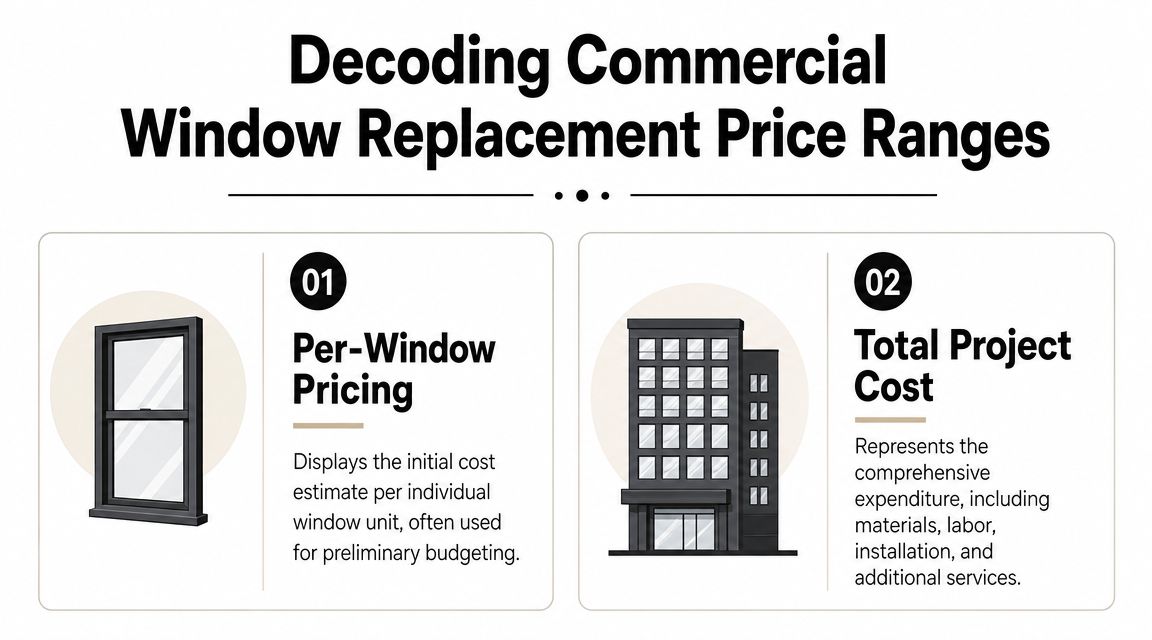
Commercial pricing is usually presented in one of two ways: per window or per square foot. Both are valid. The right format depends on the building and the scope.
When contractors use per-window pricing
Per-window pricing fits buildings with distinct, repeatable openings. Offices, schools, medical buildings, and many low- to mid-rise properties fall into this category. If each unit can be measured, removed, and replaced as an individual opening, pricing by unit is a practical starting point.
It works best when the project has:
- Repeated sizes: Similar openings reduce estimating guesswork.
- Consistent frame conditions: Matching systems are easier to price than a mix of old retrofits and field-modified openings.
- A planning-stage budget: Owners often need a rough allowance before destructive inspection or full field verification.
This method is useful early, but it can hide risk. Two windows that look identical on an elevation can price very differently once crews find damaged substrates, irregular openings, failed anchors, or interior finishes that have to be protected during removal.
When per-square-foot pricing makes more sense
Per-square-foot pricing is more common for storefronts, curtain wall sections, and large glazed areas. In those projects, the framing layout, glass makeup, and attachment details drive the budget as much as the number of visible lites.
Use that model when:
- The glazing acts as a system: Mullions, transoms, and anchors are part of the cost, not just the glass.
- The openings are large or continuous: Retail frontage and lobby glass are typical examples.
- The replacement affects an entire elevation: Area-based pricing usually reflects the work more accurately than assigning a unit count.
For bid review, consistency matters more than the format itself. A per-window proposal can be fair. A per-square-foot proposal can be fair. They are only comparable if both include the same scope, glazing performance, demolition, sealants, and finish conditions. If you need help sorting through contractor terminology, AmeriGlass publishes commercial glass FAQs for property owners and facility teams that explain common scope and product terms.
Use price ranges carefully
Published national ranges can help with rough budgeting, but they are only a starting point. They usually do not capture the cost difference between a basic replacement in an accessible opening and a code-driven project with impact-rated glass, upgraded anchorage, submittals, inspections, and tenant coordination.
That gap matters in Southwest Florida.
A realistic budget should also account for the contractor's overhead tied to safety planning, supervision, and risk. On larger or more exposed jobs, firms often carry added coverage through specialty contractor insurance programs, and that cost is part of doing the work properly, not a markup pulled out of thin air.
A better baseline for early budgeting
For early planning, use the price format that matches the building, then add a contingency for conditions you cannot confirm from drawings or a parking-lot walk. Thermally broken aluminum is still a common baseline in commercial work because it is durable and widely specified, but the actual project number depends on the full assembly and the installation conditions, not just the frame type.
That is the difference between a usable budget and a number that falls apart once the field measurements start.
The Hidden Drivers That Shape Your Final Quote
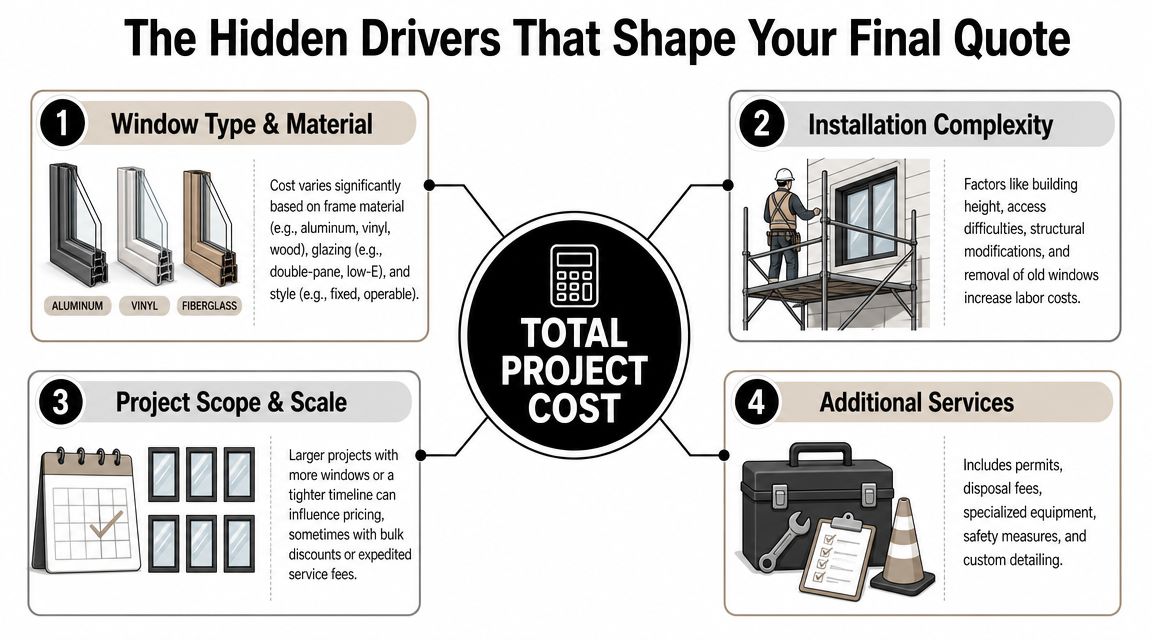
The biggest misunderstanding around commercial window replacement cost is thinking the quote covers "a window and labor." A real commercial quote covers access, safety, removal, disposal, protection, scheduling, supervision, and coordination with the building's actual conditions.
That's why a quote can look much higher than the headline price range.
According to Energy Shield's commercial window replacement cost guide, high-rise work, permits, after-hours service, and access equipment can add a 50-100% premium. In practice, that's the gap many owners miss when they compare online averages to actual contractor proposals.
Labor is not just installation
Commercial labor includes more than setting glass and fastening frames. Crews have to protect occupied space, remove existing units without damaging adjacent finishes, correct irregular openings, seal the assembly correctly, and leave the area safe and clean.
That gets more expensive when the property has:
- Occupied tenant spaces: Work windows shrink, and coordination grows.
- After-hours requirements: Retail and medical spaces often need off-peak scheduling.
- Sensitive interiors: Finished offices, displays, and equipment require protection and careful sequencing.
Access changes the whole budget
A first-floor replacement with open exterior access prices very differently from a multi-story building with limited staging. In Southwest Florida, access planning often decides whether a project stays efficient or becomes a scheduling headache.
Watch for these cost drivers:
- Lift or scaffold needs: Exterior equipment affects labor flow and site logistics.
- Restricted parking or staging: Downtown and tight commercial sites slow production.
- Interior-only access: Protecting occupied interiors takes more time than many owners expect.
Practical rule: If crews can't reach the window easily, the labor side of the quote becomes just as important as the product side.
The line items owners tend to miss
These are the charges people often assume are included when they aren't clearly discussed upfront:
| Cost driver | Why it matters |
|---|---|
| Removal and disposal | Old frames, glass, sealants, and debris have to be removed and hauled legally and safely |
| Permitting and inspections | Commercial work often requires review, documentation, and inspection scheduling |
| Project supervision | Someone has to coordinate measurements, deliveries, crews, and punch items |
| Insurance and risk controls | Larger commercial jobs carry liability considerations that reputable contractors price into the work |
On bigger jobs, it also helps to understand what your contractor carries behind the scenes. Owners and GCs comparing vendors often review documentation around liability, workers' comp, and project-specific risk management. This overview of specialty contractor insurance programs is a practical reference if you're vetting how commercial trades structure coverage.
If you're reviewing different glazing systems or related project types, a product overview like AmeriGlass commercial glass products can help you separate standard systems from more specialized assemblies that usually come with more involved installation requirements.
The Southwest Florida Factor Hurricane Codes and Materials
A Fort Myers property manager can approve a window budget based on a national per-unit number and still end up short once the local submittal package starts. In Southwest Florida, the actual cost jump usually comes from code compliance, product approvals, and opening conditions that only show up after demolition begins.
That is why local commercial window replacement budgets often feel out of sync with online averages.
Hurricane requirements change the whole scope
In this region, impact resistance affects more than the glass. It affects the full assembly, including frame selection, anchorage, sealants, attachment spacing, and the paperwork required to get the job through review. If the specified system does not match the building exposure, opening size, or approval path, the cheapest number on bid day can become the most expensive number in the job.
Property managers also need to budget for the administrative side. Product approvals, shop drawings, engineering review on some scopes, permit comments, and inspection coordination all take time and money. National articles often treat those steps as minor. They are not minor on coastal commercial work.
Material selection is tied to exposure, not preference
Aluminum remains the common starting point for many commercial buildings because it holds up well and fits a wide range of storefront and punched-opening applications. In Southwest Florida, though, coastal exposure and storm code can push a project into heavier, impact-rated systems fast.
That price increase is not just about thicker laminated glass. The system may require stronger framing members, different anchors, more involved waterproofing details, and stricter installation tolerances. Owners who compare a standard commercial window to an approved hurricane-rated assembly as if they are interchangeable products usually underbudget the job.
Where budgets usually break
The biggest misses tend to show up in a few predictable places:
- Permit and approval review: Local jurisdictions often want exact product approvals, mullion details, and clear scope descriptions before issuing permits.
- Opening repairs after removal: Older buildings regularly reveal deteriorated substrates, uneven conditions, hidden corrosion, or failed waterproofing that must be corrected before new units can be set.
- Installation requirements for rated systems: Fastener type, embedment, sealant compatibility, and perimeter detailing have to match the approved assembly, not just the crew's standard practice.
- Phasing around weather and occupancy: On occupied commercial properties, crews may need temporary protection, off-hours work, or tighter sequencing to keep the building secure during replacement.
I tell owners to read low bids carefully. In this market, a cheap quote often means somebody assumed a clean opening, light permit review, and no substrate repairs.
Local execution matters as much as the product approval
A product sheet only shows what the system can do under the right conditions. The field crew still has to measure correctly, verify substrates, order the right configuration, and install it the way the approval requires. That is true on large commercial openings and on smaller specialty glass work like frameless shower door installation in Fort Myers, where final performance depends on exact dimensions, sound backing, and clean installation details.
For commercial window replacement, those field decisions directly affect total project cost. If the contractor misses the local code path or the opening condition, the owner pays for it later in change orders, delays, or failed inspections.
Smart Strategies to Manage Your Window Replacement Budget
A Southwest Florida property manager approves a window budget based on unit counts and a clean per-opening number. Then permit comments require a different approved assembly on the street-facing elevations, two openings need concrete repair after removal, and the schedule shifts because one tenant cannot give daytime access. The budget problem was never the glass alone. It was the full project scope.
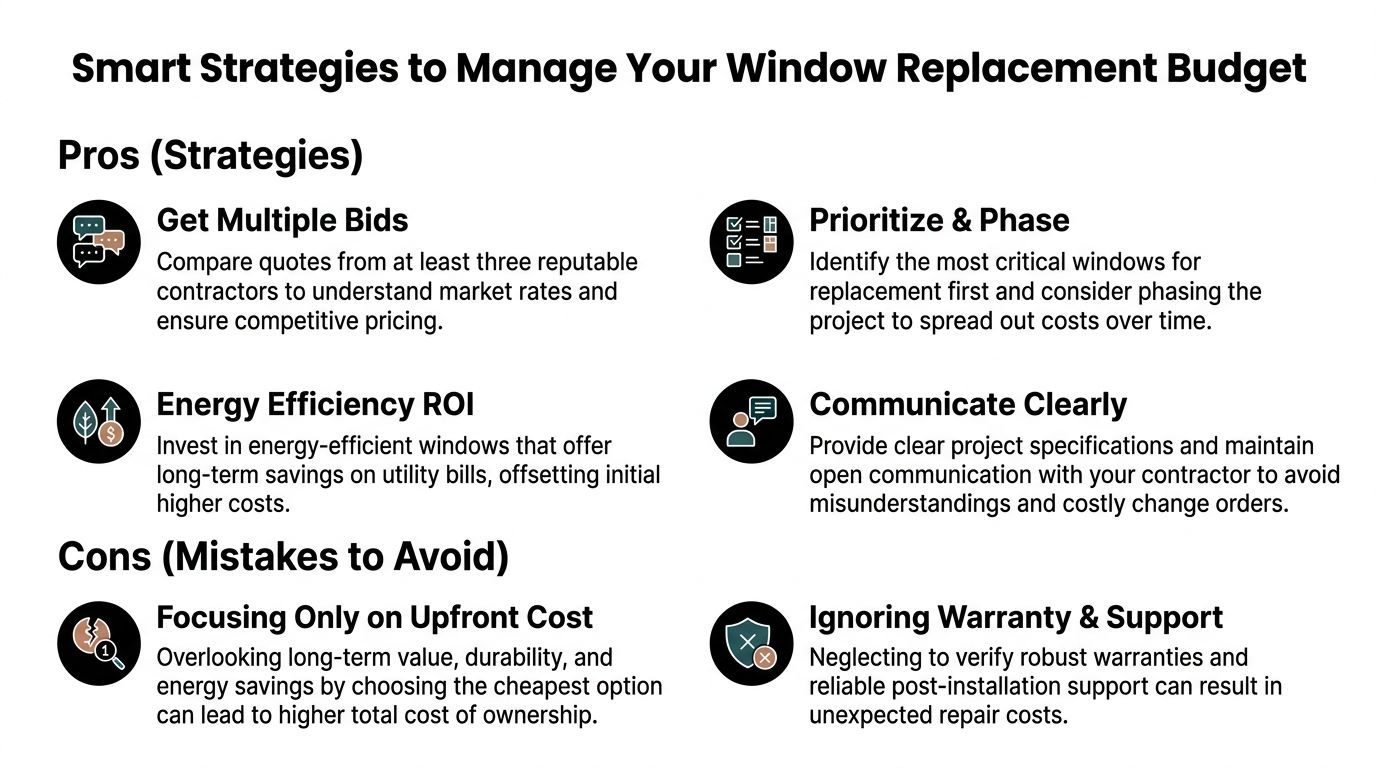
Good budget control starts with one question. Which openings require full replacement, and which ones can wait, be reinforced, or be handled in a later phase?
Replace everything or target the money where it reduces risk
Some properties need a full changeout. Others do better with a mixed plan that protects the building first and spreads capital work over time.
According to Riot Glass's discussion of reinforcing commercial windows without a full replacement, retrofit security glazing can be a lower-cost option in some cases. That does not make it the right answer for every commercial building in this region. If frames are deteriorated, water is already getting in, operation is unreliable, or the existing assembly will not satisfy current project requirements, patching around the system usually delays a larger expense.
A practical budget review usually breaks down like this:
- Use full replacement for failed frames, recurring leaks, poor operation, or openings where the existing system creates a code or insurance problem.
- Use retrofit selectively where frames are still sound and the goal is added protection, not a full reset of the opening.
- Use phased replacement on larger properties with mixed conditions. Start with exposed elevations, active problem areas, and tenant-critical spaces.
That approach usually produces a better capital plan than replacing every unit at once because all the windows are the same age.
Build contingency into the job before the first unit comes out
Existing buildings hide costs. Southwest Florida buildings hide more of them than national pricing guides suggest.
Once removal starts, crews may find wet backup, failed anchors, corroded steel, cracked masonry, or interior finishes that need protection and patching. On paper, those items look like change orders. In practice, they are common parts of replacement work on aging coastal properties.
Set aside contingency from the start. If the project only works financially when every opening is square, dry, and ready for the new unit, the budget is too tight.
Three budget decisions that protect the total project cost
Phase by exposure and consequence
Replace the openings that can do the most damage first. That usually means leaking units, wind-exposed elevations, and spaces where failure disrupts tenants or operations.Compare scopes, not just totals
One quote may include lifts, disposal, permit coordination, tenant protection, finish repairs, and project closeout. Another may price the window and basic installation only. The cheaper number often gets expensive fast.Plan around operations early
After-hours work, tenant access limits, interior protection, and security requirements can change labor cost more than many owners expect. Set those rules before bidding so contractors price the same job.
For owners who want a contractor with a documented local process, AmeriGlass Industries' company background and project approach gives a useful picture of how commercial work is reviewed before fabrication starts. That kind of upfront planning helps control the budget, which includes permits, access, repairs, protection, and scheduling, not just the window package.
Choose Your Partner The AmeriGlass Industries Advantage
A proposal can look competitive and still miss the costs that decide whether the project stays on budget. I see that happen when the number covers the window package and installation labor, but leaves permit follow-up, access equipment, interior protection, finish repairs, or dry-in planning to be sorted out later. In Southwest Florida, those gaps show up fast.
The contractor you choose affects total project cost as much as the product you buy. On coastal commercial work, the job has to clear code review, fit the actual opening conditions, and hold up to wind and water exposure. A low bid that glosses over those steps often turns into schedule delays, added mobilizations, and field fixes after units are already ordered.
What to verify before you sign
- Licensing and insurance: Ask for current documentation, not a verbal confirmation.
- Southwest Florida code experience: The contractor should be able to explain product approvals, wind-load requirements, anchoring, and permit expectations for your building type and location.
- Detailed scope: Confirm whether the quote includes lifts, removal, disposal, sealants, waterproofing, interior protection, temporary security, and closeout.
- Field verification: Measurements alone are not enough on older properties. The contractor should inspect conditions that can affect framing, attachment, and substrate repair.
- Change-order process: You need to know how concealed damage, out-of-square openings, and code-driven revisions will be priced and approved before the crew starts removing units.
Cost accuracy starts there. As noted earlier, real replacement work often comes in above the first budget number when field conditions are not fully addressed up front. The better contractors account for that risk early and explain where allowances or contingencies belong.
Why process control matters
Poor process is expensive in predictable ways. Units get ordered before permit comments are resolved. Access gets figured out after the schedule is published. Crews open a wall and find wet framing, failed sealant, or attachment conditions that were never discussed during estimating.
A disciplined process reduces those surprises.
| What you want to see | Why it matters |
|---|---|
| Measured openings matched to approved products | Avoids ordering errors and permit conflicts |
| Access, phasing, and tenant coordination defined early | Limits downtime, repeat mobilization, and after-hours labor |
| Clear allowance or contingency language | Sets expectations for substrate repairs and concealed conditions |
| Named project supervision and communication path | Speeds decisions when the field conditions change |

If you are screening local firms, review their background before you ask for a final number. The AmeriGlass Industries company background and project approach shows the kind of information owners should verify with any contractor doing commercial window work in this region. You want to know who measures, who manages permits, who supervises installation, and whether the team regularly handles occupied properties in coastal Southwest Florida.
Commercial window replacement cost is the full cost to get the work approved, installed, sealed, and closed out correctly. That is what protects the budget.