

Stepping into a freshly cleaned shower feels great for about a day. Then the haze comes back. Soap residue builds at the bottom edge, water spots dry into place, and the glass that looked sleek on install day starts asking for constant attention.
That's the moment many Southwest Florida homeowners start looking at self cleaning glass technology. The promise is simple. Less scrubbing, fewer streaks, and glass that keeps its clarity longer. It sounds especially appealing in places like Naples, Bonita Springs, and Fort Myers, where bright sun, humidity, and frequent bathroom use can make maintenance feel endless.
The catch is that self-cleaning glass isn't magic. It's a real technology, and in the right setting it can help. But it also has limits that many product descriptions gloss over, especially in dry stretches when the system's rinse cycle doesn't happen naturally. If you're researching options through a local glass specialist such as AmeriGlass Industries, it helps to understand what the glass can realistically do before you pay for it.
Introduction to Self Cleaning Glass Technology
Sara had just finished a bathroom remodel in Naples. Frameless glass, bright tile, clean lines. For the first week, everything looked polished. By the second, she noticed the return of what every shower owner knows too well. Film near the handle, dots from hard water, and a cloudy look that made the whole room seem less clean than it was.
She didn't want another cleaning routine. She wanted glass that helped itself.
That's why self cleaning glass technology gets so much attention. For homeowners, it sounds like a direct answer to a daily nuisance. For contractors and designers, it sounds like a premium feature that supports a modern, low-maintenance look. In broad terms, the idea is straightforward. The glass surface is treated so dirt or residue is either broken down, rinsed away more easily, or prevented from sticking as aggressively.
Why the idea is so appealing
The initial focus isn't often on coating chemistry. Instead, it's on chores.
A shower door, skylight, or exterior window becomes frustrating when it needs repeat cleaning to stay presentable. Self-cleaning products appeal because they shift the question from “How do I scrub this better?” to “Can the surface do some of the work for me?”
That's a worthwhile question. It's also where confusion begins, because several different technologies get grouped under the same label.
Self-cleaning glass can reduce work. It doesn't eliminate the need to think about climate, water, light, or installation details.
Why Southwest Florida changes the conversation
Southwest Florida is a useful test case because local conditions are mixed. There's plenty of sun. That helps some glass technologies. But there are also long dry spells, mineral-heavy water in some homes, salt exposure near the coast, and indoor applications like shower enclosures that don't get natural rainfall at all.
That combination matters. A product that performs well on a sloped exterior roof panel may disappoint on an indoor shower door. A feature marketed as “self-cleaning” may really mean “self-assisting,” and that difference matters when you're spending on custom glass.
Understanding Self Cleaning Glass Concepts
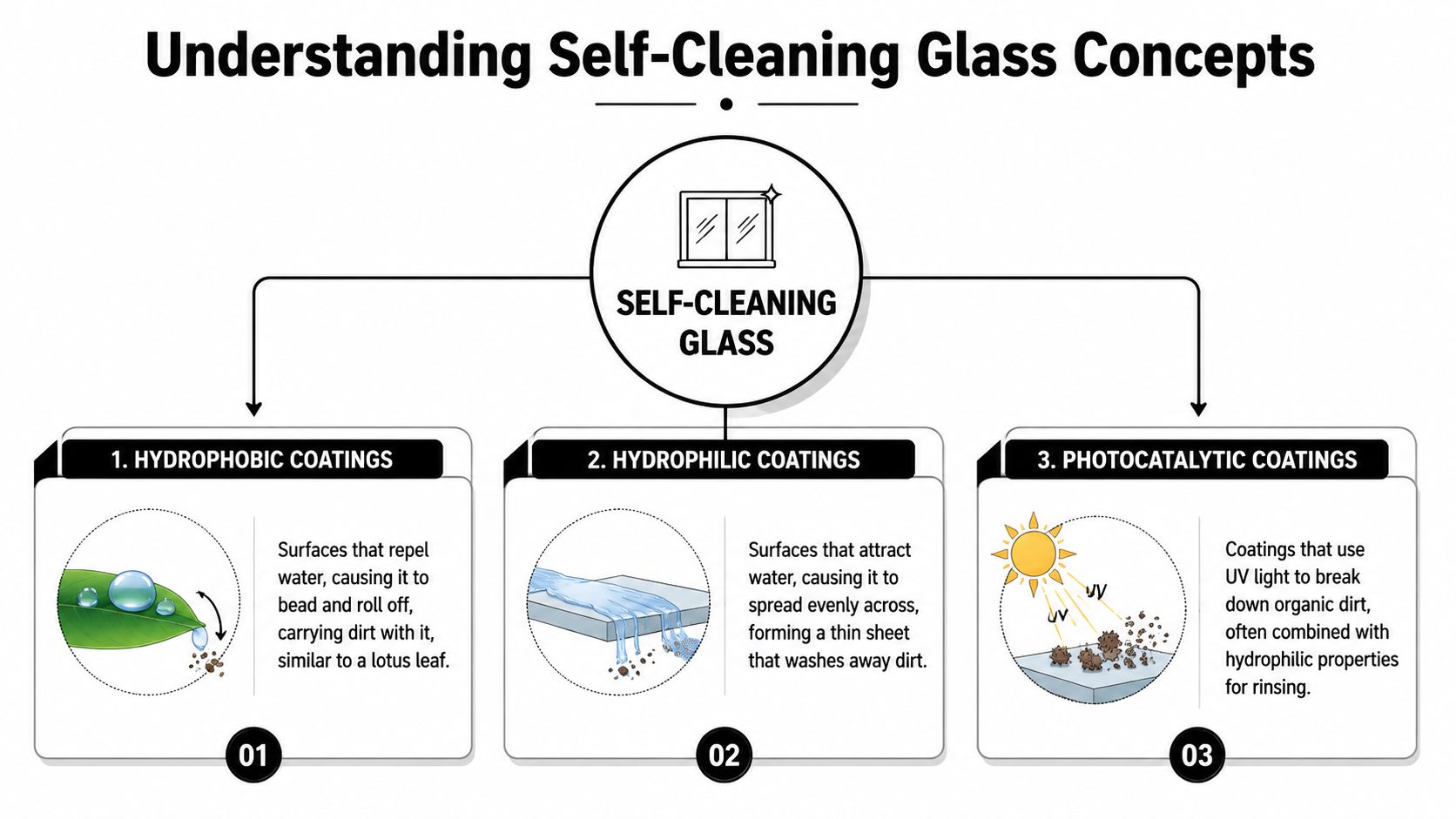
The phrase self cleaning glass technology usually covers three different ideas. If you mix them together, it's hard to compare products clearly.
The easiest way to sort them is to think about what each surface wants water, light, or dust to do.
The three main approaches
Hydrophobic coatings try to make water bead up and roll away. Think of rain sitting on a waxed car hood. The droplets gather loose debris as they move. These coatings are often easy to understand because you can see the beading effect right away.
Hydrophilic coatings do the opposite. They make water spread out into a thin sheet instead of forming droplets. That sheet can rinse a surface more evenly and leave fewer marks behind.
Photocatalytic coatings add chemistry to the mix. A thin surface layer reacts to UV light and starts breaking down organic grime. Many self-cleaning glass products combine this action with hydrophilic behavior, so sunlight helps loosen dirt and water helps carry it away.
For homeowners comparing options for clear interior applications, it also helps to understand the base glass itself, especially when visual clarity matters. A quick look at ultra-clear glass options can help you separate the look of the glass from the behavior of the coating.
A plain-language way to picture each one
Here's the simple version.
- Hydrophobic means repel. Water wants off the surface fast.
- Hydrophilic means sheet. Water spreads instead of spotting.
- Photocatalytic means react. Light helps the surface break down organic residue.
If you want an analogy, hydrophobic glass acts a bit like a rain jacket. Hydrophilic glass acts more like a countertop freshly rinsed with a flat sheet of water. Photocatalytic glass acts like a surface that uses sunlight as a trigger for a cleanup reaction.
What usually confuses buyers
Many homeowners hear “self-cleaning” and assume all products work the same way. They don't.
A few practical distinctions help:
- For outdoor glass with sun and weather, photocatalytic and hydrophilic systems make the most sense.
- For indoor shower use, a water-repelling or protective coating may feel more intuitive because you control the rinse, not the weather.
- For dusty, water-scarce environments, newer electric-field systems point in a different direction entirely.
Practical rule: Before comparing brands, ask what the technology depends on. Sunlight, rain, manual rinsing, or electricity.
How Self Cleaning Glass Technologies Work
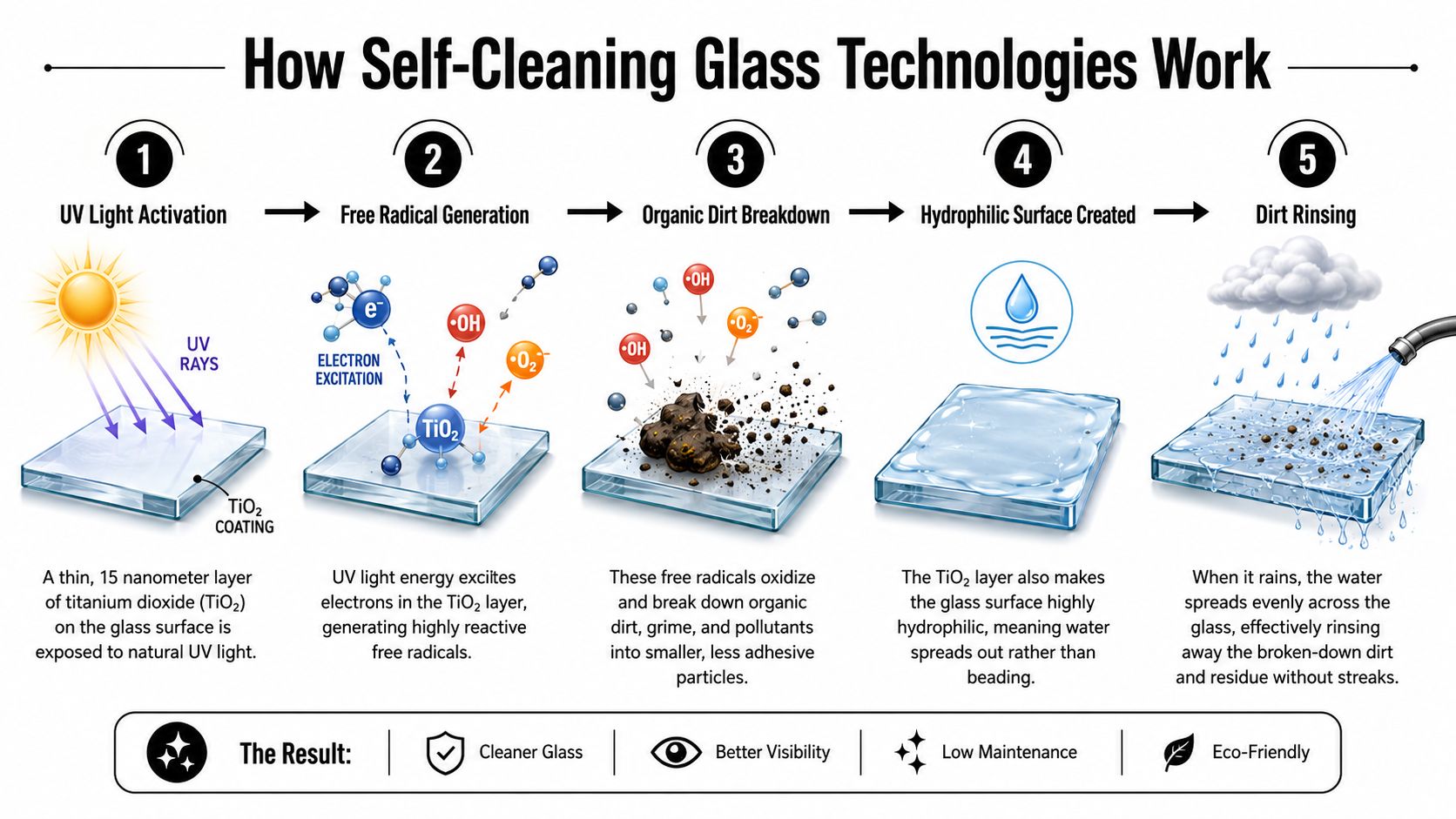
The best-known version of self-cleaning glass uses titanium dioxide, often written as TiO₂. This isn't a thick film you can see. The first commercial self-cleaning glass, Pilkington Activ™, launched in 2001 using a 15-nanometer TiO₂ coating that combines photocatalysis under UV light with a superhydrophilic rain-wash effect, according to the historical overview of self-cleaning surfaces.
That launch mattered because it turned a lab concept into a real building product.
What happens on the glass
Here's the mechanism in plain English.
UV light hits the coating.
Sunlight activates the TiO₂ layer.The coating produces reactive particles.
Those reactions create free radicals that attack organic fouling matter.Organic grime starts breaking apart.
Instead of clinging tightly to the surface, the residue becomes easier to remove.The glass turns superhydrophilic.
Water no longer beads in the usual way. It spreads.Water rinses the loosened material away.
Because the water forms a thin sheet, it can wash the surface with fewer streaks or dry spots.
That sequence is the heart of the technology. Not one stage. Two linked stages.
Why sunlight and water are partners
A lot of people assume the light does all the work. It doesn't.
The photocatalytic step helps with decomposition of organic dirt, but the washing effect still needs moisture. On exterior glass, that usually means rain. On a shower panel, it means the user is effectively supplying the rinse cycle.
The following video gives a visual explanation of how this type of coated glass behaves in use.
Why installation details matter
The coating can only help if the glass is placed where the process can happen properly. Angle, exposure, and surrounding design all matter. If water can't run across the glass well, the rinse stage weakens. If UV exposure is limited, the decomposition stage slows.
That's one reason specialty applications need careful evaluation. A roof panel, a high window, a decorative partition, and a bathroom mirror don't all give the coating the same working conditions. If you're choosing among interior decorative uses, specialty glass styles and mirror applications show how different placements can create very different maintenance realities.
Real Benefits and Limitations of Self Cleaning Glass
The value of self-cleaning glass is real. So is the marketing gap around it.
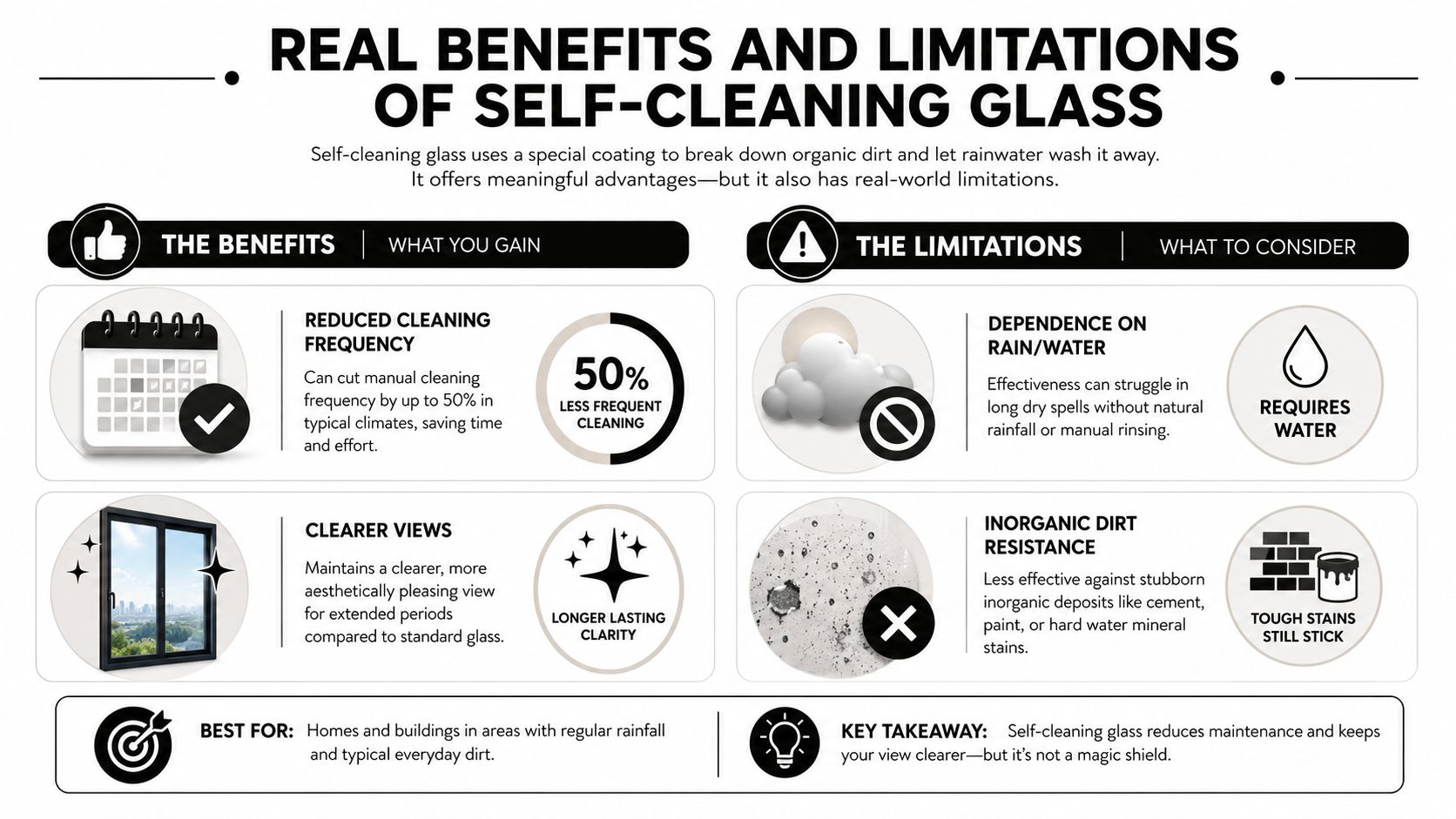
The strongest case for this technology is simple. It can reduce cleaning labor and help glass stay clearer longer when the environment supports the coating. That's one reason the category keeps expanding. The global self-cleaning glass market is projected to grow from USD 1.50 billion to USD 3.10 billion at a 7.5% CAGR, according to Fact.MR's self-cleaning glass market report.
That said, growth in a market doesn't guarantee a perfect fit for your home.
Where it earns its reputation
On well-exposed exterior glass, self-cleaning coatings can be a practical upgrade.
Fact.MR also notes that early commercial variants like Bioclean, launched in 2002, showed maintenance intervals two times more spaced out than conventional vitrage while requiring fewer detergents in the cited report. That doesn't mean every installation gets the same result, but it shows why building owners and architects pay attention.
Some of the biggest advantages are easy to understand:
- Less frequent manual cleaning when sun and water exposure line up well
- More even rinsing because water sheets across the surface
- Fewer streaks and drying marks compared with untreated glass in similar outdoor conditions
Where the promise starts to break down
The main weakness is dependency. The coating needs the right environment.
Pilkington's technical guidance states that self-cleaning glass should be installed at a minimum angle of 10° from horizontal for proper runoff, and that the glass that cleans itself loses effectiveness below that threshold. In dry periods, manual rinsing may still be needed, which the same source and the market data both reinforce.
A flat or low-slope panel can turn a good coating into an underperforming one.
A quick reality check
| Condition | Likely result |
|---|---|
| Exterior glass with sun and runoff | Best chance of helpful performance |
| Low-slope or flat installation | Reduced rinse performance |
| Long dry spell | Manual rinsing may still be necessary |
| Dirt that isn't organic | The coating may help less than expected |
The lesson is blunt. Self-cleaning glass is strongest when it works with nature, not when it has to replace it.
Suitability for Frameless Shower Doors and Mirrors
Many homeowners make the wrong assumption. If self-cleaning glass works on an exterior window, they expect it to translate neatly to a frameless shower door or bathroom mirror. Sometimes it helps. Often it helps less than people expect.
A shower door doesn't get rain. It gets splashed, steamed, and coated with soap residue. A bathroom mirror gets almost no benefit from exterior-style self-cleaning chemistry unless the product is designed for indoor use and the conditions match the coating's strengths.
Shower doors need a tougher standard
For shower enclosures in Southwest Florida, the local challenge isn't just grime. It's the mix of humidity, hard-water spotting, soap products, and periods when natural drying leaves residue behind.
Pilkington's consumer guidance makes an important point that marketing often skips. During long dry spells, the hydrophilic rain-wash stage can become ineffective, and Pilkington's complete guide to self-cleaning glass notes that the glass may still need rinsing with a hose or soft cloth and soapy water. That matters even more indoors, where shower doors never receive natural rainfall in the first place.
So for a frameless shower door, ask a practical question. Are you buying a coating that is self-cleaning, or a surface treatment that makes manual care easier?
If you're evaluating an enclosure project, examples of frameless shower door installation in Fort Myers Beach are more relevant than exterior window marketing because bathroom use patterns are completely different.
Mirrors are a separate decision
Mirrors don't face the same mess profile as shower glass.
They deal with fingerprints, toothpaste mist, and steam residue. A self-cleaning system built around UV and water sheeting may be unnecessary for that job. In many bathrooms, a straightforward protective treatment or routine wipe-down is the cleaner choice because the mirror's problem is light surface spotting, not weather-driven grime.
Indoor glass should be judged by indoor conditions, not by what works on a roof panel.
Maintenance Durability and Cost of Self Cleaning Glass
Durability is one of the better parts of TiO₂-based self-cleaning glass. The coating isn't a temporary spray that sits loosely on top. According to the PMC review of titanium dioxide coated float glass, the coating is permanently fired into the glass surface during manufacturing, which makes it UV-resistant and durable.
That's the good news.
The caution is just as important. The same review notes that construction contaminants such as plaster products or adhesives can stain or damage the surface, and a prompt water rinse after installation helps remove dust and abrasives before they cause trouble.
What homeowners should expect
If you're budgeting for a project, be careful with anyone who presents self-cleaning glass as maintenance-free. It isn't.
A realistic maintenance approach looks more like this:
- After installation rinse off construction dust and residue promptly
- During dry periods expect occasional manual rinsing if the surface isn't getting the moisture it needs
- For routine care use a soft cloth and mild cleaning approach rather than abrasive pads
- If the glass is indoors assume you'll still be involved in upkeep, especially on shower enclosures
What about cost
This is the section where many articles start inventing price ranges. That's a mistake unless the supplier gives you a written quote.
Costs vary based on glass type, fabrication, hardware, installation complexity, and whether the coating is applied at manufacture or as part of a different glass treatment strategy. For a homeowner, the better way to compare value is to ask three questions:
- How hard is this glass to access for cleaning?
- What kind of residue builds up on it in my home?
- Will this technology reduce labor enough to justify the upgrade?
If the answer to the first question is “very hard,” the math often gets easier. If the glass is a shower door you already squeegee by hand, the answer may be less dramatic. For owners who want practical upkeep guidance, a resource on shower door maintenance is often more useful than flashy coating claims.
Comparing Coatings and Technology Options
Not every low-maintenance glass solution belongs in the same bucket. Some products are true photocatalytic systems. Some are protective coatings that make residue easier to remove. Some newer technologies don't rely on water at all.
One of the most interesting developments is an emerging electric-field self-cleaning glass developed in 2025 that uses alternating fields to expel 98% of dust without water, which EnduroShield's discussion of self-cleaning glass versus easy-clean coatings describes as especially promising for arid or low-rain regions.
That doesn't replace every existing option, but it changes the conversation.
Comparison of Coatings and Technologies
| Technology | Mechanism | Water Requirement | Ideal Climate | Maintenance |
|---|---|---|---|---|
| TiO₂ photocatalytic glass | UV activates coating, breaks down organic dirt, hydrophilic surface helps rinse away residue | Yes, moisture is part of the cleaning cycle | Outdoor settings with sun and regular water exposure | Reduced manual cleaning, but not zero |
| Diamond-Fusion protective coating | Protective treatment designed to help resist buildup and simplify care | Helps with regular cleaning, but doesn't depend on rain chemistry | Indoor glass, showers, and daily-use residential applications | Easier wipe-down and ongoing care |
| Electric-field self-cleaning glass | Alternating electric fields expel dust from the surface | No water needed for dust removal | Arid, dusty, or low-rain settings | Especially promising where water-based rinse cycles are unreliable |
How to think about the options
The right choice depends less on buzzwords and more on the mess you're fighting.
If your problem is organic outdoor grime, TiO₂ technology still makes sense in the right installation. If your problem is daily shower residue, a protective coating may be more practical because you're managing soap and water spots, not relying on UV and rain. If your problem is dust in a dry region, electric-field systems point toward a stronger long-term fit.
Different glass problems need different surface strategies. A good decision starts with the contamination type, not the label on the brochure.
Conclusion and Next Steps
Self cleaning glass technology is worth understanding because it solves some real problems and creates some unrealistic expectations. It performs best when the glass gets the conditions the coating was designed for. In Southwest Florida, that means you should look hard at dry periods, indoor use, roof slope, and the kind of residue your glass collects.
For exterior glass, photocatalytic coatings can be useful. For frameless showers and mirrors, protective easy-care options may be the smarter route. For dry, dusty environments, electric-field systems are the development to watch.
If you're planning a shower enclosure, custom mirrors, or specialty glass for a Southwest Florida home, AmeriGlass Industries can help you compare the practical pros and cons of each option and choose a solution that fits your space, maintenance habits, and design goals.