

A lot of homeowners notice mirror failure the same way. One morning the room looks slightly off, and then you see it. Black edging in the corners, a cloudy band along the bottom, or a haze that doesn't come off no matter how carefully you clean it.
That moment feels small until the mirror is part of what gives the room its character. In Southwest Florida homes, that often means a custom vanity mirror, a large framed statement piece, or an antique mirror that was chosen as deliberately as the lighting or stone. Once the backing starts to fail, the question isn't just how to fix a mirror. It's whether you should preserve the original piece or start over.
When Your Reflection Starts to Fade
A homeowner may have a beautiful oval mirror in a powder room or a beveled antique mirror over a console table, and for years it looks sharp. Then the first signs of desilvering appear at the edge. After that, the defects usually become impossible to ignore because they draw the eye every time the mirror catches daylight.
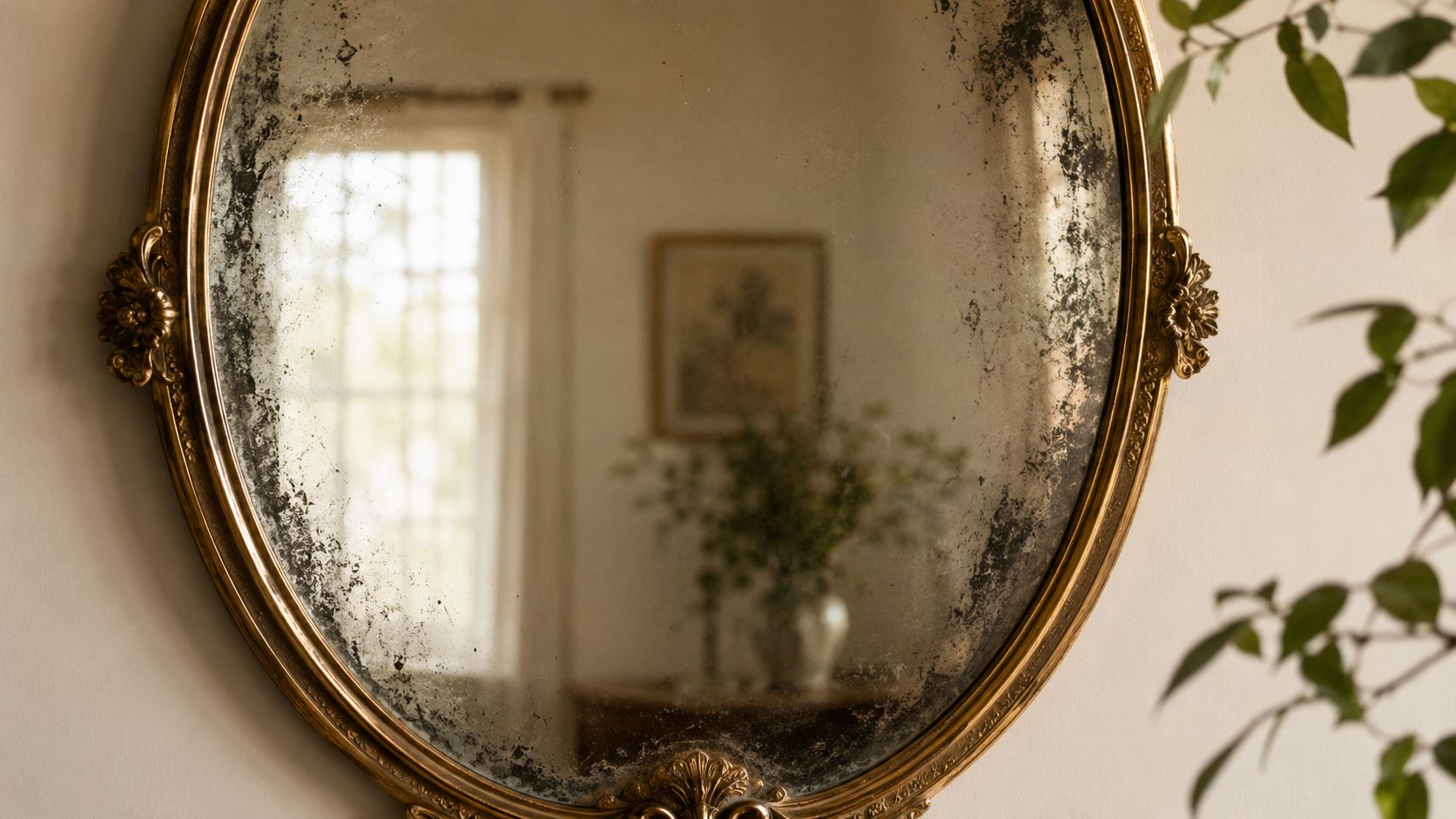
For high-end homeowners, this isn't the same decision as swapping out a standard builder mirror. Custom mirrors often fit a room in a very specific way. Antique pieces carry their own glass character, frame proportions, and presence. If you replace them casually, the room can lose something that's hard to recreate, even with quality new glass and one of many mirror and specialty glass styles.
Why this problem matters more in luxury homes
A damaged mirror can affect more than reflection quality. It can soften light in a room, interrupt symmetry at a vanity, and make a carefully designed wall look unfinished. In homes where millwork, lighting, and furnishings have been selected with intent, a failing mirror tends to stand out fast.
The key is not to assume every aging mirror should be replaced. Some should. Others are worth preserving because the value sits in the piece itself, not just in having a reflective surface on the wall.
Practical rule: If the mirror is custom-cut, unusually shaped, beveled, framed to fit an existing design, or tied to an antique frame, pause before ordering replacement glass.
That's where a mirror resilvering service becomes important. Done correctly, it isn't a cosmetic cover-up. It's a restoration of the reflective backing that gives the mirror its function and visual clarity. For the right piece, that can protect both design value and sentimental value.
Understanding the Craft of Mirror Resilvering
A mirror doesn't fail from the front first. The trouble usually starts on the back, where the reflective layers break down over time. Moisture is a major culprit, especially in bathrooms and coastal climates.
Much like corrosion on metal, you may only notice the visible damage once it reaches the surface, but the breakdown has been happening underneath. With mirrors, the glass on the front may still be intact while the silver backing behind it has already started to oxidize and separate.
What resilvering actually restores
A professional mirror resilvering service doesn't polish away black spots from the front. It addresses the failed backing on the rear side of the glass. That's an important distinction because many homeowners first try surface cleaning, edge paint, or patch-style fixes that only disguise the problem for a short time.
When a mirror is a good candidate, the restoration focuses on the original glass and replaces the deteriorated reflective system behind it. That's why it can preserve the look of a custom or antique piece in a way a surface treatment never will. In design-heavy homes, that preservation can matter just as much as the repair itself, especially if the mirror contributes to the layered, upscale feel discussed in luxury glass design ideas for the home.
Signs your mirror may be a candidate
Some symptoms point clearly to backing failure rather than a cleaning issue:
- Black edge spotting usually means the reflective layer is failing from the perimeter inward.
- Persistent haziness that won't wipe off often suggests deterioration behind the glass.
- Cloudy reflection can indicate that the silver layer is no longer uniform.
- A mirror that still looks structurally sound is often worth evaluating before replacement.
On the other hand, if the glass itself is chipped, scratched, cracked, or visibly damaged, resilvering won't solve those defects. The new backing reflects whatever condition the glass is already in.
A good restoration candidate has failing silver but salvageable glass.
That's the dividing line many homeowners miss. A mirror resilvering service is not a shortcut for every damaged mirror. It's a specialized restoration method for mirrors whose core glass still deserves to be saved.
The Anatomy of a Professional Resilvering
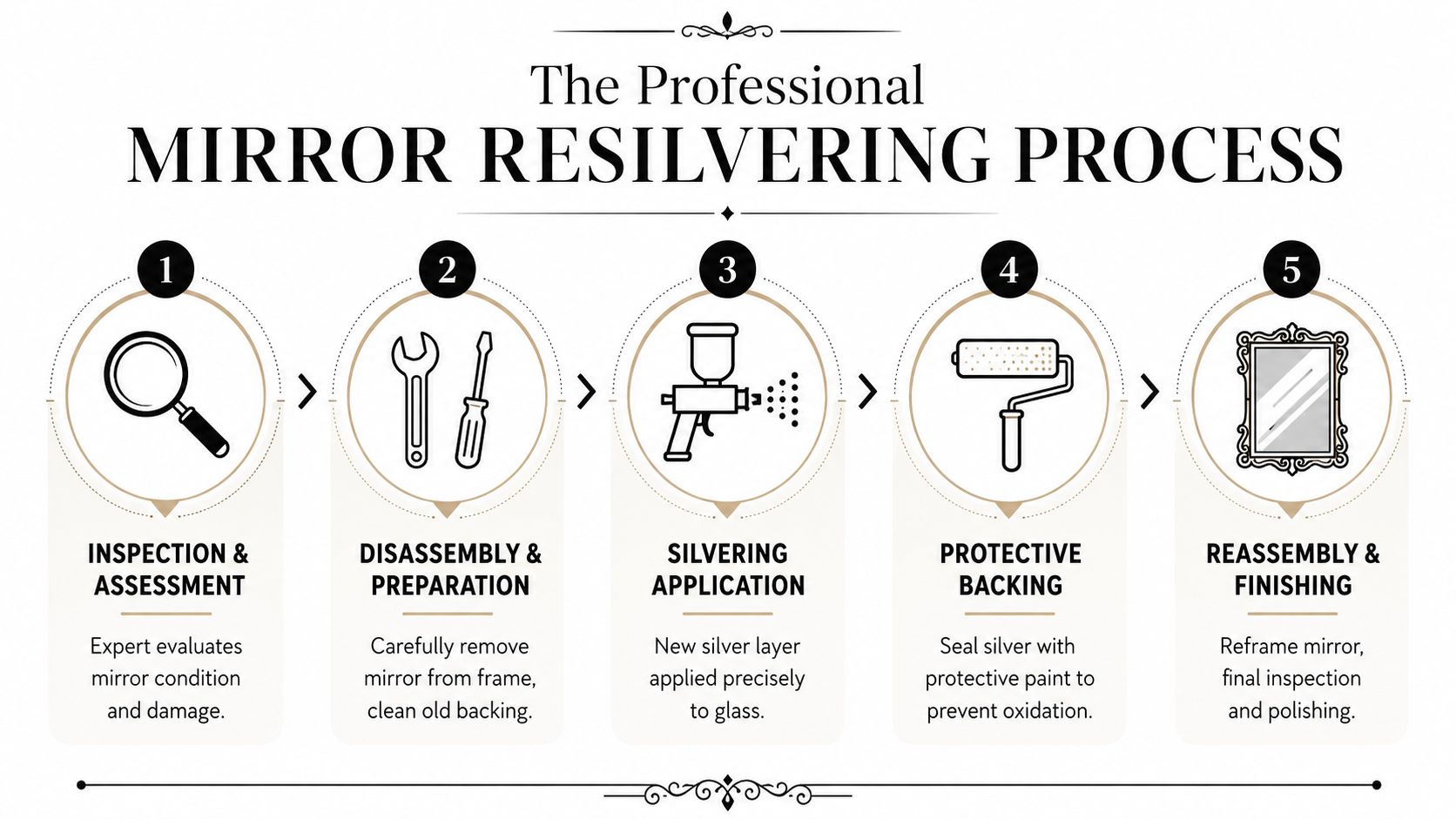
Observers typically only see the mirror before and after. The work that determines whether it lasts happens in the middle, and it's exacting. A professional resilvering process is a chemically intensive procedure that typically requires 8 to 12 hours total and follows a strict sequence of preparation, sensitizing, silver deposition, and protective treatment, as described in this professional mirror repair guide.
Step one and step two
The first stage is careful removal, disassembly if the mirror is framed, and close inspection. During this close inspection, a specialist determines whether the glass is worth saving. Deep scratches, edge damage, old stress points, or defects in the glass itself will still show after restoration.
Then the failed backing has to come off completely. Old paint, copper, and silver layers are stripped away with chemicals and gentle abrasion until the bare glass is exposed. There's no durable shortcut here. If residue remains, the new reflective layer won't bond evenly.
Step three is where skill really shows
Once the old coatings are gone, the bare glass must be cleaned to absolute purity. Any dirt, grease, or contaminant left on the glass can compromise bond quality, reflectivity, and lifespan. That's one reason DIY kits disappoint so often. They promise repair, but they don't recreate the controlled preparation that the chemistry requires.
The silvering itself happens through a reaction using silver nitrate and a reducing agent, which deposits a fresh metallic silver film onto the glass surface in the source cited above. This stage demands consistency and timing. Uneven application leaves visible defects.
The mirror only reflects as well as the preparation beneath the new silver layer.
The final protective layers determine durability
After the silver layer is established, a protective copper layer is added, followed by sealing treatments that help guard against future tarnishing and moisture intrusion. In practical terms, a mirror thereby becomes usable again instead of merely reflective for a short while.
For homeowners doing renovations, it helps to think about mirror restoration the same way they think about punch-list quality. The finish matters, but the final review matters too. A resource like Eagle Restoration's final walkthrough guide is useful because it reinforces the habit of checking details that affect the long-term result, not just the appearance on day one.
Why specialty glass knowledge matters
Mirrors are often discussed as if they're all the same, but they aren't. Clarity, edge finish, thickness, frame fit, and visual expectations all influence the quality standard for the final piece. In premium interiors, that standard is high. A restored mirror has to look intentional beside polished stone, custom cabinetry, and precise lighting.
That's why the best craftsmen approach this work with the same mindset they bring to ultra-clear glass applications. Precision is not decoration. It's the baseline.
Resilver or Replace Deciding What Is Right for Your Mirror
The right choice depends on the mirror's value, not just the damage. Some mirrors should absolutely be restored. Others are better replaced without hesitation.
If a mirror is antique, custom-sized, heavily integrated into a built-in, or paired with a frame that would be difficult to match, resilvering often makes sense. You preserve the original proportions and avoid the compromises that come with remaking a piece. In luxury homes, that continuity can be more important than many people realize.
If the mirror is ordinary, inexpensive, or the glass itself is damaged, replacement is usually the cleaner answer. A fresh new mirror gives you a predictable result, and there's no reason to preserve glass that has no design or historical value.
A practical way to decide
Use these questions before you commit:
- Is the glass unique because of age, shape, bevel, or fit within a custom frame?
- Is the problem in the backing rather than in the glass itself?
- Would a replacement alter the look of the room because of frame fit, reflection character, or edge detail?
- Is this a standard mirror that can be replaced easily with little design consequence?
If replacing the mirror changes the piece, the frame, or the room, restoration deserves a serious look.
Mirror Resilvering vs. Full Replacement
| Factor | Mirror Resilvering | Mirror Replacement |
|---|---|---|
| Best use case | Antique, custom-cut, beveled, or sentimental mirrors | Standard mirrors or mirrors with damaged glass |
| What it fixes | Failed reflective backing | Full mirror condition, including broken or badly worn glass |
| Design continuity | Preserves original glass and fit | May change the look if the original had unique character |
| Frame compatibility | Ideal when the existing frame is part of the value | Works well when the frame is simple or being updated |
| Result | Restored original piece | Entirely new mirror |
| When to avoid it | When the glass is cracked, chipped, or deeply scratched | When the original mirror itself is the item worth preserving |
Where high-end homeowners tend to land
In Southwest Florida homes, I'd weigh the room as much as the mirror. A standard vanity mirror in a secondary bath is often replaceable without consequence. A custom foyer mirror, a framed dressing mirror, or an antique piece in a formal powder room is different. Those mirrors contribute to the architecture and styling of the house.
There's also a practical point. New glass can be perfect and still feel wrong if the original mirror had distinctive proportions or old-glass character. That's why the decision is less about whether resilvering is possible and more about whether the mirror is worth preserving.
What to Expect for Mirror Resilvering in Southwest Florida
Pricing for a mirror resilvering service depends mostly on size, condition, and how demanding the piece is to handle. According to HomeAdvisor's mirror repair and resilvering cost guide, the average cost to resilver a mirror is $220, with most homeowners spending between $110 and $340. Small touch-ups can start at $50, while intricate heirloom restoration can reach up to $500.
For larger pieces, pros generally charge $15 to $40 per square foot in the same source. A 16-square-foot mirror would therefore cost between $240 and $640. For valuable or antique mirrors, the cost can exceed $500.
What changes the quote
The square footage matters, but it's not the whole story. A clean rectangular mirror is simpler than a shaped mirror in a delicate frame. A heavily deteriorated mirror also takes more work because the backing removal and surface preparation become less forgiving.
Common quote factors include:
- Size and shape because irregular pieces are harder to handle and refit.
- Condition of the backing because severe deterioration increases labor.
- Frame complexity when a mirror has to be removed and reassembled carefully.
- Value of the piece when antique or heirloom handling requires a slower, more protective approach.
How this plays out in coastal Florida homes
In Naples, Fort Myers, and Bonita Springs, homeowners often compare restoration and replacement during broader bathroom or whole-home updates. A standard mirror may be replaced as part of a more modern redesign, especially if the room is already getting new fixtures or even adjacent glass improvements like frameless shower door installation in Fort Myers, Florida.
A custom or antique mirror calls for a different conversation. The price may be higher than simple replacement, but replacement may also fail to preserve the piece that made the room feel finished in the first place.
Cost reality: Resilvering is usually easiest to justify when the mirror has design value that new stock glass can't reproduce.
Homeowners should also expect the full service timeline to be longer than the chemical application window itself. The restoration work may take place over hours, but pickup, shop handling, curing, inspection, and reinstall usually mean the project functions as a multi-day service rather than a same-day swap.
Preserving Your Restored Mirror in the Florida Climate
Southwest Florida is tough on mirrors. Humidity, shower steam, salt air, and poor airflow all work against the backing. Mirror silvering can last 15 to 25 years in dry environments but only 8 to 15 years in bathrooms because moisture accelerates corrosion, according to this antique mirror silvering guide.
That doesn't mean a restored mirror is a short-term fix. It means the environment and installation details matter.

What helps a restored mirror last longer
A few habits and installation choices make a real difference:
- Ventilate the room well so moisture doesn't sit behind the glass after showers.
- Avoid trapping the mirror flat against a damp wall if airflow can be built into the mounting approach.
- Handle the piece carefully during moving or renovation because edge damage and backing damage often begin with rough handling. Simple visual warnings such as labels from Storage & Removal Boxes are useful when a framed mirror is being transported or stored.
- Use the right cleaner and technique on the front surface so liquid doesn't run to the edges and seep toward the backing.
Choosing the right specialist
Not every glass company should handle a valuable mirror restoration. Ask whether they're insured, whether they work with custom and delicate pieces regularly, and whether they understand the installation conditions that affect longevity in humid spaces. General glass replacement experience is useful, but restoration work asks for a more careful eye.
That same attention to care shows up in other moisture-prone glass areas of the home, including shower door maintenance. The principle is the same. Good materials matter, but correct installation and upkeep determine how well they hold up in Florida conditions.
A well-executed mirror resilvering service preserves more than reflection. It preserves the proportions, style, and presence of a piece that replacement glass may never fully replicate.
If you have a custom, antique, or high-value mirror that's starting to haze, spot, or darken, AmeriGlass Industries can help you evaluate whether restoration or replacement is the smarter move for your Southwest Florida home. Reach out for a professional consultation and get clear guidance before you give up on a piece worth saving.